It is Star Wars month as we move closer and closer to the release of the latest film in the Star Wars franchise. I chose a few weeks back a favorite scene from the very first Star Wars which came out in 1977. This favorite scene is the first of three that make up the three specific scenes I love from Star Wars: A New Hope.
This second favorite scene also shows up in the early part of the film. The first scene I chose showed the wow factor of the space battle and capture of the Rebel Alliance frigate and the introduction of one of filmdom’s greatest and most iconic villains in Darth Vader. This latest chosen scene introduces us to his polar opposite in the young Luke Skywalker on the planet Tatooine.
It’s a scene that focuses on the hope and dreams of a young man stuck in a place he knows he doesn’t belong. He believes that he’s meant to be doing something more important and we find out later on in the film that his feeling is correct. It helps that the scene was helped by the score of one John Williams whose musical track playing in the background — aptly titled “Binary Sunset” — gives it a sense of longing and a promise of a better future.
Today marks 30 more days before the release of the next chapter in the Star Wars saga. It’s been almost a dozen years since the prequels finally ended and the fandom was split between those who railed against it and those of the younger generation whose first entry into the Star Wars universe were the prequels instead of the original trilogy.
For those who grew up watching the original trilogy over and over throughout the years, the prospect of the franchise returning to it’s adventure roots instead of delving into the soap operatic backstory that made up the prequels was enough to create the massive swell of hype and anticipation for a film unheard of even in these current era of superhero tentpole blockbusters and massive sequels.
Star Wars: A New Hope was my gateway to the fandom and no scene helped usher me into becoming a devoted fan than the very first few minutes of the film as we see the message crawl to start then the massive bulk of the Imperial Star Destroyer chasing down a fleeing ship of much smaller size. Yet, the scene doesn’t end there. No, it continues inside where we finally get our first introduction to one of film’s most iconic villains to ever grace the silver screen.
The Imperial Star Destroyer opening was the hook and Darth Vader pulled one in.
Since I just shared 4 shots from 4 Dario Argento films, I figured why not take this week’s horror scene that I love from an Argento film as well?
Argento’s 1995 film The Stendhal Syndrome has always gotten mixed review but I think it’s actually one of the better of his post-Tenebrae films. In the scene below, police detective Anna Manni (Asia Argento) wanders through Florence and finds herself overwhelmed by the sheer beauty of the place. Eventually, while looking at Bruegel’s Landscape With The Fall of Icarus, Anna is so overwhelmed that she faints and has a fantasy where she swims through the ocean and kisses a fish. Of course, as this happens, she is watched by serial killer Alfredo Grossi (Thomas Kretschmann).
I have to admit that one reason why I like this scene (and this film) is because I had a similar experience when, the summer after graduating high school, I visited Florence. No, I didn’t faint but I definitely found myself wandering around in a bit of a daze. Standing in Florence is like finding yourself in the middle of living painting. It’s an amazing experience and one that I recommend to everyone.
This particular scene was my third favorite from Tobe Hooper’s Salem’s Lot.
There’s much to love about this scene. It’s a very claustrophobic sequence with our protagonist Ben Mears (played by David soul) left in the morgue by his friend Bill Norton for just a few minutes. The scene itself gradually builds in tension as Ben realizes that at any second the body on the morgue table could get up. The word vampire rarely gets uttered during the first third of the series, but Ben suspects the worst and he knows that he’s ill-prepared to deal with his fears if they bear fruit.
There’s a definite tv network quality to the way the scene is shot, but Hooper milks the creeping dread and terror with each passing second as Ben creates a makeshift crucifix and begins to chant random Bible passages as a way to bless his home-made icon. When his fears have been confirmed there’s not a sense of relief that he’s not crazy, but one of sheer terror.
This third joins part one and part two of my favorite scenes from Salem’s Lot and when witnessed as a set should give an idea just how terrifying and underrated this mini-series adaptation of the classic Stephen King vampire novel really is.
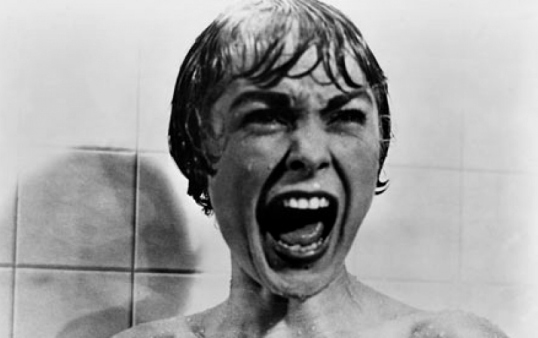
It would be difficult to get through October and not point out one of the best scenes in horror ever.
There’s Janet Leigh’s performance which conveyed the utter terror the scene wanted to convey. We have Bernard Hermann’s discordant film score highlighting the attack. Despite being a very bloodless sequence the way Hitchcock filmed the scene made audience imagine that they were actually witnessing something more violent and gory.
We all have Alfred Hitchcock to thank for this most iconic of all horror scenes.
I’ve never actually seen the 1987 film Slaughterhouse Rock. I’ve just seen the trailer included in a few compilations and, thanks to YouTube, I’ve seen the scene below. The only context that I can give for this scene is what I read on Wikipedia.
Apparently, in this scene, a ghost played by the great choreographer Toni Basil does a dance that gives the main character’s spirit the ability to roam free of his physical body. And, during the dance, we see a lot of earlier scenes from the movie. Or something like that. I don’t know. I just like the scene because of the music and Toni Basil.
I’ve always felt that dancing can take you into a spiritual realm of existence. This scene proves my point.
This scene that I love comes from the classic 1931 horror film, Frankenstein. In this poignant scene, Frankenstein’s Monster (Boris Karloff) meets young Maria. Maria is the first human to treat the Monster with true kindness. Unfortunately, the Monster does not understand that, unlike flower petals, Maria does not float.
Since I just reviewed Paul Schrader’s 1982 version of Cat People, I figured that I’d show a scene from the film that I love.
In this film, Irena (Natassja Kinski) has a dream in which her brother, Paul (Malcolm McDowell) explains the curse under which they both live. This dream leads directly into the first part of the film’s best sequence, in which Alice (Annette O’Toole) suspects that she’s being followed while out jogging.
Everything about this scene — from the music to the sets to the cinematography — is horror perfection as far as I’m concerned.
Those were some of the most terrifying words I’ve ever heard growing up. It’s all because of one scene from the tv mini-series which adapted Stephen King’s vampire novel, Salem’s Lot. It was a scene in the novel that terrified me as a young boy reading King for the first time.
I’ve always been gifted (or I sometimes say cursed) with having a very overactive imagination. This is why horror has always been such a fascinating genre for me. Even where the horror is all up in one’s face with it’s gore and messy aftermath my mind’s eye would make things worst or just constantly play it on repeat in my head days after the film has ended. It’s even worst when the horror comes across less through gore and more through atmosphere and built-up dread moving towards a jump-scare or something more insidious.
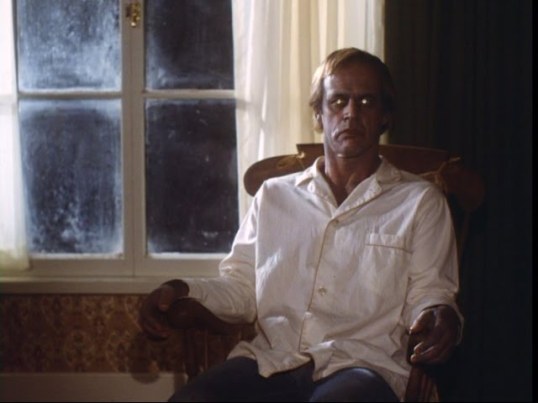
This particular scene is my second favorite from the Salem’s Lot mini-series. The first one I had posted a couple years back which just barely lags behind this one for third. What made this scene so effective despite it’s tv-style production was Tobe Hooper’s direction. Despite working with the censorship inherent in broadcast tv, Hooper was able to create a palpable sense of dread as the old English teacher Matt Burke senses a presence up in one of his house’s rooms. It was the same room where one of his former students had passed away in his sleep.
As the audience we already have an idea who or what is in that second floor room. Matt Burke has an idea as well, but his morbid curiosity wins out as he decides to investigate. Yet, despite such a lack in judgement he does come armed with a crucifix in hand. The way the scene builds and builds as Burke climbs the stairs and hesitating before opening the door to the room was almost too much to bear.
The reveal of his former student, Mike Ryerson, back in the room sitting in the rocking chair as one of the undead only increases the horror of the scene. His snake-like mannerisms was a new take on the vampire behavior. It’s not the usual silk and lace bloodsucker we grew up watching. This was a vampire that behaved like a predator beguiling it’s next prey. From the way Ryerson (played by Geoffrey Lewis) hissed his words and undulated his body as he stood to face his former teacher was disturbing at the very least.
Just writing about it and seeing the scene for the umpteenth time still gives me the shakes.
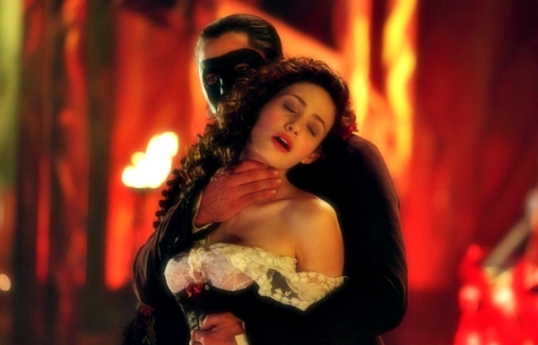
It’s time to finish off my triptych of Scenes I Love from 2004’s film adaptation of The Phantom of the Opera. The first two parts were my favorite solo and chorus scenes from film and now we finish it off with what has to be the top scene (IMO) from the film.
The characters of The Phantom and Christine have always been the focal point of the film. Even with the arrival of the wholesome and (as Lisa Marie would call him) vanilla Raoul, Vicomte de Chagny, the film continues to truly sizzle when it’s all about The Phantom and Christine moving their relationship from ingenue and mentor to unrequited lovers.
It’s the latter which this scene looks to portray through a duet written by The Phantom himself and where he swaps himself into the role of Don Juan. This duet has always been a fan favorite for those who love the musical and many different versions of it have played throughout the years. Yet, they all have one thing in common and that is the heated chemistry between the two characters once the duet begins.
The scene itself begins and comes off pretty much like foreplay between the two characters without having literal sex on the stage. The whole scene is so sexually charged that even those watching the duet who set the trap looked so transfixed that they fail to act. Even Raoul, Christine’s own fiance, finishes the scene with such a look of cuckold expression once he realizes that he could never have such a deep and personal connection that Christine has with The Phantom.
For me, this duet pretty much sums up what the whole is all about.


 Through the Shattered Lens