Film Review: Al Capone (dir by Richard Wilson)


The year is 1919 and a brutish young man named Al (played by Rod Steiger) has just arrived in Chicago.  He’s got a new job, working for the city’s top mobster, Johnny Torrio (Nehemiah Persoff).  Torrio is the second-in-command to Big Jim Colosimo (Joe De Santis) and is impressed enough by the young Al to take him under his wing.

It’s an exciting time to be a gangster in Chicago because prohibition is about to become the law of the land.  Alcohol is about to become illegal, which means that there will soon be an unregulated underground of people smuggling booze into the United States and selling it in speakeasies across the land.  Those speakeasies are going to be need men to watch the door and to toss out troublemakers and it turns out that’s a perfect job for someone who isn’t afraid of violence.

Someone like Al, for instance.

It’s while Al is working as bouncer that he receives a long and deep gash across his face.  When the wound heals, it leaves him with the scar that will come to define him for the rest of his life.  As much as he hates the nickname “Scarface,” it’s what Al Capone will be known as.

The 1959 film, Al Capone, follows Capone as he works his way up the ladder of the Chicago underworld until he eventually finds himself sitting atop an empire of corruption and crime.  Along the way Capone kills the majority of his rivals and finds the time to fall in love with Maureen Flannery (Fay Spain), the widow of one of his victims.

Well, perhaps love is the wrong word.  As played by Rod Steiger, Al Capone isn’t really capable of loving anyone but himself.  This film does not provide us with the superslick or diabolically clever Capone that has appeared in other gangster movies.  Instead, Steiger plays Capone as almost being a caged animal.  Capone comes to power through violence and betrayal and he uses the same techniques to hold onto power.  The film suggests that the secret of his success was his complete lack of conscience but that the same arrogant stupidity that makes him so fearsome also leaves him doomed to failure.  There’s really nothing subtle about Steiger’s performance but then again, there was probably nothing subtle about Al Capone, either.  Steiger’s tendency to overact every moment works well in the role of a man who constantly seems to be striking out at anyone who makes the mistake of getting too close to him.

Though many films had featured characters based on Capone, Al Capone was the first biographical film to actually be made about the infamous leader of the Chicago Outfit.  (Up until the mid-50s, the Hollywood Production Code expressly forbade anyone from portraying a “real” gangster in a movie.)  With the exception of the character of Maureen Flannery (who was a heavily fictionalized stand-in for Capone’s then-living widow), Al Capone is fairly faithful to the know facts of Capone’s life.  The film not only includes most of Capone’s violent acts (i.e., the St. Valentine’s Day Massacre) but it also explores both how Capone was protected by Chicago’s corrupt political establishment and how prohibition actually enabled the activities that it was meant to prevent.  Director Richard Wilson directs in a semi-documentary style and the film’s harsh black-and-white images capture the idea of a shadowy world hidden away from “respectable” society.  It’s a fast-paced film and fans of classic character acting will be happy to see James Gregory as an honest cop and Martin Balsam as a not-at-all honest reporter.

If you’re looking to put together a quick cinematic history lesson about the origins of the Mafia before you watch Martin Scorsese’s The Irishman later this year, Al Capone is a worthwhile addition to your curriculum.
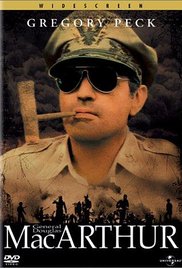
A Movie A Day #326: MacArthur (1977, directed by Joseph Sargent)


The year is 1962 and Douglas MacArthur (Gregory Peck), the legendary general, visits West Point for one last time.  While he meets the graduates and gives his final speech, flashbacks show highlights from MacArthur’s long military career.  He leaves and then returns to Philippines.  He accepts the Japanese surrender and then helps Japan rebuild and recover from the devastation of the war.  He half-heartedly pursues the Presidency and, during the Korean War, gets fired by Harry Truman (Ed Flanders).
MacArthur is a stolid biopic about one America’s most famous and controversial generals.  It was produced by Frank McCarthy, a former general who knew MacArthur and who previously won an Oscar for producing Patton.  McCarthy was obviously hoping that MacArthur was do its subject what Patton did for George Patton and both films follow the same basic pattern. a warts-and-all portrait of a World War II general with all of the action centered around the performance of a bigger-than-life actor in the title role.  Though obviously made for a low budget, MacArthur is a well-made and well-acted movie but it suffers because Douglas MacArthur was just not as interesting a figure as George Patton.  Gregory Peck does a good job subtly suggesting MacArthur’s vanity along with capturing his commitment to his duty but he never gets a scene that’s comparable to George C. Scott’s opening speech in Patton.  The main problem with MacArthur, especially when compared to Patton, is that George Patton was a born warrior while Douglas MacArthur was a born administrator and it is always going to be more exciting to watch a general lead his men into battle then to watch him sign executive orders.

Horror on TV: Thriller 2.20 “The Hollow Watcher” (dir by William F. Claxton)


Here’s one final episode of Thriller for this October’s horrorthon!

In this episode, we learn what happens when you stuff a dead body in a scarecrow.  The scarecrow stalks you!

Seriously, scarecrows are so freaky.

Enjoy!

http://www.youtube.com/watch?v=BRzvNzUZ6wY


Horror on TV: The Twilight Zone 2.18 “The Odyssey of Flight 33”


TheTwilightZoneLogo

Remember how this morning’s movie — Robot Monster — featured dinosaurs?

Well so does tonight’s episode of The Twilight Zone!  In The Odyssey of Flight 33, a commercial airline flight somehow flies straight into the past, where they see …. dinosaurs!  Now, I’ll be honest here.  These are not dinosaurs like the dinosaurs in Jurassic World.  But I imagine for 1961, those dinosaurs were pretty impressive!

And this episode holds up as well.  I especially love the ambiguous ending.

The Odyssey of Flight 33 originally aired on February 24th, 1961.

Embracing the Melodrama #31: When Time Ran Out (dir by James Goldstone)


If I had been alive in the 70s, I would have been terrified if I had ever found myself in the same general location of Paul Newman, William Holden, Ernest Borgnine, Red Buttons, Jacqueline Bisset, or Burgess Meredith.  Just based on the movies that they spent that decade appearing in, it would appear that disaster followed them everywhere.

Just consider:

Both Paul Newman and William Holden were trapped in The Towering Inferno. 

Ernest Borgnine and Red Buttons both ended up taking an unexpected Poseidon Adventure together.

Jacqueline Bisset was a flight attendant in the first Airport and nearly got killed by a mad bomber.

And finally, Burgess Meredith was a passenger on The Hindenburg.

Seriously, that’s a dangerously disaster-prone bunch of thespians!

So imagine how terrifying it must have been on the set of the 1980 film When Time Ran Out when all 6 of those actors — along with a lot of other disaster film veterans — were first gathered in one place.  People were probably running for their lives, both on-screen and off.

Lava3

When Time Ran Out takes place on an island in the South Pacific.  Shelby Gilmore (William Holden, playing yet another ruthless but essentially good-hearted businessman) owns a luxury resort that happens to be sitting dangerously close to an active volcano.  Oil rigger Hank Anderson (Paul Newman) is convinced that the volcano is about to erupt but Shelby’s son-in-law, Bob Spangler (James Franciscus), refuses to listen and claims that even if the volcano does blow, the resort will be safe.

(As a sidenote, why were William Holden’s son-in-laws always too blame in disaster movies?  First, you had Richard Chamberlain in The Towering Inferno and now, it’s James Franciscus in When Time Ran Out…)

Suspended over a volcano

Suspended over a volcano

You can just look at the film’s title (When Time Ran Out!) and guess that Bob is probably wrong.  However, Bob has other things on his mind.  First off, he’s cheating on his neurotic wife (Veronica Hamel) with a native islander (Barbara Carrera) who happens to be married to the hotel’s general manager, Brian (Edward Albert).  Brian also happens to be Bob’s half-brother and is therefore owed at least half of Bob’s fortune but nobody but Bob realizes that.

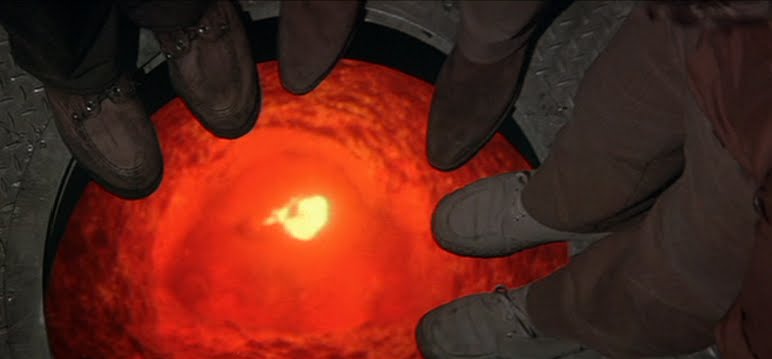
And, of course, there are other colorful guests at the hotel who will soon find themselves either fleeing from or drowning in molten lava.  There’s a white-collar criminal (Red Buttons) who is being pursued by a detective from New York (Ernest Borgnine, of course).  There’s also two retired tightrope walkers (Burgess Meredith and Valentina Cortese) and you better believe that there’s going to be a scene where one of them is going to have to walk across a plank that happens to be suspended over a river a lava…

Told ya!

Told ya!

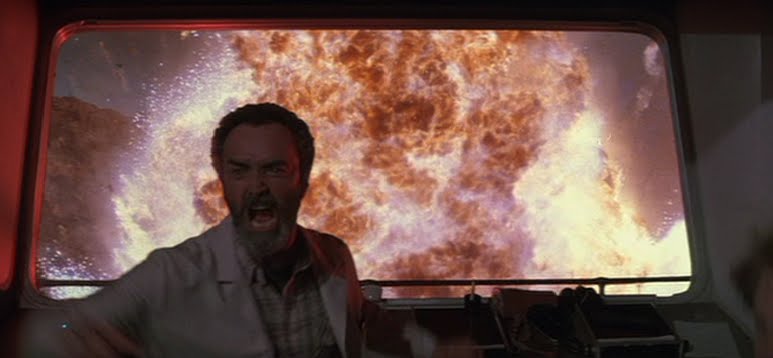
Eventually, that volcano does erupt and…well, let’s just say that When Time Ran Out is no Towering Inferno as far as the special effects are concerned.  The scene where one random fireball flies out of the volcano and heads for the resort is particularly amusing for all the wrong reasons.  Not only does the volcano apparently have perfect aim but it’s also painfully obvious that the fireball is streaking across a matte painting.  This is the type of film where, when people plunge into a river lava, they do so with heavy lines visible around their flailing bodies.  That, along with the cast’s obvious lack of interest in the material, adds up to make When Time Ran Out a film that is memorable for being so ultimately forgettable.

The Horror!

The Horror!

(It’s odd to consider that this film was directed by the same James Goldstone who directed such memorable films as Rollercoaster and Brother John.)

When Time Ran Out is something of a historical oddity because it was the last of the old 70s all-star disaster films.  (This may have been released in 1980 but it’s a 70s film through and through.)  The movie was such a monumental failure at the box office that it pretty much ended an era of disaster films.

For that reason, it also feels like an appropriate film with which to close out the 70s.  Tomorrow, we’ll continue to embrace the melodrama with the 1980s.

when time