Retro Television Review: St. Elsewhere 1.5 “Samuels and the Kid”


Welcome to Retro Television Reviews, a feature where we review some of our favorite and least favorite shows of the past! On Fridays, I will be reviewing St. Elsewhere, a medical show which ran on NBC from 1982 to 1988.  The show can be found on Hulu!
This week’s episode of St. Elsewhere featured Dr. Craig winning an award.  Good for him!

Episode 1.5 “Samuels and the Kid”

(Dir by Thomas Carter, originally aired on November 30th, 1982)

This week’s episode of St. Elsewhere was kind of boring,  It wasn’t a bad episode because the show was well-acted and even the boring subplots felt as is they were part of a bigger whole but, especially when compared to last week’s episode, Samuels and the Kid just wasn’t as compelling.

The Kid of the title is Robbie Durant (Jeremy Licht), a young patient who needs to have some minor surgery done on his ankle.  Dr. Samuels take a really intense interest in the kid, bonding with him and even offering him tickets to a Patriots football game.  At first, it seems like Samuels is just trying to be nice to a kid who is in a scary situation.  (When I was growing up, I spent a few nights in the hospital because of my asthma and it always scared me to death.)  But, at the end of the episode, it is revealed that Samuels had a son who was Robbie’s age who died in a freak accident.  As for Robbie, the operation is a success but he still dies as the result of an embolism.  It was sad but, at the same time, I knew Robbie was going to die as soon as he showed up in the hospital.  I’ve seen enough medical shows to know.

Dr. Cavanero was at a bed-and-breakfast when she learned that one of her patients had gone into labor and was at her apartment alone.  Cavenro had to beg people for change so that she could use a pay phone to call the patient’s neighbors so that she could talk them through delivering the baby.  Seen today, the most interesting thing about this storyline is that it takes place at a time when people had to carry around quarters so that they could call each other in case of an emergency.  (There is a very dusty old payphone a few blocks away from my house.  I assume it doesn’t work and I don’t think it’s been touched by human hands since the 90s — and I’m certainly not going to touch it! — but it’s always interesting to see it sitting there like some haunted beacon of the past.)

Dr. Fiscus continued to have sex with Kathy Martin.  Good for them but I really don’t know that I need to spend a good deal of time listening to Howie Mandel talk about his sex life.

Dr. Chandler (Denzel Washington) accused a nurse of being incompetent.  Nurse Rosenthal (Christina Pickles) got mad at him for yelling at the nurse in the hospital hallway.  Dr. Westphall mediated and agreed to move the nurse to another floor.  Denzel Washington is always fun when he’s yelling at people.

There was one very funny scene.  Dr. Craig won an award for surgeon of the year and gave an extremely long, pompous, and rather bitter acceptance speech.  (The award was a plaster cast of his own hands.)  William Daniels played the scene perfectly and I have a feeling that Dr. Craig is going to end up becoming my favorite character.  As a bonus, Daniels’s wife, Bonnie Bartlett, appeared as Craig’s wife.  By the middle of Craig’s speech, even she had stoppled listening and lit a cigarette.

As I said, this was a little bit of a boring episode.   Still, I look forward to the future of the show!

Speaking of the future, this is my last St. Elsewhere review of 2024.  My next review of this show will post on January 3rd!
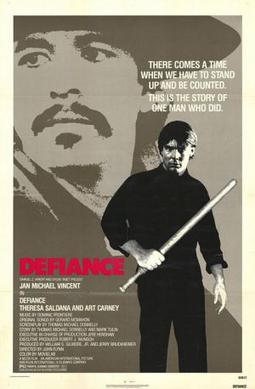
 

Defiance (1980, directed by John Flynn)


Serving out a six-month suspension, Merchant Seaman Tommy Campbell (Jan-Michael Vincent) rents an apartment on New York’s Lower East Side and passes the time painting and trying to learn Spanish in hope of getting assigned to a ship that is heading to Panama.

Tommy just wants to be left alone but he finds himself being drawn into the close-knit neighborhood.  He becomes friends with Carmine (Danny Aiello) and more than friends with his upstairs neighbor (Theresa Saldana).  He becomes a mentor to a street kid (Fernando Lopez) who lives with a punch-drunk boxer named called Whacko (Lenny Montana).  Abe (Art Carney), who owns the local bodega, agrees to let Tommy use his phone.

Tommy also finds himself drawing the attention of Angel Cruz (Rudy Ramos), head of the local street gang.  Tommy doesn’t want to get involved in any trouble.  He just wants to serve his suspension and sail to Panama.  But with Angel and his gang terrorizing the neighborhood and even robbing a church bingo game, Tommy and his friends finally stand up to the gang.

Defiance is more intelligent and realistic than many of the other urban vigilante movies that came out in the 70s and 80s.  Tommy never becomes a cold-blooded killer, like Charles Bronson did in the Death Wish films.  Instead, he spends most of the film trying to stay out of trouble and, when he does stand up for himself and the neighborhood, he does so realistically.  He fights the gang members but he doesn’t set out to the kill them.  About as deliberately destructive as he and Carmine get is that they destroy Angel’s car.  Rather than being a typical vigilante movie, Defiance is a portrait of a neighborhood where everyone takes care of everyone else.  Angel and his gang mistake the neighborhood’s kindness for weakness.  The neighborhood proves them wrong.

Defiance stars two actors who never quite got their due.  Theresa Saldana’s promising career was derailed when she was attacked and nearly killed by a deranged stalker in 1982.  Though she recovered and went on to do a lot of television, she never became the star that she should have.  Jan-Michael Vincent did become a star in the 70s and 80s but he later became better-known for his struggles with drugs and alcohol.  Both of them are very good in Defiance and leave you thinking about the careers that they could have had if things had just gone differently.

Embracing the Melodrama Part II #77: Quicksilver (dir by Thomas Michael Donnelly)


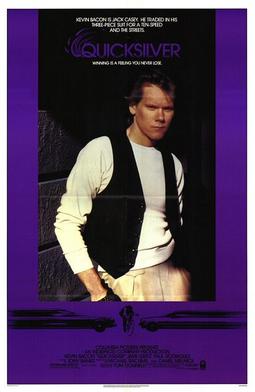
QuicksilverWho doesn’t love Kevin Bacon?

Seriously, I have yet to meet anyone who doesn’t have a positive reaction to seeing Kevin Bacon on screen.  He may not be a star in the way that Bradley Cooper or Bollywood sensation Shah Rukh Kahn are stars but still, he is one of those actors that everyone just seems to instinctively like.

I think, to a large extent, that is because, despite the fact that he’s been around and acting forever, Kevin Bacon himself still comes across as being a normal, blue-collar sorta guy.  Whenever you see him being interviewed, you get the feeling that Kevin Bacon basically shows up, does his job to the best of his ability, and, as opposed to many other actors, he doesn’t take himself or his movies too seriously.  He’s justifiably proud of the good films that he’s appeared in and he’s never had any problem admitting that he’s been in a lot of bad films as well.

In fact, it was Kevin Bacon’s openness about his bad films that led to me discovering 1986’s Quicksilver.  This is the film that, in a 2008 interview, Kevin Bacon referred to as being “the absolute lowest point of my career.”  (Consider, for a minute, that this is being said by the same Kevin Bacon who had an arrow shoved through his throat in the original Friday the 13th and that will give you some clue of how much disdain Kevin seems to have for Quicksilver.)

Naturally, having read that, I knew that I simply had to see Quicksilver.  I’ll admit right now that I was hoping to discover that it was some sort of loss and unappreciated classic.  I wanted this to be the review where I defended the unacknowledged brilliance of Quicksilver.  I wanted to say, “Don’t be so hard on yourself, Kevin!  Give Quicksilver another chance!”

But no.

Quicksilver doesn’t quite suck but it definitely comes close.

At the same time, it is interesting as a classic example of what happens when a filmmaker tries to assign some sort of deeper meaning to or find inherent nobility in an activity or job that really isn’t that interesting.  Often times, this will happen with sports movies.  A director or producer will make the mistake of thinking that just because he’s obsessed with beach volleyball that means that there’s a huge audience out there just waiting for someone to make the ultimate beach volleyball film.  Or, you’ll get a film like 1999’s Just The Ticket, where Andy Garcia is described as being the “world’s greatest ticket scalper” and the audience is supposed to be impressed.

In the case of Quicksilver, it’s all about being a bicycle messenger.  I’m assuming that, one day, director Thomas Michael Donnelly was stuck in traffic and he happened to see a bike messenger rushing down the street, whizzing past all of the stalled commuters.  And Donnelly probably thought, “I wish I was that guy right now!”  Every day after that, whenever Donnelly was stuck in traffic, he thought back to that bike messenger and slowly he grew obsessed.  All of his friends and his family got sick of listening to him talk about how much he envied the freedom of that bike messenger.  Finally, a little light bulb turned on over Donnelly’s head and he said, “I’ve got to make a movie out of this!”

And then the bulb burned out but nobody noticed.

Quicksilver-photo_625px_8col

Kevin Bacon plays Jack Casey.  When we first meet Jack, he’s a successful stock broker and he’s got a really bad, porn-appropriate mustache.  One day, he’s sitting in the back of a cab and he goads his driver into getting into a race with a bike messenger.  The messenger beats the cab.  Jack is amazed!

And then, perhaps the very same day (the film is so poorly edited that it’s hard to tell), Jack not only loses all of his money but all of his parents’ money as well.  Since poor men couldn’t afford facial hair in the 1980s, he shaves off his mustache.  Desperately needing work, Jack applies to be a  — you guessed it! — bicycle messenger.

The rest of the film is basically Jack delivering messages and talking about how he’s free now to live the life that he’s always wanted to live.  And the thing is, you like Jack because he’s being played by Kevin Bacon.  I mean, Kevin Bacon is so inherently likable that audiences even liked him when he was trying to kill Professor X and Magneto in X-Men: First Class.  But, at the same time, you listen to Jack go on and on about how much better his life is now and you just want to say, “Who are you kidding?”

Needless to say, Jack has a group of quirky coworkers.  Of course, by quirky, I mean that they are all quirky in a very predictable Hollywood sort of way.  For instance, there’s the crusty old veteran and the goofy fat guy and the hard-working Mexican guy who wants to start his own business in America and the cocky black guy who is mostly notable for being played by Laurence Fisburne.  One thing they all have in common is that they all love and damn near worship Jack, who has quite the common touch despite having formerly been a super rich stock broker with a bad mustache.

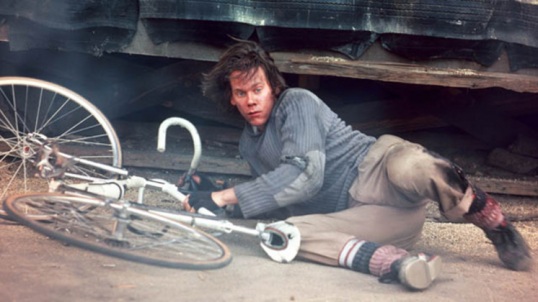
Anyway, Terri (Jami Gertz) also wants to become a bicycle messenger but she’s being used to deliver drugs by Gypsy (Rudy Ramos).  She and Jack fall in love and, along with helping out his quirky coworkers and finding a way to make back his fortune, Jack also has to deal with Gypsy.  It’s all very dramatic (though the drug dealer subplot feels as if it was awkwardly inserted into the film at the last moment) but mostly, the plot is just an excuse for scenes like the one below:

Quicksilver is … well, it’s not particularly good.  It has a few good bike weaving in and out of traffic scenes but it’s definitely no Premium Rush.  But it is kinda fun, in a “Oh my God, look at the 1980s” sorta way.  And, for what it’s worth, it’s a film that proves that Kevin Bacon can be likable in almost anything.