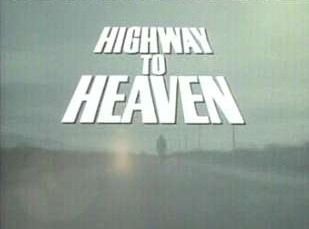
Welcome to Late Night Retro Television Reviews, a feature where we review some of our favorite and least favorite shows of the past! On Thursdays, I will be reviewing Highway to Heaven, which aired on NBC from 1984 to 1989. The entire show is currently streaming on Tubi and several other services!
This week, Mark and Jonathan meet yet another grouchy old man.
Episode 4.14 “Country Doctor”
(Dir by Michael Landon, originally aired on January 13th, 1988)
Grouchy old Dr. Hudspeth (Roscoe Lee Browne) is getting older and his health is suffering but if he retires, who will take over his practice? Jonathan and Mark come together to show Dr. Hudspeth the importance of having faith in other people and also how much everyone in the town has come to love him.
This episode was sentimental in the typical Highway to Heaven way. Grouchy old man are always secretly saints on this show. That said, this episode didn’t do much for me because the doctor was a little bit too grouchy. That’s a polite way of saying that Roscoe Lee Browne yelled almost all of his line and never quite came across as being as great a doctor as he was supposed to be. Browne wasn’t alone. Everyone in this episode overacted, including Michael Landon and Victor French. Considering how over-the-top the show tends to be with everyone delivering their lines normally, having people shout pushed the show over the edge.
In the end, this was Highway to Heaven on autopilot.
Richard Burton stars Mr. Brown (Richard Burton), a deeply cynical and world-weary Englishman who owns what passes for a luxury hotel in Haiti. Though Mr. Brown hopes to be able to sell the hotel and get out of Haiti, he is also having an affair with Martha (Elizabeth Taylor), the German wife of Pineda (Peter Ustinov), the ambassador from Uruguay. Mr. Brown tries to avoid politics, which it turns out is not easy to do when you’re living under a murderous regime.
Complicating Mr. Brown’s life is Major Jones (Alec Guinness), a retired British army officer who has come to Haiti to do business but who is promptly imprisoned when it’s discovered that he was invited to come to the island by a minister who was subsequently declared to be an enemy of the state. The fascist Captain Concasseur (Raymond St. Jacques) arrests Major Jones and Mr. Brown takes it upon himself to try to get Jones released. Unfortunately, Major Jones doesn’t quite understand how serious his situation is and he’s convinced the Haitians that he’s not only a brilliant military leader but that he can also arrange for them to receive a cache of weapons, which he claims he has hidden in a Miami warehouse.
Meanwhile, Mr. and Mrs. Smith (Paul Ford and Lillian Gish) have also arrived on the island, hoping to set up a vegetarian center in Haiti. (Mr. Smith even once ran for President of the U.S. as the candidate of the Vegetarian Party.) In many ways, Mr. and Mrs. Smith serve as a stand-in for clueless American activists, obsessing over minor issues while ignoring the larger problems that are right in front of their faces.
From the start, The Comedians establishes Haiti as being a dangerous place, a country where the people live in fear of the brutal police and where the poor struggle to survive day-to-day while their rulers live a life of luxury. It’s a place where political dissidents regularly disappear, though the police aren’t above murdering people in public as well. It’s a country where the State rules supreme, controlling the citizens through both fear and a fierce cult of personality. Rebels like Dr. Magiot (James Earl Jones) only want the country to be free but they know that, as long superpowers like America are supporting the regime, there’s little that the rebels can realistically hope to accomplish.
A major theme running through The Comedians is that the real suffering of the Haitian people is often overshadowed by the strategic concerns of the United States. Unfortunately, pretty much the same thing happens within the film itself. While there’s several black actors in supporting roles, the story focuses on the white characters and, as a result, it sometimes feels like the film’s message is less about the people being oppressed and more about how unfortunate it is that people like Brown, Jones, and the Smiths are being inconvenienced by it all. Like many similarly well-intentioned political films from the late 60s, The Comedians get so bogged down in all of the personal dramas that it loses sight of what’s actually the important part of the story. The film is often seems more interested in Brown and Martha’s affair than in the conditions that would lead to people like Dr. Magiot risking their lives to bring about change.
For the most part, it’s a well-acted film. Richard Burton’s natural self-loathing is put to good use and Alec Guinness has a few poignant scenes as a pathological liar who doesn’t realize how much trouble he’s actually in until it’s too late. (Guinness also has a scene where he wears blackface and pretends to be Burton’s maid. He does this in order to escape from the secret police and the film doesn’t treat it as being a joke but it’s still rather cringey to watch.) Elizabeth Taylor is miscast as Martha and her German accent comes and goes but Paul Ford and Lillian Gish do a good job playing clueless Americans. Perhaps the film’s strongest performance comes from Zakes Mokae, who doesn’t say much as a member of the secret police but who exudes menace every time that he’s on screen. Still, as well acted at it may be, the film is slowly paced and always seem hesitant about taking any position beyond a general sense that dictatorships are bad.
That said, there’s nothing wrong with reminding people that dictatorships are bad. That’s especially an important message today. The past few years have left me convinced that a lot of people secretly yearn for a dictatorship and would be willing to trade their freedoms for a false sense of security. Though the film may struggle dramatically, it’s still works as a warning about what true authoritarianism actually is.
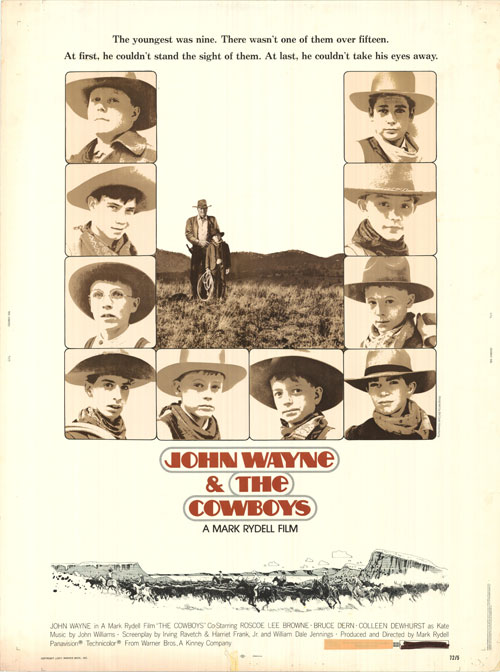
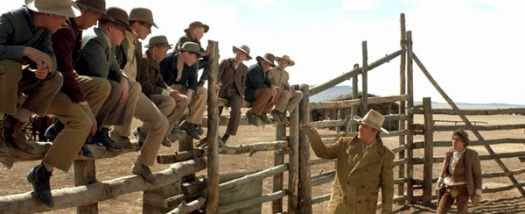
THE COWBOYS is not just another ‘John Wayne Movie’ from the latter part of his career. Not by a long shot. Duke had read the script and coveted the part of Wil Andersen, who’s forced to hire a bunch of wet behind the ears adolescents for a 400 mile cattle drive across the rugged Montana territory. Director Mark Rydell wanted George C. Scott for the role, but when John Wayne set his sights on something, he usually got what he wanted. The two men were at polar opposites of the political spectrum, and the Sanford Meisner-trained Rydell and Old Hollywood Wayne were expected to clash. They didn’t; putting their differences aside, they collaborated and cooperated to make one of the best Westerns of the 70’s.
Andersen’s regular hands have all deserted him when gold is discovered nearby, leaving the aging rancher in the lurch. He heads for Boseman to look…
Yesterday, the great character actor Harry Dean Stanton passed away at the age of 91. Cisco Pike is not one of Stanton’s best films but it is a film that highlight why Stanton was such a compelling actor and why his unique presence will be missed.
Cisco Pike (Kris Kristofferson) is a musician who has fallen on hard time. After having been busted several times for dealing drugs, Cisco now just wants to spend time with his “old lady” (Karen Black) and plot his comeback as a musician. However, a corrupt narcotics detective, Leo Holland (Gene Hackman), approaches Cisco with an offer that he cannot refuse. Holland has come into possession of 100 kilos of marijuana. He wants Cisco to sell it for him and then Leo plans to take the money and retire. Cisco has the weekend to sell all of the weed. If he doesn’t, Holland will arrest him for dealing and sent him back to prison,
About halfway through this loose and improvisational look at dealers, hippies, and squares in 1970s Los Angeles, Harry Dean Stanton shows up in the role of Jesse Dupree, an old friend and former bandmate of Cisco’s. Jesse is a free-living wanderer, too old to be a hippie but too unconventional to be a member of the establishment. Unfortunately, Jesse also has a nasty heroin habit. Jesse Dupree is a prototypical Harry Dean Stanton role. Like many of Stanton’s best roles, Jesse may be sad and full of regrets but he is not going to let that keep him from enjoying life. Stanton may not appear in much of the film but he still takes over every scene in which he appears.
Stanton is, by far, the best thing about Cisco Pike. As always, Gene Hackman is entertaining, playing the inverse of The French Connection‘s Popeye Doyle and Karen Black is her usual mix of sexy and weird. The weakest part of the movie is Kris Kristofferson, who was still a few years away from becoming a good actor when he starred in Cisco Pike. It is interesting to consider how different Cisco Pike would have been if Stanton and Kristofferson had switched roles. Stanton may not have had Kristofferon’s movie star looks but, unlike Kristofferson, he feels real in everything that he does. With his air of resignation and his non-Hollywood persona, Stanton brought authenticity to not only Cisco Pike but to every film in which he appeared.
Along with Stanton, several other familiar faces appear in Cisco Pike. Keep an eye out for Roscoe Lee Browne, Howard Hesseman, Viva, Allan Arbus, and everyone’s favorite spaced-out hippie chick, the one and only Joy Bang.
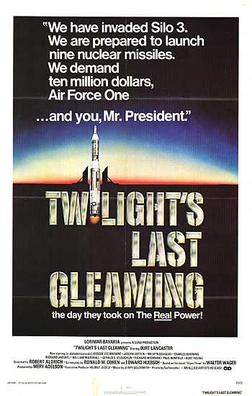
In Montana, four men have infiltrated and taken over a top-secret ICBM complex. Three of the men, Hoxey (William Smith), Garvas (Burt Young), and Powell (Paul Winfield) are considered to be common criminals but their leader is something much different. Until he was court-martialed and sentenced to a military prison, Lawrence Dell (Burt Lancaster) was a respected Air Force general. He even designed the complex that he has now taken over. Dell calls the White House and makes his demands known: he wants ten million dollars and for the President (Charles Durning) to go on television and read the contents of top secret dossier, one that reveals the real reason behind the war in Vietnam. Dell also demands that the President surrender himself so that he can be used as a human shield while Dell and his men make their escape.
Until Dell made his demands known, the President did not even know of the dossier’s existence. His cabinet (made up of distinguished and venerable character actors like Joseph Cotten and Melvyn Douglas) did and some of them are willing to sacrifice the President to keep that information from getting out.
Robert Aldrich specialized in insightful genre films and Twilight’s Last Gleaming is a typical example: aggressive, violent, sometimes crass, and unexpectedly intelligent. At two hours and 30 minutes, Twilight’s Last Gleaming is overlong and Aldrich’s frequent use of split screens is sometimes distracting but Twilight’s Last Gleaming is still a thought-provoking film. The large cast does a good job, with Lancaster and Durning as clear stand-outs. I also liked Richard Widmark as a general with his own agenda and, of course, any movie that features Joseph Cotten is good in my book! Best of all, Twilight’s Last Gleaming‘s theory about the reason why America stayed in Vietnam is entirely credible.
The Vietnam angle may be one of the reasons why Twilight’s Last Gleaming was one of the biggest flops of Aldrich’s career. In 1977, audiences had a choice of thrilling to Star Wars, falling in love with Annie Hall, or watching a two and a half hour history lesson about Vietnam. Not surprisingly, a nation that yearned for escape did just that and Twilight’s Last Gleaming flopped in America but found success in Europe. Box office success or not, Twilight’s Last Gleaming is an intelligent political thriller that is ripe for rediscovery.
1961’s The Connection opens with a title card and voice over from someone identifying himself as being J.J. Burden. Burden explains that what we are about to see is the last known work of an aspiring documentarian named Jim Dunn. Burden explains that, after he and Dunn filmed the footage that’s about to be shown, Dunn disappeared. It was left to Burden to put the footage together and he swears that he has gone out of his way to stay true to Dunn’s intentions.
Of course, if you’ve watched enough old movies, you might recognize Burden’s resonate voice as belonging to the distinguished actor, Roscoe Lee Browne. And, once the film starts, you may also notice that you’ve seen Jim Dunn in other movies. That’s because Dunn is played by William Redfield, a character actor who specialized in playing professional types.
The Connection takes place in a New York loft. A group of jazz musicians are waiting for their drug dealer. Sometimes, they play music. Sometimes, they look straight at the camera and answer questions about what it’s like to be a heroin addict. While Burden always remains behind the camera, Jim Dunn occasionally steps in front of it and scolds the men for not being dramatic enough. Dunn is attempting to stage reality. Leach (Warren Finnerty), the most verbose of the addicts, taunts Dunn over never having done drugs himself. Dunn jokingly says that maybe he could start with some marijuana.
This is no Waiting for Godot. The dealer does eventually arrive. His name is Cowboy and he’s slickly played by Carl Lee. (Carl Lee was the son of Canada Lee, who appeared in Hitchcock’s Lifeboat. Sadly, 25 years after filming his role in The Connection, Lee would die of a heroin overdose.) He’s accompanied by a flamboyant woman named Sister Salvation (Barbara Winchester). As Burden films, the musicians enter a small bathroom one-by-one, so that they can shoot up. Music is played. Overdoses are dealt with. And Dunn, who was originally so detached, becomes more and more drawn into the junkie life style…
Was The Connection the first mockumentary? To be honest, I’m really not sure but it definitely has to be one of the first. The beginning title card (and Burden’s narration) feels like it could easily be used in front of any of the hundreds of found footage horror films that have been released over the last few years. The film itself makes good use of the found footage format, though it’s also trapped by the genre’s limitations. With all of the action taking place in just one room, there’s no way that The Connection can’t feel stagey. (And, indeed, it was based on a play.) Along with detailing the lives of those on the fringes of society, The Connection makes some good points about the staging of reality, though it never goes quite to the lunatic extremes of Ruggero Deodato’s Cannibal Holocaust.
(The Cannibal Holocaust comparison is not as crazy as it may sound. Much as how the arrogant filmmakers in Deodato’s film attempted to exploit the cannibals, Jim Dunn attempts to exploit the addicts. When the addicts and Cowboy start pressuring Dunn to try heroin, it’s not that much different from the cannibals eating the cameraman in Cannibal Holocaust. The exploited are getting their revenge.)
The Connection was the first dramatic film to be directed by documentarian Shirley Clarke and, like many of Clarke’s films, it struggled to find an audience. (Both the film and Clarke would have to wait several decades before getting the recognition that they deserved.) The subject matter was considered to be so sordid (and the language so shocking) that the film was originally banned in New York. The filmmakers actually had to file a lawsuit to get the film released. The New York State Court of Appeals ruled the film was “vulgar but not obscene.”
Seen today, the film seems to be neither vulgar nor obscene. Instead, it seems like a time capsule of the era in which it was made. We tend to think of the early 60s as a time of beach movies, drive-ins, early rock and roll, and Kennedy optimism. The Connection reveals that there was a lot more going on than just that.
So, last week, I asked for everyone to vote for which film I should watch on Sunday. 864 votes were cast and the winner was Michael Anderson’s 1976 cult classic, Logan’s Run. So, last night, I sat down with my sister Erin and we watched Logan’s Run. I have to admit that we both giggled a lot but we still enjoyed watching it. (I should also note that Logan’s Run was filmed in Dallas and Ft. Worth and, even 35 years later, both of us recognized a lot of familiar landmarks. The end of the film was shot at the Ft. Worth Water Gardens and we squealed with delight as we watched it and said, “We’ve been there!”)
Like most sci-fi films released before Star Wars, Logan’s Run takes place on a post-apocalyptic Earth. It’s the 23rd Century and what’s left of humanity lives in an underground city where they’re governed by a gently condescending computer. Civilization is now based around the pursuit of pleasure. Everyone appears to live in the world’s biggest mall (probably because the “City” scenes were actually filmed in a shopping mall located in my hometown of Dallas). It’s a city that’s essentially made up of slow-motion orgies, hot tubs, and crazy plastic surgeons. Everyone dresses in these sheer tunics and it quickly becomes obvious that the world’s knowledge underwear was apparently lost during the move underground. (Then again, this could have been because the film was made in the 70s. Seriously, did nobody own a bra in the 70s?)
Future civilization appears to have only one law and that’s that anyone who reaches the age of 30 has to go to Carrousel. At Carrousel, everyone has reached their time limit levitate in the air, floats around in a circle, and then blows up. Their fellow citizens assume that those being blown up are actually being “renewed” but actually, they’re just blowing up. (In many ways, Michael Anderson’s direction of Logan’s Run is pretty pedestrian but the Carrousel sequence is actually quite visually stunning.)
Now, some citizens don’t want to get blown up. These citizens are called runners and they greet their 30th birthday by attempting to flee the City and escape to the Outside and to a mysterious place they call “Sanctuary.” Some of them end up getting caught and frozen by a bizarre little robot called Box (played, in a really odd performance, by Roscoe Lee Browne). Those that don’t get caught by Box usually end up getting gunned down by the Sandmen. The Sandmen are a group of nylon-clad fascists who are never happier than when they’re gunning down runners.
At this point, you may have noticed that it actually takes more time to explain the film’s backstory than its actual story. Logan’s Run has a fascinating concept behind it and the plot has a lot of potential. Sadly, the film itself doesn’t quite live up to that potential but the story is still intriguing enough to carry the viewer through some of the film’s more uneven moments.
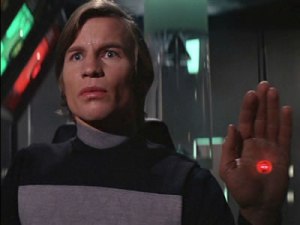
Michael York is Logan
The Logan of the title is a Sandman played by Michael York (who, when he first appears in this movie, projects just the right sense of unthinking entitlement). Logan is assigned (by the condescending computer) to infiltrate the runners and find sanctuary. In short, he’s ordered to run. However, as it quickly becomes obvious that nobody’s actually being renewed, Logan decides to run for real. Along with a runner named Jessica (played by Jenny Agutter), Logan tries to escape the city. Pursued by his best friend and fellow Sandman Francis (Richard Jordan), Logan and Jessica most deal with a psychotic plastic surgeon (well-played by the director’s son, Michael Anderson, Jr.) and his glam nurse (Farrah Fawcett!) as well as a tribe of feral children and a bunch of sex-crazed, naked people who move in slow motion. (It’s a neat visual, to be honest).
Logan, Jessica, and Farrah
When Logan and Jessica finally do reach the Outside, it turns out to not quite be all it was cracked up to be. (Or as Jessica puts it, in one of my favorite lines, “I hate outside!”) They come across the ruins of Washington, D.C. which turns out to be inhabited by a thousand cats and an old man played by Peter Ustinov. However, little do they know, Francis has followed them outside and, back at the City, the computer is still demanding to know the location of Sanctuary.
I enjoyed Logan’s Run but I’d be lying if I said it was a great film. It’s basically a big, silly, entertaining film that makes sense as long as you don’t think about it too much. I have a feeling that if I had seen this film in a theater, trapped in the same seat for 2 hours straight, I would probably be a lot harder on it. However, Logan’s Run is the perfect film to watch in the privacy of your own home with a friend or two (or, in my case, a big sister). The story is just good enough to hold your interest, you can openly giggle at the film’s more campy moments, and — once the action starts to drag — you’re free to move around and find something else to do until things get interesting again.
Ultimately, Logan’s Run shares the flaw that afflicts most sci-fi films that are about people trying to escape a decadent, dystopian society. That is, the movie is a lot more fun when everyone’s being decadent and evil than when everyone’s searching for a higher truth. When Jessica yelled that she hated the outside, I had to agree with her because the inside — even with everyone getting blown up at the age of 30 — was so much more fun. Inside the city, they had slow-motion orgies, hot tubs, and really pretty clothes. Meanwhile, the only thing that outside had to offer was Peter Ustinov reading a decayed copy of the Declaration of Independence. Don’t get me wrong — I was jealous that Ustinov got to live with all of those cute kitties but it just couldn’t compare with the psychotic plastic surgeons of the City. If that’s Outside, I can understand why everybody went inside.
(Personally, I call this the Matrix Rule. Everyone talks about how great Zion is but, seriously, what type of toadsucker would actually want to live in that tedious, ugly little Socialistic state?)
Still, despite this, Logan’s Run is a watchable and entertaining artifact of 70s “event” filmmaking. This film doesn’t have any scenes set in a disco but it really should.
Among the actors, both Michael York and Peter Ustinov are a lot of fun to watch as they both found their moments to go over the top and made the most of them. Perhaps my favorite over the top York moment came towards the end of the film when he shouted, “YOU CAN LIVE! LIIIIIIIIIIIIIIIIIIIIIIIIVE!” When I first announced, on twitter, that I would be reviewing this film, I got a lot of replies from men who apparently had fond memories of Jenny Agutter in this film and her performance here is sexy and confident. Plus, she gets to deliver one of my favorite lines of all time, “I hate outside!” Still, if you want to talk about sexy and confidence, then you have to talk about Richard Jordan’s performance as the cocky Sandman, Francis. Seriously, Francis is a Sandman who could bring me a dream any night of the week…
Sexy, Dangerous Francis
So, in the end, Logan’s Run is silly but fun, uneven but definitely watchable. Thank you to everyone who voted for me to see this film. And until next time, remember — “Theeeeerrrrreeee Issssssssssss Noooooooo Saaaaaaaanctuuuuuuuary….”
Earlier today, I did a google search and I discovered that Logan's Run was apparently spun off into a television show. Apparently, this is the cast of that show. They certainly look a lot more cheerful than their film counterparts.


 Yesterday, the great character actor Harry Dean Stanton passed away at the age of 91. Cisco Pike is not one of Stanton’s best films but it is a film that highlight why Stanton was such a compelling actor and why his unique presence will be missed.
 In Montana, four men have infiltrated and taken over a top-secret ICBM complex. Three of the men, Hoxey (William Smith), Garvas (Burt Young), and Powell (Paul Winfield) are considered to be common criminals but their leader is something much different. Until he was court-martialed and sentenced to a military prison, Lawrence Dell (Burt Lancaster) was a respected Air Force general. He even designed the complex that he has now taken over. Dell calls the White House and makes his demands known: he wants ten million dollars and for the President (Charles Durning) to go on television and read the contents of top secret dossier, one that reveals the real reason behind the war in Vietnam. Dell also demands that the President surrender himself so that he can be used as a human shield while Dell and his men make their escape.



 Through the Shattered Lens