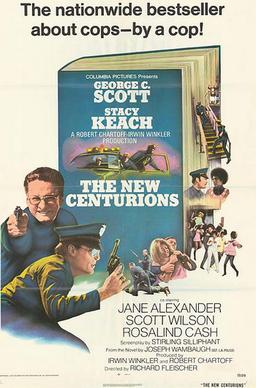
The New Centurions (1972, directed by Richard Fleischer)


Fresh from the police academy, three rookie cops are assigned to a precinct in East L.A.  Gus (Scott Wilson) is a father of three who just wants to do a good job and support his family.  Sergio (Erik Estrada) is a former gang member who saw the police academy as a way to get out of his old neighborhood, and Roy (Stacy Keach) is a new father who is going to law school at night.  Most of the movie centers on Roy, who goes from being an idealistic rookie to being a hardened veteran and who comes to love the job so much that he abandons law school and eventually loses his family.  Roy’s wife (Jane Alexander) comes to realize that Roy will never be able to relate to anyone other than his fellow cops.  Roy’s mentor is Andy Kilvinski (George C. Scott), a tough but warm-hearted survivor who has never been shot once and whose mandatory retirement is approaching.

Based on an autobiographical novel by real-life policeman Joseph Wambaugh, The New Centurion’s episodic structure allows the film to touch on all the issues, good and bad, that come with police work.  Gus is shaken after he accidentally shoots a civilian.  Sergio feels the burden of patrolling the streets on which he grew up.  Roy becomes a good cop but at the cost of everything else in his life and he deals with the stress by drinking.  There are moments of humor and moments of seriousness and then a tragic ending.  Just as Wambaugh’s book was acclaimed for its insight and its realistic portrayal of the pressures of being a policeman, the movie could have been one of the definitive portraits of being a street cop, except that it was directed in a workmanlike fashion by Richard Fleischer.  Instead of being the ultimate cop movie, The New Centurions feels more like an especially good episode of Police Story or Hill Street Blues.  (The New Centurions and Hill Street Blues both feature James B. Sikking as a pipe-smoking, martinet commander.)

George C. Scott, though.  What a great actor!  Scott only has a supporting role but he’s so good as Kilvinski that you miss him when he’s not around and, when he leaves, the movie gets a lot less interesting.  Scott makes Kilvinski the ultimate beat cop and he delivers the closest thing that The New Centurions has to a cohesive message.  A cop can leave the beat but the beat is never going to leave him.

The TSL Grindhouse: Death Drug (dir by Oscar WIlliamas)


In 1978’s Death Drug, Philip Michael Thomas plays Jesse Thomas.

Jesse is a plumber with a dream.  He wants to be a songwriter, a musician, and most of all, a star.  His girlfriend and eventual wife, Carolyn (Vernee Watson-Johnson), stands by him as he sends his music off to record companies and waits for word.  When he’s finally given a recording contract, no one is happier for him than Carolyn.  Certainly, Jesse’s own father doesn’t seem to care much about his son’s success.  “I have no son,” he says, even after Jesse wins a Grammy.

(To be fair, they’ll give just about anyone a Grammy.)

Unfortunately, with success comes temptation.  While celebrating at a local club, Jesse is approached by a drug dealer (Frankie Crocker) who gives Jesse a cigarette that is laced with Whack.  Whack, as those of us who have seen Disco Godfather can tell you, is PCP.  Remember Disco Godfather‘s cry of “We’ve got to attack the whack?”  Well, Jesse allows himself to become a victim of whack attack.  It starts out simply enough, with a moving painting.  Then, before you know it, Jesse’s hairbrush is turning into a hungry alligator and Jesse starts to become convinced that everyone is plotting against him.  Even a trip to the grocery store goes wrong as Jesse spots spiders in the produce and zombies in the aisles!  Jesse freaks out.  He runs outside.  He…. well, no spoilers for me.  But let’s remember the words of Rudy Ray Moore in Disco GodfatherPut your weight on it!  Yes, indeed.  Put your weight on it, Jesse.

This is one of those anti-drug films that was probably best enjoyed by people who viewed it while high.  It’s a rather short film, which means that Jesse goes from being a hard-working plumber-turned-musician to a ranting and raving maniac in record time.  Philip Michael Thomas throws himself into the role, especially the ranting and raving part.  I’ve been binging Miami Vice so seeing the usually collected and cool Thomas screaming in terror at things that aren’t there was an interesting experience.  Because the film was so short, there’s some filler that’s awkwardly tacked on, presumably to bring the movie up to feature length.  We get a news report about a man who went crazy from PCP-usage and had to be taken down by the cops.  We get a report about Jesse Thomas’s musical career that features a much-older looking Philip Michael Thomas performing a song that’s more from the 80s than the 70s.  (That was inserted into the film when it was re-released in 1985, at the height of Thomas’s Miami Vice success.)  There’s a lengthy news report at the end that, hilariously, has a moment where the reporter apologizes for “technical difficulties” that were probably included just to get the movie past the 70-minute mark.

As I mentioned, this film was re-released in 1985.  Philip Michael Thomas filmed a special introduction for the film, in which he played pool in his Hollywood mansion and told the viewer that, out of all the roles he had played (“cops, kings….”), none of them meant as much to him as his performance as Jesse Thomas.  Philip Michael Thomas is the epitome of 80s cool in that introduction and in a short scene that appears after the end credits.  Don’t worry, folks, the film is telling us.  Jesse Thomas may have fallen victim to the whack but Philip is still over here putting some weight on it.

In the end, it’s all fairly silly but it does make a nice companion piece to Don Johnson’s Heartbeat.  If you’re a success, you really owe it to yourself to have a vanity project.  It’s what the people want.

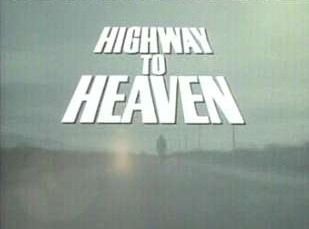
Late Night Retro Television Review: Highway to Heaven 3.16 “A Song of Songs”


Welcome to Late Night Retro Television Reviews, a feature where we review some of our favorite and least favorite shows of the past!  On Thursdays, I will be reviewing Highway to Heaven, which aired on NBC from 1984 to 1989.  The entire show is currently streaming on Tubi and several other services!

This week, not even the presence of the great James Earl Jones can save Highway to Heaven.

Episode 3.16 “A Song of Songs”

(Dir by Michael Landon, originally aired on January 21st, 1987)

Mark and Jonathan are driving out in the middle of nowhere, waiting for their next assignment.  Mark is annoyed.  He says he’s been driving for ten hours.  Personally, I think Mark has every right to be annoyed.  I’ve noticed that Jonathan never drives.  Are angels not allowed to drive?  Did he never learn how?  It seems a bit self-centered to make Mark do all the driving.

Eventually, Jonathan and Mark stop off at a roadhouse.  Mark order a huge amount of ribs.  Jonathan smiles, even though Mark is going to give himself a heart attack if he’s not careful.  By an amazing coincidence, an old friend of Mark’s is also at the roadhouse.  Gabe (James Earl Jones) is a blind jazz pianist.  He’s also this week’s assignment.

Jonathan and Mark are hired to work at a storefront church that is led by Eleanor (Rosalind Cash).  Eleanor is strict and demanding and when her daughter (Akosua Busia) wants to go off on her own and perform her own type of music, Eleanor accuses her of only caring about “the devil’s music.”  It turns out that Eleanor is also Gabe’s ex-girlfriend!  Eleanor was not always so strict.  Can Jonathan and Mark bring these two back together and also repair the relationship between Eleanor and her daughter?

Eh, this episode didn’t do much for me.  I hate to say that because James Earl Jones was one of our best actors and he’s definitely the strongest thing about this episode but overall, the plot was a bit too predictable and both Rosalind Cash and Akosua Busia gave such over-the-top performances that it was hard to take their storyline seriously.  This was Highway to Heaven at its most predictable and the episode didn’t even benefit from Michael Landon’s trademark earnestness.  It just fell flat.

Oh well, there’s always next week.  Maybe Mark will finally get a break from always having to do the driving!  I wouldn’t count on it, though.

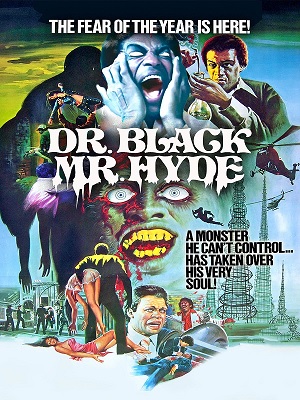
The TSL Horror Grindhouse: Dr. Black, Mr. Hyde (dir by William Crain)


1976’s Dr. Black, My Hyde tells the story of Dr. Henry Pride (Bernie Casey).

Dr. Pride is a respected doctor, the head of a free clinic in the Watts district of Los Angeles.  He has a big house.  He has a fancy car.  With Dr. Billie Worth (Rosalind Cash), he is researching a serum that will help people with cirrhosis to regenerate the tissue of their liver.  Of course, Dr. Pride wasn’t always rich.  In his own words, he and his mother grew up in the guest house of a brothel.  But now that he is rich and successful, some people claim that he’s lost touch with his community.  As a prostitute named Linda (Marie O’Henry) tells him, “You talk white, you think white, you probably drive a white car.”

In a scene that is designed to bring to mind the horrors of the Tuskegee syphilis experiments, Dr. Pride considers the ethics of injecting his serum into his patients without warning them that there might be consequences.  Billie warns him that what he’s thinking about doing would be not only unethical but illegal.  Dr. Pride questions whether ethics matter when dealing with something that could potentially save lives in the future.  After Dr. Pride injects an elderly black woman with the serum, she turns into a white-skinned monster who attempts to strangle a nurse before promptly dying.  Despite this, Dr. Pride continues to develop the serum and eventually, he tries it on himself.

Under the effects of the serum, Dr. Pride becomes a white-skinned madman.  (Bernie Casey wears a white makeup whenever he plays this film’s version of Mr. Hyde.)  Under the influence of the serum, Pride rampages through Watts, killing prostitutes and pimps before transforming back into the Dr. Pride.  The police are investigating the murders but they’re searching for a white man.  Meanwhile, Dr. Pride continues to obsess on trying to work out the kinks of her serum.  He wants Linda to be his latest test subject.

Dr. Black, Mr. Hyde is a blaxploitation take on Dr. Jekyll and Mr. Hyde and, as with many blaxploitation films, the subtext is frequently more interesting than what actually happens on screen.  Dr. Pride, after continually being accused of acting white, takes his serum and soon literally becomes white and sets out to kill the prostitutes and the pimps who remind him of his life before he became a doctor.  And while it’s easy to see this as an example of the serum turning a good man into an evil monster (the classic Jekyll and Hyde formula), it’s also true that, even before his transformation, Dr. Pride views his patients as being potential test subjects.  For all of his talk about helping people, Dr. Pride maintains his distance from the members of his own community.  Is the serum turning Dr. Pride into a monster or is it just revealing who Dr. Pride truly wishes to be?  Given the film was directed by William Crain, who also did Blacula and who, unlike a lot of Blaxploitation directors, actually was black, it’s easy to believe that the subtext was intentional.

Of course, subtext aside, Dr. Black, Mr. Hyde is a cheap-looking and haphazardly edited film.  Much of the acting is amateurish but Bernie Casey gives a strong performance as both the repressed black doctor and his violent, white alter ego.  Cheapness aside, Dr. Black, Mr. Hyde is a frequently intriguing film.

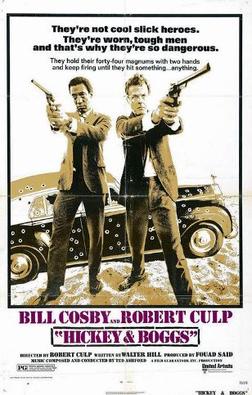
Hickey & Boggs (1972, directed by Robert Culp)


Frank Boggs (Robert Culp) and Al Hickey (Bill Cosby) are two private investigators who are constantly in danger of losing their licenses and going out of business.  Hickey is the responsible one.  Boggs is the seedy alcoholic.  When Hickey and Boggs are hired to track down a missing woman, their investigation lands them in the middle of a war between the mob and a group of political activists who are fighting over who is going to get the loot from a recent robbery.  Hickey and Boggs are targeted by the mob and soon, everyone is dying around them.

With its cynical themes and downbeat ending, Hickey & Boggs is very much a 70s film.  The script was written by future director Walter Hill and when it was eventually offered to Bill Cosby, Cosby agreed to star on the condition that his I Spy co-star, Robert Culp, be hired to direct.  Producer John Calley hired Culp but after Calley refused to provide the budget that Culp requested, Culp bought the script and raised the money himself.

There are a few problems with Hickey & Boggs, the main one being that the plot is next to impossible to follow.  As a director, Robert Culp apparently didn’t believe in either filming coverage or providing establishment shots so, especially early on, it is often impossible to tell how one scene is connected to another or even how much time has passed between scenes.  I don’t know if this was an intentional aesthetic decision or if the production just ran out of money before everything could be shot but it makes it difficult to get into the film’s already complicated story.  On a positive note, Culp did have a flair for staging action scenes.  The film ends with a shoot out on the beach that’s is handled with such skill that it almost makes up for what came before it.  Also, like many actors-turned-director, Culp proved himself capable of spotting talent.  Along with giving early roles to Vincent Gardenia, James Woods and Michael Moriarty, Culp also took the chance of casting sitcom mainstay Robert Mandan as a villain.  It was a risk but it worked as Mandan convincingly portrays the banality of evil.

Of course, the biggest problem with Hickey & Boggs is that it stars Bill Cosby as a straight-laced hero and that’s no longer a role that anyone’s willing to believe him in.  Cosby actually does give a convincing dramatic performance in Hickey & Boggs.  Just look at the final scene on the beach where Hickey has his “what have we done” moment and shows the type of regret that Cosby has never shown in real life.  The problem is that to really appreciate Cosby’s performance, you have to find a way to overlook the fact that he’s Bill Cosby and that something that I found impossible to do while watching Hickey & Boggs.  When you should be getting into the movie, you’re thinking about how many decades Bill Cosby was able to get away with drugging and assaulting women.  If not for a comment from Hannibal Buress that led to a social media uproar, Cosby would probably still be getting away with it.  If Buress’s anti-Cosby comments hadn’t been recorded and hadn’t gone viral, Bill Cosby would still be free and the media would probably still be holding him up as some sort of role model.

At the time Hickey & Boggs was made, both Bill Cosby and Robert Culp were at a career crossroads.  Cosby was hoping to transform himself into a film star.  Culp was hoping to become a director.  Hickey & Boggs, however, was disliked by critics and flopped at the box office.  Culp never directed another film and we all know what happened with Bill Cosby.  (Of course, it wasn’t just the box office failure of Hickey & Boggs that kept Cosby from becoming a movie star.  Say what you will about Robert Culp as a director, he had nothing to do with Leonard Part 6.)  Hickey  & Boggs is too disjointed to really work but Robert Culp and Bill Cosby were convincing action stars and the film’s downbeat style and cynical worldview is sometimes interesting.

Feeling the Burn: Death Spa (1989, directed by Michael Fischa)


Michael (William Bumiller) owns the hottest health club in Los Angeles but that may not stay true if he can’t do something about all the guests dying.  Members get baked alive in the sauna.  Another is killed when a malfunctioning workout machine pulls back his arms and causes a rib to burst out of one side of his body.  Shower tiles fly off the wall and panic a bunch of naked women.  A woman loses her arm in a blender and a man is somehow killed by a frozen fish.  Strangely, all of the deaths don’t seem to hurt business as people still keep coming to the gym.  Surely, there are other, safer health clubs in Los Angeles.
Michael suspects that his brother-in-law, David (Merritt Butrick), might be to blame for all of the trouble.  David is good with computers and since this movie is from 1989, that means that he can do anything.  (David is described as being a “hacker,” which may be the first time that overused term was used in a film.)  Michael feels that David has never forgiven him for the suicide of his sister.  Two useless cops show up to investigate the murders while the spa gets ready for Mardi Gras night.

This incredibly cheesy horror movie used to be a mainstay on HBO, where young viewers like me appreciated all of the gore and slightly older viewers appreciated all of the nudity.  Viewed today, Death Spa is a real nostalgia trip.  From the leg warmers to the bulky computers to the choreographed workout routines, this is a movie that could only have been made in the 80s.  The plot is beyond stupid but some of the gore effects were well-executed and that scene where the frozen fish comes to life continues to amaze.  Sadly, this was Merritt Butrick’s last film.  The actor, who was best known for playing Captain’s Kirk’s son in The Wrath of Khan and The Search for Spock, died the same year that Death Spa was released.

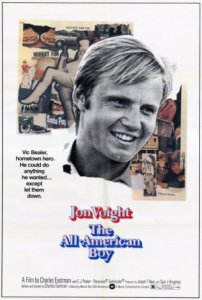
A Movie A Day #149: The All-American Boy (1973, directed by Charles Eastman)


Vic “The Bomber” Bealer is an amateur boxer who appears to be poised to escape from life in his dreary hometown.  He is such a good fighter that he is on the verge of making the U.S. Olympic Team and he is so good-looking that everyone, from his teenage girlfriend (Anne Archer) to his gay manager (Ned Glass) to a woman he meets at a gas station, automatically falls in love with him.  However, after his girlfriend tells him that she is pregnant, Vic abandons both her and boxing.  When she leaves town to have an abortion, Vic starts boxing again but then he learns that she may not have actually had an abortion and Vic leaves for Los Angeles, to see both her and his son.

Sadly, there is something about boxing that has always brought out the pretentious side of some filmmakers and that is the case with The All-American Boy.  This episodic film (which claims to portray “The Manly Art In Six Rounds”) tries to present Vic as being an anti-hero but mostly, he just seems to be vacant loser.  Vic sulks through the entire film, despite not really having much to sulk about.  When one of his conquests asks him what he is thinking, Vic replies, “I ain’t thinkin'” and the movie provides no reason to doubt him on this point.  I was not surprised to learn that The All-American Boy was filmed in 1969 and was deemed unreleasable until the combined success of Midnight Cowboy and Deliverance made Voight into a star.  On the plus side, when he made the film, Jon Voight looked like he could actually step inside the ring and throw a few punches.  On the negative side, the boxing scenes go heavy on the slow motion which, when overused, just looks stupid.  Raging Bull, this film is not.

When it comes to The All-American Boy, Duke has the right idea:

I Am Legend: THE OMEGA MAN (Warner Brothers 1971)


gary loggins's avatarcracked rear viewer

When I was a lad of 13, back in the Stone Age, I saw THE OMEGA MAN on the big screen during it’s first run. I remember thinking it was real cool, with Charlton Heston mowing down a bunch of mutant bad guys with his sub-machine gun, some funny one-liners, and a few semi-naked scenes with Rosalind Cash. What more could an adolescent kid ask for in a movie? Now that I’m (ahem!) slightly older, I recently re-watched the film, wondering just how well, if at all, it would hold up.

I’m happy to report THE OMEGA MAN, despite some flaws in logic, stands the test of time as a post-apocalyptic sci-fi action/adventure, with a touch of Gothic horror thrown in. The film is the second of three based on Richard Matheson’s novel I AM LEGEND, the first written by Matheson himself (under the pseudonym Logan Swanson) as THE LAST MAN ON EARTH, a 1964…

View original post 368 more words

A Movie A Day #15: Special Bulletin (1983, directed by Ed Zwick)


specialbulletin2

“We interrupt our regularly scheduled programming for a special report…”

Led by veteran anchor John Woodley, the RBS news team is providing continuing coverage of a developing crisis in Charleston, South Carolina, where terrorists are holding several members of the coast guard, a local new reporter, and his cameraman hostage on a small tugboat.  These are not typical terrorists, though.  Two of them are nuclear scientists.  One of them is a social worker.  Another one is a nationally-renowned poet.  The final terrorist is a former banker robber who was just recently released from prison.  This unlikely group has only two demands: that the U.S. government hand over every single nuclear trigger device at the U.S. Naval Base and that RBS give them a live television feed so that they can explain their actions to the nation.  If either of those demands are not met, a nuclear bomb will be detonated and will destroy Charleston.

This made-for-TV movie was shot on video tape, to specifically make it look like an actual news broadcast.  Though much of the movie seems dated when compared to today’s slick, 24-hour media circus, Special Bulletin was convincing enough that, when it was originally broadcast in 1983, it caused a mini-panic among viewers who missed the opening disclaimer:

specbull_disclaimer

Because the movie deals with the threat of nuclear terrorism instead of a U.S.-Soviet nuclear war, it still feels relevant in a way that many of the atomic disaster films of the 1980s do not.  Beyond making an anti-nuclear statement, Special Bulletin is also a critical look at how the news media sensationalizes every crisis, with the RBS news team going from smug complacency to outright horror as the situation continues to deteriorate.  David Clennon and David Rasche are memorable as the two most outspoken of the terrorists and Ed Flanders is perfectly cast as a veteran news anchor struggling to maintain control in the middle of an uncontrollable situation.  Special Bulletin won an Emmy for Outstanding Drama Special and can be currently be found on YouTube.

Keep an eye out for Michael Madsen, who shows up 57 minutes in and gets the movie’s best line: “That guy’s a total psycho ward.”

madsen-special-bulletin

Cleaning Out The DVR Yet Again #40: Melinda (dir by Hugh A. Robertson)


(Lisa recently discovered that she only had about 8 hours of space left on her DVR!  It turns out that she’s been recording movies from July and she just hasn’t gotten around to watching and reviewing them yet.  So, once again, Lisa is cleaning out her DVR!  She is going to try to watch and review 52 movies by the end of 2017!  Will she make it?  Keep checking the site to find out!)

melinda

I recorded Melinda off of TCM on November 13th.

First released in 1972, Melinda is technically a murder mystery.  Frankie J. Parker (Calvin Lockhart, giving a brilliant performance) is a popular radio DJ in Los Angeles.  When we first see Frankie, he’s driving his expensive sportscar through a poor neighborhood.  It’s a neighborhood that he knows well but, as opposed to those around him, he’s made it out.  He’s handsome, slick, and more than a little arrogant.  When he arrives at a local gym, he looks at himself in a mirror and says, “I shouldn’t say it … but I am a pretty motherfucker.”  Frankie’s a student in a taekwondo class taught by Charles Atkins (Jim Kelly).  Charles gives Frankie a hard time about not giving back to the community.  Frankie blows off his concerns.  To be honest, we really should dislike Frankie but he’s so damn charming.  As played by Calvin Lockhart, Frankie has one of those irresistible smirks, the type of the lights up the screen.

One night, Frankie meets the mysterious Melinda (Vonetta McGee) and spends the night with her.  He thinks that it’s just going to be another one night stand but Melinda tells Frankie that he has the potential to be more than he realizes.  Touched, Frankie goes to work and resolves to be a better person.  Then he returns home and discovers that Melinda has been murdered!

The rest of the film deals with Frankie’s attempts to discover who murdered Melinda.  It turns out that Melinda had underworld connections and mob boss Mitch (Paul Stevens) is desperate to recover something that Melinda had in her possession when she died.  But honestly, the whole murder subplot is a MacGuffin (if you want to get all Hitchcockian about it).  Ultimately, Melinda is a character study of Frankie Parker and how, over the course of solving Melinda’s murder, he learns that there’s more to life than just looking out for himself.

Though Melinda was obviously made to capitalize on the blaxploitation craze of the early 70s, it’s actually far more low-key than most of the better known films in the genre.  (Or, at least it is until the karate-filled finale.)  Perhaps because it was directed by a black man and written by noted black playwright Lonne Elder III, Melinda is far more interested in exploring what makes its characters who they are, as opposed to just putting a gun in their hand and having them shoot up the screen.  Frankie Parker emerges as a fascinating character.

Mention should also be made of the performance of Rosalind Cash, who plays Terry, Frankie’s ex.  Cash gets an absolutely amazing scene where, while attempting to convince a bank employee that she’s Melinda so that she can get into Melinda’s safe deposit box, she tells off a rude teller.  It’s such a good scene and Cash delivers her lines with such fury that you find yourself forgetting that the teller was actually correct in her suspicion that Terry wasn’t actually who she said she was.

Melinda is probably one of the best films that hardly anyone has ever heard of.  Keep an eye out for it.