Film Review: And The Band Played On (dir by Roger Spottiswoode)


I live in a very cynical time.

That was one of my main thoughts as I watched 1993’s And The Band Played On.

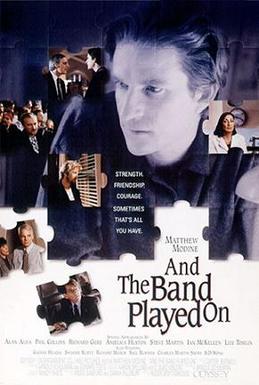
Directed by Roger Spottiswoode and featuring an all-star cast, And The Band Played On deals with the early days of the AIDS epidemic.  It’s a film that features many different characters and storylines but holding it all together is the character of Dr. Don Francis (Matthew Modine), an epidemiologist who is haunted by what he witnessed during the Ebola epidemic in Africa and who fears that the same thing is going to happen in America unless the government gets serious about the mysterious ailment that is initially called “gay cancer” before then being known as “GRID” before finally being named AIDS.  Dr. Francis is outspoken and passionate about fighting disease.  He’s the type who has no fear of yelling if he feels that people aren’t taking his words seriously enough.  In his office, he keeps a track of the number of HIV infections on a whiteboard.  “Butchers’ Bill” is written across the top of the board.

Throughout the film, quite a few people are dismissive of Dr. Francis and his warnings.  But we, the audience, know that he’s right.  We know this because we know about AIDS and but the film also expects us to trust Dr. Francis because it’s specifically stated that he worked for the World Health Organization before joining the Center For Disease Control in Atlanta, Georgia.  As far as the film is concerned, that’s enough to establish his credentials.  Of course, today, after living through the excesses of the COVID pandemic and the attempts to censor anyone who suggested that it may have begun due to a lab leak as opposed to some random guy eating a bat, many people tend to view both the WHO and the CDC with a lot more distrust than they did when this film was made.  As I said, we live in a cynical time and people are now a lot less inclined to “trust” the experts.  To a large extent, the experts have only themselves to blame for that.  I consider myself to be a fairly pragmatic person but even I now find myself rolling my eyes whenever a new health advisory is issued.

This new sense of automatic distrust is, in many ways, unfortunate.  Because, as And The Band Played On demonstrates, the experts occasionally know what they’re talking about.  Throughout the film, people refuse to listen to the warnings coming from the experts and, as a result, many lives are lost.  The government refuses to take action while the search for a possible cure is hindered by a rivalry between international researchers.  Alan Alda gives one of the best performances in the film, playing a biomedical researcher who throws a fit when he discovers that Dr. Francis has been sharing information with French scientists.

It’s a big, sprawling film.  While Dr. Francis and his fellow researchers (played by Saul Rubinek, Glenne Headly, Richard Masur, Charles Martin Smith, Lily Tomlin, and Christian Clemenson) try to determine how exactly the disease is spread, gay activists like Bobbi Campbell (Donal Logue) and Bill Kraus (Ian McKellen) struggle to get the government and the media to take AIDS seriously.  Famous faces pop up in small rolls, occasionally to the film’s detriment.  Richard Gere, Steve Martin, Anjelica Huston, and even Phil Collins all give good performances but their fame also distracts the viewer from the film’s story.  There’s a sense of noblesse oblige to the celebrity cameos that detracts from their effectiveness.  All of them are out-acted by actor Lawrence Monoson, who may not have been a huge star (his two best-known films are The Last American Virgin and Friday the 13 — The Final Chapter) but who is still heart-breakingly effective as a young man who is dying of AIDS.

Based on a 600-page, non-fiction book by Randy Shilts, And The Band Played On is a flawed film but still undeniably effective and a valuable piece of history.  Director Roger Spottiswoode does a good job of bringing and holding the many different elements of the narrative together and Carter Burwell’s haunting score is appropriately mournful.  The film ends on a somber but touching note.  At its best, it’s a moving portrait of the end of one era and the beginning of another.

Cleaning Out The DVR: Just The Ticket (dir by Richard Wenk)


(Hi there!  So, as you may know because I’ve been talking about it on this site all year, I have got way too much stuff on my DVR.  Seriously, I currently have 193 things recorded!  I’ve decided that, on January 15th, I am going to erase everything on the DVR, regardless of whether I’ve watched it or not.  So, that means that I’ve now have only have a month to clean out the DVR!  Will I make it?  Keep checking this site to find out!  I recorded the 1999 romantic comedy Just The Ticket off of Epix on October 13th!)

Just The Ticket tells the story of Gary Starke (Andy Garcia).

Gary lives in New York City.  He is a tough, streetwise character, loyal to his friends and quick to anger if he feels that anyone is trying to take advantage of him.  He has no time for pretentious posturing or snobbish social gatherings.  Gary’s a man of the people.  He works with and takes care of an aging former boxer named Benny (Richard Bradford).  He looks after a pregnant, former drug addict named Alice (Laura Harris).  When the slick and dangerous Casino (Andre B. Blake) starts to do business in Gary’s territory, Gary is the only person with the guts to stand up to him.  Having never had a family (he’s never even seen his birth certificate and has no idea who his parents were), Gary has adopted the street people as his surrogate family.

That’s not all.  Gary is also a lapsed Catholic who, when he goes to confession, opens by saying that it’s been 25 years since his last confession and that he’s taken the Lord’s name in vain 20 to 30 times that morning.  Gary needs some help because his girlfriend, an aspiring chef named Linda (Andie McDowell), has left him and Gary wants to win her back.  The priest asks Gary if he can get him tickets to see the Knicks…

Why does he ask that?

You see, Gary is a legendary ticket scalper and…

Okay, I probably just lost you when I used the terms “legendary” and “ticket scalper” in the same sentence.  And I’ll admit that, when I discovered this movie was about ticket scalpers, it nearly lost me as well.  Just The Ticket treats ticket scalping with a dignity and reverence that I’m not quite sure it deserves.  I wasn’t surprised to discover that director/writer Richard Wenk apparently based the character of Gary on an actual ticket scalper that he knew.  A lot of bad movies have been made as the result of a director, writer, or producer coming across some mundane activity and thinking, “Wow, this would make a great movie!”

(That’s one reason why, every few years, we suddenly get a dozen movies about race car drivers.)

However, I was pleasantly surprised to discover that Just The Ticket is not a terrible movie.  Admittedly, it’s totally predictable and there are a lot of scenes that don’t work.  For instance, there’s a lengthy scene where Gary and Linda destroy a snobbish food critic’s kitchen.  I could imagine Gary doing that because he has nothing to lose.  But Linda is actually hoping to become a chef in New York City.  Would she really run the risk of making a permanent enemy at the New York Times?  There’s nothing about Andie McDowell’s performance that suggests she would.  The scenes between Gary and his aging partner also tend to overplay their hand.  Richard Bradford gives a good performance as Benny but we all know what’s going to end up happening to him as soon as he starts crying after Gary insults him.

With all that in mind, Just The Ticket still has an undeniable charm.  Some of it is due to Andy Garcia’s dedicated performance.  He is frequently better than the material and he and Andie McDowell have enough chemistry that you do want to see Linda and Gary get back together.  Some of it is because Just The Ticket is not afraid to shy away from being sentimental.  It’s hard to think of any other romantic comedy in which the Pope plays such an important supporting role.  It’s a sweet movie.  It has a good heart.

There’s something to be said for that.

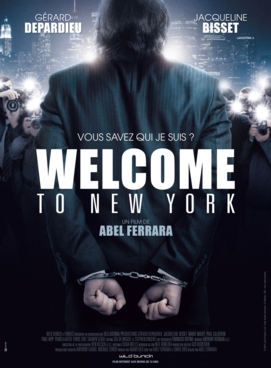
Playing Catch Up: Welcome to New York (dir by Abel Ferrara)


Welcome_to_New_York_(2014)

Gerard Depardieu is naked a lot in Welcome to New York and I know you’re probably being snarky and sarcastically thinking, “Well, then I’m definitely going to track down this film…” but actually, the frequent display of Depardieu’s body gets to the heart of what makes his performance so memorable.  Playing an extremely unsympathetic role, Depardieu doesn’t hide the character’s depravity from the audience.  He reveals every inch of the character, from his flabby body to his empty soul.  It takes courage to bring such an unsympathetic character to life and talent to keep the audience watching and fortunately, Depardieu has both of those.

Welcome to New York opens with Depardieu (as himself) talking to a group of reporters and explaining why he’s decided to play a character based on Dominique Strauss-Kahn in Abel Ferrara’s upcoming movie.  It’s an interesting way to start, both because it features Depardieu’s scornful opinion of politicians and because it leaves no doubt that, even if Depardieu’s character has been renamed Devereaux, Welcome to New York is directly based on the Dominique Strauss-Kahn case.

(Dominique Strauss-Kahn, of course, was the wealthy French socialist who many thought was going to be the next President of France until he was arrested after raping a hotel maid in New York City.  As a wealthy and well-connected white man, he was acquitted of raping the maid, who neither wealthy, well-connected, or white.   Throughout the trial, the usual collection of elitists complained about how Americans just didn’t understand French culture but, ultimately, Strauss-Kahn’s political career was ended by the scandal.)

Welcome to New York closely follows the facts of the Strauss-Kahn case.  Wealthy banker and politician Devereaux is in New York on business.  When he meets his daughter and her boyfriend, he spends the entire lunch asking them about their sex life.  When he returns to his hotel, he and his business associates hire a group of prostitutes and have one of the most depressing orgies ever captured on film.

I have to admit that during these first part of the film, I was often tempted to turn off Welcome To New York.  No, it wasn’t that the film was too explicit.  Instead, my problem was that Devereaux was such a dull character.  Devereaux has a lot of sex during the first third of the film but, at no point, does he seem to enjoy it.  Instead, he is detached from everything happening around him and it doesn’t exactly make for compelling viewing.

But, as the film played out, I realized that we weren’t supposed to find Devereaux in any way compelling.  Instead, Devereaux is portrayed as a hollow and empty shell.  For him, sex is all about entitlement and power.  After his is arrested for raping the hotel maid, Devereaux appears to be more surprised than anything else.  Rather than feeling regret at being caught or even fear that he might be convicted, Devereaux seems to be shocked that a man of his wealth would be held responsible for his actions.

After Devereaux is arrested, the film’s pace picks up a bit.  Devereaux’s wife, Simone (Jacqueline Bisset), flies to New York and takes over her husband’s defense.  It’s not that Simone feels that Devereaux has been wrongly accused.  In fact, Simone really doesn’t seem to care much for her husband in general.  However, Simone is determined that Devereaux is going to be the next president of France and she certainly has no intention of allowing some American criminal case to stand in his way.  Bisset gives a chilling performance as the almost fanatically driven Simone.

Soon, Devereaux is under house arrest and staying at a rented house.  (For these scenes, Welcome to New York filmed in the same house that Strauss-Kahn stayed at during his trial.)  It’s while locked away in the house that Devereaux finally starts to realize that he has gone too far.  It’s in the house that Devereaux remembers the man he was once was and is forced to confront the man that he has become.

Welcome to New York is not always an easy film to watch but, thanks to Depardieu and Bisset’s ferocious performances, it’s a film that will reward patient viewers.