Without further ado, here is the list that we’ve all been waiting for! Here are my picks for the 26 best films of 2021! Why 26? Because Lisa doesn’t do odd numbers!
Now that the Oscars and the Sundance Film Festival are over with, it’s time to start a new series of reviews here on the Shattered Lens. For the rest of February, I will be looking at some films that deal with the universal topic of love. Some of these films will be romantic. Some of them will be sad. Some of them might be happy. Some of them might be scary. Some of them might be good. And some of them might be bad. In fact, to be honest, I haven’t really sat down and made out a definite list of which films I’ll be reviewing for Love On The Shattered Lens. Instead, I figure I’ll just pick whatever appeals to me at the moment and we’ll see what happens!
Let’s start things off with the 1968 film version of William Shakespeare’s Romeo and Juliet.
“Oh my God! Romeo and Juliet are hippies!”
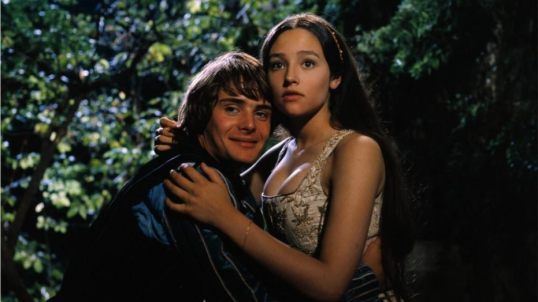
Well, that’s not quite true. I mean, it is true that Romeo (played by Leonard Whitting) and Juliet (Olivia Hussey) are played by actual teenagers in this version of the classic play. It’s also true that, even though the film is set in a painstakingly recreated version of 15th century Verona, almost all of the actors have what would have then been contemporary haircuts. Romeo, Benvolio (Bruce Robinson), and Mercutio (John McEnery) all have longish hair, dress colorfully, and look like they could all be in the same band, covering the Beatles and writing songs about dodging the draft. Even Tybalt (Michael York) seems a bit counter-cultural in this version.
As played by Olivia Hussey, Juliet comes across as being far more rebellious in this version of Romeo and Juliet than in some of the others. It’s hard to imagine that Olivia Hussey’s Juliet would have much patience with Juliets played by Norma Shearer, Claire Danes, Hailee Steinfeld, or even the version of the character that Natalie Wood played in West Side Story. Olivia Hussey’s Juliet is always one step away from running away from home and hitch-hiking to the free Rolling Stones concert at the Altamont Speedway. Like the audience that the film was intended for, Romeo and Juliet both know that their parents are out-of-touch and that their friends are only temporary. Embracing love and pursuing all that life has to offer is what matters.
Was this the first film version of Romeo and Juliet to make explicit that the two characters had consummated their marriage? I imagine it was since it was apparently also the first version of Romeo and Juliet to feature on-screen nudity. That’s quite a contrast to the largely chaste 1936 version, in which Norma Shearer and Leslie Howard both seemed determined to keep a respectable distance from each other. Leonard Whiting and Olivia Hussey have an amazing chemistry together. They’re the two prettiest people in Verona and they just look like they belong together. From the minute they meet, you believe not only that they would be attracted to each other but that they’re also meant to be lovers.
Of course, we all know the story. The Capulets and the Montagues are rival families. Juliet is a Capulet. Romeo is a Montague. Juliet’s cousin, Tybalt, kills Romeo’s friend Mercutio. Romeo kills Tybalt. Juliet fakes her death. Romeo commits suicide. Juliet wakes up and does the same. The Prince shows up and yells at everyone. This film version moves around some of the events and it leaves out a few scenes but it actually improves on the play. For instance, poor Paris (Roberto Bissaco) doesn’t die in this version. Seriously, I always feel bad for Paris.
Throughout it all, director Franco Zeffirelli emphasizes the youth of the characters. It’s not just Romeo and Juliet who are presented as young. The entire Montague and Capulet feud is largely portrayed as being just a silly turf war between two competing high school cliques. When Tybalt and Mercutio have their fateful duel, it starts out largely as a joke and, when Tybalt kills Mercutio, it comes across as if it was an accident on Tybalt’s part. Tybalt appears to be just as shocked as anyone, like a scared kid holding a smoking gun and trying to explain that he didn’t know it was loaded when he pulled the trigger. When Mercutio curses both the Capulets and the Montagues, it’s all the more powerful because Mercutio is undoubtedly wondering how the duel could have so quickly gone from playful taunting to a fatal stabbing. The entire conflict between the Montague and the Capulets is a war that makes no sense, one in which the young are sacrificed while the old retreat to the safety of their homes.
Romeo and Juliet was a hit in 1968 and it’s still an achingly romantic film. Whiting and Hussey generate more chemistry in just the balcony scene than Leonardo Di Caprio and Claire Danes did in the entirety of Baz Luhrmann’s version of the tragic tale. Along with being a box office hit, it was also a critical hit. The Academy nominated it for best picture, though it lost to Oliver!
You know the story that’s told in this 1936 film already, don’t you?
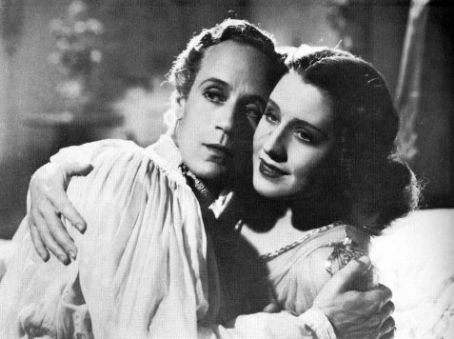
In the city of Verona, Romeo Montague (Leslie Howard) has fallen in love with Juliet Capulet (Norma Shearer). Normally, this would be cause for celebration because, as we all know, love is a wonderful thing. However, the House of Capulet and the House of Montague have long been rivals. When we first meet them all, they’re in the process of having a brawl in the middle of the street. There’s no way that Lord Capulet (C. Aubrey Smith) will ever accept the idea of Juliet marrying a Montague, especially when he’s already decided that she is to marry Paris (Ralph Forbes). Things get even more complicated with Juliet’s cousin, Tybalt (Basil Rathbone), kills Romeo’s best friend, Mercutio (John Barrymore). Romeo then kills Tybalt and things only grow more tragic from there.
It’s hard to keep track of the number of films that have been made out of William Shakespeare’s tale of star-crossed lovers and tragedy. The plot is so universally known that “Romeo and Juliet” has become shorthand for any story of lovers who come from different social sects. Personally, I’ve always felt that Romeo and Juliet was less about love and more about how the rivalry between the Montagues and the Capulets forces the young lovers into making hasty decisions. If not for Lord Capulet throwing a fit over his daughter’s new boyfriend, she and Romeo probably would have split up after a month or two. Seriously, I’ve lost track of how many losers I went out with in high school just because my family told me that I shouldn’t.
Producer Irving Thalberg spent five years trying to get MGM’s Louis B. Mayer to agree to greenlight a film version of Romeo and Juliet. Mayer thought that most audiences felt that Shakespeare was above them and that they wouldn’t spend money to see an adaptation of one of his plays. Thalberg, on the other hand, thought that the story would be a perfect opportunity to highlight the talents of his wife, Norma Shearer. It was only after Warner Bros. produced a financially successful version of A Midsummer Night’s Dream that Mayer gave Romeo and Juliet the go ahead.
Of course, by the time the film went into production, Norma Shearer was 34 years old and a little bit too mature to be playing one of the most famous teenagers in literary history. Perhaps seeking to make Shearer seem younger, Thalberg cast 43 year-old Leslie Howard as Romeo, 44 year-old Basil Rathbone as Tybalt, and 54 year-old John Barrymore as Mercutio, (In Barrymore’s defense, to me, Mercutio always has come across as being Verona’s equivalent of the guy who goes to college for ten years and then keeps hanging out on the campus even after dropping out.)
In short, this is the middle-aged Romeo and Juliet and, despite all of the good actors in the cast, it’s impossible not to notice. There were few Golden Age actors who fell in love with the authenticity of Leslie Howard and Basil Rathbone is a wonderfully arrogant and sinister Tybalt. Norma Shearer occasionally struggles with some of the Shakespearean dialogue but, for the most part, she does a good job of making Juliet’s emotions feel credible. As for Barrymore — well, he’s John Barrymore. He’s flamboyant, theatrical, and a lot of fun to watch if not always totally convincing as anything other than a veteran stage actor hamming it up. The film is gorgeous to look at and George Cukor embraces the melodrama without going overboard. But, everyone in the movie is just too old and it does prove to be a bit distracting. A heart-broken teenager screaming out, “I am fortune’s fool!” is emotionally powerful. A 43 year-old man doing the same thing is just not as effective.
Despite being a box office failure (it turned out that Mayer was right about Depression-era audiences considering Shakespeare to be too “arty”), Romeo and Juliet was nominated for Best Picture of the year, the second Shakespearean adaptation to be so honored. However, the award that year went to another big production, The Great Ziegfeld.
When the infamous epic Caligula was first released back in 1979, a disco version of Caligula’s love theme — We Are One — was also released as a promotional gimmick. If you’ve sat through the behind-the-scenes footage on the Caligula Imperial Edition DVD, this song has probably been forever branded on your brain.
And that’s not necessarily a bad thing.
This song is so over-the-top, so blatantly exploitive, so insidiously catchy, and so totally inappropriate for the film it was written for that it simply cannot be ignored. To me, this song represents everything that makes the Grindhouse great.
(As well, I hope whoever was playing bass got paid extra…)
While we’re on the subject, I’m also going to include the opening credits of Caligula because I’ve always liked the use of Profokiev’s Romeo and Juliet.
(I also love the fact that the screenplay is credited as being adapted from a script by Gore Vidal yet no one is given credit for doing the adapting, the editing is credited to “the production,” and director Tinto Brass is credited with “principal photography.”)

 Through the Shattered Lens