Lisa Marie Reviews An Oscar Nominee: The Insider (dir by Michael Mann)


In the 1999 Best Picture Nominee, The Insider, the American media takes a beating.

Al Pacino plays Lowell Bergman.  Bergman is a veteran newsman who, for several years, has been employed as a producer at 60 Minutes.  He is a strong believer in the importance of the free press and he’s proud to be associated with both 60 Minutes and CBS News.  He’s one of the few people who can manage the famously prickly correspondent, Mike Wallace (Christopher Plummer).  When we first see Bergman, he and Wallace are in the Middle East and arranging a tense interview with the head of Hezbollah.  It’s easy to see that Bergman is someone who will go anywhere and take any risk to get a story.  It’s also apparent that Bergman thinks that the people that he works with feel the same way.

That all changes when Bergman meets Jeffery Wigand (Russell Crowe), a recently fired tobacco company executive who initially agrees to serve as a consultant for one of Bergman’s story but who leaves Bergman intrigued when he reveals that, due to a strict confidentiality agreement, he’s not allowed to discuss anything about his time as an executive.  As the tobacco companies are currently being sued by ambitious state attorney generals like Mississippi’s Mike Moore (who plays himself in the film), Bergman suspects that Wigand knows something that the companies don’t want revealed.

And, of course, Bergman is right.  Wigand was fired for specifically objecting to his company’s effort to make cigarettes more addictive, something that the tobacco industry had long claimed it wasn’t doing.  Wigand’s pride was hurt when he was fired but he knows that breaking the confidentiality agreement will mean losing his severance package and also possibly losing his marriage to Liane (Diane Venora) as well.  However, Wigand is angered by the heavy-handed techniques that his former employer uses to try to intimidate him.  He suspects that he’s being followed and he can’t even work out his frustrations by hitting a few golf balls without someone watching him.  When Wigand starts to get threats and even receives a bullet in the mail, he decides to both testify in court and give an interview to Wallace and 60 Minutes.

The only problem is that CBS, after being pressured by their lawyers and facing the risk of taking a financial loss in an upcoming sell, decides not to run the interview.  Bergman is outraged and assumes that both Mike Wallace and veteran 60 Minutes producer Don Hewitt (Philip Baker Hall) will support him.  Instead, both Wallace and Hewitt side with CBS.  Left out in the cold is Jeffrey Wigand, who has sacrificed almost everything and now finds himself being attacked as merely a disgruntled employee.

Directed by Michael Mann and based on a true story, The Insider is what is usually described as being “a movie for adults.”  Instead of dealing with car chases and super villains and huge action set pieces, The Insider is a film about ethics and what happens when a major media outlet like CBS News fails to live up to those ethics.  (No one is surprised when the tobacco company tries to intimidate and silence Wigand but the film makes clear that people — or at least people in the 90s — expected and hoped for more from the American press.)  Wigand puts his trust in Bergman and 60 Minutes largely because he believed Bergman’s promise that he would be allowed to tell his story.  It’s a promise that Bergman made in good faith but, in the end, everyone from the CBS executives to the tobacco companies is more interested in protecting their own financial future than actually telling the truth.  Wigand loses his family and his comfortable lifestyle and Bergman loses his faith in the network of Edward R. Murrow.  It’s not a particularly happy film but it is a well-made and thought-provoking one.

Pacino and Crowe both give excellent performances in the two lead roles.  Pacino, because he spends most of the film outraged, has the flashier role while Crowe plays Wigand as a rather mild-mannered man who suddenly finds himself in the middle of a national news story.  (Crowe’s performance here is one of his best, precisely because it really is the opposite of what most people expect from him.)  Crowe does not play Wigand as being a crusader but instead, as an ordinary guy who at times resents being put in the position of a whistleblower.  (Director Mann does not shy away from showing how Bergman manipulates, the reluctant Wigand into finally testifying, even if Bergman’s motives were ultimately not malicious.)  That said, the strongest performance comes from Christopher Plummer, who at first seems to be playing Mike Wallace as being the epitome of the pompous television newsman but who eventually reveals the truth underneath Wallace’s sometimes fearsome exterior.

The Insider was nominated for Best Picture.  Somehow, it lost to American Beauty.
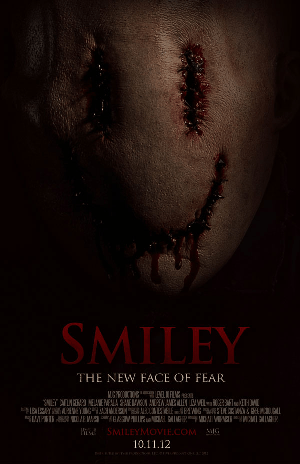
The TSL’s Daily Horror Grindhouse: Smiley (dir by Michael Gallagher)


Smiley_Movie_Poster

Oh God, this movie.

Whenever I watch 2012’s Smiley (and, since this is one of those films that always seems to be playing whenever I have insomnia, I actually have seen Smiley more times than I should probably admit), I always find myself hoping that it will actually be a better film than I remember it being.

Some of that, I have to admit, is because I once dated a frat boy whose nickname was Smiley.  His high school football coach gave him that name because he was always smiling!  (Yes, I once dated a football player who smiled a lot and didn’t really care much about literature, art, movies, history, or anything else that I was actually interested in. Don’t ask me to explain how these things happen.)  His pickup truck even had a personalized licence plate that read, “SMILY.”  That’s right — he wasn’t really sure how to spell Smiley.  Whenever I see the title Smiley listed in the guide, I think of him and I have to kind of laugh.

Beyond that, Smiley was an independent, low-budget film and I have to admit that my natural inclination is always to support independent filmmakers.  If Smiley was a huge studio production, I’d have absolutely no qualms about ripping it apart.  But when I see an indie horror film like Smiley, there’s a part of me that almost feels that I have to be supportive.  But the things is, it’s one thing to be supportive and it’s another thing to be delusional.  I may want Smiley to be a good horror film but it’s not and I’m really not doing anyone any good if I pretend otherwise.

Finally, I always want Smiley to be better than it actually is because the film features one of the creepiest killers that I’ve ever seen.  Even if the character is cheapened by a rather stupid twist, Smiley is scary looking.  Smiley is presented as being the spirit of a man who, after stitching his own eyes closed, carved a permanent smile on his face.  As a force of evil, Smiley is genuinely frightening and it’s unfortunate that the rest of the film doesn’t live up to the character’s potential.

As for the rest of the film … well, it’s pretty much your typical slasher.  All of the characters are loathsome, the murders are neither suspenseful nor gory enough to really be memorable, and this is one of those films that relies far too much on scenes of people running into someone, screaming in terror, and then discovering that it was just one of their friends.  It is true that there is a twist towards the end of the film that’s designed to make you question everything that you’ve just see but since the twist doesn’t make much sense and comes out of nowhere, it’s hard to get excited about it.  The best thing the film had going for it was the character of Smiley and the twist pretty much ruins that.

(The film’s other big twist is that the cast is full of YouTube personalities, which makes Smiley the spiritual descendant of The Scorned, a similarly bad slasher film that was full of reality TV stars.)

By the way, the idea behind Smiley is that you can go on Chatroulette and, if you type “I did it for the lulz” three times, Smiley will appear and kill whoever your chatting with.  Just for the record, I’ve tried it and it doesn’t work.*

——

* Well, to be honest, I got a friend of mine to try it and it didn’t work.  I’ve got better things to do then watch some guy jerking off on Chatroulette.

Review: The Midnight Meat Train (dir. by Kitamura Ryuhei)


There’s a certain number of books when I was much younger that I thought would’ve made for some great horror films. They were the early works by Clive Barker. Short stories collected into several volumes aptly dubbed his Books of Blood. While several short stories from these volumes were adapted to film in the intervening years most were not worth the time to watch them. So, lo and behold that when I finally saw the latest short story adapted from these collections I was genuinely surprised at how well-made and entertaining it turned out to be. The Midnight Meat Train by Japanese filmmaker Kitamura Ryuhei was a fine piece of horror filmmaking that dripped in atmosphere and a growing sense of existential dread right up to it’s very surprising end.

The Midnight Meat Train is quite a simple story when one really breaks it down to it’s component parts. It’s a crime thriller wrapped in the bloody layers of an extreme horror film. There’s a certain noirish quality to it’s storytelling as we see the film’s protagonist in Leon (Bradley Cooper). He’s a photographer struggling to find the inspiration for his next set of photographs and decides to wander the train stations at midnight to find that inspiration. It’s during one visit at night that he begins to suspect that he might’ve come across one of the latest missing persons who might’ve become a victim of the so-called “Subway Butcher”. The film shows his growing obsession in finding out if the urban legend of this so-called serial killer is actually true.

His mental state only deteriorates as the reality about the “Subway Butcher” (Vinnie Jones in one of his best roles to date) catches up to the truth on one midnight ride on the subway train. His witnessing of the killer at work brings him into a hidden world the rest of the city seems unaware or incapable of acknowledging despite the hundreds of people who go missing year in and year out for almost a hundred years. His girlfriend Maya (Leslie Bibb) and best friend Jurgis (Roger Bart) soon become drawn into Leon’s nightmarish situation and must confront the very boogeyman who has begun to haunt Leon’s waking life.

The film is Kitamura Ryuhei’s first Hollywood film and it doesn’t diminish the talent for some creative visuals he earned while directing horror and genre films in his native Japan. He makes great use of the nighttime setting and the stark environs of the subway trains at midnight to give The Midnight Meat Train an almost black and white look punctuated by vivid splashes of visceral red during the many inventive killings by Vinnie Jones’ mute Mahogany character. Kitamura showed that he was able to squeeze as much as was possible from a script that was average at best. Especially considering that the script had to adapt one of Barker’s shorter tales.

The performances by the ensemble group led by Bradley Cooper ranged from good to excellent with the aforementioned Vinnie Jones leading the pack. Even Bradley Cooper as the tormented protagonist Leon handled the role well. I’ve never warmed to Cooper as an actor as he always came across as a smirking douchebag in almost every role he played prior to this one. He quickly shed some of that reputation for me with his performance in this film and continues to do so with every one since this film. The smirk is still there but he has managed to drop the douchebag aspect of it. I also must point out a nice turn by veteran genre actor Tony Curran as the train conductor who exuded a sense of the otherworldly and a character who held the answers to the questions brought up by the film.

Since this is a horror film one must mention it’s horrofic aspects and this film fills it’s quota of horror. The scenes where Jones’ Mahogany dispatches the unwary last riders of the train at midnight were shot extremely well and with some visual flairs Kitamura has gained a reputation for. There’s nothing cartoony about these kills unlike other slasher films of it’s type. The kills are done in a brutal fashion as meat tenderizers smash into skulls and backs. Then there are the dressing of the kills which gives meaning to the film’s title. The only part of this film which seemed so out of place, but was necessary in the film’s overall narrative was the make-up effects in the end of the dead-end tunnel where Leon finally sees the truth of why Mahogany has been killing passengers on the subway train. It’s here that the film’s budget shows. At least Kitamura was smart enough to film these scenes in very low light to hide some of the zippers and laces on the costuming.

Overall, The Midnight Meat Train was one horror film in 2008 that deserved to have been seen by more people. It’s a shame that the handling of this film’s distribution by Lionsgate bordered on the criminal as it failed to be screened  by many theaters which led to it’s failure in the box-office. This was a horror film that delivered on the goods without pandering to the torture porn crowd who had begun to dominate the scene due to the popularity of the Saw franchise. Kitamura’s first work in America showed that he brings a fresh new voice to Western horror. The film also ends up becoming the best of all the Books of Blood short story adaptations and shows that Barker’s earlier grand guignol writing phase could be adapted well to the bigscreen.

Here’s to hoping that the failure of this film in the box-office (Again, I say fuck you Lionsgate) doesn’t keep other up-and-coming horror filmmakers from tapping into Barker’s volumes of short stories for their projects. There’s horror gold to be found there and Kitamura’s The Midnight Meat Train was one gleaming example of it.