Film Review: The Death of Stalin (dir by Armando Iannucci)


2017’s The Death of Stalin opens in Moscow in 1953.  Joseph Stalin (Adrian McLoughlin) calls into Radio Moscow and demands that he be sent a recording of the piano concerto that has just been performed live.  The only problem is that no one bothered to record it while it was being performed.  In a panic, the head of Radio Moscow announces that no one — not the musicians, not the exhausted conductor, and certainly not the audience — is allowed to leave until the orchestra has performed again.

Indeed, one of the recurring themes of The Death of Stalin is that everyone is terrified of their beloved dictator.  The orchestra fears being executed for failing to recreate their performance.  The members of the Central Committee fear being the next person to be purged from the ranks of Stalin’s government.  The two guards that are posted outside of Stalin’s bedroom are so terrified of interrupting Stalin and getting on his bad side that they don’t investigate when they hear Stalin collapsing to the floor.  When Stalin is found unconscious, the only doctors available are young and inexperienced because Stalin recently exiled all of the good doctors from Moscow.  Even after Stalin dies from a cerebral hemorrhage, his reign of terror continues as all the members of his household staff are promptly executed to keep anyone from learning either the exact details of Stalin’s death or the way that the members of the Central Committee responded to his passing.

The Death of Stalin is a dark comedy that follows the members of the Central Committee as they scramble to protect their own positions after Stalin’s death.  The humor comes from watching historical figures like Nikita Khrushchev, Vyacheslav Molotov, Lavrenti Beria, and Georgy Malenkov act like panicked junior executives who are desperately trying to save their own jobs during a corporate takeover.  Of course, the stakes are a bit higher.  Whoever succeeds Stalin will undoubtedly want to execute every other contender for the post.  As with so many of Armando Iannucci’s works, the humor comes from watching very powerful people act in very immature and petty ways.  While Malenkov (Jeffrey Tambor) tries to convince people that he actually is in charge, the brutal Beria (Simon Russell Beale) tries to bully his way into power and the wily Khrushchev (Steve Buscemi, giving one of his best performances) waits for his moment to strike.  (Beria, it should be noted, is one of history’s greatest monsters and the film, while a comedy, does not shy away from his depravity.)  Molotov (a hilarious Michael Palin) is so loyal to the Party that he says that Stalin was absolutely correct to have his wife executed just to then have Beria show up and reveal that Molotov’s wife is still alive.  Meanwhile, Stalin’s idiot son (Rupert Friend) claims that it’s all an American plot while the rest of the Central Committee laughs at him behind his back.  Only Georgy Zhukov (Jason Isaacs) seems to have full control of his emotions and his actions and it’s not a surprise to learn that, long after the events depicted in this film, purged from the Party.  In The Death of Stalin, the leaders of Russia are obviously scared of anyone who is too competent at their job.

The Death of Stalin is not only a satiric portrayal of petty bureaucrats.  It’s also a darkly humorous look of life in a dictatorship, where everyone is at the whim of whoever happens to be in charge at any given time.  The film is full of power-hungry narcissists who use their ideology and their nationalism as a shield for their own ambitions.  Everyone wants to control someone else.  Even as mourners pass by Stalin’s coffin, they’re given orders on how to properly grieve and move.  The film ends with a series of pictures of various people either having their faces scratched or, in some cases, just vanishing.  In a free country, failure leads to humiliation.  In a dictatorship,  it leads to non-existence as the formerly prominent are suddenly erased from a history that no longer has a place for them.  Ironically, of all the original leaders of communist Russia, it was Molotov who lived the longest.  He was 96 when he died in 1986.  If not for Stalin’s sudden death, he probably would have been purged and executed at the age of 63.

On this May Day, with so many people currently trying to rehabilitate the reputations of the 20th Century’s worst dictators, The Death of Stalin is must-watch.
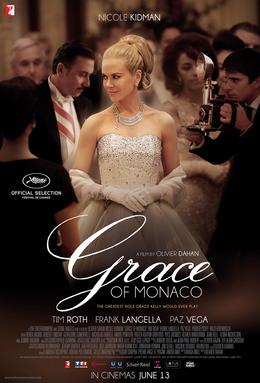
 

So, I Finally Watched Grace of Monaco…


Grace_of_Monaco_PosterWell, I finally saw Grace of Monaco and…

Oh God.

Seriously, I am sitting here right now and I am just thinking to myself, “Oh God, do I really have to try to think up something interesting to say about this movie?”  Grace of Monaco is not a good movie but, at the same time, it’s bad in the worst way possible.  It’s not so bad-that-its-entertaining.  Instead, it’s just a dull misfire.

In fact, probably the only really interesting thing about Grace of Monaco is that it is the first film to go from opening Cannes to premiering on Lifetime.  Though it may seem impossible to believe now, there was a time in 2013 when everyone was expecting Grace of Monaco to be a major Oscar contender.  It seemed like everyone was saying that Nicole Kidman was a lock for a best actress nomination and maybe more!

Then the film’s American release date was moved from November of 2013 to June of 2014.  Rumor had it that the infamous Harvey Weinstein was chopping up the film and destroying the vision of director Olivier Dahan.  “Bad Harvey!” we all said.  (Of course, having now seen the film, I can understand why Harvey may have had some concerns…)

Okay, we told ourselves, Grace of Monaco probably won’t be a best picture contender.  But surely Nicole Kidman can get a nomination.  Surely the costumes and the production design will be honored…

And then the film played opening night at the Cannes Film Festival and it was greeted with less than appreciate reviews.  In fact, the reaction to the film was so negative that it has since become somewhat legendary.

And so, the American premiere was canceled.  The film opened in Europe, where it made little money and received scathing reviews.  But it was destined to never play in an American theater.  Instead, Grace of Monaco was sold to the Lifetime network.

And, after all of the drama and the waiting, I finally got to see Grace of Monaco tonight and … well, bleh.

Don’t get me wrong.  It’s a pretty movie.  I loved looking at what everyone was wearing.  I enjoyed looking at the ornate settings.  Whenever Grace Kelly stopped to look out at the view from the palace, I appreciated it because it was a beautiful view.  If I had hit mute and simply enjoyed the film as a look at beautiful people wearing beautiful clothes and living in beautiful houses, I probably would have enjoyed it a lot more.

But, unfortunately, Grace of Monaco has a plot that gets in the way.  The evil French, led by Charles De Gualle (played by Andre Penvern, who gives a performance that would probably be more appropriate for a James Bond film), want to take over Monaco because the citizens of Monaco don’t pay any income tax.  (I was totally Team Monaco as far as this was concerned.  Everyone should stop paying their taxes.  If we all do it, we’ll be fine.  They can’t prosecute all of us!)  Only Princess Grace Kelly can stop them but first, she has to convince her headstrong husband, Prince Rainier (Tim Roth), to listen to her opinions.  She has to convince her subjects that she’s more than just an opinionated American.

But Grace doesn’t just want to keep the French out of Monaco!  She also wants to return to her film career.  Alfred Hitchcock (Roger Ashton-Griffiths) wants her to star in Marnie.  (Hitchcock is always filmed as being slightly out-of-focus.)  Rainier doesn’t want her to return to acting.  And neither does a priest played by Frank Langella…

What was Frank Langella doing in this movie?  I have no idea.  He was some sort of advisor.  I understand that he’s based on a historical figure but honestly, the film was so boring that I can’t even bring myself to go on Wikipedia to find out who exactly he was.

But really, the main issue with Grace of Monaco is that it tells us absolutely nothing about Grace Kelly.  The film doesn’t seem to know who she was or what it wants to say about her.  And Nicole Kidman is a good actress and I hope that I look as good as she does when I’m 47 and after I’ve given birth to two children but seriously, she seems to be totally lost in this film.  Olivier Dahan fills the film with close-ups of Kidman’s face but for what reason?  Never for a minute do we believe we’re looking at the face of the star of High Noon, Rear Window, or To Catch A Thief.  Instead, we’re always aware that we’re looking at Nicole Kidman and she doesn’t seem to be sure just what exactly she’s supposed to be doing.  We learn nothing about Grace, Monaco, France, royalty, or movies.

And it’s a shame really.  Because the story of Grace Kelly would make a great film.  But Grace of Monaco doesn’t really tell you anything about her life.

It’s just boring and a film about an actress like Grace Kelly has absolutely no right to be boring.

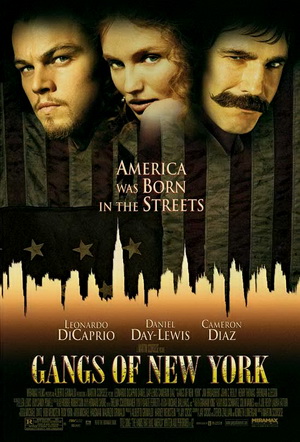
Shattered Politics #71: Gangs of New York (dir by Martin Scorsese)


Gangs_of_New_York_Poster

Despite the fact that it was nominated for best picture and marked the start of his fantastically successful collaboration with actor Leonardo DiCaprio, Martin Scorsese’s 2002 film Gangs of New York does not have the best reputation.  It always seems to be regarded as one of Scorsese’s lesser films and, often times, both The Aviator and The Departed are described as representing a comeback of sorts from Gangs.

To a certain extent, I have to agree.  Gangs of New York is a lesser Scorsese movie but then again, a lesser Scorsese film is still a hundred times better than the greatest films from Brett Ratner or Michael Bay.

The flaws of Gangs of New York are many.  The film, which tells the epic story of how an Irish gang led by Leonard DiCaprio battled a nativist gang led by Daniel Day-Lewis in Civil War-era New York City, runs for nearly 3 hours and yet it somehow still feels rushed and incomplete.  Cameron Diaz is far too contemporary of an actress to be truly believable as a 19th century pickpocket.  For that matter, Leonardo DiCaprio gives one of the worst performances of his career, coming across as being one-note and shrill.  If you only knew DiCaprio from his work in Gangs of New York, you would have a hard time believing that he was capable of doing the type of work that he did in Inception or The Wolf of Wall Street.

And yet, Gangs of New York is one of those flawed films that I can’t help but enjoy.

First off, on a purely personal level, how can I not love a film about how terribly the Irish were treated in the 19th Century?  Seriously, the Irish were regarded as if they were somehow subhuman.  They were attacked for being Catholic.  They were viewed as being criminals.  An entire freaking political party — the American party — was formed specifically to keep the Irish out.  But you know what?  We Irish kept coming, we kept fighting for our rights, and now everyone wishes they could be one of us!

Secondly, and this should not a shock when you consider that the film was directed by Martin Scorsese, the film looks absolutely gorgeous!  Despite the fact that it’s takes place in a 19th century slum and most of the characters are poor, Gangs of New York is a visual feast.  I loved the ornate sets and all the colorful clothes.  I loved the attention to detail that was put into everything.

(My favorite visual from the film: Daniel Day-Lewis and his entourage walking down a street while fireworks explode directly over Day-Lewis’s shoulder.)

Third, there’s Daniel Day-Lewis’s performance as Bill “The Butcher” Cutting.  One reason why DiCaprio’s performance is so noticeably bad is because he’s acting opposite Day-Lewis.  Sporting a handle-bar mustache and speaking in an almost satirically exaggerated New York accent, Day-Lewis turns Bill into one cinema’s greatest villains.

Add to that, the great Italian actor Giovanni Lombardo Radice show up for a few minutes, playing Simon Legree in a theatrical production of Uncle Tom’s Cabin!  Scorsese should make more films with Radice.

But, perhaps the main reason why I enjoy Gangs of New York is because, as I’ve mentioned so many times in the past, I really am a big history nerd.  And Gangs of New York deals with a period in American history that really doesn’t get as much attention as it deserves.  While we all know that the Civil War started when the South seceded from the union, what is often forgotten is that the North was not united in their support of Abraham Lincoln and the Union.  In fact, the Mayor of New York, Fernando Wood, was such a strong supporter of the Confederacy that he, at one point, suggested that New York City should secede from the union as well.  And when Lincoln instituted the draft, NYC — and several other cities in the north — exploded into riots.

Of course, Gangs of New York is not a 100% historically accurate.  For one thing, it compresses the time frame of the draft riots and — as films often do — it downplays the culture of Northern racism and instead portrays racists like Bill Cutting as being the exception to the rule.  But, even with that in mind, Gangs of New York still serves as a good starting point for those who want to learn more about American history than what they’ve been told in school.

My favorite parts of Gangs of New York dealt not with how the gangs fought each other but instead how the gangs were used as political foot soldiers.  One of the major supporting characters in Gangs of New York is William “Boss” Tweed (Jim Broadbent), a real-life politician who was at the center of one of America’s first major political scandals.  When we first meet Tweed, he is using Bill Cutting’s gang to fix elections.  However, as the film progresses, Tweed comes to realize that the political future of New York rests with the Irish.  So, Tweed starts using the Irish gang to fix elections.  For those of us who are into political history, the Boss Tweed scenes are a lot of fun.

Gangs of New York has its flaws.  It’s the type of project that, if it were made today, it would probably be a series on HBO and it would win all sorts of awards.  (Actually, it did kinda.  It was called Boardwalk Empire.)  It’s not perfect, but I like it.