The Martian Chronicles: Episode 3: The Martians (1980, directed by Michael Anderson)


Episode 2 of The Martian Chronicles ended with Sam Parkhill (Darren McGavin) helplessly watching as Earth was consumed by nuclear fire.  Episode 3 opens with Col. John Wilder (Rock Hudson) returning to Earth in 2006 and discovered that the entire planet is dead.  He had hoped to find his brother and rescue him but instead, all Wilder finds is a video of his brother being vaporized by an atomic blast.

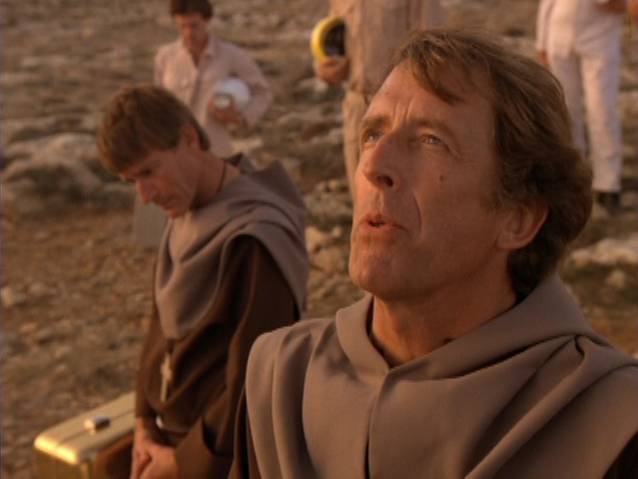
Back on Mars, the planet is nearly deserted.  Most of the human colonizers were ordered to return to Earth before the war broke out and, as a result, they died in the atomic inferno.  Only a few humans remain on Mars.  One of them, Ben Driscoll (Christopher Connelly), is excited to discover another survivor named Genevieve (Bernadette Peters) but he abandons her when he discovers that she’s too high-maintenance for him.  He decides he’d rather live alone.  (Too mean-spirited to really be funny, this was the weakest short story in Rad Bradbury’s collection and it’s also the weakest segment of the miniseries.)  Wilder and Father Stone (Roddy McDowall) visit another survivor, a scientist named Peter Hathaway (Barry Morse).  Peter lives with his devoted wife and daughter but when he dies of heart attack, they barely notice because they’re robots.

The first hour of the final episode of The Martian Chronicles is considerably weaker than the two episodes that proceeded it.  After the effective scenes of Wilder exploring Earth, the series is suddenly taken over by Christopher Connelly, playing a character that we’ve never seen before and who isn’t very likable.  The Ben and Genevieve sequence is weak and never that funny, despite Peters’s skill with comedy.  The sequence with Dr. Hathaway and the robots feels like a dry run for something Ray Bradbury would have written for The Twilight Zone.

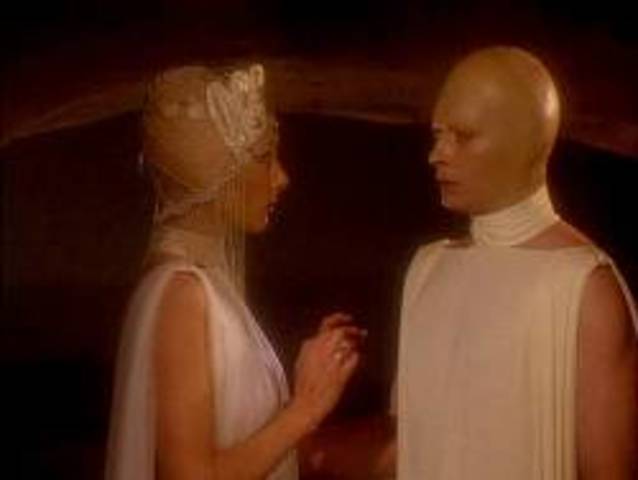
Fortunately, the final segment of The Martian Chronicles swoops in to save the series.  Col. Wilder and his family spend the day camping at the same ancient Martian city where, during the first episode, Spender tried to convince Wilder not to allow Mars to be colonized.  While walking around the ruins of the city, Wilder meets what is either the ghost or the future projection of a Martian.  They have a friendly and philosophical conversation.  They talk about how The Martian doesn’t know if he’s from the past or if he’s from the future but it doesn’t matter.  Returning to his family, Wilder looks at their reflection in Briggs Canal and he say that, with Earth gone, they are now the Martians.  With Earth in ruins and only a few humans left, it’s up to the survivors to combine the ways of Earth with the ways of Mars and create a new world.  Though Hudson is usually held up as being the epitome of a stuff actor, when he made The Martian Chronicles, he had the right amount of gravitas to make the final scenes work.

The Martian Chronicles is an uneven miniseries.  The first episode is so good that the two that follow struggle to keep up.  But just, as in Bradbury’s book, the ending is perfectly realized and it still work, ever after all these years later.

The Martian Chronicles: Episode 2: The Settlers (1980, directed by Michael Anderson)


The first episode of The Martian Chronicles ended with a dying Jeff Spender (Bernie Casey) warning John Wilder (Rock Hudson) that humans settling on Mars would be the worst thing that could ever happen to the once powerful red planet.

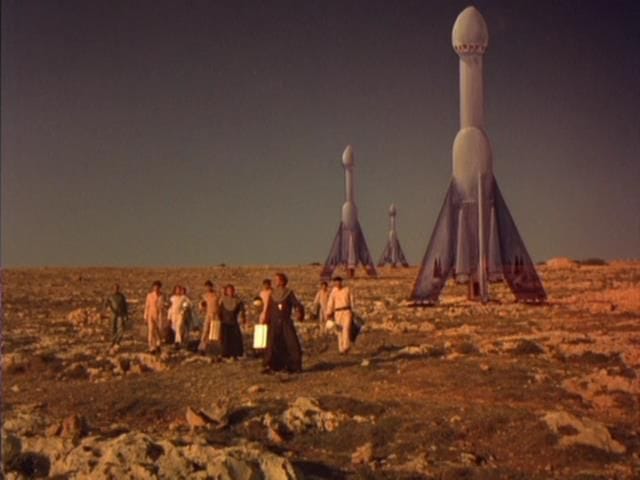
The second episode, called The Settlers, sets about to prove Spender right.  By 2004, humans are desperately leaving the war-torn Earth for a new home on Mars.  They rename all of the Martian landmarks, honoring the men who died exploring the planet.  In one of the few deliberately funny moments of this entire miniseries, it’s revealed that the canal that Briggs threw his beer cans in was eventually named Briggs Canal.  There’s one unfortunate shot of a line of miniature space ships that are supposed to be orbiting Mars and waiting for their chance to land.  The episode then gets down to showing what the settlers do to Mars.

It’s nothing good.  The main town looks like a traveling carnival, full of bars and crime.  Many of the people who come to Mars are people who are fleeing something on Earth and Col. Wilder has his hands full trying to keep the peace.  All of the Martians are believed to be dead but it turns out that there are still a few out there.  Using their mental powers, they disguise themselves as humans.  A large part of the second episode deals with a Martian who approached an elderly couple, disguised as their dead son.  Even though they know that he’s not really their son, they allow him to live in their home.  But, when the Martian goes to the city, he becomes overwhelmed by all the thoughts that bombard his mind.  Everyone sees him as being someone that they care about.  Even the local priest, Father Peregrine (Fritz Weaver), sees the Martian as being Jesus.  (That’s no big deal today but that had to have been controversial in 1980.)  Eventually, the Martian becomes so overwhelmed that he dies while a group of humans gawk at him.

As for Father Peregrine and Father Stone (Roddy McDowall, who spent most of his later years appearing in miniseries like this one), they explore the Martian mountains, searching for three lights that have been reported as hovering in the sky.  When they find the lights, the lights explain that they are ancient Martians who long ago abandoned their corporeal bodies.  They also somewhat implausibly say that they worship the same God as the two priests.  In a departure from Bradbury’s original short stories (in which Bradbury was skeptical about the idea of bringing religion to the Mars), Father Peregrine commits to building a church so that, even on the Red Planet, people can worship.

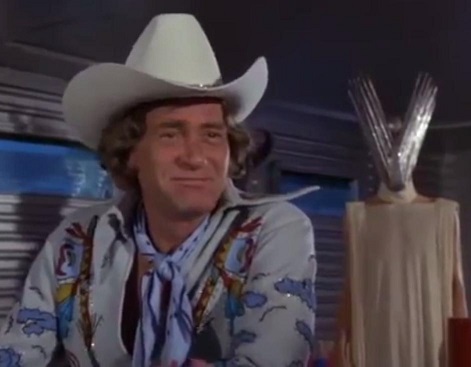
Finally, Sam Parkhill (Darren McGavin) has achieved his dream of building a restaurant on Mars.  He says that, as soon as more Earthlings arrive, he’ll be rich because every trucker will stop off at his place for a bite to eat.  When a Martian suddenly shows up in the diner, Parkhill panics and shoots him.  When more Martians show up, Parkhill flees.  It’s only when the Martians catch up to him does he learn that they’re giving him a grant for half the land on Mars.  “Tonight’s the night,” they tell him, “Prepare.”  Old Sam Parkhill’s pretty excited until he looks through a space telescope and sees that Earth, the home of his future customers, is now glowing with the sure sign of nuclear fire.  I can’t remember how old I was when I first saw this episode on late night Baltimore TV but I do remember being thoroughly freaked out by the scene where Sam watches as a fiery glow encircles the Earth and the planet’s green surface turns brown.  It’s the most powerful moment in the miniseries and a fitting visualization of Bradbury’s concerns about the nuclear age.

As for the rest of The Settlers, it’s good but it’s not as strong or as cohesive as the first episode.  The Martin shapeshifter story is good but the two priests in the mountains felt like they were included to keep religious viewers happy and their segment takes too many liberties with Bradbury’s original material.  Then, Darren McGavin returns to the story. dressed like a cowboy and getting chased by a Martian sandship and The Martian Chronicles goes back to being one of the coolest miniseries to ever be broadcast.

With Earth dead, would Mars follow?  That was the theme of the next episode of The Martian Chronicles, which we’ll look at tomorrow.

The Martian Chronicles: Episode 1: The Expeditions (1980, directed by Michael Anderson)


In 1980, NBC adapted the Ray Bradbury short story collection, The Martian Chronicles, into a three-part miniseries.  Though Bradbury’s original book featured short stories that were only loosely connected by two shared locations (Earth and Mars), the miniseries connected most of the stories through the character of Colonel John Wilder (Rock Hudson), the NASA project director who headed up the project to colonize Mars and who later regretted his decision after it became clear that humanity was going to treat Mars just as badly as they treated their previous home.  The miniseries was adapted by Richard Matheson and directed by Michael Anderson.

Unfortunately, the miniseries itself was not a hit with critics, who complained that the story moved too slowly.  Audiences, having just experienced Star Wars and Close Encounters of the Third Kind, were not impressed with the special effects, in which miniatures were used to simulate spacecraft flying through space.  Despite all of that, though, The Martian Chronicles has built up a cult following.  I can remember first catching the miniseries playing late at night on one of the local station in Baltimore.  I’ve always liked it.  It’s not as good as Bradbury’s original collection, of course.  But the miniseries still has its strengths, despite the miniatures.

The first and best episode of the miniseries was The Expeditions.  Starting with a recreation of Viking 1 landing on Mars in 1976, the episode jumps forward to the far future of 1999!  The first manned spacecraft lands on Mars and the two astronauts aboard are promptly killed by the first Martian that they meet, an angry husband who thinks that one of the astronauts is going to have an affair with his wife.

The second expedition is led by Captain Arthur Black (Nicholas Hammond, best-know for playing Spider-Man in the late 70s TV series).  When they land on Mars, they discover that the formerly Red Planet now looks like Black’s childhood home of Green Bluff, Illinois.  All of their relatives are waiting for them!  Falling into the belief that they’ve returned to the past, the astronauts are killed by their “families” that night.  It turns out that the Martians were using Black’s memories to set a trap for them.  As the Martian who disguises himself as Black’s brother explains it, they’ve seen, in the minds of the astronauts, what the humans are doing to their own planet and they can’t allow that to happen to Mars.  “Forgive us,” the Martians says, “we were once an honorable race.”  In one of the best scenes in both the book and the miniseries, the Martians still have an Earth-style funeral for the men that they’ve killed because they too got sucked into the world that they created and came to care about the men they felt they had to kill.

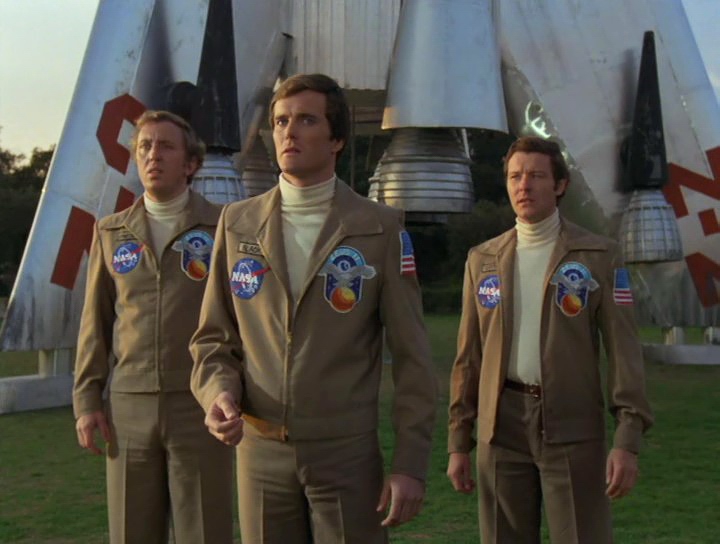
Years later, a third expedition arrives.  This one takes up the majority of the episode.  It’s led by Colonel Wilder himself and includes Sam Parkhill (Darren McGavin), Jeff Spender (Bernie Casey), Briggs (John Cassady), and McClure (Peter Marinker).  Almost all of the Martians have apparently died, the victims of the Earth germs that were brought to the planet by the second expedition.  While Parkhill plots to open a barbecue joint and Briggs gets drunk and tosses his empty beer cans into a waterway that he christens, “Biggs Canal,” Spender investigates a deserted Martian city.  Unlike the others, Spender is in awe of the Martian civilization and angry that it’s been so casually destroyed.  When Spender returns, he declares himself to be “the last Martian” and tries to kill the members of the expedition.

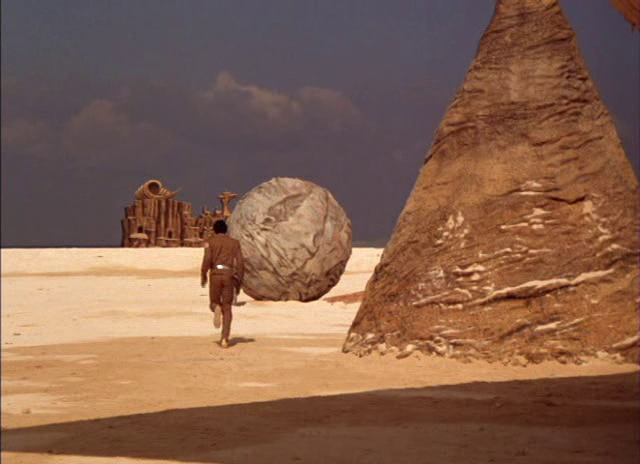
Of the three episodes, The Expeditions is the one that sticks closest to the stories on which it was based, in both content and theme.  Not surprisingly, it’s also the best of the miniseries, with each vignette working as both a separate story and a part of a larger whole.  It’s the episode that sticks closest to what Bradbuy himself was going for in his original collection.  While the miniature spaceships are a distraction, the desolate Martian landscape is sharply realized and the first episode is full of striking shots, from the Martian husband walking through the red desert to “greet” the first expedition to the funeral for the second expedition to the final battle between Spender and the survivors of the third expedition.  Among the members of the cast, Nicholas Hammond and Bernie Casey are the stand-outs but everyone plays their part well.  Darren McGavin is always a welcome presece in any miniseries and John Cassady is so obnoxious as Briggs that it’s impossible not to see where Spender is coming from.  (Back when the IMDb still has message boards, every message on Cassady’s board was someone posting about Briggs Canal.)  Rock Hudson is as stiff as ever but it’s appropriate for his character.  The scene where he and Bernie Casey debate whether humanity is worthy of a planet like Mars is well-acted by both actors, with the different opinions of their characters reflected in the different performing styles of the two actors.  Though the miniseries never explicitly states it, it is perhaps not a coincidence that Spender, as the only black character in the miniseries, is the only one to truly understand what humans colonizing Mars could lead to.

The Expeditions ends with Spender warning that humans will destroy Mars if they’re allowed to colonize it.  The next episode would explore whether he was correct.  We’ll take a look at The Settlers tomorrow.

Film Review: Avalanche (dir by Corey Allen)


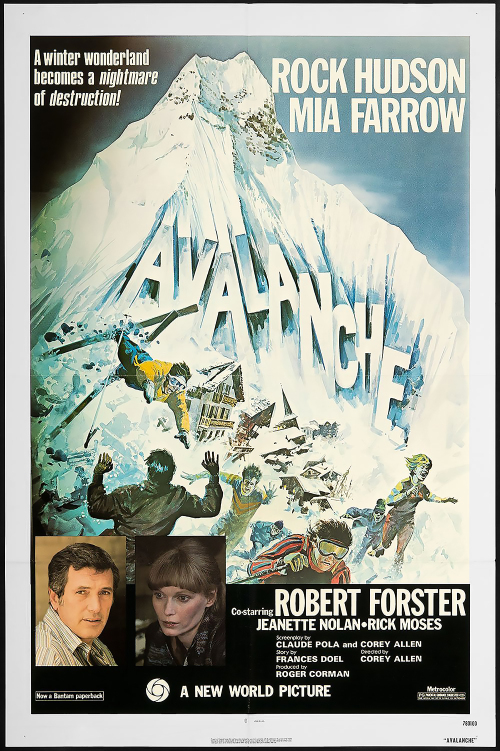
The 1978 film Avalanche tells the story of a beautiful resort that’s been built in the mountains of Colorado.  Self-righteous photographer and activist Nick Thorne (Robert Forster) keeps insisting that it’s not environmentally safe to build a resort up in the mountains.  According to him, there’s too much snow building up and it’s inevitably going to lead to an avalanche.

The owner of the resort, David Shelby (Rock Hudson), insists that Nick doesn’t know what he’s talking about.  Sure, David may have had to cut a few ethical corners to get his resort built and he may currently be under criminal investigation but that doesn’t make David a bad guy.  All he wants is to have a nice and expensive resort located in the most beautiful and dangerous place on Earth.  Does that make him a bad guy?

Unfortunately, if David was watching the film with the rest of us, he would be aware of all the shots of snow ominously building up on the side of the mountain.  However, David would still probably be distracted by the presence of his ex-wife, Caroline (Mia Farrow).  David would love to get back together with Caroline but Caroline finds herself growing attracted to Nick.  When David isn’t chasing after Caroline, he’s trying to keep his mother, Florence (Jeanette Nolan), from drinking all of the liquor in the resort.  Good luck with that!  Florence is an eccentric old person in a disaster film so, of course, she’s going to be drunk off her ass for the majority of the run time.

There are other dramas occurring at the resort, of course.  TV personality Mark Elliott (Barry Primus) is upset because his ex, Tina (Cathey Paine), is hooking up with arrogant skier Bruce Scott (Rick Moses).  Bruce is upset because Tina expects him not to cheat on her.  Ice skater Cathy Jordan (Pat Egan) is hoping to conquer her insecurities.  Rival ice skater Annette River (Peggy Browne) is …. well, she’s there.  To be honest, I’m not really sure what the whole point of the ice skating rivalry was since they all end getting buried in snow regardless.  Then again, maybe that is the point.  An avalanche doesn’t care about your personal dramas.  All it cares about is destroying tacky resorts that overuse wood paneling.

Yes, the avalanche does come crashing down the mountain eventually.  It takes a while, though.  There’s almost an hour of Rock Hudson walking around with a pained look on his face before the snow finally comes crashing down.  For all of Nick’s talk about how the avalanche would probably be the result of too many people skiing, it actually happens because someone crashes a plane into one of the mountains.

Obviously, the avalanche is the main reason why anyone would want to watch a movie called Avalanche.  Anyone with any knowledge of the disaster genre knows that no one watches these movies for the human drama.  They watch them because they want to see at least 10 minutes of solid destruction.  A disaster movie can get away with almost anything as long as the disaster itself looks good.

The disaster in Avalanche does not look particularly good.  This film was directed by Roger Corman and, despite being one of the most expensive films that Corman ever produced, the avalanche effects are definitely a bit cut-rate.  At the same time, the cheapness of the special effects does provide the film with its own odd charm.  Just consider the scene where one of the ice skaters gets covered in snow while spinning around with a triumphant smile on her face.  (Sure, she might be dead and she’ll certainly never make it to the Olympics but at least she finally mastered a fairly basic skating move.)  The avalanche effects are super imposed over the image of the skater spinning but it’s obvious that it didn’t occur to anyone to tell the skater, “Hey, act like there’s a gigantic amount of snow crashing down on you!”  It’s so inept as to be charming, like when a child draws a really ugly picture but it’s cute because at least they tried and, as a result, you wait until the child leaves your house before you throw it away.

The thing I love about Avalanche is how everyone is even more ineffectual after the avalanche than they were before it.  Usually, in a movie like this, the disaster leads to unexpected heroism and the villains getting the comeuppance.  In this one, the avalanche just inspires more stupidity.  Fire trucks and ambulances literally collide with each other while heading for the resort.  At one point, a group of fireman set up a net directly underneath someone falling out of a ski ramp chair just for the person to somehow land a few inches to the left of them.  Though the film sets David Shelby up to be the villain, it’s hard not to feel that everyone at the resort is just an idiot.

Listen, I love Avalanche.  It’s terrible but it’s a lot of fun and the less-than special effects go along perfectly with the overheated (or, in some cases, underheated) performances.  Rock Hudson wanders through the movie with a strained smile on his face that has to be seen to be believed while Mia Farrow and Robert Forster both try so hard to make their underwritten characters credible that you can’t help but kind of appreciate their devotion to a lost cause.  If nothing else, the shots extras reacting to superimposed shots of the avalanche makes this film worth a look.  This is a cheap and silly movie and if you don’t enjoy it, I don’t know what’s wrong with you.

Book Review: Giant — Elizabeth Taylor, Rock Hudson, James Dean, Edna Ferber, And The Making Of A Legendary American Film by Don Graham


Wow, that Edna Ferber sure was a bitch.

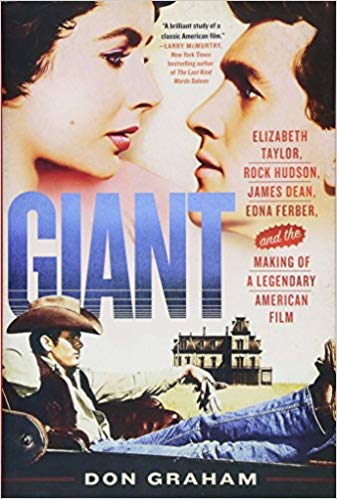
That was my first thought as I read Giant, Don Graham’s history about the making of the film of the same name.  In the early 50s, Edna Ferber, a writer who was born in Michigan, raised in Wisconsin, and lived in New York, wrote a novel about Texas.  The novel was called Giant and it told a story of ranchers, oilmen, and casual racists.  It was meant to be an attack on Texas, a warning to the rest of the country to not allow itself to turn into Texas.  Ferber presented Texas as being a land where everything was big and everyone owned a jet and an oil well and all the rest of the usual stereotypes.  When Ferber’s novel was turned into a movie, she was apparently not happy to discover that the film was not the vehement denunciation of the state and its citizens that she wished it to be.  In Don Graham’s book, Edna Feber often seems to be hovering in the background of every scene, throwing a fit about every detail of the movie.  She comes across as a certain type of character that every Texan has had to deal with: the angry Northerner who can’t understand why we’re not as impressed with them as they are.

That’s not to say that Giant, as a film, was blindly pro-Texas.  The film featured a subplot that deal with the prejudice that Mexicans faced in Texas.  But the film also indicated that things could change and that people could grow and that was something that Ferber apparently did not agree with, at least as far as Texans are concerned.

If Graham’s entire book was just about Ferber’s displeasure with Giant, it would make for a fairly tedious read but, fortunately, Edna Ferber is just a minor part of the sprawling story that Graham tells.  Instead of worrying too much about Ferber, Graham focuses on the filming of Giant and how it not only brought Hollywood to the citizens of Marfa, Texas but also what it meant to George Stevens, the film’s director and it’s three stars, Rock Hudson, Elizabeth Taylor, and James Dean.  Giant was the film that proved that Elizabeth Taylor could act.  It was also the film that brought Rock Hudson some rare critical acclaim.  And, perhaps most importantly, it was the last film that James Dean made before his death.

Perhaps not surprisingly, the book is at its most interesting when it deals with James Dean.  Graham does not make the mistake of blindly idolizing Dean.  Indeed, Dean often comes across as a brat.  Graham writes about Marlon Brando’s well-known dislike of Dean but he also shares anecdotes from the set that reveal that Dean was incredibly talented but also very self-destructive.  Reading about Dean’s behavior and his frayed relationship with George Stevens, one gets the feeling that, even if he had survived the car accident, Dean’s acting career probably would never have survived his own self-destructive impulses.  Graham celebrates Dean’s talent without idealizing his character.

Much as in the movie, Rock Hudson is frequently overshadowed by Dean.  In the book, Hudson comes across as being …. well, he’s come across as being a bit of a jerk.  Elizabeth Taylor, on the other hand, comes across as being driven, fragile, and committed to her stardom.  She also comes across as possessing an unexpectedly sharp wit.  If both Dean and Hudson were both a bit too self-impressed, Taylor possessed the knowledge of someone who had spent her entire life in the film industry.

Don Graham’s Giant is an entertaining book. Full of anecdotes and more than a little bit juicy speculation about what went on behind the scenes, Giant is a great read for Texans and film fans alike!

Once I Had A Secret Love: RIP Doris Day


gary loggins's avatarcracked rear viewer

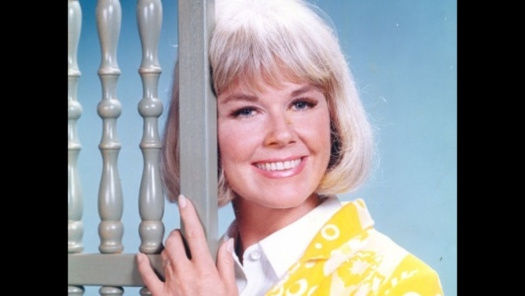
You wouldn’t think from reading most of the content I publish – Western actioners, horror flicks, film noir, exploitation trash – that I’d be a big Doris Day fan. But the first film I can remember seeing on the Big Screen is THAT TOUCH OF MINK, with Doris and Cary Grant, and I’ve been in love ever since. Talent is talent, and the iconic singer/actress, who died earlier today at age 97, had it in bucketloads. Doris’s career spanned nearly 50 years, from the Big Band Era to Cable TV, and was “America’s Sweetheart” for most of her adult life (not to mention “The World’s Oldest Living Virgin” due to her squeaky-clean screen image!).

Cincinnati-born Doris Mary Ann Kappelhoff, born in 1922, wanted to be a professional dancer, but a severe car accident in 1937 curtailed that dream. Instead she turned to singing, and became a local sensation, eventually landing…

View original post 674 more words

30 Days of Noir #13: Undertow (dir by William Castle)


In the 1949 film, Undertow, Scott Brady plays Tony Reagan.  Tony used to be a member of the Chicago mob but that’s all in the past now.  He served his country in World War II and now, as he tells his old racket friend, Danny (John Russell), all Tony wants to do is settle down and run a hunting lodge in Reno.

However, before Tony can forever abandon Chicago for Nevada, he has to make peace with his future in-laws.  He’s engaged to marry Sally Lee (Dorothy Hart).  In fact, he’s so in love with her that not even meeting a single teacher named Ann McKnight (Peggy Dow) can distract Tony from his plans.  The only problem is that Sally is the niece of a Chicago gangster named Big Jim Lee and, in the past, Big Jim and Tony haven’t always been the best of friends.  In fact, the Chicago police are constantly harassing Tony because they’re convinced that he wants to start a gang war with Big Jim.  Instead, Tony just wants to make peace with Big Jim before the wedding.

Tony goes to visit Big Jim and …. well, you can guess what’s going to happen, can’t you?  If you’ve seen enough film noirs, you know that no one is every totally out of the rackets.  No one believes an ex-mobster when they say that they’re no longer interested in making trouble.  Even worse, any murder committed with automatically be blamed on anyone who says that they’re no longer a member of the rackets.  That’s what happens to Tony.  Not only does he discover that Big Jim has been shot dead but everyone thinks that he’s the one who did it.  Fleeing through the shadowy streets of Chicago, Tony finds himself not only being pursued by the police but also by the murderers.  Everyone wants to either capture or kill Tony.

In fact, the only person who seems to be on Tony’s side is Ann McKnight.  Ann lets Tony hide out at her apartment while he tries to figure out what’s going on.  Of course, Ann does have a nosy landlady who has no hesitation about letting herself into the apartment whenever she feels like it….

The plot of Undertow isn’t going to win any points for originality.  It’s not going to take you long to figure out who is setting Tony up, if just because there really aren’t enough characters in the film for there to be much suspense about who is betraying who.  But no matter!  The film is still an atmospherically shot and briskly-paced thriller.  Undertow was directed by William Castle, who is probably best known for directing campy B-movies like The Tingler and Strait-Jacket.  There’s nothing campy about Castle’s direction of Undertow.  The majority of the film was shot on location and Castle makes great use of Chicago.  When Tony tries to lose the cops that are tailing him, it helps that he’s not running across a soundstage but instead down real city streets, ones that feels alive with tension and danger.  There’s also a great chase that takes place in a long and dark corridor in an underground garage.

Scott Brady (who was the brother of tough-guy actor Lawrence Tierney) gives a sympathetic performance as Tony and he and Peggy Dow have a really likable chemistry in their scenes together.  Dorothy Hart is also well-cast as the film’s femme fatale, while Bruce Bennett has a few good scenes as a detective who is an old friend of Tony’s.  Fans of “classic” matinée idols will want to keep an eye out for Rock Hudson, making a brief appearance in his second film and credited as “Roc” Hudson.

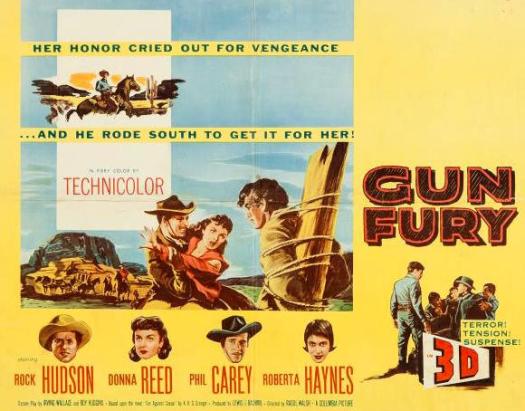
No Surprises Here: GUN FURY (Columbia 1953)


gary loggins's avatarcracked rear viewer

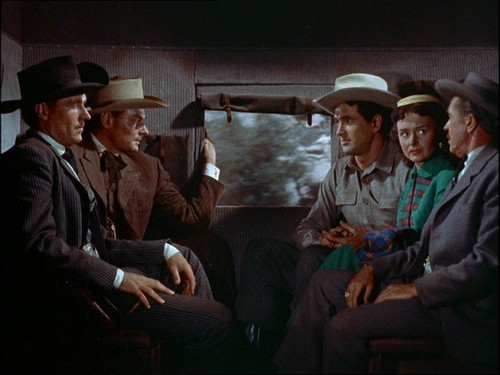
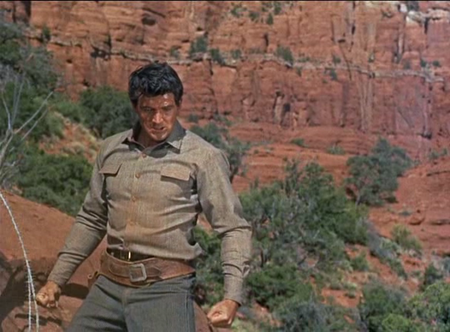
I watched GUN FURY expecting a surprise. What I got instead was a routine Western, not bad for its type, bolstered by a better-than-average cast, solid direction from veteran Raoul Walsh , and some lavish Technicolor location footage from Sedona, AZ. But I kept waiting and waiting for that “surprise” that never came. What am I talking about? Read on and find out, buckeroos!

Ben Warren, a peaceful Civil War vet, meets his intended bride Jennifer Ballard at the stagecoach station. The two lovebirds intend to travel to the next stop and get hitched. Also onboard the stage is mean desperado Frank Slayton, an “unreconstructed Southerner” feared across the territory, and his partner-in-crime Jess Burgess. Frank’s gang, disguised as Cavalry soldiers, lie in wait and rob the stage of it’s shipment of gold, stealing the loot killing everyone except Jennifer, who Frank has designs on and kidnaps.

But wait! Ben’s…

View original post 432 more words

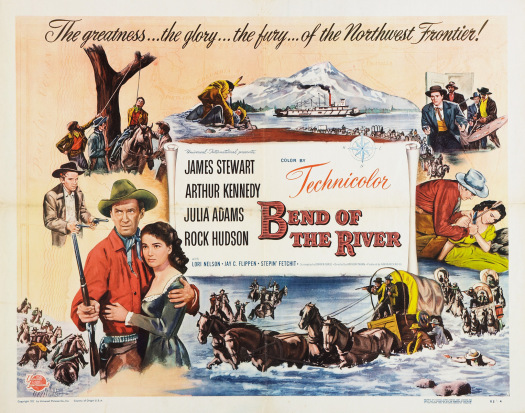
Western Noir: James Stewart in BEND OF THE RIVER (Universal-International 1952)


gary loggins's avatarcracked rear viewer

BEND OF THE RIVER, the second of the James Stewart/Anthony Mann Westerns, isn’t quite as good as the first, WINCHESTER ’73 . That’s not to say it isn’t a good film; it’s just hard to top that bona fide sagebrush classic. Stewart continues his post-war, harder edged characterizations as a man determined to change his ways, and is supported by a strong cast that includes a villainous turn by the underrated Arthur Kennedy .

Jimmy plays Glyn McLyntock, an ex-outlaw now riding as trail boss for a group of farmers heading to Oregon to begin a new life. He encounters Kennedy as Emerson Cole, a horse thief about to be hanged, and enlists his help on the trail west. Both men know each other’s reputations; they were both once raiders along the Missouri/Kansas border. The wagons are attacked at night by Shoshone, an arrow piercing young Laura Baile, daughter of…

View original post 580 more words

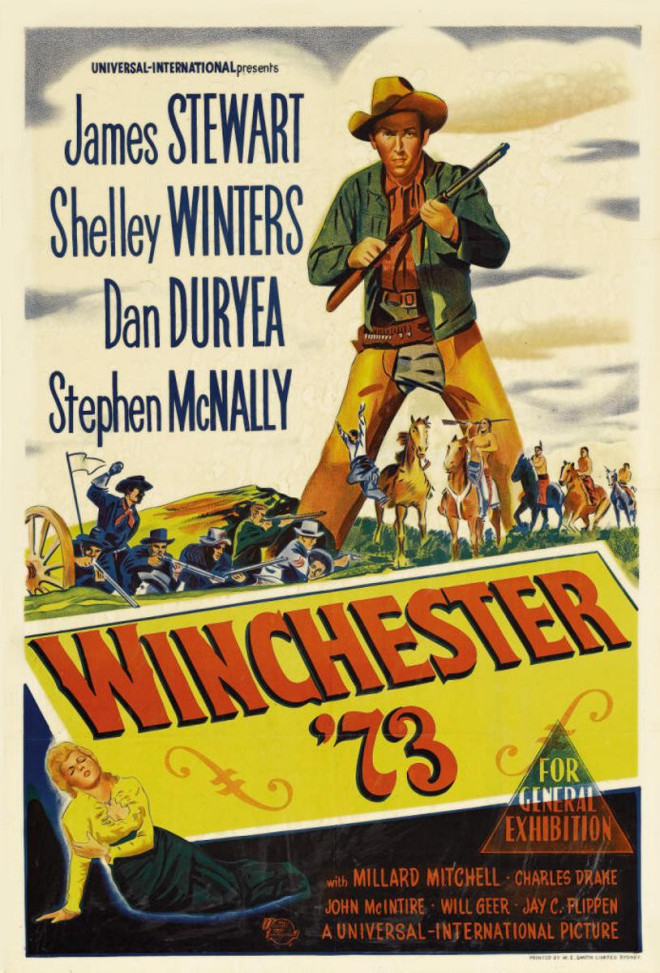
Dark Western Sky: James Stewart in WINCHESTER ’73 (Universal-International 1950)


gary loggins's avatarcracked rear viewer

James Stewart  and Anthony Mann made the first of their eight collaborations together with the Western WINCHESTER ’73, a film that helped change both their careers. Nice guy Stewart, Hollywood’s Everyman in Frank Capra movies like MR. SMITH GOES TO WASHINGTON and IT’S A WONDERFUL LIFE, took on a more mature, harder-edged persona as Lin McAdam, hunting down the man who killed his father, Dutch Henry Brown (Stephen McNally ). As for Mann, after years of grinding out B-movie noir masterpieces (T-MEN, RAW DEAL ), WINCHESTER ’73 put him on the map as one of the 1950’s top-drawer directors.

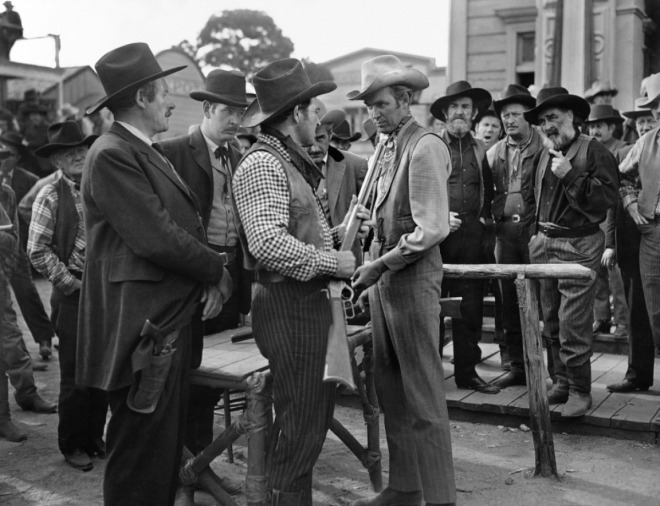
The rifle of the title is the movie’s McGuffin, a tool to hold the story together. When McAdam and his friend High Spade (the always welcome character actor Millard Mitchell) track Dutch Henry to Dodge City, the two mortal enemies engage in a shooting contest judged by none other than Wyatt Earp (Will Geer)…

View original post 465 more words