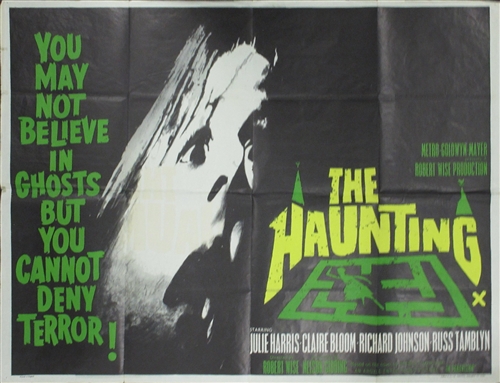
There’s nothing like a good haunted house movie, and 1963’s THE HAUNTING is one of the best ever. Producer/director Robert Wise cut his filmic teeth on Val Lewton shockers like THE BODY SNATCHER and noirs such as BORN TO KILL before graduating to mainstream movies like I WANT TO LIVE! and WEST SIDE STORY. In THE HAUNTING he returns to his dark roots to create a nightmarish vision of Shirley Jackson’s eerie novel The Haunting of Hill House.
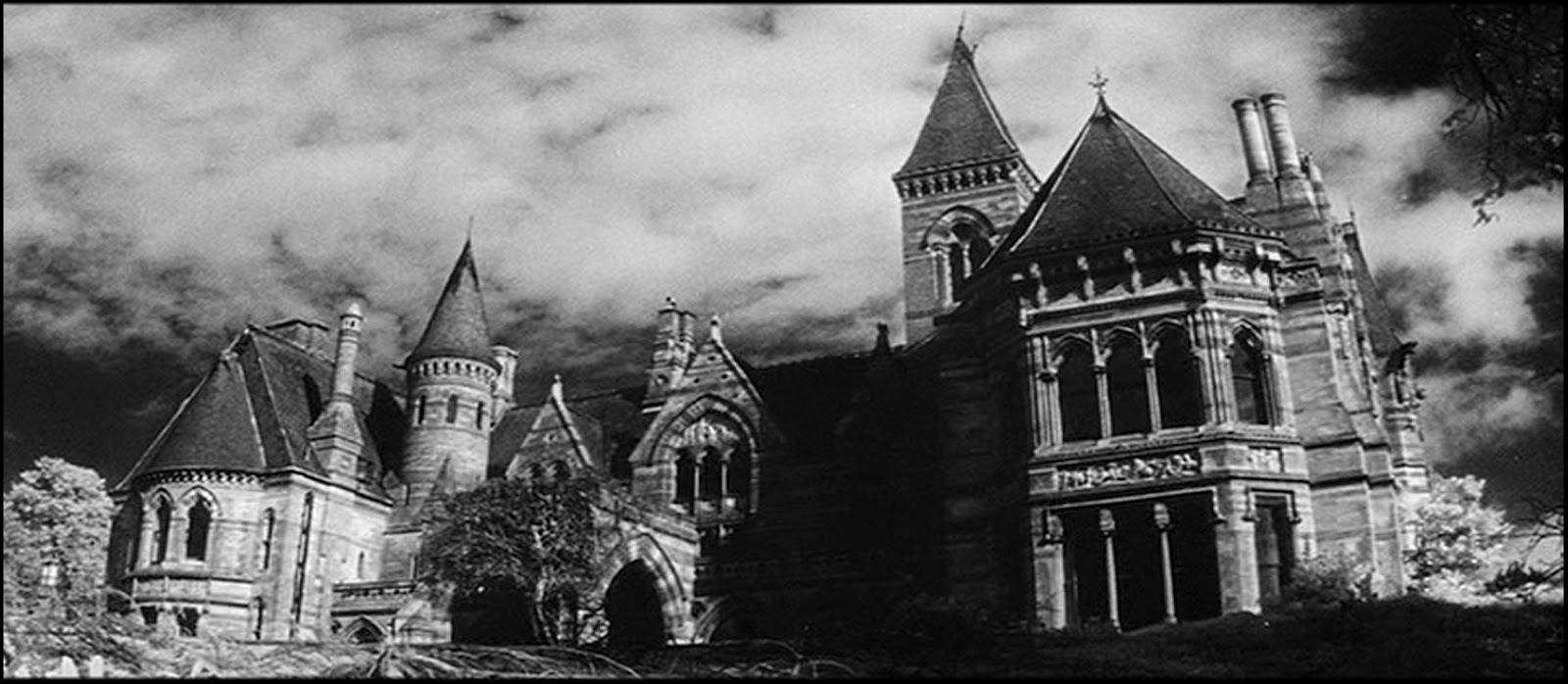
“Scandal, murder, insanity, suicide” have plagued Hill House for close to 100 years. The cursed Crain family were its original inhabitants, designed by eccentric Hugh Crain. The house is a darkly foreboding Gothic structure with oddly tilted angles both inside and out. Dr. John Markham, a paranormal investigator, visits proper Bostonian matron Mrs. Sanderson, the house’s current owner, asking to take a lease…
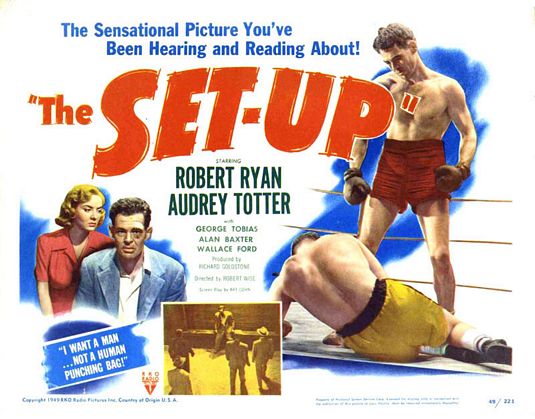
The seedy worlds of professional boxing and film noir were made for each other. Both are filled with corruption, crime, and desperate characters trapped in situations beyond their control. Movies like CHAMPION, BODY AND SOUL, and THE HARDER THEY FALL expose the dark underbelly of pugilism. One of the best of this sub-genre is THE SET-UP, Robert Wise’s last film for RKO studios. He doesn’t fail to deliver the goods, directing a noir that packs a wallop!
THE SET-UP follows one night in the life of aging, washed up fighter Stoker Thompson ( Robert Ryan ). Stoker’s 35 now, ancient in boxing terms, but still has delusions of making the big time. Wife Julie (Audrey Totter ) is tired of going from one tank town to the next, and fears for Stoker’s safety. She refuses to go to tonight’s fight, a matchup with up and coming young contender Tiger…
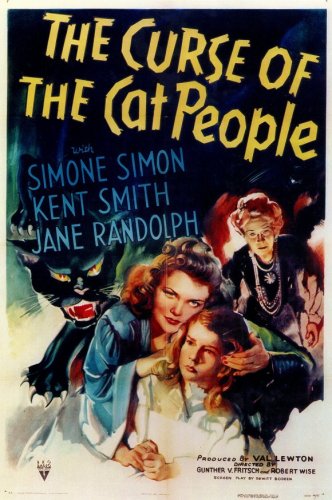
So, you can add the 1944 film The Curse of the Cat People to the list of films that made me cry.
And I know that you’re probably going to point out that it’s already a very long list and I know that some people believe that I cry at every movie that I see. (Listen, if I cried every time that I watched a movie, that would mean that not a single hour would pass without me shedding tears and … well, anyway, lets move on…) But seriously, The Curse of the Cat People is a wonderful and heartfelt film.
Technically, it’s a sequel to the original Cat People. Oliver (Kent Smith) and Alice (Jane Randolph) are married now and they have a six year-old daughter named Amy (Ann Carter). Irena (Simone Simon) does return but we’re never quite sure whether she’s a ghost or if she’s meant to be a figment of Amy’s imagination. There is no mention of Irena being cursed, though a hissing cat does make an appearance at the beginning of the film. In the original Cat People, Elizabeth Russell played a mysterious woman who asked if Irena was her sister. In The Curse of the Cat People, Russell appears in a different role but, interestingly enough, she’s still linked to the memory of Irena.
Instead, The Curse of the Cat People is about Amy. Amy is a shy girl who spends most of her time daydreaming and Ann Carter (who was 8 years old at the time) gives a very real and very authentic performance, one that is totally the opposite of the type of performance that we often expect from child actors. I was a shy child myself (I was famous for always hiding behind my mom whenever I saw a stranger approaching) and, from the minute Amy appeared, I knew exactly how she felt and what was going through her mind.
While Alice feels that Amy’s daydreaming is harmless, Oliver worries about her daughter. At one point, he says that he fears that she’ll never leave her fantasy world and that she’ll grow up to be like Irena. (Interestingly enough, this line suggests that Oliver still doesn’t believe that Irena was actually a cat person.) Amy, meanwhile, has a vision of Irena standing in the backyard and soon, the two of them are best friends.
At the same time, Amy has also become friends with Julia Farren (Julia Dean), an elderly woman who lives in the neighborhood. Just like Amy, Julia lives in a fantasy world. She treats Amy like her own daughter. Meanwhile, Julia refuses to acknowledge her true daughter, Barbara (Elizabeth Russell), accusing Barbara of being a spy and saying she is only pretending to be her daughter. Barbara grows more and more resentful of Amy and that resentment leads her to consider doing a truly terrible thing.
I guess it’s debatable whether or not The Curse of the Cat People can truly be called a horror film. While it does have elements of the horror genre, The Curse of the Cat People is ultimately both a coming-of-age story and a plea for adults to allow their children to be children. It’s all so heartfelt and so wonderfully performed by Ann Carter, Kent Smith, Jane Randolph, Elizabeth Russell, and Simone Simon that I couldn’t help but cry at the end of the film. The Curse of the Cat People is a great film to watch in October or any other month.
Nearly two weeks ago, I started on something that I call Embracing the Melodrama, Part II. For the next month or so, I will be reviewing, in chronological order, 126 examples of cinematic melodrama. I started things off by reviewing the 1927 classic Sunriseand now, 24 reviews later, we’re ready to start in on one of my favorite decades, the 1960s!
And what better way to start the 60s than be taking a look at the 1961 best picture winner, West Side Story?
Being a lifelong dancer, I have to admit that I’ve lost track of how many times I’ve seen West Side Story. If you love to dance, this is one of those films that you simply have to see. Of the various musicals that have won best picture, West Side Story is arguably the best. Based on a hit Broadway show (which was itself rather famously based on William Shakespeare’s Romeo and Juliet), West Side Story was co-directed by the great choreographer Jerome Robbins and it features some of the greatest dance numbers ever filmed. If you don’t get excited while watching the Sharks and the Shark Girls arguing about America, then there’s really no hope for you. Tonight Quintet, Somewhere, A Boy Like That, Maria … even Gee, Officer Krupke, has there ever been another musical score that just leaves you wanting to sing as much as West Side Story does?
(I mean, I’ll be the first admit that I absolutely love the theme song from Santa Claus Conquers The Martians but it can’t even compare to West Side Story!)
What’s funny is that, in between viewings of the film, I always seem to forget just how good West Side Story actually is. (Fortunately, this also means that I’m pleasantly surprised every time I watch the movie.) In theory, this is an easy film to joke about. It tells the story of street gangs who are apparently just as good at dancing as they are at fighting. The all-white Jets snap their fingers and tell us that when you’re a jet, you’re the best. The Puerto Rican Sharks are moving in on the Jets’s territory. The two leaders of the gangs — Riff (Russ Tamblyn) and Bernardo (George Chakiris) — want to settle thing with a “rumble.” And it’s easy for contemporary audiences to laugh because “rumble” is such an old-fashioned way of saying things that it’s now one of those terms that’s only used when one is trying to be ironic or snarky.
(For instance, I was with some friends at the movies and the people sitting behind us kept talking. One of my friends told them to shut up. One of the loud people replied that we were the ones who need to shut up. As the insults escalated, I finally said, “Y’all — do we really have to have a rumble right now?” Unfortunately, everyone was too busy arguing to appreciate my pitch perfect delivery.)
Riff’s best friend is Tony (Richard Beymer). Tony was a co-founder of the Jets but now, he wants to move on from the gang. He meets a girl named Maria (Natalie Wood) and the two of them fall in love. However, Maria is Bernardo’s younger sister. Her best friend, Anita (Rita Moreno), is Bernardo’s girlfriend. Loving Tony, in other words, is prohibido.
And, since West Side Story is based on Romeo and Juliet, you can probably guess to what type of tragedy all of this leads.
Now, before I heap too much praise of West Side Story, I do need to admit that, in the role of Tony, Richard Beymer does not exactly radiate charisma. He’s handsome enough but you never quite buy that he was former member of the Jets. Since Tony’s singing voice was dubbed by Jimmy Bryant, you do believe everything that he sings. But otherwise, Richard Beymer comes across as being stiff and rather awkward.
And it doesn’t help, of course, that he’s acting opposite Russ Tamblyn who, in the role of Riff, is a whirlwind of unstoppable energy. Tamblyn is the one who you remember at the end of the film, followed by George Chakiris. Compared to those two, Richard Beymer’s performance is just dull.
Fortunately, there’s Maria (played by Natalie Wood with Marni Nixon doing the singing). Natalie Wood is one of my favorite of the classic Hollywood actresses. She’s certainly one of the actresses with whom I most idenitfy. With Richard Beymer sleepwalking through the role of Tony, it falls on Natalie to provide some true emotion to the film’s love story and that’s exactly what she does. Every time I see West Side Story, I want to be Natalie Wood and I want to have a best friend like Rita Moreno and I want to meet someone like Riff…
Sorry, Tony.
West Side Story is one of the best musicals ever made. If you’re not dancing and then crying and then dancing while crying as you watch West Side Story, then you’re doing it wrong.
After watching Witness For The Prosecution, I continued TCM’s 31 Days of Oscar by watching the 1966 Best Picture nominee, The Sand Pebbles.
Considering that The Sand Pebbles is close to four hours long, it’s interesting how little there is to really say about it. Taking place in 1926, The Sand Pebbles follows the crew of the USS San Pablo, a gunboat that patrols the Yangtze River in China. The San Pablo is there to protect American business interests, which are in particular danger because China is caught up in a communist revolution. For the most part, the crew of the San Pablo are portrayed as being lazy and racist. They have little interest in understanding the culture of the people around them and they use Chinese laborer to do the work on the boat.
When Jake Holman (Steve McQueen) is transferred to the San Pablo, he upsets his fellow crewmen by insisting on working in the ship’s engine room himself, the fear being that if Holman is willing to work then the rest of them will be expected to work as well. The ship’s commander, Lt. Collins (Richard Crenna), views Holman as being a threat to morale and starts to make plans to get Holman off of his boat. But, first, the boat is going to have to get out of China…
The Sand Pebbles is an episodic film and some of those episodes are more interesting than others. Typically, an episode will start out positively and then end with some sudden tragedy. For instance, Holman trains one laborer (Mako) to be a boxer and then watches as he beats the most racist crewman on the ship. However, just a few minutes later, the laborer is captured and savagely tortured by the communists and Holman is forced to perform a mercy killing.
In another subplot, Holman’s only friend, Frenchy (Richard Attenborough), marries a local prostitute (Emmanuelle Arsan, who would later write an autobiography that would serve as the basis for a very different type of film). However, in order to see his wife, Frenchy has to continually swim to shore in the middle of the night. Frenchy soon develops pneumonia and dies while his wife is dragged off and apparently executed.
And finally, Holman strikes up a romance with Shirley Eckert (Candice Bergen), an innocent missionary. However, when her arrogant and naive boss, Jameson (Larry Gates), refuses to leave the country despite the revolution, the San Pablo is ordered to rescue them. This, of course, leads to a final battle with the communists which leaves a good deal of the cast dead.
As I watched The Sand Pebbles, my main impression was that it was an extremely long movie. The film’s climatic battle was exciting and Steve McQueen (not to be confused with the director of 12 Years A Slave and Shame) gave a good performance but otherwise, the film often seemed to drag. While the movie’s theme of Americans struggling (and failing) to understand another country’s culture had a definite resonance, The Sand Pebbles did not seem to be quite sure what it truly wanted to say about it.
Let’s face it — over 500 films have been nominated for best picture. And, while a good deal of them hold up surprisingly well and are still entertaining to watch, there’s also a handful like The Sand Pebbles, ambitious films that never quite reached their potential but were probably nominated because they seemed like the type of epic film that should be nominated. Many of these films were nominated and a few even won.
However, in the case of The Sand Pebbles, a nomination would have to be enough. That year, the Oscar for Best Picture was won by A Man For All Seasons.



 Through the Shattered Lens