They Were Expendable (1945, directed by John Ford)


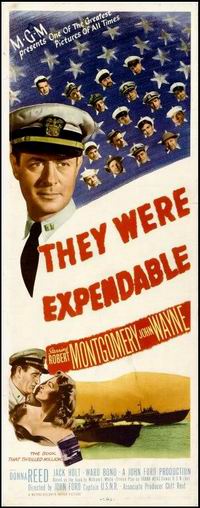
In December of 1941, Lt. John Brickley (Robert Montgomery) commands a squadron of Navy PT boats, based in the Philippines.  Brickley is convinced that the small and agile PT Boats could be used in combat but his superior officers disagree, even after viewing a demonstration of what they can do.  Brickley’s second-in-command, Rusty (John Wayne), is frustrated and feels that he will never see combat.  That changes when the Japanese attack Pearl Harbor and then turn their attention to the Philippines.  Brickley gets his chance to show what the PT boats can do but both he and his men must also deal with the terrible risks that come with combat.  Brickley and his men have been set up to fight a losing battle, only hoping to slow down the inevitable Japanese onslaught, because both they and their boats are considered to be expendable.  The hot-headed Rusty learns humility when he’s sidelined by blood poisoning and he also falls in love with a nurse, Sandy (Donna Reed).  However, the war doesn’t care about love or any other plans that its participants may have.  With the invasion of the Philippines inevitable, it just becomes a question of who will be sent with MacArthur to Australia and who will remain behind.

One of John Ford’s best films, They Were Expendable is a tribute to the U.S. Navy and also a realistic look at the realities of combat.  The movie features Ford’s trademark sentimentality and moments of humors but it also doesn’t deny that most of the characters who are left behind at the end of the movie will not survive the Japanese invasion.  Even “Dad’ Knowland (Russell Simpson), the fatherly owner of a local shipyard who does repair work on the PT boats, knows that he’s expendable.  He resolves to meet his fate with a rifle in hand and a jug of whiskey at his feet.  Rusty, who starts out thirty for combat, comes to learn the truth about war.  Ford was one of the many Hollywood directors who was recruited to film documentaries during World War II and he brings a documentarian’s touch to the scenes of combat.

Robert Montgomery had previously volunteered in France and the United Kingdom, fighting the Axis Powers before America officially entered the war.  After the war began, he entered the Navy and he was a lieutenant commander when he appeared in They Were Expendable.  Montgomery brought a hardened authenticity to the role of Brickley.  (Montgomery also reportedly directed a few scenes when Ford was sidelined with a broken leg.)  John Wayne is equally good in the role of the hot-headed Rusty, who learns the truth about combat and what it means to be expendable.  The cast is full of familiar faces, many of whom were members of the John Ford stock company.  Keep an eye out for Ward Bond, Cameron Mitchell, Leon Ames, Jack Holt, and Donald Curtis.

They Were Expendable is one of the best of the World War II movies.  It’s a worthy film for Memorial Day and any other day.

Lisa Marie Review An Oscar Nominee: Here Comes Mr. Jordan (dir by Alexander Hall)


1941’s Here Comes Mr. Jordan tells the story of Joe Pendelton (Robert Montgomery).

Joe’s a boxer, an honest and kind-hearted guy who is in training for the big title fight.  Despite the concerns of his trainer, Max (James Gleason), Joe decides to take his own private airplane out for a flight.  A freak accident causes the plane to go into a nosedive and Joe suddenly finds himself standing amongst the clouds with a bunch of other people who are waiting for their chance to enter Heaven.

7013 (Edward Everett Horton), an angel, explains that he took Joe’s soul up to heaven when he saw that the plane was about to crash.  Joe is not happy about this.  He wants his title fight!  7013’s superior, Mr. Jordan (Claude Rains), checks his records and discovers that a mistake has been made.  Joe was supposed to live until 1991 and he was also supposed to win the boxing championship.  Unfortunately, Max has had Joe’s body cremated.  Mr. Jordan decides to put Joe’s soul into the body of someone else who is scheduled to die.  Joe asks to be put in the body of an athlete so that he can pursue his boxing career.

Instead, Joe ends up in the body of a middle-aged banker named Bruce Farnsworth.  Farnsworth has been poisoned by his wife (Rita Johnson) and her lover (John Emery).  At first, Joe refuses to become Farnsworth but when he sees his murderers taunting Bette (Evelyn Keyes), whose father was defrauded by Farnsworth, Joe changes his mind.  His murderers are shocked when Farnsworth turns out to be alive.  Bette is shocked when the previously cold Farnsworth helps her get back the money that her father lost.  And Max is shocked when Farnsworth calls him to the mansion and explains that he’s really Joe Pendleton.  Only with Joe/Farnsworth plays the saxophone badly does Max believe what Joe says.  Joe asks Max to train him for the boxing match that he was scheduled to fight while alive.  Max agrees but Mr. Jordan warns Joe that, if he’s going to fulfill his destiny and become champ, it’s not going to be as Bruce Farnsworth, regardless of the fact that Joe/Farnsworth and Bette have now fallen in love.

A romantic comedy that is blessed with two likable performances from Robert Montgomery and Evelyn Keyes and a great one from Claude Rains, Here Comes Mr. Jordan was nominated for Best Picture of 1941.  It lost to How Green Was My Valley.  While Here Comes Mr. Jordan really can’t compare to some of the other films that lost (amongst the other nominees were Citizen Kane and The Maltese Falcon), it’s still a wonderfully charming film that holds up well today.  Everyone should be as lucky as to have a guardian who is as charming and urbane as Claude Rains is as Mr. Jordan.

In 1978, Here Comes Mr. Jordan was remade by Warren Beatty, who named his version of the story Heaven Can Wait.  That version of the story was also nominated for Best Picture, though it lost to The Deer Hunter.

Cleaning Out the DVR: Lady In The Lake (dir by Robert Montgomery)


(Lisa is once again in the process of cleaning out her DVR!  She recorded the 1947 film noir Lady In The Lake off of TCM on June 17th!)

You are Raymond Chandler’s world-famous private detective, Phillip Marlowe!

Well, no.  Actually, you aren’t.  Lady in the Lake is best-known for being one of the first (if not the first) film to be shot from the viewpoint of the main character but actually, the film goes out of its way to remind you that you’re seeing the story through Marlowe’s eyes but you’re not Marlowe yourself.  There are three scenes in which Marlowe (played by Robert Montgomery, who also directed the film) is seen sitting behind a desk and directly addressing the audience.  He shows up to fill in a few plot details and to assure the audience that, while the film they’re watching may be experimental, it’s not too experimental.  For his part, Montgomery looks and sounds absolutely miserable whenever he has to speak directly to the audience.  One gets the feeling that these scenes were forced on him by nervous studio execs, who were probably worried that the film would be too weird for mainstream audiences.

However, the rest of the film is seen totally through Marlowe’s eyes.  When Marlowe gets punched, we see the fist flying at him.  When Marlowe smokes a cigarette, we see the smoke float away from him.  When Marlowe leers at every single woman that he meets, the camera leers as well.  When Marlowe looks at himself in a mirror, we see his reflection.  When Marlowe passes out after a beating or a car accident, the image grows blurry before fading to black.  There’s even a rather clever scene when Marlowe leans in for a kiss, just to suddenly change his mind and pull back.

Today, of course, the film’s technique doesn’t seem quite as revolutionary.  We’re used to point of view shots and moving cameras.  Last year, Hardcore Henry told its entire stupid story through a point of view shot and the shaky cam effect actually made me physically ill.  In Lady in the Lake, there is no shaky, hand-held camera work and I was happy about that.  Marlowe may turn his head left and right and he may walk forward but he apparently has nerves of steel because the image stays steady and only shakes when Marlowe’s getting beat up.

As for the film’s plot, it opens with Marlowe explaining that, since he’s not making enough money as a P.I., he’s decided to try his hand at writing for a pulp magazine.  While his stories are not accepted, publishing executive Adrienne Fromsett (Audrey Totter) does hire him to track down the missing wife of her boss, Derace Kingbury (Leon Ames).  As Marlowe quickly figures out, nobody’s motives are exactly pure.  Adrienne wants to marry her boss and get her hands on his money.  The wife’s lover (Richard Simmons) claims that he hasn’t seen her in weeks but still lets slip that she may no longer be alive.  The police (represented by Lloyd Nolan and Tom Tully) are corrupt, rather rude, and may know more than they are letting on.  Even a seemingly innocent landlady (Jayne Meadows) might have a secret or two.

And, of course, there’s the dead woman who is discovered in a nearby lake.  Her identity holds the key to many mysteries…

It’s an intriguing puzzle and it actually helps to see everything through Marlowe’s eyes.  If nothing else, it cuts down on the red herrings.  If Marlowe stops to stare at something, you know exactly what he’s staring at and you can be sure that it will prove to be important at some point in the story.

By the way, did I mention that Lady In The Lake is not just an experimental film noir but a Christmas movie?  Seriously, it opens with holiday music playing in the background and the opening credits are printed on cheery Christmas cards.  It’s only after the credits are over that we see that there’s a gun underneath the cards.  As a director, Montgomery does a great job juxtaposing the cheeriness of Christmas with the sordidness of the people who Marlowe has to associate with on a daily basis.  He may be dealing with a bunch of murderers and greedy con artists but almost everyone has a Christmas tree in their apartment.

In fact, it’s so easy to get so wrapped up in the film’s technique that the viewer runs the risk of not noticing just how dark and cynical Lady in The Lake truly is.  Everyone that Marlowe meets is sleazy.  Marlowe, himself, does not come across as being particularly likable.  Every room that Marlowe enters is underlit.  Interestingly, with the exception of the opening credits and a driving montage, there’s not much music to be heard in the film, a reminder that we’re only hearing what Marlowe hears.  And, in Marlowe’s world, there’s no music playing in the background to provide relief from the tension.  There’s just a mix of lies and threats.

Lady in the Lake is an intriguing film and it shows up on TCM fairly frequently.  Keep an eye out for it.

Lisa Reviews An Oscar Nominee: The Divorcee (dir by Robert Z. Leonard)


Before I get into reviewing the 1930 best picture nominee, The Divorcee, I want to share something that I recently posted on twitter:

I’m not just sharing this because it’s one of the best things that I’ve ever tweeted.  I’m also sharing it because it’s a beyond perfect description of Jerry (played, in an Oscar-winning performance, by Norma Shearer), the lead character in The Divorcee.  (Whenever you tweet something that is beyond perfect, you’ve earned the right to make sure everyone else knows it.)  The Divorcee came out in 1930 so, needless to say, it’s a bit dated but I totally related to the character of Jerry and that’s perhaps the main reason why I enjoyed this film.

The Divorcee tells the type of story that, today, would probably make for a memorable Lifetime film.  It’s a film that follows four friends over several years.  They are the idle rich, the type who go to parties, dance on tables, and cheerfully ignore the ban on liquor.  Jerry (Norma Shearer) loves Ted (Chester Morris).  Dorothy (Helen Johnson) loves Paul (Conrad Nagel).  However, Paul loves Jerry and when Jerry announces that she and Ted are engaged to be married, Paul doesn’t handle it well.  In fact, Paul gets drunk, Paul drives a car with Dorothy in the passenger’s seat, and eventually Paul crashes the car, leaving Dorothy so disfigured that she spends the rest of the movie wearing a black veil.

The years pass.  In order to make up for horribly disfiguring her, Paul agrees to marry Dorothy.  Jerry marries Ted.  They’re happy until they’re not.  On the day of their third anniversary, Jerry discovers that Ted has been cheating on her.  So, Jerry cheats on Ted.  When Ted gets upset, they file for divorce.

Suddenly, Jerry is …. (dramatic music cue) … THE DIVORCEE!

Ted becomes an alcoholic, the type who makes scenes at parties and destroys ornate wedding cakes.  In the past, I assume Jerry would have been forced to wear a scarlet D and she would have made it work because there’s nothing that Jerry can’t do.  However, since this film takes place in the 1920s, Jerry spends her time flirting and plotting to steal Paul away from Dorothy.

And it would have worked too if not for the fact that Dorothy is a complete and total saint…

Drinking, sex, adultery, disfigurement, and Norma Shearer!?  That’s right, this is a pre-code film!  The Divorcee is actually a pretty typical example of a type of film that was very popular during the 1930s and actually remains rather popular today.  This is a film where rich people do stupid things but look good doing it.  When an audience watches a film like this, they can both look down on the rich and vicariously experience their lifestyle.  No wonder these movies are so popular!

Anyway, I liked The Divorcee.  It’s an incredibly silly little film but it’s hard for me not to enjoy something this melodramatic.  Chester Morris and Conrad Nagel are stuck playing heels and Helen Johnson is a bit to saintly but it doesn’t matter because the film is pretty much designed to be a showcase for Norma Shearer, the most underrated of all of the Golden Age actresses.  (Far too often, Shearer is dismissed as simply being Irving Thalberg’s wife.)  Shearer gives a great performance.  She seems to be having the time of her life and it’s fun to watch.

The Divorcee was nominated for best picture but it lost to a far different picture, All Quiet On The Western Front.

the_divorcee_poster

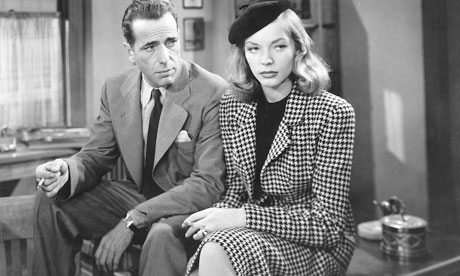
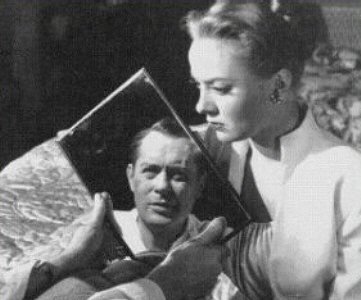
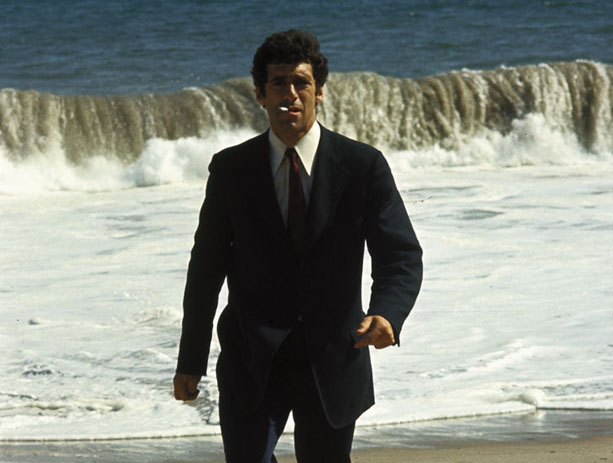
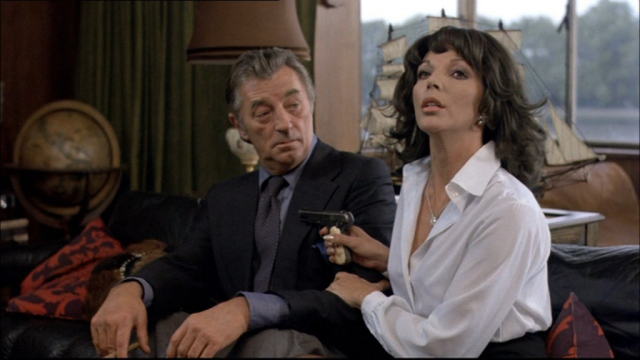
4 Shots From 4 Films: The Big Sleep, The Lady In The Lake, The Long Goodbye, The Big Sleep


Happy belated birthday, Raymond Chandler.  These four shots from four films show four different versions of Chandler’s most famous creation, P.I. Philip Marlowe.

Four Shots From Four Films

The Big Sleep (1946, directed by Howard Hawks)

The Big Sleep (1946, directed by Howard Hawks)

The Lady In The Lake (1947, directed by Robert Montgomery)

The Lady In The Lake (1947, directed by Robert Montgomery)

The Long Goodbye (1973, directed by Robert Altman)

The Long Goodbye (1973, directed by Robert Altman)

The Big Sleep (1978, directed by Michael Winner)

The Big Sleep (1978, directed by Michael Winner)


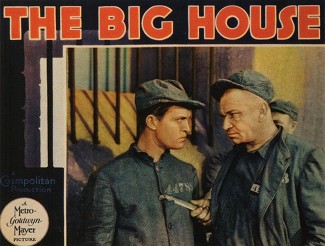
Embracing the Melodrama Part II #3: The Big House (dir by George Hill)


The_Big_House_film_poster

The 1930 Best Picture nominee The Big House opens with a black Model T car slowly pulling up to the front of a large and imposing prison.  Handcuffed in the back seat of the car is a handsome, nervous-looking young man named Kent (Robert Montgomery).  Kent is led into the prison where he is forced to hand over all of his possessions to a grim-looking guard.  We find out that Kent has been convicted of manslaughter, the result of hitting someone while driving drunk.  For the next ten years, this prison (which, we’re told, was designed to house 1,800 but actually holds 3,000) will be Kent’s home.

Kent finds himself sharing a cell with two lifers.  Butch (Wallace Beery) is a coolly manipulative sociopath who alternatively counsels and abuses Kent.  Meanwhile, Morgan (Chester Morris) tries to protect Kent and even helps him get his cigarettes back from Butch.  These three prisoners represent the three faces of prison: Butch is the unrepentant criminal who is actually more at home in prison than in the “real” world.  Morgan is the former criminal who has changed his ways but who is apparently destined to spend the rest of his life paying for his poor decisions.  And Kent is the young man who has to decide if he’s going to be like Butch or if he’s going to be like Morgan.  The Big House makes the still-relevant argument that the American prison system is more likely to turn Kents into Butches than into Morgans.

When the film began, I assumed that Kent would be the main character but actually, he’s secondary to most of the action.  From the moment he first shows up, Kent is not particularly sympathetic and he becomes steadily less likable as the film progresses.  Instead, the film is more focused on the always-scheming Butch and the regretful Morgan.  While Morgan makes plans to escape from captivity and ends up falling in love with Kent’s sister (Leila Hyams), Butch spends his time plotting ways to take over the prison.  For his performance as Butch, Wallace Beery won an Oscar but, seen today, it’s obvious that the film’s heart and soul belongs to Chester Morris’s Morgan.

Like a lot of films from the period, The Big House feels undeniably creaky when viewed through modern eyes.  The Big House was made at a time when Hollywood was still trying to make the transition from silent to sound films.  As such, the film’s pacing is slower than what contemporary audiences are used to and a few of the performances are undeniably theatrical.  I can honestly say that I’m never been more aware of how much I take for granted nonstop background music than when I watch a movie from the early 30s.

That said, once you’ve adapted to the different aesthetic, The Big House holds up fairly well.  Director George Hill films the prison like a town in a German expressionist horror film and Chester Morris’s performance remains sympathetic and compelling.  If the plot seems familiar, it’s important to remember that The Big House is the film first introduced a lot of the clichés that we now take for granted.

The film’s best moments are the ones that deal not with Kent, Butch, and Morgan but instead just the ones that show hordes of prisoners — all anonymous and forgotten men — going about their daily life.  It’s during those scenes that you realize just how many people have been crammed into one tiny space and why that makes it impossible for prison to reform the Kents of the world.

Gandhi once said that the true value of any society can be determined by how that society treats its prisoners and The Big House certainly makes that case.