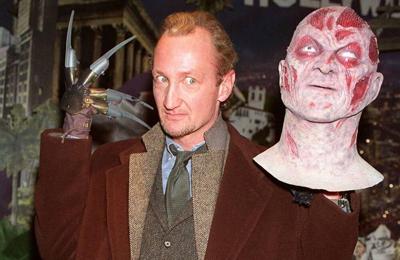
Horror Scenes I Love: Robert Englund in A Nightmare on Elm Street


Ah, Robert Englund.

By most accounts, Robert Englund is one of the most affable men in Hollywood, someone who is so talkative and friendly that people are often stunned to remember that he’s best known for playing Freddy Krueger.  Indeed, in his pre-Nightmare on Elm Street films, Englund was usually cast as quirky and often shy characters.  It was rare to see him play a villain.

That all changed when he was played Freddy Krueger in 1984’s A Nightmare on Elm Street.  (Interestingly enough, director Wes Craven wrote the role with David Warner in mind.)  In the role of Freddy, Englund became a horror icon.  Freddy himself became such a quip machine in the later films that it’s easy to forget just how terrifying a figure he was in the first film.

In this scene, we see just how scary Robert Englund’s performance truly was in A Nightmare on Elm Street.

Late Night Retro Television Reviews: Nightmare Café 1.2 “Dying Well Is The Best Revenge”


Welcome to Late Night Retro Television Reviews, a feature where we review some of our favorite and least favorite shows of the past!  On Mondays, I will be reviewing Nightmare Cafe, which ran on NBC from January to April of 1992.  The entire show is currently streaming on YouTube!
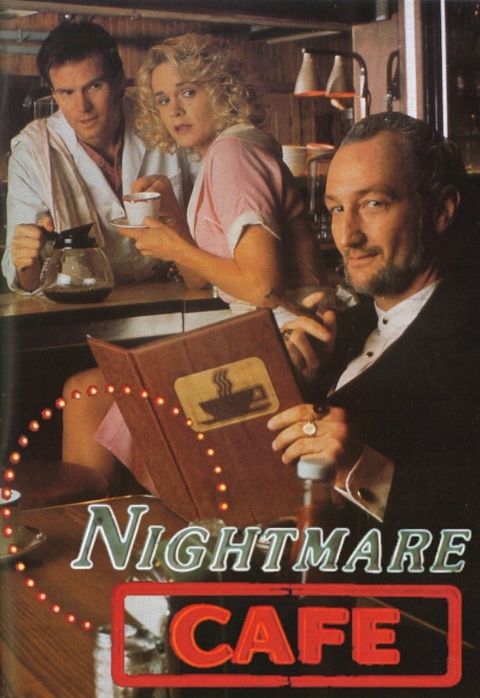
This week, Frank and Fay get involved in a case of ghost noir!

Episode 1.2 “Dying Well Is The Best Revenge”

(Dir by Armand Mastroianni, originally aired on March 6th, 1992)

This week’s episode of Nightmare Café begins with Frank and Fay feeling pretty comfortable in their new roles of working at the café under the watchful eye of Blackie.  I guess some time has passed since the pilot, as both Frank and Fay seem to be totally okay with the fact that they’re both dead and destined to spend the rest of their existence working as, respectively, a cook and a waitress.

Don’t get me wrong, of course.  There’s nothing wrong with being a cook or a waitress.  If I was a waitress, I would definitely want to work for Robert Englund and get to wear a cute uniform like Fay does.  I think what is throwing me is that Fay and Frank seem to be so comfortable with the idea of being dead.  It would take me a bit longer to accept that.

As for tonight’s episode, the action starts when a sultry woman named Angela (Beth Toussaint) enters the café and asks for a cup of coffee.  Frank immediately starts flirting with her and Angela flirts back in typical film noir fashion.  All of the flirting ends, though, when Angela’s husband, Edward (Justin Deas), stumbles into the café, his face bloodied from apparently being attacked outside while he was waiting for Angela.  Angela and Edward leave but Angela later returns so that she can talk to Frank.

Angela claims that Edward is abusive.  Frank leaves the café so that he can visit Angela at home and eventually sleep with her.  (Fay and Blackie watch on the television.)  Fay doesn’t trust Angela, especially after her previous lover — a country club tennis pro (Andrew Airlie) — is mysteriously run over by a hit-and-run-driver.  As Fay puts it, she thinks that Frank could be putting his life at risk.  But, the thing with that is that Frank and Fay are already dead.  That was established in the pilot.  So, if Frank is already dead, how is he putting his life at risk?  For that matter, if Frank and Fay are dead and the Nightmare Café is basically a dimensional portal, how are they both able to casually leave the café and walk around town?  I mean, are they dead and in purgatory or not?  Seriously, what are the rules of the Nightmare Café?

Eventually, Edward confronts Frank and Angela and Frank …. SHOOTS HIM!  Well, I guess since Frank is dead, he can be a murderer.  Except, in a clever twist, it turns out that Edward was already dead and the Nightmare Café gave him a second chance to prove that Angela was the one who set up his murder.  When Angela tries to put Edward in the trunk of her car, Edward suddenly gets out of the trunk and Angela shoots him several times.  Edward pretends to die once again, allowing the police to arrest Angela for murder.  The episode ends with Angela in prison, with Edward as her ghostly companion.

So, as I said earlier, I’m still not sure what the rules of the Nightmare Café are supposed to be and, in this episode, it felt like Frank and Fay could basically just do whatever was convenient to the plot.  That’s a bit of a problem because, when there are no rules, there aren’t any stakes either.  That said, this episode was helped immensely by the friendly charm of Robert Englund.  Blackie didn’t really get involved in the storyline but he did break the fourth wall and talk directly to the audience a few times and Englund delivered the lines with just the right amount of cheery sarcasm.  Robert Englund definitely kept things entertaining!

Last Night Retro Television Reviews: Nightmare Cafe 1.1 “Nightmare Cafe”


Welcome to Late Night Retro Television Reviews, a feature where we review some of our favorite and least favorite shows of the past!  On Mondays, I will be reviewing Nightmare Cafe, which ran on NBC from January to April of 1992.  The entire show is currently streaming on YouTube!

Created by Wes Craven and Thomas Baum, Nightmare Café was an anthology show about a mysterious café and the people who worked there.  The proprietor was played by Robert Englund.  The series only aired for six episodes and apparently, NBC didn’t really give the show much of a chance to find an audience.  Myself, I just recently came across it on YouTube and I’m looking forward to reviewing it over the course of October!

Episode 1.1 “Nightmare Café”

(Dir by Phillip Noyce, originally aired on January 29th, 1992) 

“See those two folks up there?” Robert Englund, playing a sharply-dressed man named Blackie, asks while staring straight at the camera.  “They’re about to get a second chance.  And you know what?  I bet they blow it.”

The two people to whom Blackie is referring are Frank Nolan (Jack Coleman) and Fay Pernovic (Lindsay Frost).  On a foggy night, Fay stops her car on the side of the bridge and jumps into the water below.  Fortunately, Jack already happens to be in the water so he grabs her and pulls her to dry land.  Standing on the deserted road and soaking wet, Fay refuses to say thank you and Frank refuses to mention why he was there to begin with.  However, when they see an all-night café in the distance, they decide to get a cup of coffee.  As they head to the café, Blackie watches them from the shadows.  As they enter the café, the neon sign changes from saying “Night Café” to “Nightmare Café.”

The café appears to be deserted, though in working order.  Jack goes behind the counter finds a chef’s outfit.  Fay finds a waitress outfit.  When she heads into the restroom to change clothes, she briefly hears the sound of a woman crying but, upon entering, she finds no one.  Meanwhile, Jack notices that a TV screen at the front of the café has come to life and …. uh-oh!  He’s suddenly watching what appears to be security footage of Fay removing her wet clothes.  Jack does the right thing and turns the TV off but seriously, what’s happening with this place!?

In the restroom, Fay marvels at how well the waitress uniform fits, almost as if it was made for her.  Suddenly, she hears more crying.  She touches the bathroom mirror and she sees herself sobbing and pulling pills out of a medicine cabinet.

Fay steps back into the main part of the café.  Frank confesses about watching her change on the television.  Fay demands to know what color underwear she was wearing.  “White …. with red hearts on back,” is Frank’s reply.  (For the record, as I sit here typing this, I am wearing black underwear with red hearts on the back.)  Fay accuses him of being a pervert and peeking in on her while she was changing.  Frank turns on the TV in an attempt to prove that he’s not a perv but, instead of showing the restroom, the TV shows the chemical plant where, according to Frank, he works as a night watchman.  He watches as two men steal a barrel of chemical waste and brag about how they’re going to dump it into the harbor.  Frank says that his worst nightmare is seeing something that’s wrong and not doing anything to stop it.  Fay pinches Frank in an attempt to wake him up.  On the TV screen, Frank Nolan tries to stop the men from driving off with the chemical waste.  Frank is fired and then knocked unconscious.

Realizing the Frank has vanished from the café, Fay runs over to a payphone and dials 9-1-1, just to be informed that the number cannot be reached.  Fay opens the door to the café and discovers that she and the café are apparently floating in space!

Returning to the television, Fay sees that, at the chemical plant, Frank is still on the ground and his employer tells a bunch of thugs that he wants them to make Frank watch as they dump the waste into the harbor.  However, once the thugs drive down to the harbor, Frank jumps out of the trunk of their car and into one of the trucks transporting the chemical waste.  The thugs shoot at the truck until it explodes and then decide that it’s time to get a cup of coffee.

Realizing that the thugs might be coming, Fay decides she better pretend to be a real waitress.  She grabs a cup of coffee and walks into the back where she discovers Frank rising out of a water-filled sink.  “You know what?” Frank says, “I don’t think this is your run-of-the-mill all night café!”

Fay congratulates Frank on doing the right thing and standing up to the thugs.  Suddenly, Fay starts to worry about what she saw in the restroom so she and Frank enter and, in the mirror, they see the two thugs approaching the cafe.  Frank and Fay run into the kitchen.  Frank opens a door marked exit and plunges back into the harbor.  Fay closes the door and then opens it again and finds herself staring at a back alley.  Deciding to face the thugs, she heads to the front of the café, where the two thugs demand to know where Frank is.  She tells them that he’s in the ladies room.  They rush into the restroom and suddenly find themselves on a police shooting range with a bunch of cops aiming their guns at them.

“This place has possibilities,” Fay says as the two thugs run from the café.

Suddenly, the TV turns on Fays sees herself in her bedroom, getting dressed for a date.  Frank steps back into the café and watches the TV, barely noticing that Fay has vanished from the café.  While he’s doing this, Blackie steps into the café and, breaking the fourth wall, says, “This ought to be interesting.”

On the television, Fay gets a call from a guy named Al (John D’Aquino) who explains that he’ll be delayed but he’ll see her later.  Frank recognizes Al as being his boss at the chemical plant and then he realizes that Blackie also worked at the chemical plant and was one of the people who always told him not to waste his time reporting the toxic waste dumping.  Blackie holds up a deck of cards and says that whoever pulls the low card will pay for their meal.  Frank says that the only person that he’s betting on is Fay.

On the TV, Fay drives towards Al’s house.  Suddenly, Frank is standing on the side of the road and hitchhiking.  Fay gives him a ride and suddenly, the two thugs pop up and start shooting at them.  Fay speeds off, with Frank in the car.  Fay outmaneuvers the pursuing thugs, who end up crashing their car into the harbor.

Suddenly, Blackie is the only one sitting in the café.  He watches Fay and Frank talk in the car.  Frank tells Fay all about Al and Fay kicks Frank out of the car, not understanding how he could possibly know her name.  Suddenly, Frank is back in the café.  He and Blackie watch as Fay knocks on the door of Al’s penthouse.  No one answers and Frank cheers as Fay starts to walk away.  Suddenly, Blackie appears on the television and unlocks the door so Fay can enter the penthouse.

Fay gives Al a really ugly sweater for his birthday but is then shocked to discover that Al is at the penthouse with another woman (played by Carrie-Anne Moss in an early role), who promptly asks if Fay is the maid.  As Fay heads for the penthouse’s bathroom, one of the thugs shows up and announces that he previous saw Fay at the café.  Meanwhile, Fay searches the medicine cabinet for pills before heading back to her car

Seeing Fay driving towards the harbor on the television, Frank runs out of the café to save Fay again.  But this time, instead of jumping into the harbor, Fay looks at the water and then says that it would be foolish to kill herself over a loser like Al.  Suddenly, Al drives up and Fay and Frank have to jump into the water to avoid getting hit.  However, once they hit the water, Frank realizes that they’re already dead.

Upon figuring this out, Frank and Fay are transported back to the café where Blackie tells them that they’re dead in the real world but they’re alive in the café and now, they get to make a difference in other people’s lives.  Blackie opens the door, to show Frank and Fay that they are once again floating in space and that the Earth in the distance.  Blackie tells them that they’ve been selected by “a higher authority” to help the people who enter the café and “maybe learn a little about yourselves along the way.”  But they’re both dead so what’s left to learn?

Suddenly, Al enters the café.  Blackie tells Al that Frank and Fay are in the restroom.  Al steps into the restroom and suddenly has a vision of Fay testifying against him in court.  Terrified, Al runs from the café but, upon opening the door, he plunges through space and lands in a vat of chemical waste.

A woman (played by Joan Chen of Twin Peaks fame) opens the front door.  “Hi,” she asks, “Are you open?”

Nightmare Café only ran for 6 episodes and anthology shows are notorious for being uneven.  All that considered, I really enjoyed the pilot for Nightmare Café, with its twisty plot, frequently surreal visuals, and — last but not least — Robert Englund having what appears to be a lot of fun as the show’s host.  The pilot was directed by Philip Noyce, who keeps the action moving a great pace.  Even more importantly, from their first scene together, Lindsay Frost and Jack Coleman have a lot chemistry.  I’m looking forward to watching the remaining episodes and seeing where all of this goes!
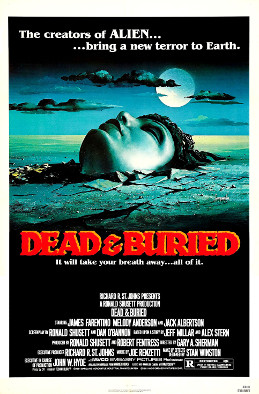
Horror Film Review: Dead & Buried (by Gary Sherman)


The 1981 horror film, Dead & Buried, takes place in the small town of Potters Bluff.  It seems like it should be a nice place to live.  The people are friendly.  The scenery is lovely.  The town is right on the coast of the ocean so the view is great.  It’s a bit of an artist’s colony, the type of place where you would expect to find Elizabeth Taylor painting the sunset while Richard Burton battles a hangover in the beach house.  It’s the type of small town that used to by very popular on television.  It’s just one Gilmore girl away from being an old CW show.

It’s such a nice town.  So, why are so many people dying?

That’s the mystery that Sheriff Dan Gillis (James Farentino) has to solve.  Actually, it’s one of the many mysteries that Dan has to solve.  There’s also the mystery of why his wife, Janet (Melody Anderson), has been acting so strangely.  And then there’s the mystery of what happened to the person who, one night, Dan ran into with his car.  The person ran away but he left behind his arm.  When Dan gets some skin from the arm analyzed, he’s told that the arm belongs to someone who has been dead for at least four months!

Who can explain all of this?  How about William G. Dobbs (Jack Albertson), the folksy coroner who seems to enjoy his work just a little bit too much.  In fact, Dr. Dobbs seems to be a bit more than just a tad eccentric.  One would necessarily expect a coroner to have a somewhat macabre view of life but Dr. Dobbs seems to take things to extreme.  Is it possible that Dr. Dobbs knows more than he’s letting on?

Dead & Buried has a reputation for being something of a sleeper, a deliberately-paced and often darky humorous horror film that had the misfortune to be released at a time when most horror audiences were more interested in watching a masked man with a machete kill half-naked teenagers.  Because the studio wasn’t sure how exactly to market Dead & Buried, it failed at the box office and it was only years later, after it was released on home video, that people watched the film and realized that it was actually pretty good.  And make no mistake about it, Dead & Buried is a fairly clever horror film, one that is full of effective moments and which does a good job of creating a creepy atmosphere.  If I’m not quite as enthused about this film as others, that’s because I do think that it’s occasionally a bit too slow and the film’s twist ending, while well-executed, didn’t particularly take me by surprise.  This is one of those films that you enjoy despite the fact that you can see the surprise conclusion coming from a mile away.

In the end, Dead & Buried fills like a particularly twisted, extra-long episode of one of those old horror anthology shows, like Night Gallery, Twilight Zone, or maybe even Ghost Story.  It’s a nicely done slice of small town horror, featuring a study lead performance from James Farentino and an enjoyably weird one from Jack Albertson.  Though the film is not heavy on gore, Stan Winston’s special effects are appropriate macabre.  Even if it’s not quite up there with Gary Sherman’s other films (like Vice Squad and Death Line, to name two), Dead & Buried is an entertainingly eccentric offering for Halloween.

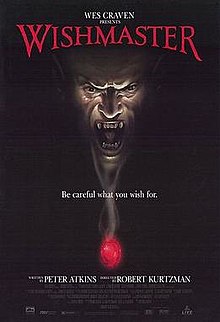
Horror Film Review: Wishmaster (dir by Robert Kurtzman)


Do you all remember Wishmaster?

Played by Andrew Divoff, the Wishmaster was a genie (or a djinn) who made his film debut in the 1997 film of the same name. The Djinn’s schtick is to randomly approach people and say something like, “Would you like to be rich?” or “Would you like all of your enemies to suffer?” He grants wishes but he does so in ironic ways. So, if you say want to be rich, you might very well turn into someone named Rich who is on the verge of getting hit by a bus. If you say that you want to escape from your mundane life, you might end up in a straight-jacket under water, struggling to perform one of Harry Houdini’s signature escapes.

I rewatched Wishmaster a few months ago and what I immediately discovered was the the Djinn wasn’t really that good at his job. He pretended to be clever in the way that he would fool humans but, honestly, it often seemed less like he was tricking people and more like he really wasn’t playing fair. Take the security guard who made the mistake of wishing for an escape. As I just mentioned, The Djinn immediately put him underwater in a straight-jacket. But the guard’s wish was not to have to escape. The guard’s wish was to simply escape. So, putting him in a life-and-death situation and telling him to figure it out for himself wasn’t fulfilling the guard’s wish. It just seemed like the Djinn wanted to drown someone and he decided to use his wish-granting job as an excuse.

The guard, by the way, was played by Tony Todd, one of the many horror icons who appeared in small roles in Wishmaster. (Today, Tony Todd is best known for the Final Destination films but, when Wishmaster came out, he was known for playing the Candyman.) Among the other cameos:

From Phantasm, Angus Scrimm provided the narration while Reggie Bannister played an unlucky pharmacist.

From Friday the 13th, Kane Hodder played a security guard who made the mistake of saying that he wished he could see the Djinn try to walk straight through him.

Day of the Dead’s Joseph Pilato played a crane operator.

John Carpenter vet George “Buck” Flower played an angry homeless man.

Sam Raimi’s brother, Ted Raimi, showed up long enough to get crushed by a crate.

And finally, Robert Englund played the somewhat pretentious professor who was responsible for bringing the Djinn to America in the first place.

As you can probably guess by looking at all of the cameos, Wishmaster is not a film that’s meant to be taken seriously. It’s often deliberately campy. Wes Craven may have produced it and was undoubtedly responsible for recruiting many of the actors who appeared in it but the film’s direction was handled by special effects maestro, Robert Kurtzman and he puts more emphasis on the visual effects than on any sort of serious exploration of the somewhat random series of events that make up the film’s storyline. Of course, when seen today, the film’s special effects look a bit cheap but, for many viewers (like me!), that’s actually a part of the film’s grisly charm.

Wishmaster does have a plot but it’s not particularly important. The Djinn tries to make Alexandra (Tammy Lauren) make three wishes so that he can unleash the forces of Hell. Why he spends all of his time granting wishes to other people instead of just concentrating on Alex is never really explained. It may be an often dumb movie but it’s also undeniably entertaining when taken on its own terms. Andrew Divoff is enjoyably sinister as the Djinn, playing the character with a sarcastic wit to go along with his evil schemes. It’s a fun movie to watch, even if it does feel like it was basically slapped together in a handful of days.

You should always be careful what you wish for but Wishmaster is still an entertaining piece of 90s horror.

(Author’s Note: Wow, this is embarrassing.  Right after I posted this review, I discovered that I previously reviewed Wishmaster in 2018!  Whoops!  Well, it’s nice to see that my thoughts on the film have remained consistent. — LMB)

The TSL’s Horror Grindhouse: 2001 Maniacs (dir by Tim Sullivan)


https://www.youtube.com/watch?v=ZngG5lFV-Js

A lot of people die over the course of this 2005 film but none of them are particularly likable so who cares.

A remake of the Herschell Gordon Lewis classic (though Lewis’s film only featured Two Thousand Maniacs!), 2,001 Maniacs is about a small town called Pleasant Valley in Georgia.  During the Civil War, Union soldiers killed 2,001 of the residents of Pleasant Valley so, as a result, the angry spirits of the town will not be happy until they’ve killed 2,001 Northerners.  Luckily, for them, some yankee college students come driving through on their way to Daytona Beach for Spring Break.  That means it’s time to bring out the hooks, the blades, the flames, and all the other things that can be used to dismember people on screen.  It’s a bloody good time in Pleasant Valley.

The mayor of Pleasant Valley is played by Robert Englund and, if nothing else, Englund brings a lot of demented glee to the role.  One thing that I’ve always liked about Englund is that, even though he could probably get away with it, he’s always refused to coast on the fact that he’s a horror icon.  No matter the quality of the film in which he’s appearing, Englund always goes all out and gives a memorable performance.  As played by Englund, the mayor comes across as being an affable and welcoming guy, or at least he does until he starts killing people.  The viewers automatically know that the mayor’s a bad guy because they know the type of role in which Robert Englund typically gets cast.  But, and this is the important, you can at least understand why the film’s victims didn’t automatically run in fear as soon as they met him.  The mayor is all about hospitality.  (That, and bloody revenge.)

Anyway, it’s tempting to view 2,001 Maniacs as being some sort of statement about Confederate war memorials but …. eh.  I mean, again, it’s tempting but I think it’s ultimately kind of pointless.  This is not a subversive film.  This is not a film that’s attempting to scratch the surface of any major issues.  This is just another gory film that examines the amount of ways someone’s body can pulled apart.  That’s not necessarily a bad thing.  There’s a lot of classic horror films that are centered around people dying in gory ways.  The problem with 2,001 Maniacs is that, since none of the people dying are particularly interesting, you don’t really care about how they die or even the fact that they’re dead.  “Oh hey,” you find yourself saying, “at least I won’t have to listen to that guy talk anymore.”

Despite being a bit on the dull side for most of its running time, 2,001 Maniacs does have an effective final few minutes.  There’s a big battle between a survivor and a ghost that is surprisingly well-directed and would have been exciting if we actually cared about whether or not the survivor was actually going to …. well, survive.  As for the film itself, it ends on a properly macabre note.  I actually laughed at the film’s ending, even though perhaps I shouldn’t have.  Again, it all comes down to not really caring that much about anyone in the movie.

Anyway, 2,001 Maniacs didn’t do much for me.  The Lewis version is still the version to go with.  Thank God for Robert Englund, though.  That man can act.


When It Comes To Halloween, Should You Trust The IMDb?


Dr. Sam Loomis

Like a lot of people, I enjoy browsing the trivia sections of the IMDb.  While it’s true that a lot of the items are stuff like, “This movie features two people who appeared on a television series set in the Star Trek Universe!,” you still occasionally came across an interesting fact or two.

Of course, sometimes, you just come across something that makes so little sense that you can only assume that it was posted as a joke.  For instance, I was reading the IMDb’s trivia for the original 1978 Halloween and I came across this:

Peter O’Toole, Mel Brooks, Steven Hill, Walter Matthau, Jerry Van Dyke, Lawrence Tierney, Kirk Douglas, John Belushi, Lloyd Bridges, Abe Vigoda, Kris Kristofferson, Sterling Hayden, David Carradine, Dennis Hopper, Charles Napier, Yul Brynner and Edward Bunker were considered for the role of Dr. Sam Loomis.

Now, some of these names make sense.  Despite the fact that Sam Loomis became Donald Pleasence’s signature role, it is still possible to imagine other actors taking the role and perhaps bringing a less neurotic interpretation to the character.

Peter O’Toole as Dr. Loomis?  Okay, I can see that.

Kirk Douglas, Sterling Hayden, Charles Napier, Steve Hill, or Lloyd Bridges as Dr. Loomis?  Actually, I can imagine all of them grimacing through the role.

Walter Matthau?  Well, I guess if you wanted Dr. Loomis to be kind of schlubby….

Abe Vigoda?  Uhmmm, okay.

Dennis Hopper?  That would be interesting.

Mel Brooks?  What?  Wait….

John Belushi?  Okay, stop it!

Dr. Sam Loomis

My point is that I doubt any of these people were considered for the role of Dr. Loomis.  Both director John Carpenter and producer Debra Hill have said that they wanted to cast an English horror actor in the role, as a bit of an homage to the Hammer films of the 60s.  Christopher Lee was offered the role but turned it down, saying that he didn’t care for the script or the low salary.  (Lee later said this was one of the biggest mistakes of his career.)  Peter Cushing’s agent turned down the role, again because of the money.  It’s not clear whether Cushing himself ever saw the script.

To be honest, I could easily Peter Cushing in the role and I could see him making a brilliant Dr. Loomis.  But, ultimately, Donald Pleasence was the perfect (if not the first) choice for the role.  Of course, Pleasence nearly turned down the role as well.  Apparently, it was his daughter, Angela, who changed his mind.  She was an admirer of John Carpenter’s previous film, Assault on Precint 13.  Carpenter has said that he was originally intimidated by Donald Pleasence (the man had played Blofeld, after all) but that Pleasence turned out to be a professional and a gentleman.

Laurie Strode

Of course, Halloween is best known for being the first starring role of Jamie Lee Curtis.  Curtis was actually not Carpenter’s first choice for the role of Laurie Strode.  His first choice was an actress named Annie Lockhart, who was the daughter of June Lockhart.  Carpenter changed his mind when he learned that Jamie was the daughter of Janet Leigh.  Like any great showman, Carpenter understood the importance of publicity and he knew nothing would bring his horror movie more publicity then casting the daughter of the woman whose onscreen death in Psycho left moviegoers nervous about taking a shower.

There was also another future big name who came close to appearing in Halloween.  At the time that she was cast as Lynda, P.J. Soles was dating an up-and-coming actor from Texas named Dennis Quaid.  Quaid was offered the role of Lynda’s doomed boyfriend, Bob but he was already committed to another film.

Not considered for a role was Robert Englund, though the future Freddy Krueger still spent some time on set.  He was hired by Carpenter to help spread around the leaves that would make it appear as if his film was taking place in the October, even though it was filmed in May.

Robert Englund, making May look like October

Interestingly enough, Englund nearly wasn’t need for that job because Halloween was not originally envisioned as taking place on Halloween or any other specific holiday.  When producer Irwin Yablans and financier Moustapha Akkad originally approached Carpenter and Hill to make a movie for them about a psycho stalking three babysitters, they didn’t care when the film was set.  It was only after Carpenter and Hill wrote a script called The Babysitter Muders that it occurred to Yablans that setting the film during Halloween would be good from a marketing standpoint.  Plus Halloween made for a better title than The Babysitter Murders.

And, of course, the rest is history.  Carpenter’s film came to define Halloween and it still remains the standard by which every subsequent slasher movie has been judged.  Would that have happened if the film had been known as The Babysitter Murders and had starred John Belushi?

Sadly, we may never know.

Horror Movie Review: A Nightmare On Elm Street (dir by Wes Craven)


Damn, this is a scary movie.

That may seem like an obvious point to make when talking about the original A Nightmare On Elm Street but it’s still one that needs to be made.  I always seem to forget just how scary the original is.  I mean, there’s been so many sequels.  And there was that kind of silly movie where Freddy Krueger fought Jason Vooerhees.  And then there was the fairly forgettable reboot.  Freddy Krueger is something of a cultural icon.  Even people who have never watched any of the movies knows who Freddy Krueger is.  Freddy has become so well-known for his quips and his puns and his bad jokes that it’s easy to forget that the reason he put razors on his gloves was so he could kill children.

Despite the fact that Jackie Earle Haley took over the role in the reboot, Freddy Krueger will always be associated with the actor who first played him, Robert Englund.  What’s interesting is that, whenever you watch or read an interview with Englund, he comes across as being literally the nicest guy in the world.  (His autobiography is one of the most cheerful Hollywood memoirs that I’ve ever read.)  Before he was cast as Freddy, Englund was a fairly busy character actor.  It’s always a little odd when he pops up in some old movie on TCM because, inevitably, he’s always seems to be playing a nice and often kinda shy guy.  Supposedly, when Englund auditioned for the role of Freddy, he darkened his lower eyelids with cigarette ash and he purposefully said very little while meeting with director Wes Craven.  Craven, who based Freddy Krueger on a childhood bully, was impressed enough to cast this very likable actor as one of the most evil killers in the history of horror cinema.

And make no mistake about it.  In the first film, Freddy Krueger is terrifying.  He’s not the joker that he would become in later installments of the franchise. When he does laugh, it’s because he’s taunting his latest victim.  This Freddy isn’t quite as quick-witted as the Freddy who showed up in Dream Warriors and other films.  This Freddy keeps things simple, popping up in your nightmares, chasing you, and, once he catches you, killing you.  It’s not just his glove and his burned faced that makes Freddy terrifying in this film.  It’s how determined and relentless he is.  He’s not going to stop until he catches you and, seeing as how he’s already dead, there’s really not much you can do to slow him down.  Englund plays Freddy as being the ultimate bully.  The only joy he gets is from tormenting the rest of us.  It’s a testament to the strength of Englund’s performance that memories of Freddy dominate our thoughts when it comes to A Nightmare of Elm Street, despite the fact that Freddy is only onscreen for seven minutes.

It’s an effective film, not just because of the nightmare scenes but also because of the scenes that take place in the waking world.  The majority of the film follows Nancy (Heather Langenkamp), Glen (Johnny Depp), Tina (Amanda Wyss), and Rod (Jsu Garcia, who is credited as Nick Corri in this film) as they try not to die.  And let’s be honest.  None of these characters are particularly deep.  Rod’s the bad boy.  Tina’s the rebellious Catholic.  Glen’s the nice guy.  Nancy’s the good girl.  They’re archetypes that should be familiar to anyone who has ever seen a slasher film.  And yet, you really do care about them, especially Nancy and Glen.  (Admittedly, everyone that I’ve ever talked to about this film seems to care about Rod the least.)  Langenkamp, Depp, and Wyss all give such likable performances that you really do find yourself worrying about what will happen to them when and if they fall asleep.

I rewatched A Nightmare on Elm Street last night and I was shocked to discover that, even though I knew what was coming, the movie still scared me.  The sight of Freddy straining against the wall over Nancy’s head was still unbelievably creepy.  The gory scene where Freddy attacks Tina still frightened me, as did the famous geyser of blood scene.  Even the much-parodied scene where Freddy’s glove rises up between Nancy’s legs while she sleeps in the bathtub still made me shudder.

It’s easy to take for granted just how good and scary the original Nightmare on Elm Street actually is.  For horror fans, it’s a film that deserves to be watched this October season.  Just don’t fall asleep afterwards.

Horror Film Review: Wishmaster (dir by Robert Kurtzman)


Remember the Wishmaster films?

There were four of them and they all deal with this ancient Djinn (Andrew Divoff) who, during each film, would escape from his magical prison and then wander around granting people their wishes.  Of course, since the Djinn was evil, there was always a catch.  He would either interpret the wish very literally or he would manipulate people into asking for the wish in the wrong way.  As a result, people would always get their wish but they’d get in a way that would make them suffer.

For instance, a typical Wishmaster conversation would go something like this:

“I wish I was a better actor.”

“Am I to understand that you wish you were John Wilkes Booth?”

“Wait …. what?”

“As you wish.”

Sic semper tyrannis!”

The first Wishmaster was released in 1997 while the fourth (and, to date, last) installment was released in 2002.  They’ve never gotten as much attention as some of the other horror franchises from that period, largely because there was really only so much that you could do with a character like the Djinn.  Part of the problem was that almost every scene depended on someone not understanding the importance of being clear when making a wish.  There’s only so many times that you can watch the Djinn trick people into saying, “I wish I never get old,” before the whole novelty of it all wears off.

That said, the Wishmaster films did have one thing going for them and that was Andrew Divoff.  A veteran character actor (and one who you might recognize from Lost, where he played a member of the Others who was both Russian and who had only one eye), Divoff was always creepy as fug in the role of the Djinn.  Whenever someone made the mistake of making a wish, this little smile would appear on Divoff’s face and you knew that someone was about to learn an important lesson about being careful what you wish for.  Divoff was seriously frightening of the Djinn, so much so that you regretted that the films themselves could never quite keep up with his performance.

Last night, I watched the first Wishmaster film for the first time in six years and it was actually a little bit better than I remembered.  The plot itself is typical Wishmaster stuff.  The Djinn is trapped inside of a gem that eventually makes it way to the United States.  An idiot lab worker attempts to experiment on it, which leads to the gem exploding, the Djinn getting free, and an epidemic of mass wish granting.  Nobody seems to have learned the lesson that the first thing you wish for is more wishes.

Wishmaster is stupid but fun.  The first film was produced by Wes Craven and perhaps that explains why the film is full of cameos from everyone who was anyone in low-budget 90s horror.  As a result, you’ve got Kane Hodder saying that he would “love it if” the djinn “tries to go right through him,” and Robert Englund playing a businessman and Tony Todd showing up as a doorman.  It’s nice to see them all, though ultimately the main reason to watch the film is for Andrew Divoff’s wonderfully smirky turn as the Djinn.  It’s hard not to wish that he had another horror franchise to dominate.

Be care what you wish for!

(Sorry, had to do it….)