Horror Film Review: The Hideous Sun Demon (dir by Tom Boutross and Robert Clarke)


“It’s never late until the sun comes up.”

Those words are spoken in the 1958 film, The Hideous Sun Demon.  Sultry pianist Trudy (Nan Peterson) may just be talking about her own nocturnal lifestyle and her job as the entertainment at a bar but those words also have a double meaning to scientist Gil McKenna (Robert Clarke).  Whenever the sun comes up, Gil is transformed into the Hideous Sun Demon!
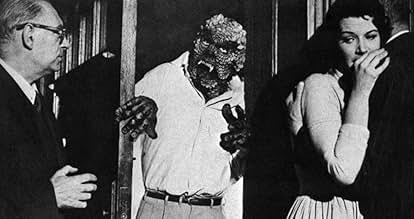
In theory, of course, this is an interesting take on the werewolf legend or even a traditional vampire tale.  Typically, monsters aren’t supposed to come out until the sun goes down and they can move under the cover of darkness.  The werewolf is transformed by the moonlight.  The vampire is destroyed by the sun.  (Or, at least, he used to be.  Largely due to authorial laziness, many modern vampire tales have abandoned the whole idea of not being able to go out during the day.)  Gil, however, reverses the trend.  By night, he’s a handsome and brooding scientist.  By day, he’s not just the sun demon.  He’s the …. HIDEOUS SUN DEMON!

(Seriously, that can’t be good for his self-esteem.)

Like all great monsters, Gil doesn’t want to be the sun demon.  He tries to stay in his house until night falls so that he won’t be transformed into a monster.  But it’s difficult when he finds himself talking to Trudy and getting lost in their conversation.  The beach looks so nice at night but it looks even better at dawn!

Why is Gil found himself in this position?  It won’t shock you to know that Gil was once a research scientist who was working a new radioactive isotope.  That’s right …. it was the radiation!  In the 50s and the 60s, the radiation was blamed for just about everything.  There was literally nothing that the radiation couldn’t do.  The radiation woke up Godzilla The radiation turned a tree stump into a walking monsterThe radiation caused Col. Glen Manning to become the Amazing Colossal Man.  Wherever there was radiation, you could be sure that giant animals and deformed monsters would follow.  Tor Johnson was just fine until he drove out to Yucca Flats.  The aliens were so concerned about man’s love for radiation that they decided they had no choice but to raise the dead in an attempt to stop us from exploding atoms and the sunlight itselfSome scientisteven  suspected that radiation — in this case, space radiation — led the first zombie apocalypse.  (Regardless, they were all messed up.)  In fact, the only thing that couldn’t be stopped by radiation was the Martian invasion.  We had to depend on good old germs for that!

As for Gil, he’s got a lot of scientists working on a cure for his condition but he knows it’s hopeless and he’s pretty bitter about it.  Poor guy.  I may not turn into a demon but I do have red hair so I could slightly relate to his feelings.  Redheads don’t tan as much as we just burn.  I guess that’s one reason why I love this time of year.  The skies are full of clouds and one can safely walk around during the daylight hours.

As for The Hideous Sun Demon, it is a ludicrous and fun B-movie, a quick 74-minute beach romp with a convincing performance from Robert Clarke and an effective monster costume.  The scientists investigating Gil’s case are all extremely sober while Gil is extremely mopey and Trudy is extremely sultry and George (Peter Similuk), a bar patron who also likes Trudy, is a true middle-aged 50s tough guy.  It’s very much a film for the 50s drive-in crowd and all the more entertaining because of it.
A Blast From The Past: Dragnet 1970 4.22 “D.H.Q.: Night School” (dir by Jack Webb)


Dragnet began as a radio program in 1949 before making it’s way over to television in 1951. Each episode starred (and the majority were directed by) Jack Webb, who played a no-nonsense cop named Joe Friday. Friday narrated every episode, dropping trivia about the history of Los Angeles while also showing viewers how the cops went about catching criminals. Despite what is commonly believed, Joe Friday never said, “Just the facts, ma’m,” but he did investigate each case with the cool determination of a professional who kept his emotions under control. The majority of Dragnet’s episodes were based on actual cases that were worked by the LAPD, hence the opening declaration of, “The story you are about to see is true.”

On television, Dragnet originally ran from 1951 to 1959, during which time Dragnet also became the first television series to be adapted into a feature film. Jack Webb decided to relaunch Dragnet in 1966 and he produced a made-for-television movie that followed Friday and his latest partner, the far more talkative Bill Gannon (Harry Morgan), as they worked multiple cases over the course of one long weekend.  That made-for-television movie led to a series that ran from 1967 to 1970.

The second television series is the best-remembered version of Dragnet, beloved for its scenes of Friday and Gannon debating the issues with a motely collection of hippies, campus radicals, and pipe-smoking academics.  Jack Webb viewed Friday as being the voice of the common American, who supported the troops, supported the president, and who wanted to spend the weekend grilling in peace.  Friday was the middle-aged suburbanite who wanted to the kids to stay off the grass, whether it was on his front lawn or being sold on a college campus.  These episodes were often campy.  It’s hard not to smile while listening to Friday and Gannon deadpan their way through conversations with flakey long-haired hippies.  It was often obvious that the writers of Dragnet had never actually had any experiences with the hippies, beyond what they saw on the evening news.  And yet, as silly as things often were, the show is an interesting time capsule of the era in which it was made.  If nothing else, it’s a chance to see the turbulent 60s through the eyes of the other side.

Last year, I shared my favorite episode of Dragnet.  For the new year, I’m sharing my second favorite, an episode that originally aired on March 19th, 1970.  In Night School, Joe Friday is attending a night class where he and his classmates sit in a circle and just “rap” about the issues of the day.  No one knows that Joe is a cop but Joe feels that he is still on duty and when he sees that the guy sitting across from him has a baggie of weed in his notebook, Friday makes an arrest.  The professor, who says “There’s nothing wrong with marijuana, I smoke it myself!,” attempts to kick Sgt. Friday out of his class.  “Would you rather be known as good ol’ friendly Joe, the class narc?” the professor asks.  Joe fights for his right to get an education and a man with an eyepatch emerges as an unlikely voice of reason.

Why do I like this episode?  There’s something undeniably entertaining about seeing straight-laced, deadpan Joe Friday attending a class with at least three hippies.  It always amuses me that, on this show, Joe Friday loosening up just means that Joe trades his suit for a sweater.  Also entertaining is Leonard Stone’s over-the-top performance as the villainous professor.  And how can you not smile at Bill Gannon’s weary claim of “I just knew there was no way you could get a B sitting around talking?”  Or Jack Webb’s delivery of the line, “That’s my thing, keeping the faith, baby?”  Or Jack Curtiss’s hyperactive performance as campus drug pusher Jerry Morgan?  “Hey, that’s just oregano!”  Whatever you say, Jerry.

Today’s blast from the past certainly does feel like a trip in a time machine.  Step on in and take a look at California in 1970!

Retro Television Reviews: Fantasy Island 3.16 “Rogues and Riches/Stark Terror”


Welcome to Retro Television Reviews, a feature where we review some of our favorite and least favorite shows of the past!  On Tuesdays, I will be reviewing the original Fantasy Island, which ran on ABC from 1977 to 1986.  Almost entire show is currently streaming is on Youtube!

Smiles, everyone!  Smiles!

Episode 3.16 “Rogues and Riches/Stark Terror”

(Dir by Cliff Bole, originally aired on January 19th, 1980)

Our latest weekend on Fantasy Island is both strange and entertaining!

Attorney Mark Hendicks (John Schuck) comes to the Island with a briefcase full of papers.  He’s searching for his former law partner, Pete Gilbert (singer Robert Goulet).  Years ago, Pete came to Fantasy Island with a simple fantasy.  He wanted to be an 18th century British outlaw.  However, Pete had so much fun in the past that he decided that he never wanted to leave.  Mark needs to get Pete’s signature on some official forms so that Mark can sell some land that he and Pete bought before Pete’s fateful trip to the Island.

Mr. Roarke explains to Mark what’s going on with Pete and Mark is surprisingly accepting of Roarke’s explanation.  Roarke drives Mark out to a bridge.  He tells Mark that crossing the bridge will transport Mark to Pete’s fantasy.  Mark crosses the bridge and immediately sees Pete being chased by a bunch of British soldiers.  Pete is having a grand ol’ time in the 18th century but he’s more than willing to take some time out from plundering so that he can sign the papers so that will allow Mark to become a millionaire once he returns to the present.  However, after a dinner scene that is basically lifted shot-for-shot from Tom Jones, Mark falls in love with Margaret Winston (Dolly Read), the wife of sword-wielding Judge Winston (Alan Hale, Jr).  Mark is tempted to remain in the past but, in the end, he decides that his place is in the present.  Fortunately, it turns out that Margaret was having a fantasy of her own and she and Mark leave the Island together.

While that silly but enjoyable fantasy plays out out, Amy Marson (Melissa Sue Anderson) searches for the solution to a mystery that was so traumatic that it caused her to lose her ability to speak.  Amy’s mother (Elinor Donahue) died in front of her and Amy hopes to discover not only who killed her mother but also to recover her ability to speak.  This leads to Amy visiting the lighthouse where she grew up and having a reunion with the kindly lighthouse keeper, Joshua Templar (Michael Constantine).  Amy’s flashbacks lead her to the solution to the mystery of her mom’s death and also to Joshua’s secret son (David Drucker).

This storyline, much like last week’s battle against Elizabeth Bathory, was enjoyably creepy and it featured good performances from Anderson, Constantine, Donahue, and Drucker.  In the best tradition of Fantasy Island, the storyline was both macabre and also rather life-affirming.  Fantasy Island was always at its best when it revealed the hidden humanity at the heart of each fantasy.  Amy learns the truth of her mother’s death and she regains her ability to speak.  Tattoo tells her that she has a beautiful voice.  Awwwwww!

This was a great weekend on Fantasy Island!

The TSL’s Horror Grindhouse: Beyond The Time Barrier (dir by Edgar G. Ulmer)


This 1960 film tells the story of Bill Allison (Robert Clarke), an air force test pilot who flies his test craft into space and then returns to discover that Earth has totally changed!

The Air Force base where he previously worked is now deserted and desolate.  After he’s captured by a group of silent soldiers, Allison is taken to an underground city known as the Citadel.  He meets the head of the city, an older man known as The Supreme (Vladimer Sokoloff).  The Supreme explains that only he and his second-in-command, The Captain (Red Morgan), can speak and hear.  The rest of humanity communicates through telepathy.  Though the Supreme’s granddaughter, Princess Trirene (Darlene Tompkins), telepathically insists that Allison is not a threat, the Supreme and the Captain still exile him to live with a bunch of angry, bald mutants who are determined to destroy the city.  Allison meets three other exiles and discovers that they too are time travelers.  The scientists explains that Bill has found himself in the far future.  The year is no longer 1960.  No, the year is …. 2024!

OH MY GOD, WE’VE ONLY GOT TWO YEARS LEFT!

Actually, we’ve probably got less than two years left.  This is October and the film appears to be taking place in the summer so we’ve probably only got 18 months to go!

(Cue Jennifer Lawrence: “We’re all gonna die!”  Cue Leonardo Di Caprio: “I’m so scared!”  Okay, tell them both to shut up now.)

Anyway, Allison assumes that society must have collapsed due to a global war but the scientists explain that the first manned spacetrip to the moon actually ushered in an era of peace.  (Wow, how did I miss this?)  In fact, humans had colonized the Moon, Mars, and Venus by 1970.  (Woo hoo!  Yay, humanity!)  However, years of nuclear testing had weakened the Earth’s atmosphere and, in 1971, the planet was bombarded by cosmic rays.  (Uh oh….)  Humanity was forced to move into underground cities.  Some of them developed telepathy and became super advanced.  Others became bald mutants.  Unfortunately, everyone is now sterile and the Supreme probably expects Allison to impregnate Trirene and do his part to repopulate the planet.

On the one hand, Allison and Trirene are falling in love.  Allison is handsome and strong.  Trirene has pretty hair and is the only citizen of the Citadel who gets to wear anything flattering.  They’re a cute couple.  On the other hand, if Allison sticks around the repopulate the planet, he’ll never be able to go back to his present and warn everyone about the upcoming cosmic ray plague.  Plus, it soon becomes clear that the scientists have an agenda of their own.  Allison finds himself torn between the two factions trying to control the Citadel.

Made for next to no money and filmed at Fair Park in Dallas, Beyond The Time Barrier is a surprisingly good film.  It was directed by Edgar G. Ulmer, an Austrian director who started out as an associate of Fritz Lang’s and who followed Lang to the United States.  Ulmer made films for the Poverty Row studios and he was a master of creating atmosphere on a budget.  He was one of the pioneers of film noir and he brought that same style to his horror and sci-fi films.  As envisioned by Ulmer in Beyond The Time Barrier, the future is full of menacing shadows, dangerous con artists, and untrustworthy authority figures.  It’s a fatalistic film, one that ends on a surprisingly downbeat note.  Even if Allison can save humanity, will it really be worth all the trouble?  Much like Detour, Ulmer’s best-known film, Beyond The Time Barrier plays out like a deliberately-paced dream, full of surreal moments and ominous atmosphere.

Beyond The Time Barrier is available on YouTube and Prime.  Watch it now before we have to go underground.

Horror On The Lens: The Hideous Sun Demon (dir by Robert Clarke and Tom Boutross)


Hideous Sun Demon

Hi there and welcome to October!  This is our favorite time of the year here at the Shattered Lens because October is horror month.  For the past three years, we have celebrated every October by reviewing and showing some of our favorite horror movies, shows, books, and music.  That’s a tradition that I’m looking forward to helping to continue this year.

So, let’s start things off with the 1959 cult classic The Hideous Sun Demon.  In The Hideous Sun Demon, a scientist named Gil (played by Robert Clarke, who also wrote and directed) is exposed to radiation.  Perhaps not surprisingly, this does not turn out well for Gil.  Now, whenever Gil is exposed to direct sunlight, he turns into a scaly and murderous monster.  Struggling to control his new monstrous side and slowly losing his grip on his own sanity, Gil retreats to a seaside town where he spends most of his time sitting in the dark.  He only emerges from his house at night and then only so he can go down to a bar and listen to the sultry Trudy sing a song.  However, the sun always rises…

The Hideous Sun Demon may not be a great film but it’s perfect for a little Halloween fun.  Robert Clarke is sympathetic in the lead role and, while the Sun Demon might just be a man in a rubber suit, that’s all just a part of the film’s charm.

So, let’s start October by pulling down the shades, blocking out the sun, and enjoying The Hideous Sun Demon!