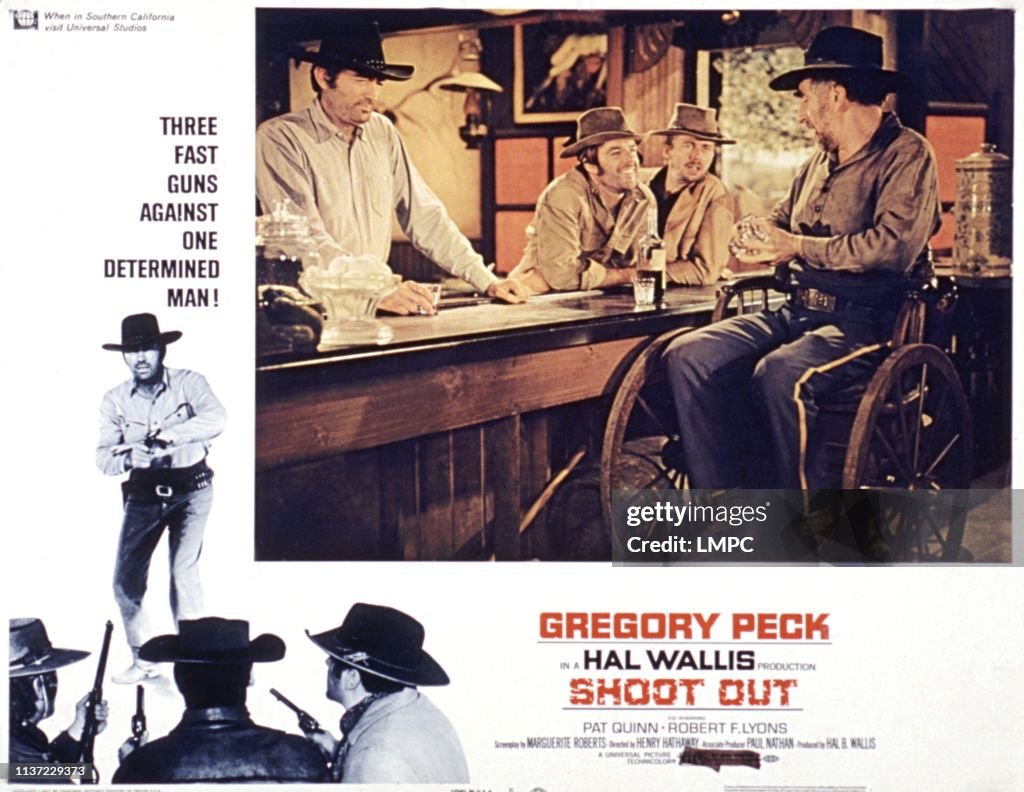
Brad reviews SHOOT OUT (1971), starring Gregory Peck & Robert F. Lyons! 


After serving a stretch at the Canon City penitentiary, Clay Lomax (Gregory Peck) gets out with only one thing on his mind… revenge on his former partner Sam Foley (James Gregory), who shot him in the back during a bank robbery, leaving him to take the rap. Foley isn’t a fool, though, so he’s hired a trio of young punks, Bobby Jay (Robert F. Lyons), Skeeter (John Davis Chandler), and Pepe (Pepe Serna) to surveil Lomax and let him know if he’s heading to his home in Gun Hill with payback on his mind. These guys are about as crazy as it gets, and they make two major mistakes. First, they kill Lomax’s friend Trooper (Jeff Corey) who lets him know where Foley is with his dying breath. Second, they kidnap the prostitute Alma (Susan Tyrell) just because they want to treat her like crap and have fun with her, which turns out to be a dumb move. Interrupting Lomax’s quest for revenge, he finds himself being forced to care for a young child named Decky (Dawn Lyn), who just may be his daughter with a lady back in Kansas City who used to be his “friend.” Looking after Decky, and then meeting and falling for the widow Juliana Farrell (Patricia Quinn), Lomax is soon facing off against his most dangerous foe, the crazed Bobby Joe, as he attempts to protect all these new people that he loves so he can move on with his life. But is it all too late?!!

I love westerns, but I must admit that I’m not the biggest fan of director Henry Hathaway’s SHOOT OUT. Hathaway has directed some of my favorite actors and movies, like Charles Bronson’s debut film with Gary Cooper, YOU’RE IN THE NAVY NOW (1951), along with the Jimmy Stewart film CALL NORTHSIDE 777 (1948) and John Wayne’s Oscar winning TRUE GRIT (1969). Unfortunately, it seems his best years are behind him, and he would only direct one more film after this, the less than excellent black action film HANGUP (1974). This isn’t exactly Gregory Peck’s best work either. Coming nine years after his Oscar winning performance in TO KILL A MOCKINGBIRD (1962), this is definitely not even close to that kind of level. Don’t get me wrong, I do enjoy his turn as Lomax when he’s the wronged outlaw looking for revenge, but I don’t really care at all for his part as the reluctant father figure trying to deal with the six-year-old Decky. I found Dawn Lyn to be more annoying than cute in the role, and this storyline distracted me from the revenge plot that I actually enjoyed. As a co-host of the “This Week in Charles Bronson Podcast,” we had the opportunity to interview Robert F. Lyons, who plays the bad guy, Bobby Jay Jones. I specifically asked him about this film and what it was like working with Gregory Peck. While he enjoyed working with Peck, his response about the film itself was telling…. “The work in there is not my work.” If you’ve watched much of the excellent actor’s work before, you can immediately understand what he means. Lyons goes so over-the-top as the spying outlaw Bobby Jay Jones, that his performance is inconsistent with the bulk of his career. Lyons told us that his performance was orchestrated by Hathaway in a way that he disagreed with, and he essentially disowns his work in the film. You can see a similar vibe with his “gang” that includes the actors John Davis Chandler and Pepe Serna. 

While I’m not a huge fan of the overall direction of the storyline or the focus of some of the main performances in SHOOT OUT, I am appreciative of the genre and the classic western stars that Hathaway cast in supporting roles. I especially enjoy seeing Jeff Corey in the small but pivotal role as the wheelchair bound Trooper, Paul Fix as the train brakeman who delivers Decky and a stack of cash to Lomax, and Arthur Hunnicutt as the ranch owner who barters with Lomax over the price of a pony. Hunnicutt is a particular favorite of mine although his role here is very small. Nominated for an Oscar for his performance in Howard Hawks’ THE BIG SKY (1952), Hunnicutt is from the small town of Gravelly, Arkansas, which is not far from where my own family is from. He even attended the same college that I graduated from, the University of Central Arkansas, which was known as the Arkansas State Teachers College when he (and my dad) went there. And then there is the setup of the revenge scenario at the beginning and the final showdown at the end, classic staples of the western genre. These are enjoyable and satisfying moments as Lomax settles his scores and the bad guys get their comeuppance.

Overall, SHOOT OUT is best enjoyed by fans of old school westerns and star Gregory Peck. It veers aways from the best storylines of the genre and wastes a lot of time with uninteresting melodrama, but it does offer us another chance to see some of our great character actors doing what they do. That means something to me. 

I’ve included our podcast episode with Robert F. Lyons below. He discusses SHOOT OUT at around the 1:00:30 mark.
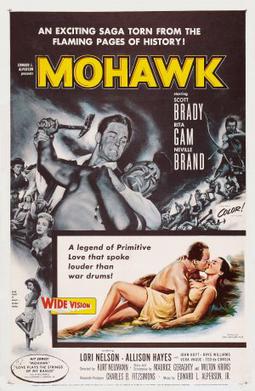
Mohawk (1956, directed by Kurt Neumann)


In the late 18th century, Boston socialite Cynthia Stanhope (Lori Nelson) travels to Fort Alden in upstate New York to visit her fiancé, a painter named Jonathan Adams (Scott Brady), who has been commissioned to paint the local scenery.  As soon as Cynthia and her mother arrive, they are shocked to discover that not only Jonathan has been painting pictures of the members of the Native local tribes but that he is also now flirting with a barmaid named Greta.  Greta is played by Allison Hayes so who can blame him?  Cynthia wants to return to their normal upper class life in Boston but Adams has fallen for the untamed wilderness of the frontier.

When Onida (Rita Gam), the daughter of Iroquois chief Kowanen (Ted de Corsia) is captured during a raid on the fort, Adams is assigned to escort her back to her tribe.  Leaving behind Cynthia and Greta, Adams falls in love with Onida over the course of the journey.  When he meets the Iroquois, he earns the respect of her father and the entire tribe when he agrees to paint the chief’s portrait.

Meanwhile, a haughty settler named Butler (John Hoyt) is trying to play the army and the Iroquois against each other, feeding both of them false information in an attempt to spark a war.  Butler is hoping that a war will lead to both sides wiping each other out so that he can once again have the valley to himself.  When it turns out that his words might not be enough to spark a war, Butler resorts to murder.  When Kowanen’s son is killed, the Iroquois prepare for war while Adams is framed for the crime and finds himself tied to a stake.

Mohawk is a standard B-western, with a plot that is largely lifted from John Ford’s Drums Along The Mohawk.  Unfortunately, Adams is about as sympathetic hero as you would expect someone manipulating three different women to be and, when it comes to depicting the Iroquois, Mohawk resorts to too many clichés.  This is one of those westerns where the Native characters speak broken English, even when they are just talking to each other.

Mohawk does have three things to recommend it.  Number one, John Hoyt was a master at playing haughty villains and Butler is easy to root against.  You will look forward to seeing him get his comeuppance.  Number two, Allison Hayes was a force of nature and that’s true even in this film, where she’s not given nearly enough to do.  Number three, one of Iroquois braves is played by Neville Brand.  A highly decorated World War II veteran, Brand built a long career playing tough guys.  In Mohawk, it only takes one look at Neville Brand to know that this isn’t someone you want to mess with.  Anyone watching would want to stay on Neville Brand’s good side.

Otherwise, Mohawk is forgettable.  Two years after it was released, Mohawk’s director Kurt Neumann, would be responsible for the much more memorable The Fly.

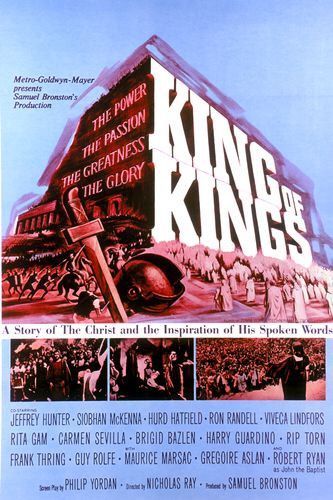
Film Review: King of Kings (dir by Nicholas Ray)


The 1961 film, King of Kings, was the final biblical film that I watched on Easter.  Like The Greatest Story Ever Told, it tells the story of Jesus from the Nativity to the Ascension.  Like The Greatest Story Ever Told, it’s an epic film that was directed by a renowned director.  (In this case, Nicholas Ray.)  Like The Greatest Story Ever Told, King of Kings also has a huge cast and there’s a few familiar faces to be seen, though it doesn’t really take the all-star approach that George Stevens did with his telling of the story.

Probably the biggest star in King of Kings was Jeffrey Hunter, who played Jesus.  Hunter was in his 30s at the time but he still looked young enough that the film was nicknamed I Was A Teenage Jesus.  (Some of that also probably had to do with the fact that Nicholas Ray was best known for directing Rebel Without A Cause.)  But then again, for a man who had so many followers, Jesus was young.  He hadn’t even reached his 40th birthday before he was crucified.  As well, his followers were also young while his many opponents were representatives of the establishment and the old way of doing things.  It makes perfect sense that Jesus should be played by a young man and Hunter gives a good performance.  As opposed to so many of the other actors who have played Jesus in the movies, Jeffrey Hunter is credible as someone who could convince fishermen to throw down their nets and follow him.  He’s passionate without being fanatical and serious without being grim.  He’s a leader even before he performs his first miracle.

King of Kings is one of the better films that I’ve seen about the life of Jesus.  While remaining respectful of its subject, it also feels alive in the way that so many other biblical films don’t.  Perhaps not surprisingly, Nicholas Ray focuses on the idea of Jesus as a rebel against the establishment.  Ray emphasizes the casual cruelty of the Romans and their collaborators.  When John the Baptist (Robert Ryan) is arrested by Herod (Frank Thring), it’s not just so the filmmakers can have an excuse to work Salome (Brigid Bazlen) in the film.  It’s also to show what will happen to anyone who dares to challenge the establishment.  When Jesus visits John the Baptist in his cell, it’s a summit between two rebels who know that they’re both destined to die for the greater good.  When Pilate (Hurd Hatfield) makes his appearance, he’s smug and rather complacent in his power.  He’s not the quasi-sympathetic figure who appears in so many other biblical films.  Instead, he’s the epitome of establishment arrogance.

As a director, Nicholas Ray keeps things simple.  This isn’t Ben-Hur or The Ten Commandments.  The emphasis is not on grandeur.  Instead, the film is about common people trying to improve the world in which they’re living, while also preparing for the next.  Jeffrey Hunter gives an excellent performance as Jesus and, all in all, this is one of the better and more relatable biblical films out there.