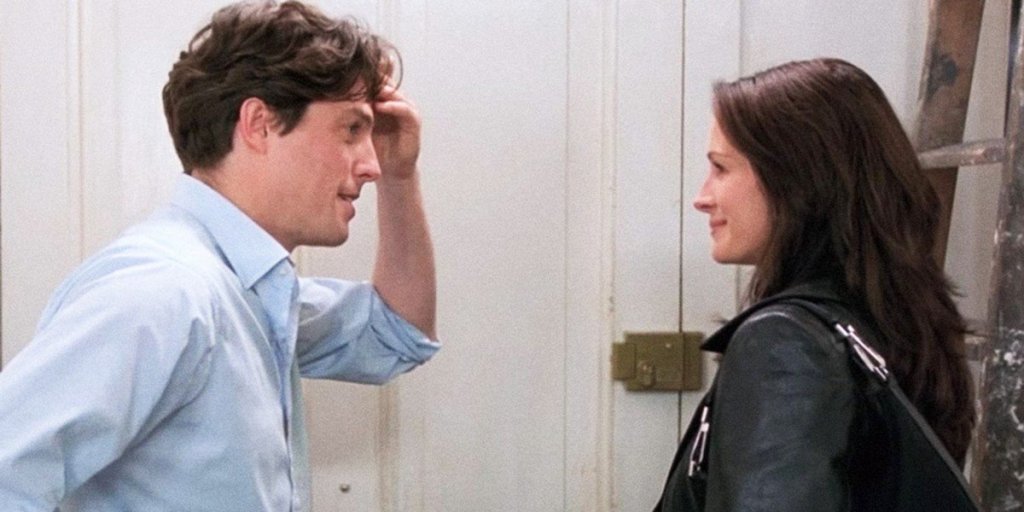
Brad reviews NOTTING HILL (1999), starring Julia Roberts and Hugh Grant!


Life takes an unexpected turn for the reserved Englishman William Thacker (Hugh Grant) when the hugely popular American movie star Anna Scott (Julia Roberts) wanders into his humble little travel book shop in the district of Notting Hill in West London. When the initial meeting is followed up by some coincidentally spilled orange juice and an unexpected kiss, William finds himself completely smitten. After Anna leaves, and still in a state of disbelief, William struggles focusing on his normal life with his eccentrically odd flat mate Spike (Rhys Ifans). When Anna surprisingly reaches back out to him wanting to get back together, the sweet and shy William is ecstatic, but he remembers that he’s already obligated himself to attend his sister Honey’s (Emma Chambers) birthday party that night. Wanting to be part of something normal, Anna goes to the party as William’s date, where she has a wonderful, relaxing evening with Honey and their close-knit group of best friends that includes Max (Tim McInnerny), Bella (Gina McKee) and Bernie (Hugh Bonneville), even if she did give them quite the shock when she walked through the door. Everything seems to be going beautifully, but the life of an international film icon tends to be complicated, and William soon finds himself caught up in a whirlwind that includes her “boyfriend,” the arrogant American actor Jeff King (Alec Baldwin). He’s not really her boyfriend anymore, but that seems of little consequence to the press. And then there’s the sudden emergence of racy pictures of Anna from her past in the British tabloids. As much as William loves Anna, will he ever be able to deal with life in Anna’s superstar spotlight?

NOTTING HILL is part of a trilogy of modern-day love stories that I’m sure to watch every year, with the other two being RETURN TO ME (2000) and HITCH (2005). I’ve noticed that these three movies have plot points in common that I find extremely appealing. First, both NOTTING HILL and RETURN TO ME feature main characters who have a group of loyal family and friends who offer uncompromising love and support. William Thacker’s sister and friends clearly care about him and want what’s best for him. If necessary, they’re willing to prove it by being honest with him when he’s unwilling to be honest with himself. One of the best scenes of the film occurs near the end when William tells his group of friends that he’s turned down Anna’s request to continue their relationship, even after she says the famous lines, “I’m also just a girl, standing in front of a boy, asking him to love her.” While his friends struggle to find the right words, the flaky Spike, played superbly by Rhys Ifans, rushes into the meeting and when asked his opinion, says these three words to William, “You daft prick!” A memorable song on the movie’s excellent soundtrack reminds us sometimes that “you say it best when you say nothing at all,” but sometimes words need to be spoken, and Spike cares enough to tell William what he needs to hear. I’ve said it before, but I love it when a movie surrounds its characters with the type of people we’d love to have in our corner in real life. Second, both NOTTING HILL and HITCH feature plot lines that show a “star” falling for a sweet nobody. Maybe it’s because I’m a nobody myself, but the idea of the rich and powerful falling in love with regular people like me always strikes a nerve. Sure, it may be a fantasy, but it’s a fantasy I’m perfectly willing to roll with. 

As far as I’m concerned, Julia Roberts and Hugh Grant have never been more appealing than they are in NOTTING HILL. Julia is so beautiful, and I fell in love with her myself for the first time when I watched this movie at the theater in 1999. There are scenes where William is watching Anna Scott on the big screen and the small screen, whether it be a love story or a science fiction movie, and he’s clearly in complete awe of her. As a film buff going back to my early teens, I can relate so easily to his character, whether it be my crush on Elizabeth Shue in the 80’s or Salma Hayek in 90’s. Heck, as recently as a couple of years ago, after interviewing the lovely Jan Gan Boyd who starred with Charles Bronson in ASSASSINATION (1987), I can still identify with a man completely smitten with a beautiful actress. And Hugh Grant is so sweet, witty and funny as William Thacker. This was a big film for Grant, as a few years earlier his promising Hollywood career had somewhat stalled due to his arrest on Sunset Strip in Los Angeles for “lewd conduct in a public place” with a prostitute named Divine Brown. With the irony not lost on me, if you’ve seen NOTTING HILL before you’ll understand that my inclusion of this matter of public record proves the character of Anna Scott to be correct when she explains to William just how difficult it can be to live life in the public eye. Regardless of all that, Hugh Grant is great in the film, and with a few years separating the events, it seems the filmgoing public was ready for forgiveness. NOTTING HILL was a runaway box office success, raking in $365 million dollars at the worldwide box office. 

The final thing I want to point out about NOTTING HILL is the incredible talent behind the scenes. Director Roger Michell helmed one of my very favorite Jane Austen adaptations, PERSUASION from 1995, starring Amanda Root and Ciaran Hinds. It’s a perfect movie as far as I’m concerned, and I watch it several times every year. Writer Richard Curtis has written the wonderful films FOUR WEDDINGS AND A FUNERAL (1994), BRIDGET JONES’S DIARY (2001), and LOVE ACTUALLY (2003), and he clearly knows how to push our love buttons. Both Michell and Curtis do the most successful work in their careers here. Now whether or not it’s their very best is a matter of opinion, but it’s definitely great work that I can confidently recommend to anyone. 
Playing Catch-Up With The Films of 2016: Eye In The Sky (dir by Gavin Hood)


Eye in the Sky is many things.  It’s a tense and involving drama.  At times, it’s a satire of the bland and often cowardly bureaucracy that controls so much of the world.  Occasionally, it’s an angry polemic and a sad-eyed look at the state of the world today.  It’s a film about drone warfare, one that is remarkably honest about both the costs and the benefits of being able to randomly blow people up on the other side of the world.  It’s a film that will make you think and it will make you cry and it will even make you laugh in a resigned sort of way.

But, at heart, it’s ultimately the story of two houses in Nairobi, Kenya.

In the first house, terrorists are plotting their next attack.  The film leaves little doubt as to what they are planning.  Thanks to a miniature drone controlled by Jama Farah (played by Barkhad Abdi and it’s good to see him giving as good a performance here as he did in Captain Phillips), both American and British intelligence are aware of what’s happening in that house.  A British jihadist is planning her next attack.  Guns are being loaded.  Suicide vests are being prepared.  If nothings done to stop their plans, hundreds of people are going to die.

Sitting nearby is the other house.  And, in this other house, an apolitical Kenyan family is going about their day with zero knowledge of what’s happening just a few doors down.  11 year-old Alia Mo’Allim (Aisha Takow) twirls a hula hoop while her father watches.  Later, in the day, she’ll go out in her village and, while the local militia harasses anyone who doesn’t look right to them, Alia will attempt to sell bread.  She’ll set up her table directly outside of the first house.

And what no one in that village realizes is that an armed drone is hovering above them.  As they go about their day, they have no idea that there are men and women in America and Britain who are debating whether or not to blow them up.

Colonel Katherine Powell (a steely and totally convincing Helen Mirren) is determined to blow up that house and the terrorists within, even if it means blowing up Alia in the process.  However, before Powell can give the order, she has to get permission from Lt. Gen. Frank Benson (Alan Rickman, at his weary best) and Benson has to get permission from the government.  And the government is full of people who are eager to take credit for killing terrorists but who don’t want to be blamed for any of the inevitable collateral damage.  Everyone passes responsibility to someone else.

Powell may be the most determined of everyone to blow up that house but she is not the one who will actually be firing the missiles.  That responsibility falls on two Americans, Lt. Steve Watts (Aaron Paul) and Carrie Gershon (Phoebe Fox).  As the teorrists prepare and Alia tries to sell bread and the bureaucrats debate, Watts and Gershon are the only ones who seem to truly understand what’s about to happen.  If they fire the missiles, Alia will probably die.  If they don’t, hundreds of other definitely will.

It all makes for incredibly tense and thought-provoking film, one that is all the more effective because it actually allows both sides to make their case.  In Eye in the Sky, no one is presented as being perfect.  On the one hand, Powell may be willing to manipulate the data to get permission to fire that missile.  But, on the other, the film doesn’t deny that Powell is right when she says that if they don’t blow up the terrorists when they have a chance, hundreds of innocent people are going to die.  Towards the end of the film, Alan Rickman says, “Never tell a soldier that he doesn’t understand the cost of war,” and Eye in the Sky appears to understand that cost as well.  Nobody escapes this film untouched.

Well-acted and intelligently written and directed, Eye in the Sky was one of the most thought-provoking films of the previous year.  See it if you haven’t.

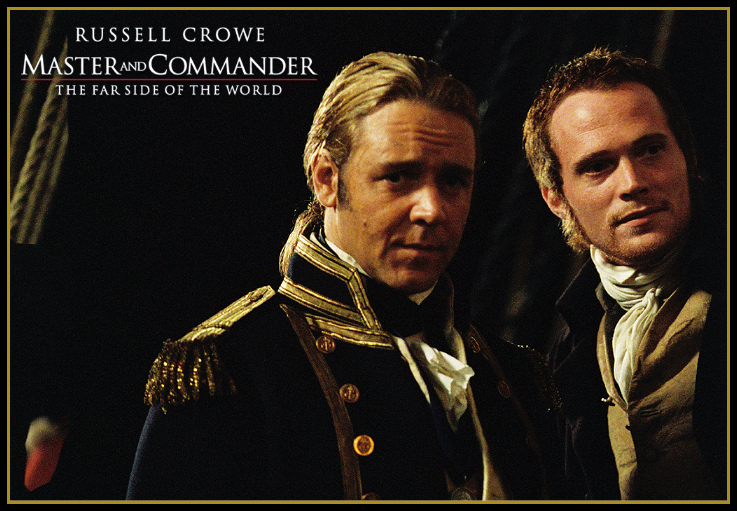
Quickie Review: Master and Commander: The Far Side of the World (Peter Weir)


If there was a film which deserved better when it first came out in 2003 it would be Peter Weir’s epic adaptation of the Patrick O’Brian seafaring novels starring the character of Capt. Jack Aubrey. It was just bad luck on the part of Weir’s film that it came out the same year and month as the juggernaut that would sweep through not just the box-office for the 2003 holiday season, but all through the award-season. If Master and Commander: The Far Side of the World had only come out a year later there’s a great chance it would’ve been the frontrunner for 2005 Academy Awards for Best Picture, Best Director, Best Adapted Screenplay and many more. But the juggernaut that was Peter Jackson’s Lord of the Rings: The Return of the King would not be denied after two previous years when Jackson and his magnum opus were passed over.

To say that Peter Weir was at the top of his game with Master and Commander would be an understatement. Working from a script written by Weir himself and John Collee, the film would take several episodes from the Patrick O’Brian Aubrey-Maturin novels and combine them to make a coherent and thrilling period piece that rarely ever get made anymore. This was epic filmmaking at its finest with Weir’s direction keeping the long-running time of the film from becoming too tedious. Yet, he was also able to keep the film from becoming one battle setpiece following another. There was enough of a balance between the quiet storytelling, especially between the characters of Capt. “Lucky” Jack Aubrey (played by Russell Crowe in what had to be his best role ever) and his close friend and ship’s doctor Stephen Maturin (Paul Bettany matching Crowe scene for scene) to keep the film grounded in reality.

Master and Commander is set during the Napoleonic Wars when France and England battle it out on land and in the high seas. On one side is the HMS Surprize captained by Jack Aubrey which patrols the sea lanes from French privateers looking to attack and loot the rich English whaling ships to help fund Napoleon’s ambitions. The film is actually a cat-and-mouse thriller wrapped around a character piece as Aubrey’s ship and crew, outgunned and less armored than the French frigate Acheron it has come across during its patrol, must not just try and survive but find a way to beat it’s larger opponent. It’s during the quiter scenes in-between sea engagements that the film actually becomes stronger. We see life onboard the HMS Surprize as being quite harsh and primitive and not so glamourous as past films about sailing life would have audiences believe. The film shows how this harsh life for volunteers and press-ganged crew ratings creates a strong bond of fellowship amongst the crew members that when they believe someone is jeopardizing their lives they quickly turn on that individual. But it’s through the near-dictatorial handling of his crew which keeps both ship and crew from devolving into mutiny. Crowe does a great job of giving Jack Aubrey that balance of ruthless taskmaster whose word is law onboard, but also gives his captain that bon vivant flair which when used accordingly makes Aubrey a hero to the very men he has to lord over.

This benevolent dictator was balanced out by Bettany’s Dr. Maturin who acts not just as the scientific counter to Aubrey’s militaristic personality, but also as the conscience of the ship who looks first to the crew’s well-being. This dynamic between Crowe and Bettany kept the film anchored and stabilized as we see the long-standing friendship between these two get tested not just by the crisis they find themselves in but also the vast ideological differences between the military man and the scientist. Yet, despite all their problems and difference when things became rough the two would settle it amicably and concentrate on their shared task with their bond of friendship intact and much stronger after.

The film doesn’t shirk it’s thrills as Master and Commander provides audiences with some of the most thrilling and accurate portrayal of naval combat during the Napoleonic era. There are no steel-hulls or rapid-fire guns. The engagements between the HMS Surprize and the Acheron were all brutal affairs from the first time the latter ambushes Aubrey’s ship early in the film to the final battle which sees not just ship-to-ship fighting but boarding actions as the crew of the Surprize attempt a desperate gamble to take the fight to the bigger French privateer. It’s a testament to Weir’s direction that even through the chaotic nature of each battle he’s able to keep each scene easy to follow and allow for main characters to stand out for audiences to recognize.

It’s a shame that the film didn’t succeed in the box-office more than it did. Master and Commander: The Far Side of the World showed that there was still old-school epic filmmaking left in Hollywood with filmmakers willing to tell a grand story with bigger-than-life characters on a broad canvas. The fact that it took an even more epic film to surpass Peter Weir’s film shouldn’t detract from this film’s accomplishments.