For today’s horror on television, we’re very happy to present to you, Dead of Night!
From 1977, this television film is a horror anthology, made up of three stories directed by Dan Curtis and written by Richard Matheson. In the first story, a youngish Ed Begley, Jr. travels through time. In the 2nd story, Patrick Macnee plays a man whose wife is apparently being menaced by a vampire. And in the third story, Joan Hackett plays a mother who brings her dead son back to life, just to discover that sometimes it’s best to just let sleeping corpses lies.
The entire anthology is good, though the third story is clearly the best and the most frightening. Not only is it scary but it’s got a great twist ending.
Today, I present to you one of the most important films in horror history. Though it wasn’t appreciated when it was first released back in 1964, The Last Man On Earth was not only the 1st Italian horror film but George Romero has also acknowledged it as an influence on his own Night of the Living Dead.
It’s easy to be a little bit dismissive of The Last Man On Earth. After all, the low-budget is obvious in every scene, the dubbing is off even by the standards of Italian horror, and just the name “Vincent Price” in the credits leads one to suspect that this will be another campy, B-movie. Perhaps that’s why I’m always surprised to rediscover that, taking all things into consideration, this is actually a pretty effective film. Price does have a few over-the-top moments but, for the most part, he gives one of his better performances here and the black-and-white images have an isolated, desolate starkness to them that go a long way towards making this film’s apocalypse a convincing one. The mass cremation scene always leaves me feeling rather uneasy.
The film is based on Richard Matheson’s I Am Legend and no, it’s nowhere as good as the book. However, it’s still a worthy adaptation and one that stays true to the tone of the text, including the fact that Price’s main tormenter was also once his neighbor and best friend. This is one of those films that just hits differently in the wake of 2020’s COVID hysteria.
And now, it’s time for The Last Man On The Earth….
For tonight’s horror on television, we have 1973’s The Night Strangler.
This is the sequel to The Night Stalker and it features journalist Carl Kolchak (Darren McGavin) in Seattle. (After all the stuff that happened during the previous movie, Kolchak was kicked out of Las Vegas.) When Kolchak investigates yet another series of murders, he discovers that paranormal murders don’t just occur in Las Vegas and aren’t just committed by vampires.
I actually prefer this movie to The Night Stalker. The Night Strangler features a truly creepy villain, as well as a trip down to an “underground city.” It’s full of ominous atmosphere and, as always, Darren McGavin is a lot of fun to watch in the role in Kolchak.
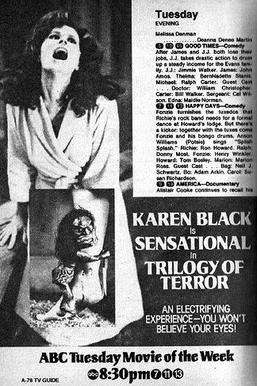
1975’s Trilogy of Terror is a true classic, a rare made-for-television horror film that could have just as easily and effectively been released in theaters.
As one can surmise from the title, it features three stories. Each story is directed by Dan Curtis and written by Richard Matheson. Each story also features Karen Black in the lead role, giving Black a chance to play not just one but four very different characters over the course of one film. One of the things that makes this film work so well is Karen Black’s totally committed performance. Sadly, Karen Black later expressed some regret about having appeared in the film because it led to her being typecast as a horror actress, which she definitely hadn’t been before. (One need only watch Karen Black in Five Easy Pieces, Nashville, or Family Plot to see what a good actress she was. Even in something like Easy Rider, where she had only a small role and very few lines, her talent is obvious.) As a result, Black was no longer considered for the big studio films that she had appeared in previously and instead, she spent the remained of her career appearing in low-budget horror films. That’s a shame because Trilogy of Terror really does show what a strong actress Black was.
The first segment features Black as Julie, a seemingly uptight teacher who somewhat surprisingly agrees to go out on a date with Chad (Robert Burton), a sleazy college student. Chad drugs Julie’s drink during their date and later undresses her and takes pictures which he then uses in an attempt to blackmail Julie into basically being his sex slave. Julie, however, turns out to have a big secret of her own and Chad discovers too late that he was the one who was being manipulated. This segment was the least interesting of the three stories but the ending was very satisfying. Anyone who has ever dated a “nice guy” who turned out to actually be a jerk will enjoy Julie’s revenge.
The second segment is enjoyably sordid, an over-the-top soap opera that I can’t talk too much about without spoiling the plot. Black plays Millicent, a repressed brunette, who is hatefully obsessed with her twin sister, blonde Theresa (Black again). Millicent fears that Therese is planning to corrupt and destroy her boyfriend, Thomas (John Karlen). Millicent explains to her therapist (George Gaynes) all of the terrible things that Therese has done. Of course, the truth turns out to be much more complicated. This story was entertaining and featured a surprisingly effective twist.
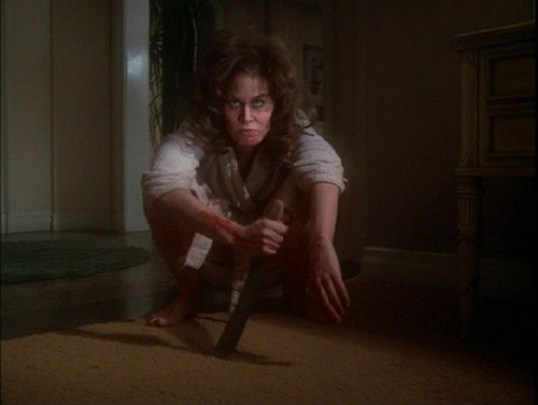
The third segment is the one that everyone remembers. Amelia (Karen Black) lives alone in a high-rise apartment and has recently purchased, as a present for her anthropologist boyfriend, a wooden fetish doll in the form of a misshapen aboriginal warrior with pointed teeth and a spear. The doll comes with a scroll that explains that the doll is inhabited by the spirit of a Zuni hunter and that the only thing keeping the doll from coming to life is the gold chain adorning the doll. Of course, the chain eventually falls off and Amelia finds herself being pursued through her apartment by a viscous doll that is obsessed with killing her. This is the simplest and the scariest of the Trilogy of Terror’s three stories. It’s easy to say that it’s just a doll until it pops out of nowhere and stabs Amelia in the ankle. This story ends on a properly dark note and that final image of Karen Black is haunting.
For a fifty year-old film, Trilogy of Terror holds up remarkably well. Watch it and witness just how good an actress Karen Black truly was.
Trilogy of Terror (1975, dir by Dan Curtis. DP: Paul Lohmann)
For today’s horror on the lens, we have 1973’s The Night Strangler.
This is the sequel to The Night Stalker and it features journalist Carl Kolchak (Darren McGavin) in Seattle. (After all the stuff that happened during the previous movie, Kolchak was kicked out of Las Vegas.) When Kolchak investigates yet another series of murders, he discovers that paranormal murders don’t just occur in Las Vegas and aren’t just committed by vampires.
I actually prefer this movie to The Night Stalker. The Night Strangler features a truly creepy villain, as well as a trip down to an “underground city.” It’s full of ominous atmosphere and, as always, Darren McGavin is a lot of fun to watch in the role in Kolchak.
For today’s horror on the Lens we have a made-for-TV movie that was produced and directed by Dan Curtis.
Trilogy of Terror, which aired in 1975, is an anthology film, featuring three segments that were each based on a short story from Richard Matheson. What makes this particular film special is that each segment features Karen Black playing a radically different character from the previous segment. The film really is a showcase for this underrated actress, though Black herself later said that the film ruined her career because it typecast her as a horror actress.
The third segment is the one that gets all the attention. That’s the one with the killer doll. I like all of the segments, though. The first one is often considered to be the weakest but anyone who has ever been through a similar situation will appreciate it as tale of revenge. The second segment has a playful vibe that I liked. And yes, the third segment is genuinely frightening.
Hi there and Happy October 8th! For today’s treat from the ranks of horror films that have fallen into the public domain, I present to you one of the most important films in horror history. Though it wasn’t appreciated when it was first released back in 1964, The Last Man On Earth was not only the 1st Italian horror film but George Romero has also acknowledged it as an influence on his own Night of the Living Dead.
It’s easy to be a little bit dismissive of The Last Man On Earth. After all, the low-budget is obvious in every scene, the dubbing is off even by the standards of Italian horror, and just the name “Vincent Price” in the credits leads one to suspect that this will be another campy, B-movie. Perhaps that’s why I’m always surprised to rediscover that, taking all things into consideration, this is actually a pretty effective film. Price does have a few over-the-top moments but, for the most part, he gives one of his better performances here and the black-and-white images have an isolated, desolate starkness to them that go a long way towards making this film’s apocalypse a convincing one. The mass cremation scene always leaves me feeling rather uneasy.
The film is based on Richard Matheson’s I Am Legend and no, it’s nowhere as good as the book. However, it’s still a worthy adaptation and one that stays true to the tone of the text, including the fact that Price’s main tormenter was also once his neighbor and best friend. This is one of those films that just hits differently in the wake of 2020’s COVID hysteria.
If you have 87 minutes to kill, please enjoy The Last Man On The Earth.
“Shall I ever see the rare and radiant Lenore again?” — Dr. Erasmus Craven (Vincent Prince)
“How they Hell should I know?” — Dr. Adolphus Bedlo (Peter Lorre)
This exchange comes from Roger Corman’s 1963 film, The Raven, and it pretty much epitomizes the film. Very loosely based on the poem by Edgar Allan Poe, The Raven was one of the many Poe adaptations that Corman did with Vincent Price. As opposed to the other films in Corman’s Poe cycle, The Raven was a flat-out comedy, one that parodied the other films in the cycle. Reportedly, Peter Lorre improvised his response to Vincent Price’s question about Lenore. In fact, Lorre improvised a good deal of his performance and his jokes sometimes even took Corman by surprise. As a result and despite the fact that Richard Matheson did write a script for the film, The Raven is one of those films that feels like it was made up while the camera was rolling.
The Raven is a film about three sorcerers who are always fighting and arguing with each other. Dr. Erasmus Craven (Vincent Price) spends his time mourning the late Lenore. The evil Dr. Scarabus (a frail-looking Boris Karloff) has his own castle where he lives with the ghost of the late Lenore (Hazel Court). Dr. Adolphus Bedlo (Peter Lorre) is a sarcastic ne’er-do-well who saw Lenore in Scarabus’s castle and was transformed into a talking raven as a result.
In raven form, Dr. Bedlo flies over to Craven’s castle and convinces Craven to transform him back into human form. After informing Craven that Scarabus has Lenore’s ghost in his castle, the heart-broken Craven decides to head over to Scarabus’s castle and get some answers. Accompanying the group is Craven’s daughter, Estelle (Olive Sturgess) and Bedlo’s son, Rexford (Jack Nicholson, looking somewhat lost in the role of a boring young man).
At the castle, Scarabus puts on an act of being a friendly and gracious host but the opposite soon turns out to be true. In fact, the entire castle is full of secrets and it quickly turns out that hardly anyone — with the exception of Estelle and Rexford — are who they actually claim to be. It leads to a battle in magic between Craven and Scarabus. I nearly described their battle as being “epic” but that’s probably not the right world. It’s epic by the standards of Roger Corman but actually, the big battle is just as jokey as the rest of the film.
The Raven is definitely not a film that’s meant to be taken seriously. One gets the feeling that Corman knew that the presence of Price, Karloff, and Lorre would make the film a success no matter what the film was like so he decided to have some fun with it. (Price and definitely Lorre appear to have been in on the joke while Karloff was perhaps a bit less so.) To be honest, the film’s only earnest moments come courtesy of Oliva Sturgess and Jack Nicholson but, because Nicholson is Nicholson, you watch those earnest moments waiting for Rexford to arch an eyebrow or flash that devilish grin. Unfortunately, he doesn’t. Jack is pretty boring here.
The Raven, if we’re going to be honest, is probably too jokey for its own good but it’s still hard to resist the charm of Price, Lorre, and Karloff. The film is a chance to see three horror icons acting opposite each other and, as a result, it’s a fun film for horror fans. Vincent Price breaks the fourth wall at the end of the film and it’s hard not to love it.
Hi there and Happy October 28th! For today’s treat from the ranks of horror films that have fallen into the public domain, I present to you one of the most important films in horror history. Though it wasn’t appreciated when it was first released back in 1964, The Last Man On Earth was not only the 1st Italian horror film but George Romero has also acknowledged it as an influence on his own Night of the Living Dead.
It’s easy to be a little bit dismissive of The Last Man On Earth. After all, the low-budget is obvious in every scene, the dubbing is off even by the standards of Italian horror, and just the name “Vincent Price” in the credits leads one to suspect that this will be another campy, B-movie. Perhaps that’s why I’m always surprised to rediscover that, taking all things into consideration, this is actually a pretty effective film. Price does have a few over-the-top moments but, for the most part, he gives one of his better performances here and the black-and-white images have an isolated, desolate starkness to them that go a long way towards making this film’s apocalypse a convincing one. The mass cremation scene always leaves me feeling rather uneasy.
The film is based on Richard Matheson’s I Am Legend and no, it’s nowhere as good as the book. However, it’s a lot better than the Will Smith version.
If you have 87 minutes to kill, please enjoy The Last Man On The Earth.
Miriam Oliver (Karen Black) is a prim housewife who always keep her hair in a tight bun and who wears eyeglasses. After she starts to have dreams about going to her own funeral, Mrs. Oliver’s personality starts to change. Her husband, Greg (George Hamilton), can only watch as Mrs. Oliver puts on a blonde wig, ditches her eyeglasses, and starts to dress in revealing clothes. Greg wants to concentrate on starting a family but the new Mrs. Oliver only cares about going out and partying all night. She also wants to move into a new house, one that was previously owned by a woman named Sandy. Sandy, who was a student of the occult, died in a mysterious fire.
The Strange Possession of Mrs. Oliver is a good made-for-TV movie that gives viewers two Karen Blacks for the price of one! Black is undeniably sexy, whether she’s playing the prim Mrs. Oliver or the wild Sandy. But she also delivers a really good performance as she switches back and forth from being Mrs. Oliver and being Sandy. Richard Matheson provides an intelligent script while Gordon Hessler’s direction keeps you guessing as to whether Mrs. Oliver is truly possessed or if she’s just having a mental breakdown of some sort. This is an enjoyably twisty thriller with a good ending and a knockout performance from Karen Black.
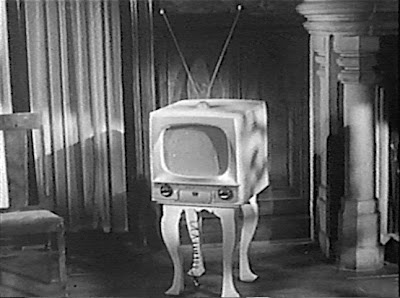 For today’s horror on television, we’re very happy to present to you, Dead of Night!


 Through the Shattered Lens