Cleaning Out The DVR: Just The Ticket (dir by Richard Wenk)


(Hi there!  So, as you may know because I’ve been talking about it on this site all year, I have got way too much stuff on my DVR.  Seriously, I currently have 193 things recorded!  I’ve decided that, on January 15th, I am going to erase everything on the DVR, regardless of whether I’ve watched it or not.  So, that means that I’ve now have only have a month to clean out the DVR!  Will I make it?  Keep checking this site to find out!  I recorded the 1999 romantic comedy Just The Ticket off of Epix on October 13th!)

Just The Ticket tells the story of Gary Starke (Andy Garcia).

Gary lives in New York City.  He is a tough, streetwise character, loyal to his friends and quick to anger if he feels that anyone is trying to take advantage of him.  He has no time for pretentious posturing or snobbish social gatherings.  Gary’s a man of the people.  He works with and takes care of an aging former boxer named Benny (Richard Bradford).  He looks after a pregnant, former drug addict named Alice (Laura Harris).  When the slick and dangerous Casino (Andre B. Blake) starts to do business in Gary’s territory, Gary is the only person with the guts to stand up to him.  Having never had a family (he’s never even seen his birth certificate and has no idea who his parents were), Gary has adopted the street people as his surrogate family.

That’s not all.  Gary is also a lapsed Catholic who, when he goes to confession, opens by saying that it’s been 25 years since his last confession and that he’s taken the Lord’s name in vain 20 to 30 times that morning.  Gary needs some help because his girlfriend, an aspiring chef named Linda (Andie McDowell), has left him and Gary wants to win her back.  The priest asks Gary if he can get him tickets to see the Knicks…

Why does he ask that?

You see, Gary is a legendary ticket scalper and…

Okay, I probably just lost you when I used the terms “legendary” and “ticket scalper” in the same sentence.  And I’ll admit that, when I discovered this movie was about ticket scalpers, it nearly lost me as well.  Just The Ticket treats ticket scalping with a dignity and reverence that I’m not quite sure it deserves.  I wasn’t surprised to discover that director/writer Richard Wenk apparently based the character of Gary on an actual ticket scalper that he knew.  A lot of bad movies have been made as the result of a director, writer, or producer coming across some mundane activity and thinking, “Wow, this would make a great movie!”

(That’s one reason why, every few years, we suddenly get a dozen movies about race car drivers.)

However, I was pleasantly surprised to discover that Just The Ticket is not a terrible movie.  Admittedly, it’s totally predictable and there are a lot of scenes that don’t work.  For instance, there’s a lengthy scene where Gary and Linda destroy a snobbish food critic’s kitchen.  I could imagine Gary doing that because he has nothing to lose.  But Linda is actually hoping to become a chef in New York City.  Would she really run the risk of making a permanent enemy at the New York Times?  There’s nothing about Andie McDowell’s performance that suggests she would.  The scenes between Gary and his aging partner also tend to overplay their hand.  Richard Bradford gives a good performance as Benny but we all know what’s going to end up happening to him as soon as he starts crying after Gary insults him.

With all that in mind, Just The Ticket still has an undeniable charm.  Some of it is due to Andy Garcia’s dedicated performance.  He is frequently better than the material and he and Andie McDowell have enough chemistry that you do want to see Linda and Gary get back together.  Some of it is because Just The Ticket is not afraid to shy away from being sentimental.  It’s hard to think of any other romantic comedy in which the Pope plays such an important supporting role.  It’s a sweet movie.  It has a good heart.

There’s something to be said for that.

A Movie A Day #265: Hoodlum (1997, directed by Bill Duke)


1930s.  New York City.  For years, Stephanie St. Clair (Cicely Tyson) has been the benevolent queen of the Harlem underworld, running a successful numbers game and protecting her community from outsiders.  However, psychotic crime boss Dutch Schultz (Tim Roth) is determined to move into Harlem and take over the rackets for himself.  With the weary support of Lucky Luciano (Andy Garcia), Schultz thinks that he is unstoppable but he did not count on the intervention of Bumpy Johnson (Laurence Fishburne).  Just paroled from Sing Sing, Bumpy is determined to do whatever has to be done to keep Schultz out of Harlem.

When I reviewed The Cotton Club yesterday, I knew that I would have to do Hoodlum today.  Hoodlum and The Cotton Club are based on the same historic events and both of them feature Laurence Fishburne in the role of Bumpy Johnson.  Of the two, Hoodlum is the more straightforward film, without any of the operatic flourishes that Coppola brought to The Cotton Club.  Fisburne is surprisingly dull as Bumpy Johnson but Tim Roth goes all in as Dutch Schultz and Andy Garcia is memorably oily as the Machiavellian Luciano.  Hoodlum is about forty minutes too long but the gangster action scenes are staged well.  Bumpy Johnson lived a fascinating life and it is unfortunate that no film has yet to really do him justice, though Clarence Williams III came close with his brief cameo in American Gangster.  (Interestingly enough, Williams is also in Hoodlum, playing one of Shultz’s lieutenants.)

One final note: Hoodlum features William Atherton in the role of District Attorney Thomas E. Dewey.  Atherton plays Dewey as being a corrupt and sleazy politician on Luciano’s payroll.  In real life, Dewey was known for being so honest that Dutch Schultz actually put a contract out on his life after he discovered that Dewey could not be bribed.  I am not sure why Hoodlum decided to slander the subject of one of America’s most famous headlines but it seems unnecessary.

A Movie A Day #245: The Missouri Breaks (1976, directed by Arthur Penn)


After Tom Logan (Jack Nicholson) and his gang of rustlers (played by Randy Quaid, Frederic Forrest, and Harry Dean Stanton) rob a train, Logan uses the money to buy a small ranch.  Their new neighbor is Braxton (John McLiam), a haughty land baron who considers himself to be an ambassador of culture to the west but who is not above hanging rustlers and hiring gunmen.  One such gunman is the eccentric Robert E. Lee Clayton (Marlon Brando), a “regulator” who speaks in a possibly fake Irish brogue, is a master of disguise, and uses a variety of hand-made weapons.  Braxton hires Clayton to kill Logan and his men, despite the fact that his daughter (Kathleen Lloyd) has fallen in love with Logan.
A flop that was so notorious that it would be five years before Arthur Penn got a chance to direct another film, The Missouri Breaks is best remembered for Marlon Brando’s bizarre performance.  Brando reportedly showed up on the set late and insisted on largely improvising his part, which meant speaking in a comical Irish accent, singing an impromptu love song to his horse, and disguising himself as an old woman for one key scene.  (According to Patrick McGilligan’s Jack’s Life: A Biography of Jack Nicholson, co-star Harry Dean Stanton grew so incensed at Brando’s behavior that he actually tried to rip the dress off of Brando, saying that he simply would not be “killed’ by a man wearing a dress.)  Brando’s later reputation for being a disastrously weird performer largely started with the stories of his behavior on the set of The Missouri Breaks.

I had heard so many bad things about Brando and The Missouri Breaks that I was surprised when I finally watched it and discovered that it is actually a pretty good movie.  For all of his notoriety, Brando does not enter this leisurely paced and elegiac western until after half a hour.  The majority of the movie is just about Jack Nicholson and his gang, with Nicholson giving a low-key and surprisingly humorous performance that contrasts well with Brando’s more flamboyant work.  While Arthur Penn may not have been able to control Brando, he still deftly combines moments of comedy with moments of drama and he gets good performances from most of the supporting cast.  Quaid, Stanton, Forrest, and Nicholson are all just fun to watch and the rambling storyline provides plenty of time to get to know them.  Whenever Brando pushes the movie too close to self-parody, Nicholson pulls it back.   The Missouri Breaks may have been a flop when it was released but it has aged well.

The TSL’s Grindhouse: Night Game (dir by Peter Masterson)


Apparently, today is the opening day of the 2017 baseball season.  The only reason that I know that is because of my sister Erin.  I don’t know much about baseball, to be honest.  I know that my city’s team is the Texas Rangers and they were once owned by George W. Bush.  I know that Houston has a team called the Astros.  But, really, the main thing that I know about baseball is that my sister absolutely loves it.

So, when Erin asked me to review a baseball movie today, how could I say no?  I mean, I may know next to nothing about baseball but I certainly know something about movies!

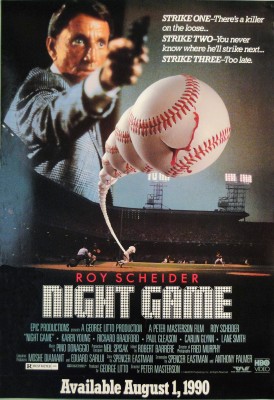
For that reason, I’m going to take a few minutes to tell you about a 1989 film called Night Game.  Night Game is many things.  It’s a movies that features a lot of baseball, even though it’s not really a sports film per se.  It’s a police procedural, though the film itself suggests that the police often don’t have the slightest idea what they’re actually doing.  It’s a serial killer film, though its killer is never quite as loquacious as we’ve come to expect in this age of Hannibal Lecter and Dexter Morgan.  At times, it’s a slasher film, though it’s never particularly graphic.  Mostly, Night Game is a Texas film.

Directed by native Texan Peter Masterson, Night Game is like the original Texas Chainsaw Massacre in that it is one of those rare films that not only takes place in Texas but was actually filmed on location.  To be exact, Night Game was filmed in both Galveston and Houston.  The entire film has a friendly and quirky Texas feel to it.  Masterson may not have been a great visual director (If not for some language and nudity, Night Game could pass for a TV movie) but Night Game is a movie where the plot is less important than capturing the little details of a time. a location, and the people who lived there.  Though Night Game is 28 years old, it’s portrait of my home state still seemed very contemporary to me.  I guess Texas hasn’t really changed that much over the past few decades.

As for the film’s plot, someone is murdering young women in Galveston and leaving their bodies on the boardwalk.  Obviously, that’s not going to be good for attracting Spring Break revelers.  The film doesn’t make any effort to keep the murderer’s identity a secret.  We see his face fairly early on.  We also see that he has a hook for a hand.  Eventually, we do learn the murderer’s motives.  They’re pretty silly but then again, individual motives rarely make sense to anyone other than the guy with the hook for a hand.

Detective Mike Seaver (Roy Scheider) has been assigned to solve the case.  One thing that I really liked about Night Game was that Mike was pretty much just a normal guy with a job to do.  He wasn’t self-destructive.  He wasn’t always drunk.  He wasn’t suicidal.  He wasn’t always lighting a cigarette and staring at the world through bloodshot eyes while the lighting reflected off of his artful stubble.  He was just a detective trying to do his job and get home on time.  After sitting through countless films about self-destructive cops and criminal profilers, the normalcy of Mike was a nice change of pace.

Mike does have a backstory.  He used to play baseball and he still loves the game.  He goes to every Astros home game in Houston.  He’s in love with Roxy (Karen Young), who works at the stadium.  Things are only slightly complicated by the fact that Mike had a previous relationship with Roxy’s mother (Carlin Glynn).  Don’t worry, Mike’s not secretly Roxy’s father or anything like that.  It’s not that type of movie.

Anyway, Mike is such a fan of baseball that he realizes something.  The killer only strikes on nights that the Astros win a game.  And he only strikes if a certain pitcher was throwing the ball.  The obvious solution would be to shoot the pitcher in the arm and end his athletic career.  However, Mike’s too nice a guy to do that.  Instead, he just tries to track down the killer…

And, as I said, Night Game actually isn’t a bad little movie.  Make no mistake, it’s a very slight movie.  At no point are you going to say, “I’m going to remember that scene for the rest of my life!”  That said, it’s a surprisingly good-natured film and Roy Scheider’s performance is likable and unexpectedly warm.  With all that in mind, Night Game is an entertaining and (mildly) bloody valentine to my home state.

Plus, it’s a baseball movie!  I don’t know much about baseball but, if my sister loves it, it has to be a good thing!

When McQueen Met Ibsen: An Enemy of The People (1978, directed by George Schaefer)


What happened when famed action star Steve McQueen met playwright Henrik Ibsen?

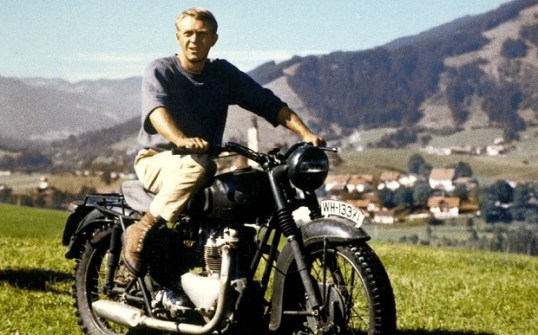
Here’s Steve McQueen in The Great Escape:

Steve McQueen In The Great Escape

This is Steve McQueen in Bullitt:

Steve McQueen in Bullitt

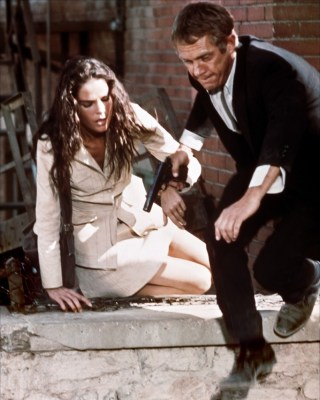
Here’s Steve McQueen with his future wife, Ali MacGraw, in The Getaway:

Steve McQueen in The Getaway

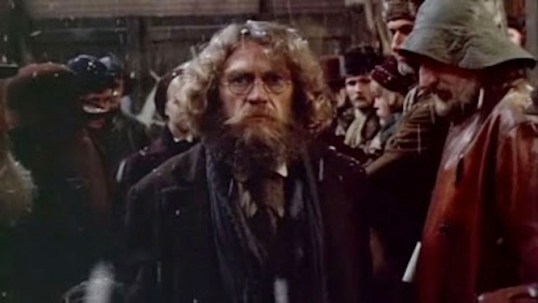
And finally, here’s Steve McQueen starring in An Enemy of the People:

Steve McQueen in Enemy of the People

In the four years between appearing in the Oscar-nominated The Towering Inferno and starring in An Enemy of the People, McQueen notoriously turned down several high-profile projects.  He turned down the lead role in Sorcerer because director William Friedkin would not write a role for MacGraw.  He turned down the lead role in Steven Spielberg’s Close Encounters of The Third Kind because he felt that he would not be able to cry on cue.  (When Spielberg offered to take out the crying scene, McQueen replied that it was the best scene in the script.)  Francis Ford Coppola could not afford his salary and McQueen missed out on the chance to play Capt. Willard in Apocalypse Now, a role he would have been perfect for.

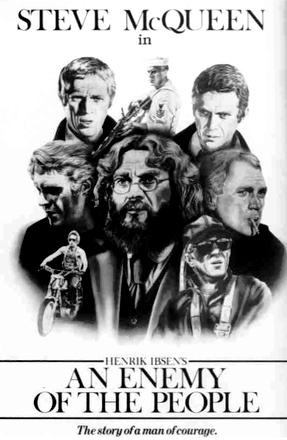
AnEnemyOfThePeople_posterInstead, after a four years absence, McQueen returned to the screen in one of the least expected films of his career.  Based on Arthur Miller’s adaptation of Henrik Ibsen’s original play, An Enemy of the People featured McQueen playing Dr. Thomas Stockmann, a scientist who discovers that his town’s local spring has been polluted by a tannery.  When Stockmann reveals his findings, the town turns against him and his family.  Stockmann has to decide whether to give into pressure from the town or to stay true to his principles.
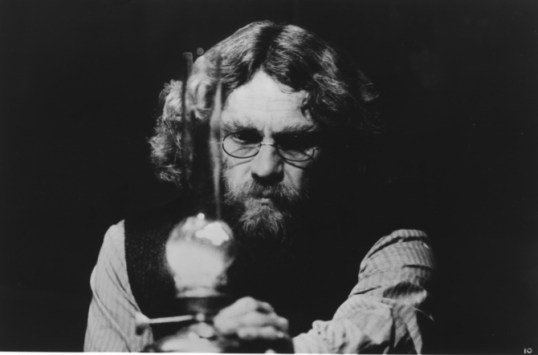
As a star who was best known for playing stoic men of action, Steve McQueen was the last actor that anyone expected to appear in a film based on an Ibsen play.  McQueen also insisted on playing the role with a heavy beard and a stocky build, making him virtually unrecognizable on-screen.  Warner Bros. had no idea how to advertise An Enemy of The People so they didn’t.  After a year of sitting on the shelf, An Enemy of the People was given a limited run in a few college towns.  Many critics assumed that McQueen deliberately made an uncommercial movie just to get out of his contract with Warner Bros but, according to both Ali MacGraw and Marshall Terrill’s Steve McQueen: An American Rebel, McQueen was actually very enthusiastic about making An Enemy of the People and extremely disappointed when it was not a success.  After the film failed to find an audience, Steve McQueen returned to appearing in action films and westerns.

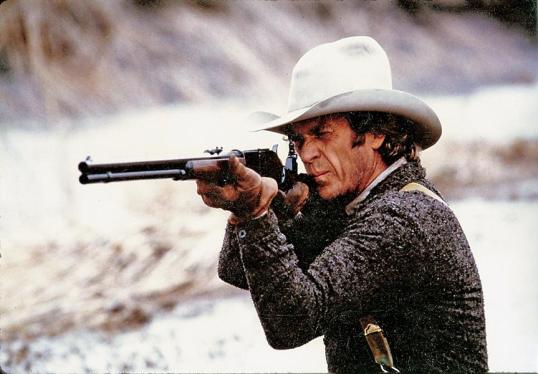
Steve McQueen in Tom Horn (1980)

Steve McQueen in Tom Horn (1980)

I recently saw An Enemy of the People on TCM and I thought it was slow and didactic.  (It did not help that An Enemy of the People is Ibsen’s weakest play.)  Especially in the beginning, there are a few scenes where McQueen struggles to hold his ground against co-stars Charles Durning and Richard Dysart, both of whom had far more theatrical experience.  But McQueen gets better as the film goes on and proves that his deceptively casual approach can still be effective even when he is playing an intellectual who chooses to make his point with his words instead of his fists.  He does a good job handling Ibsen’s notoriously wordy speeches.  By the end of the movie, the idea of Steve McQueen in an Ibsen play no longer seems strange at all.

After An Enemy of the People, McQueen would only make two more movies before dying of cancer at the age of 50.  Based on his performance as Dr. Stockmann, I believe that if McQueen had not died, he would have aged into being a great actor, in much the same way as Clint Eastwood.  It’s unfortunate that McQueen never got that chance.

bfi-00o-4ni