TV Review: Twin Peaks 1.3 “Zen, or the Skill to Catch a Killer” (dir by David Lynch)


“She’s filled with secrets. Where we’re from, the birds sing a pretty song and there’s always music in the air.”

— The Man From Another Place (Michael Anderson) in Twin Peaks Episode 1.3, “Zen, or the Skill to Catch a Killer”

Oh my God, this is the episode with the dream!!!

Okay, a confession.  Originally, this episode was not assigned to me.  Originally, it was assigned to someone else.  However, as soon as I realized that this was the episode that ended with the dream sequence, I begged and begged to be allowed to review it.  I even cried a little.

Seriously, I love this episode.

Of course, when people talk about how “weird” Twin Peaks supposedly was, this is one of the episodes that they usually cite as evidence.  They always mention that little man who speaks backwards and who dances in the room with the red curtains.

However, I think that labeling this episode — or, for that matter, anything else that David Lynch has directed — as merely being “weird” is a major misreading of Lynch’s signature style.  When it comes to examining Lynch, it’s important to remember that, before he became a filmmaker, David Lynch was a painter.  A David Lynch-directed film (or television episode) is essentially a moving painting.  Often times, the plot is not to be found in the dialogue or what actually happens on screen.  The plot is to be found in the mood that Lynch’s visuals create.

I once read an interview with Lynch where he talked about being fascinated by the fact that, if you removed bark from a tree, you could discover a very chaotic world happening underneath an otherwise genteel surface.  All of his work has been about peeling back the outer layers of our world and seeing what lies underneath.  When you think of this episode’s famous dream as just being another layer, one that is hidden until we close our eyes, shut off our assumptions, and go to sleep, you realize that there’s nothing strange about it.

It’s just Twin Peaks.

So, with all that in mind, let’s take a look at the third episode of Twin Peaks, “Zen, or the Skill to Catch A Killer.”
 To say that we start with the opening credits probably sounds like the most obvious thing that I could possibly say conerning this episode but it’s still important to point out.  The opening credits of Twin Peaks — the combination of the mill, the mountains, the road, and Angelo Badalamenti’s beautiful theme music — are absolutely brilliant.  More than just letting you know what show you’re watching, the opening credits of Twin Peaks transport you into the world of this sordid little town.

And what’s happening in Twin Peaks?  It’s the third day of the Laura Palmer investigation.  The homecoming queen who tutored Johhny Horn (Robert Bauer), taught Josie (Joan Chen) how to speak English, and helped organize the local Meals on Wheels program is still dead and a shocked town is still struggling to come terms with it.  It all goes back to what I said earlier about how this show is all about peeling back layers and revealing what lies underneath.  Though each episode may end with Laura’s blandly pretty homecoming photo, the layers underneath are full of chaos and secrets.

The episode opens with an awkward dinner with the Horne family.  It’s Ben (Richard Beymer), Audrey (Sherilyn Fenn), Johnny, and Ben’s wife.  They’re all sitting in a dining room that, like every room in Ben’s hotel, is completely made out of wood.  (Again, you have to remember what Lynch said about the world underneath the bark.)  Nobody speaks.  It’s as awkward as that montage in Citizen Kane, the one where the collapse of Charles and Emily’s marriage is shown over the course of several increasingly strained breakfasts.  But then Ben’s brother, Jerry (David Patrick Kelly), shows up.  Jerry has just returned from Paris and he’s brought bread!

Up until this point, Ben has been a stiff figure, one who was largely defined by his greed.  But when Jerry shows up, Ben’s face lights up and, almost like an animal, he bites into the bread.  Why shouldn’t Ben be happy?  Jerry is as flamboyant and eccentric as Ben was measured and closed off.  (It helps that Jerry is played by David Patrick Kelly, who is one of those actors who can go totally over the top without losing his credibility or his charm.  Before playing Jerry, Kelly achieved pop culture immortality by chanting, “Warriors, come out to play!” in 1979’s The Warriors.)  When Jerry gets depressed at the news that the Norwegian deal fell through and that Laura Palmer’s dead, Ben suggests that they go to everyone’s favorite Canadian brothel, One-Eyed Jacks.

While we watch Ben and Jerry (undoubtedly named for everyone’s favorite Vermont capitalists) flirt with the lingerie-clad prostitutes at One-Eyed Jacks, we’re struck by just how dorky both of them truly are.  The Hornes may be one of the richest and most powerful families in town but, emotionally, Ben and Jerry are children, still trying to impress each other with their stunted masculinity.  The general ickiness of One-Eyed Jacks is nicely contrasted with a genuinely sweet scene of James Hurley (James Marshall) and Donna Hayward (Lara Flynn Boyle), wondering if they should feel guilty for being chastely attracted to each other so soon after Laura’s death.

Back at the hotel, Dale (Kyle MacLachlan) gets a call from Deputy Hawk (Michael Horse), informing him that a one-armed man has been seen wandering around the hospital.  There’s a knock at the door.  When Dale answers it, he finds only a note.  It reads: “Jack with One Eye.”

Meanwhile, the three least likable people on the show — Bobby Briggs (Dana Ashbrook), Leo (Eric Da Re), and idiot Mike (Gary Hershberger) — get to have a scene of the very own.  Bobby and Mike go out to the woods to pick up the drugs that they paid Leo for.  Leo’s waiting for them, of course.  He wants to know if Bobby knows who Shelley’s been cheating on him with.  Since that person would be Bobby, Bobby is quick to say that he has no idea.  It’s tempting to compare Bobby and Mike to Ben and Jerry.  Whereas Ben and Jerry are rich and can pretty much indulge their vices without any fear of retribution, Bobby and Mike are still trying to reach that point.  They still have to deal, on a face-to-face basis, with dangerous people like Leo.  Again, I found myself looking that all trees, all the bark, and all the layers that surrounded Mike, Bobby, and Leo.  Ben and Jerry may be rich but peel away and you’ll find Mike and Bobby.  Mike and Bobby may be football stars but peel away and you’ll find Leo.
The next morning, life in Twin Peaks continues.  Shelley (Madchen Amick), bruised from her latest beating, walks around the curiously unfinished home that she shares with Leo.  When Bobby comes by and says that he’ll kill Leo if he ever hits Shelley again, they kiss and the camera zooms in on the bruise on Shelley’s jaw.  When Ed Hurley (Everett McGill) gets yelled at for accidentally stepping on one of Nadine’s (Wendy Robie) drapes, he goes to the diner to see Norma (Peggy Lipton).

(Of all the minor characters in Twin Peaks, Nadine may seem like the most cartoonish but one should not be too quick to dismiss her.  Her obsession with creating a silent drape runner may seem insane but actually, it’s an attempt to bring a little peace and order to an otherwise chaotic world.  Nadine has become so obsessed with creating that peace that she doesn’t realize that she’s managed to alienate everyone around her.  Her attempts to find perfection have only amounted in creating more chaos.)

It’s all a bit soapy and I don’t want to spend too much time on any of those subplots.  Not in this review, anyway.  What’s important is what Agent Cooper, Harry (Michael Ontkean), Hawk, Andy (Harry Goaz), and Lucy (Kimmy Robertson) are doing during all of this.  If anyone had any doubt that Twin Peaks‘s version of the FBI is a bit different from the real world FBI, those doubts will be erased by the scene in which Cooper displays his investigative technique.

Out in the woods (and again, we’re reminded of the layers under the bark), Cooper has set up a blackboard.  “By way of explaining what we’re about to do, I am first going to tell you a little bit about the country called Tibet…”

Cooper explains the sad history of Tibet and how Communist China forced the Dalia Lama into exile.  “After having a dream three years ago,” Cooper woke up with much sympathy for the plight of the people Tibet and also with the knowledge of a new type of deductive technique.

That deductive skill comes down to throwing rocks at bottles while Sheriff Truman reads the name of every suspect whose name starts with a “J.”  If Dale hits a bottle, Lucy is instructed to put a check mark next to that person’s name.  Andy is sent down to stand near the bottle.

“I’m getting excited!” Andy shouts.

We all are, Andy.

Dale misses when Harry reads the names of James and Josie.  But, when he says, “Lawrence Jacoby!,” the rock hits the bottle but does not break.  “Make a note,” Dale says, regarding to the bottle not breaking, “that’s very important.”

The rest of the throws only lead to Andy getting bonked by a rock.  At least, that is until the final throw.  “Leo Johnson!” Harry says.  Dale throws the rock.  The bottle shatters.

As brilliant as MacLachlan is as Cooper, what really makes this scene work are the reactions of Harry, Hawk, Andy, and especially Lucy.  Harry watches it all with a resigned but respectful skepticism.  Hawk nods sagely as Cooper talks about the importance of being attuned with the spiritual world.  Andy insists that it didn’t hurt when he got hit in the head by a rock.  And Lucy gets totally and enthusiastically caught up in the minutiae of Cooper’s technique.  When Harry says that “Jack with One Eye” is probably a reference to One-Eyed Jacks, Lucy very earnestly explains that she’s going to have to erase Jack With One Eye off of the list of suspects.  By trying to apply logical rules to Cooper’s illogical technique, Lucy serves as a stand-in for the audience.  The pure and sincere earnestness of Kimmy Robertson’s performance is one of the best things about his episode.
At the diner, the Hayward Family eats an after-church lunch when Audrey comes in and plays a song on the jukebox.  Apparently, the jukebox only carries mood music written by Angelo Badalmenti.  Donna and Audrey talk and the scene makes good use of the contrast between the two, Donna being the stereotypical good girl with secrets and Audrey being the artist who has been incorrectly typecast as a bad girl.

Back at the police station, Albert Rosenfield (Miguel Ferrer) shows up and I have to admit that I got a little bit choked up when I saw Ferrer looking so young and healthy.  Albert is a forensic pathologist and he’s as abrasive as Dale is cheerful.  If Dale immediately fell in love with small town life, Albert hates everything about it.  Harry and Albert take an immediate dislike to each other, as well they should.  But the thing with Albert is that it’s impossible to dislike him because he’s played by Miguel Ferrer.  Ferrer could make even the most obnoxious of characters charming.

(Miguel Ferrer was the son of Jose Ferrer.  I just recently watched the 1952 best picture nominee Moulin Rouge, which starred Jose as artist Henri de Toulouse-Lautrec.  If I hadn’t already known they were related, I would have guessed just from looking at Miguel in this episode.  Miguel Ferrer died on January 7th of this year.  He and his immense talent will certainly be missed.)

Night falls in Twin Peaks.  Catherine (Piper Laurie) and Pete (Jack Nance) bicker.  Leland Palmer (Ray Wise) deals with his grief by picking up Laura’s picture and dancing with it while Pennsylvania 6-5000 plays on a record player.  “We have to dance for Laura!” Leland yells.  (This scene is even more disturbing if you’ve seen Twin Peaks: Fire Walk With Me.)

And, back in his hotel room, Dale Cooper is having the dream.

(It’s interesting to note that, when Dale goes to bed, he wears the type of pajamas that you would normally expect to see a suburban dad in a 1950s sitcom wear.  For all of his zen, Cooper truly is a symbol of what we think of as being a more innocent time.)

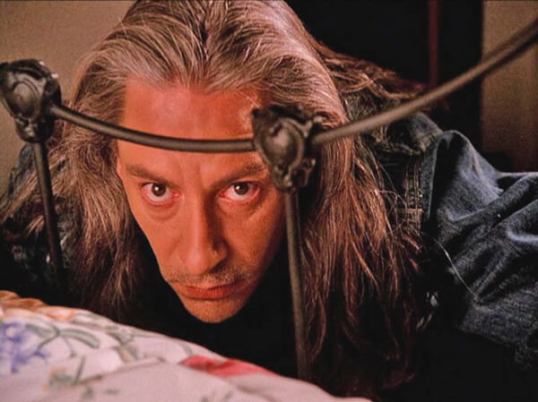
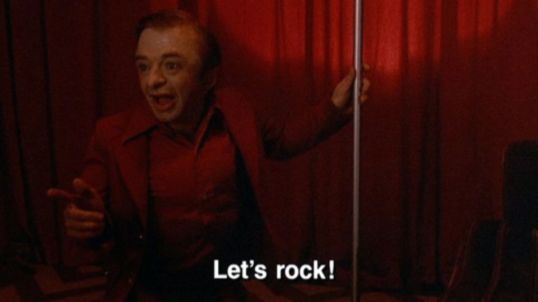
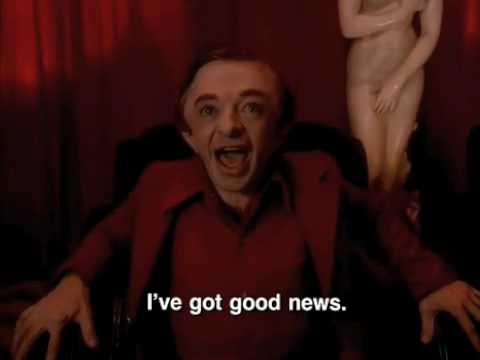
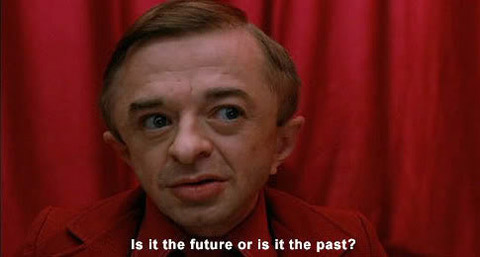
In his dream, a much older, gray-haired Dale Cooper sits in a room with red curtain.  (The old age makeup that was put on MacLachlan for the dream sequence immediately made me think of Keir Dullea watching himself age, at the end of 2001: A Space Odyssey, before being reborn as a new being.)  A little man — credited as being The Man From Another Place (Michael Anderson) — stands in a corner with his back to Dale and shakes in a way that almost seems obscene.  Somewhere, perhaps behind the curtains, a distorted voice chants, “Laura!  Laura!”

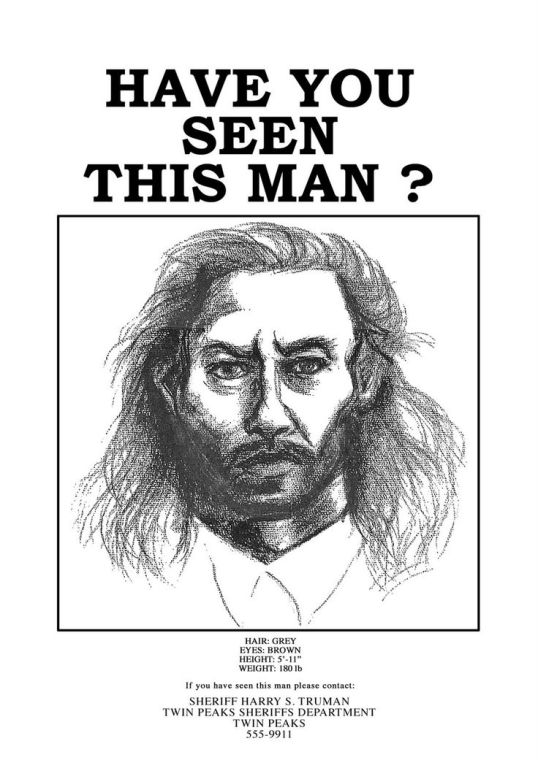
There are a succession of quick cuts.  Mrs. Palmer (Grace Zabriskie) runs down the dark staircase in her house.  The character who will eventually be known as Killer BOB (Frank Silva) stares menacingly at the viewer.

The one-armed man, who has wandered through the previous two episodes, appears and recites a poem: “Through the darkness of futures past/ The magician longs to see/ One chants out between two worlds/ Fire Walk With Me.”  The one-armed man says that “we lived among the people.  I think you say convenience store.  We lived above it.”  The man says that he was touched by the “devilish one.”  He has a tattoo on his left shoulder but when the man saw the face of God, he chopped his arm off.  “My name is Mike … his name is BOB.”

(Intentionally or not, we are reminded of another Mike and Bob who live in Twin Peaks.  Could the Mike and BOB of Cooper’s dream but just layers of what lies underneath the two drug-dealing star football players?  Is Cooper dreaming or is he just looking under the bark?)

BOB appears, sitting in what appears to be a boiler room, bringing to mind another film about a dream killer, Wes Craven’s A Nightmare on Elm Street.  BOB, never one for subtlety, announces, “I’ll catch you with my death bag! You may think I’ve gone insane, but I promise, I will kill again!”

The older Cooper is back in the room with red curtains.  The Man From Another Place continues to shake in the corner, his jerky movements almost mimicking masturbation.  Meanwhile, Laura Palmer, in a black dress, sits across from Cooper and smiles.

What follows is one of the best scenes in David Lynch’s legendary career.  When The Man From Another Place finally turns around and starts to talk to Cooper, his voice has been dubbed backwards.  The same is true of Laura when she speaks.  We only know what they say because of the subtitles.  It’s a very disconcerting effect, one that leaves us feeling as if the world is spinning in the wrong direction and might come off its axis at any moment.

The Man and Laura say a lot to Cooper.  Some of what they say we know to be true.  When The Man says that Laura is full of secrets, we know that he speaks the truth.  When he says that Laura is not Laura but is instead his cousin (“but doesn’t she look like Laura Palmer,” he says) we may be confused but lovers of film noir will immediately think of Otto Preminger’s Laurain which a detective thinks he’s falling in love with a dead woman until it’s revealed that the woman who was killed was not actually Laura but instead a look alike.  (It has been suggested that Laura Palmer was specifically named after the title character in Preminger’s film.)  When Laura says that, “Sometimes I feel like her but my arms bend back…,” it’s an obvious reference to the torture she endured in that railway car.

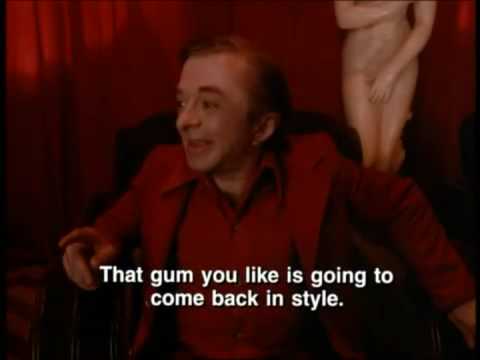
But there are other lines that only make sense if you’re willing to accept that they’re meant to be random.  Why does the Man tells Cooper, “The gum you like is going to come back in style?”  It could be an acknowledgement that the chivalrous and optimistic Cooper is a man out of time.  Or it could just be something that the Man said to make conversation.

And why does the Man From Another Place dance at the end of the dream?  That question gets asked more than any other and the answer is deceptively simple.  If you know anything about the aesthetic of David Lynch, you know that the Man From Another Place dances just because he does.  Things happen and, Lynch suggests, there often is no specific reason.

While the Man dances, Laura kisses Cooper.  As I rewatched this scene, I particularly noticed that creepy way that the previously chaste Cooper smiled as Laura kissed him.  It’s hard not to compare his smile to the somewhat goofy grin that decorated the face of Ben Horne when he visited One-Eyed Jacks at the start of this episode.  Again, another layer has been peeled away and we’ve seen what lurks underneath.

Laura whispers in Cooper’s ear as the episode ends.  What she says will have to wait for our next review.  What’s important, for now, is that Cooper awakes, calls Harry, and announces, “I know who killed Laura Palmer!”
Previous Entries in The TSL’s Look At Twin Peaks:

  1. Twin Peaks: In the Beginning by Jedadiah Leland
  2. TV Review: Twin Peaks 1.1 — The Pilot (dir by David Lynch) by Lisa Marie Bowman
  3. TV Review: Twin Peaks 1.2 — Traces To Nowhere (directed by Duwayne Dunham) by Jedadiah Leland

TV Review: Twin Peaks 1.2 “Traces to Nowhere” (directed by Duwayne Dunham)


Traces to Nowhere is an episode defined by two accidents.

The first is Pete Martell serving Agent Cooper (Kyle MacLachlan) and Sheriff Truman (Michael Ontkean) fish-tainted coffee while Cooper and Truman are asking Josie (Joan Chen) about Laura Palmer (Sheryl Lee) tutoring her in English.  Pete runs into the room, saying, “Fellas, don’t drink that coffee!  A fish fell into the percolator!”  Hours later, sitting at the Double R Diner, Cooper says that he still has “the taste of that fish-flavored coffee in my mouth.”

The other accident was Killer Bob, who makes his first appearance when Mrs. Palmer (Grace Zabriskie) has a vision of him in the corner of a room.  Bob and his sudden appearances would become one of the best known things about Twin Peaks but, ironically, he wasn’t even a part of the show’s original conception.  Bob was played by Frank Silva, a prop master and set decorator who was working on the pilot episode of Twin Peaks when David Lynch accidentally caught his reflection on camera.  Lynch was so taken by the accidental image that he created the role of Killer Bob specifically for Silva.  Silva made a strong and undeniable impression as the growling Bob but, unfortunately, it would be his only role as an actor.  Silva died of AIDS in 1996, four years after appearing in Twin Peaks: Fire Walk With Me.

Frank Silva as Killer Bob

Traces to Nowhere was the first regular episode of the series, following the pilot.  Probably in order to reassure nervous television executive and viewers who were on the fence about whether or not Twin Peaks was for them, this episode is more quirky than actively strange.  A lot of time is devoted to the show’s more soapy plot threads, like the affairs between Ben Horne (Richard Beymer) and Catherine Martell (Piper Laurie) and Donna Hayward (Lara Flynn Boyle) and James Hurley (James Marshall) and the abusive marriage of Leo (Eric Da Re) and Shelley (Madchen Amick).

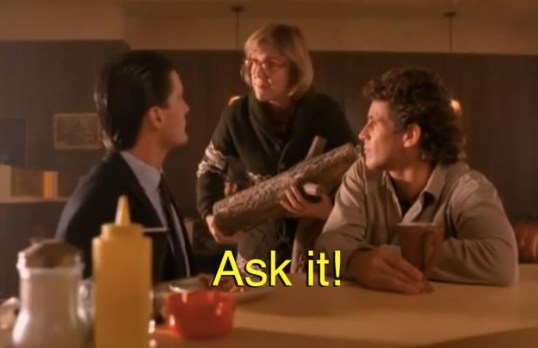
There are a lot of first in Traces to Nowhere.  This is the episode where Audrey first talks to Cooper, Cooper first says that the Great Northern serves a “damn fine cup of coffee,” where Cooper first has a slice of cheery pie, and where Cooper first talks about Albert Rosenfield.  This episodes also features the first mention of the Bookhouse Boys and, most importantly for fans of the series, the first appearance of Catherine Coulson as everyone’s favorite Log Lady.  When the Log Lady first shows up and tells Cooper to ask her log who killed Laura Palmer, the character seems like just a throw away joke.  But fans of the show know how important the Log Lady will become.

Catherine Coulson, was passed away in 2015, was the ex-wife of Jack Nance, who played Pete Martell.  Coulson and Nance both worked with David Lynch on his first film, Eraserhead.  It is said that during the shooting of Eraserhead, Lynch looked over at Coulson and said that he had just suddenly had a vision of her holding a log.  (Nance and Coulson were not the only Eraserhead alumni to later appear on Twin Peaks.  Charlotte Stewart, who played the weak mother of Bobby Briggs on Twin Peaks, earlier played Mary X, Nance’s strange girlfriend in Erasherhead.)

Up next: Zen, or the Skill To Catch a Killer!

Previous Entries in The TSL’s Look At Twin Peaks:

  1. Twin Peaks: In the Beginning by Jedadiah Leland
  2. TV Review: Twin Peaks 1.1 — The Pilot (dir by David Lynch) by Lisa Marie Bowman

TV Review: Twin Peaks 1.1 “The Pilot” (dir by David Lynch)


(In anticipation of the upcoming revival on Showtime, we’re rewatching and reviewing every single episode of the original Twin Peaks all through April!  Enjoy!)

“She’s dead, wrapped in plastic.”

— Pete Martell (Jack Nance) in Twin Peaks 1.1 “The Pilot”

When I was thinking about how I was going to open this review of the pilot episode for David Lynch’s iconic (and soon to be revived television series), Twin Peaks, I thought that I would start with this simple statement:

Twin Peaks opens with tears.

Then I rewatched the pilot on Netflix and I discovered that I was actually very incorrect.  Though I always think of the tears whenever I think of Twin Peaks, the pilot does not open with them.  Instead, it opens in a very David Lynch-like fashion — with signs of normalcy while Angelo Badalmenti’s ominous theme music provides hints that all is not as safe as it seems.

Really, it’s silly to try to talk about the pilot of Twin Peaks without including the opening credits because, in their deceptively simple way, they really do provide a road map of what’s to follow:

The opening credits, with their mix of shrouded atmosphere, man-made machinery and seemingly placid nature, are about as Lynchian as you can get.

Then again, the town of Twin Peaks is about as Lynchian as you can get.  Located only a few miles from the Canadian border in Washington State and surrounded by beautiful mountains and glorious wilderness, Twin Peaks is a town that seems strangely out of time.  Twin Peaks takes place in 1990s but, at times, the town seems to be stuck in the 50s.  Not the real 50s, of course.  Instead, it’s the 1950s of television, movies, and the popular imagination.  It’s a town where soulful loner James Hurley (James Marshall) wears a leather jacket and drives a motorcycle while teenage vixen Audrey Horne (Sherilyn Fenn) dresses like Natalie Wood in Rebel Without A Cause and waits until she’s safely at her locker to slip on a pair of red high heels.  Audrey’s father, ruthless Ben Horne (Richard Beymer), makes plans to sell the town to the Norwegians while, at the local diner, wise Norma Jennings (Peggy Lipton) wearily watches over her customers.  It’s a world that could only exist in a dream and what a dream it is.

So no, the pilot of Twin Peaks does not open with tears.  Instead, it opens with Pete Martell (played by Jack Nance, the star of Lynch’s Eraserhead) going out to fish.  He tries to get a kiss from his wife, Catherine (Piper Laurie), but is coolly — but not cruelly — rebuffed.  One gets the feeling that this is a ritual that they go through every morning.  It’s only after Pete has stepped outside that he sees the girl on the shore, naked and wrapped in plastic.

That girl, of course, is Laura Palmer (Sheryl Lee).  The high school homecoming queen.  The girl who did volunteer work.  The girlfriend of football player Bobby Briggs (Dana Ashbrook).  The daughter of Leland Palmer (Ray Wise), Ben Horne’s lawyer.  The best friend of Donna Hayward (Lara Flynn Boyle) and the occasional rival of Audrey Horne.  The secret girlfriend of James Hurley.

It’s after Laura is discovered that the tears begin and those tears dominate the first 30 minutes of this 90-minute pilot.  Deputy Andy (Harry Goaz) is the first to cry.  Laura’s mother (Grace Zabriskie) cries when she gets the news.  Leland cries.  Donna cries.  At the high school, a girl runs by a window, screaming.  The school principal announces that Laura has been found dead and breaks down into tears.  Only a few people don’t cry.  Ben doesn’t cry, knowing that a murder could ruin his business deal.  Bobby doesn’t cry, even when he’s arrested under suspicion of having committed murder.  (He was the last person known to have been with Laura.)  Audrey doesn’t cry and instead, appears to faintly smile at the chaos around her.

And Sheriff Harry S. Truman (Michael Ontkean) doesn’t cry.  However, that’s to be expected.  Harry is the rock on which Twin Peaks is built, both as a show and town.  He’s the least quirky character in the series.  He is law and order.  He’s got a murder to solve and making things even more urgent is that a classmate of Laura’s, Ronette Pulaski, is also missing.

The first 37 minutes of the pilot do a perfect job of establishing both the town and it’s inhabitants.  Everyone has a secret.  Everyone has a motive.  Along with those that I’ve already mentioned, we also meet waitress Shelly (Madchen Amick), who is married to an abusive trucker named Leo (Eric Da Re) and who is having an affair with Bobby.  We meet Bobby’s best friend and fellow football player, a real idiot named Mike (Gary Hershberger).  We meet Donna’s father, Doc Hayward (Warren Frost).  We meet the police dispatcher, the sweetly off-center Lucy (Kimmy Robertson).  We meet Deputy Hawk Hill (Michael Horse) who is as stoic as Andy is emotional.  We meet James’s uncle, Ed Hurley (Everett McGill) and Ed’s one-eyed, drapery-obsessed wife, Nadine (Wendy Robie).  We meet Josie Packard (Joan Chen), who inherited the mill from her late husband and who is secretly Harry’s lover.

And, after Ronette is discovered wandering, zombie-like on a bridge, we meet FBI Special Agent Dale Cooper (Kyle MacLachlan).  More than anything else, Cooper is who people think of whenever they think of Twin Peaks.  MacLalchlan plays the quirky FBI agent with just the right combination of earnestness and eccentricity.  Speaking into his ever-present tape recorder and praising everything from the trees to the pie to the coffee, Cooper quickly establishes himself as the perfect man to figure out what’s going on in Twin Peaks.

David Lynch once famously described his previous collaboration with MacLachlan, Blue Velvet, as being the “Hardy Boys Go To Hell,” and the same can be said of Twin Peaks.  If the first 37 minutes of the pilot were dominated by sadness and secrets, the final 60 are dominated by Dale Cooper’s enthusiasm and cheerful positivity.  The town may be strange but Dale loves the trees.  Dale may be investigating horrible and brutal crimes but at least he’s found a good slice of pie and damn fine cup of coffee.

“You know why I’m whittling?” Dale asks Harry at one point.  “Because that’s what you do in a town where a yellow light means slow down instead of speed up.”  Dale smiles after he says it.  It doesn’t take him long to fall in love with Twin Peaks.

Throughout the rest of the pilot, we get more hints of a world that’s threatening to spin off of its axis.  Dale and Harry run into Dr. Lawrence Jacoby (Russ Tamblyn, who co-starred with Richard Beymer in West Side Story), who was Laura’s psychiatrist and appears to be in need of some therapy himself.  When they look at Laura’s body in the morgue, the lights flicker on and off.  When Dale finds a scrap of newspaper — featuring the letter “R” — underneath Laura’s fingernail, he grins as if he’s just made it through his first Communion.  When Harry and Dale go to the local bank, a moose’s head just happens to be lying on the table in the conference room.  It fell, they’re told.  Despite all the strangeness, they go about their business.  They’ve got a murder to solve.

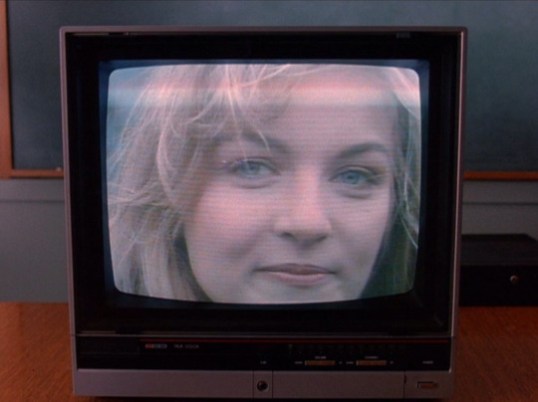
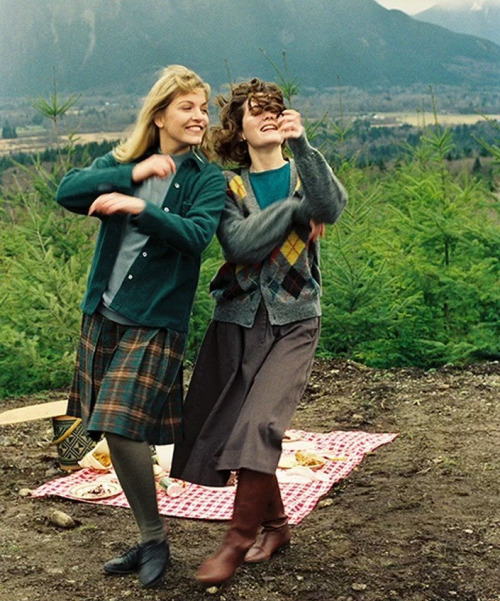
“Mr. Cooper,” Harry says, at one point, “you didn’t know Laura Palmer.”  But, as quickly becomes obvious, no one knew Laura Palmer.  No one, for instance, knew that she was doing cocaine.  And Bobby didn’t know that she was seeing James, or at least he doesn’t until he watches a video that Donna, James, and Laura shot inn the mountains over looking the town.  Laura, who we’ve previously just seen as a dead body, is so happily alive in that video that it’s a bit jarring to see her.  You half expect her to come out of the TV, like the girl in The Ring.  The video ends with her smiling, as if she’s daring both Cooper and the show’s viewers to try to figure out who she actually was.  Only later is it revealed that, in a plot twist reminiscent of Dario Argento’s Four Flies on Grey Velvet, James’s motorcycle is reflected in Laura’s eye.

Life goes on in Twin Peaks.  Audrey, the character to whom I most relate whenever I watch this show, sits in her father’s hotel and penetrates a styrofoam cup of coffee with a pencil.  “What would happen if I pulled this out?” she asks before doing just that.  Audrey walks into the hotel’s conference room and tells the Norwegians that she’s feeling sad because her best friend was just brutally murdered, destroying her father’s business deal.  (“The Norwegians are leaving!  The Norwegians are leaving!” a hotel concierge vainly yells.)

(Perhaps not coincidentally, Norway was also the home of Henrik Ibsen, whose theatrical melodramas often dealt with many of the same themes — greed, infidelity, the corruption that comes with progress — that are present in Twin Peaks.  An Enemy of the People could have just just as easily taken place in the American Northwest.)

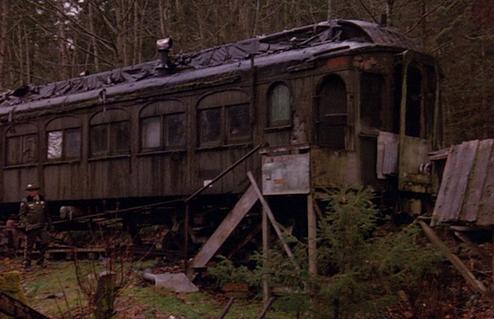
Meanwhile, the local police come across the abandoned railroad car where Laura was murdered and Ronnette raped.  Andy calls the sheriff’s office, in tears.  “Tell Harry I didn’t cry,” he begs Lucy, “but it’s so horrible!”  It’s a moment of very real humanity in the middle of this odd and disturbing mystery.  When Andy begs Lucy not to reveal his very human reaction, it’s more than just shame on his part.  It’s an indication that perhaps the only way to solve this mystery is to sacrifice one’s emotions.

And, as Andy said, it is horrible.  When Dale and Harry walk through that railway car, we are reminded that, as quirky at the show may be, a very disturbing crime is still at heart of it.  Among other things, they find a half-heart necklace (the other half is with James) and, written in blood in the debris, a message: “Fire Walk With Me.”  As disturbing as this is in the pilot (and this scene really is Lynch at his best), it’s even more disturbing if you know who will ultimately be revealed to have been Laura’s murderer.  But that information will have to wait for a later review.

It easy to believe that arrogant Bobby Briggs killed Laura but Cooper only has to talk to him for a few minutes to realize that he didn’t do it.  Bobby may be a jerk and a drug dealer.  And Cooper is surely correct when he says that Bobby never loved Laura.  But Bobby is a bully, not a murderer.  When Bobby is released, he and Mike go looking for James.  As unlikable as Bobby is, Mike — with his blonde hair and all-American looks — is somehow even worse.  At least Bobby is open about being an bad guy.  Mike hides his darker instincts behind a carefully cultivated facade of blandness.  Looking at Mike in his red letterman jacket, you really do want someone to claw his eyes out.

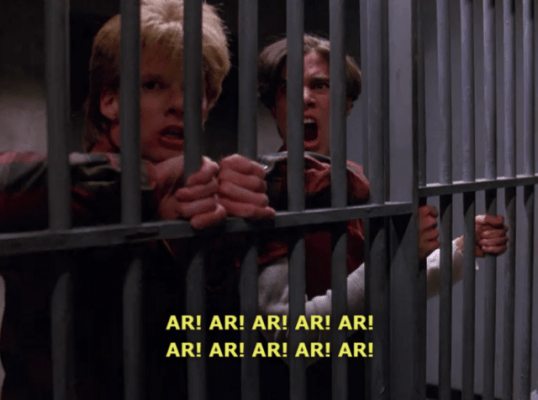
Mike and Bobby look for James at the Roadhouse, one of the most important locations in Twin Peaks.  It’s a place where illicit lovers (like Norma and Ed) meet and where Julee Cruise sings haunting songs.  Bobby and Mike may not find James but they do find a fight with Ed.  This leads to Bobby and Mike spending the night in jail, which, ironically, is where they eventually find James.  James has been arrested as a suspect in the death of Laura Palmer.  In their cell, Bobby and Mike start to bark like wild dogs.

And so, a pilot that started with the humanity of tears ends with animalistic howls of anger, hate, and jealousy.

And so, Twin Peaks begins.

If I haven’t already made it clear, I am huge fan of the pilot for Twin Peaks.  Say what you will about where the series eventually went, the pilot was and remains an absolutely brilliant dream of dark and disturbing things.  Having rewatched the pilot, I am definitely looking forward to rewatching the rest of the series for this site and I hope you’ll enjoy the rest of our reviews!

Previous Entries in The TSL’s Look At Twin Peaks:

  1. Twin Peaks: In the Beginning by Jedadiah Leland

Embracing the Melodrama Part II #25: West Side Story (dir by Robert Wise and Jerome Robbins)


West_Side_Story_poster

Nearly two weeks ago, I started on something that I call Embracing the Melodrama, Part II.  For the next month or so, I will be reviewing, in chronological order, 126 examples of cinematic melodrama.  I started things off by reviewing the 1927 classic Sunrise and now, 24 reviews later, we’re ready to start in on one of my favorite decades, the 1960s!

And what better way to start the 60s than be taking a look at the 1961 best picture winner, West Side Story?

Being a lifelong dancer, I have to admit that I’ve lost track of how many times I’ve seen West Side Story.  If you love to dance, this is one of those films that you simply have to see.  Of the various musicals that have won best picture, West Side Story is arguably the best.  Based on a hit Broadway show (which was itself rather famously based on William Shakespeare’s Romeo and Juliet), West Side Story was co-directed by the great choreographer Jerome Robbins and it features some of the greatest dance numbers ever filmed.  If you don’t get excited while watching the Sharks and the Shark Girls arguing about America, then there’s really no hope for you.  Tonight Quintet, Somewhere, A Boy Like That, Maria … even Gee, Officer Krupke, has there ever been another musical score that just leaves you wanting to sing as much as West Side Story does?

(I mean, I’ll be the first admit that I absolutely love the theme song from Santa Claus Conquers The Martians but it can’t even compare to West Side Story!)

What’s funny is that, in between viewings of the film, I always seem to forget just how good West Side Story actually is.  (Fortunately, this also means that I’m pleasantly surprised every time I watch the movie.)  In theory, this is an easy film to joke about.  It tells the story of street gangs who are apparently just as good at dancing as they are at fighting.  The all-white Jets snap their fingers and tell us that when you’re a jet, you’re the best.  The Puerto Rican Sharks are moving in on the Jets’s territory.  The two leaders of the gangs — Riff (Russ Tamblyn) and Bernardo (George Chakiris) — want to settle thing with a “rumble.”  And it’s easy for contemporary audiences to laugh because “rumble” is such an old-fashioned way of saying things that it’s now one of those terms that’s only used when one is trying to be ironic or snarky.

(For instance, I was with some friends at the movies and the people sitting behind us kept talking.  One of my friends told them to shut up.  One of the loud people replied that we were the ones who need to shut up.  As the insults escalated, I finally said, “Y’all — do we really have to have a rumble right now?”  Unfortunately, everyone was too busy arguing to appreciate my pitch perfect delivery.)

Riff’s best friend is Tony (Richard Beymer).  Tony was a co-founder of the Jets but now, he wants to move on from the gang.  He meets a girl named Maria (Natalie Wood) and the two of them fall in love.  However, Maria is Bernardo’s younger sister.  Her best friend, Anita (Rita Moreno), is Bernardo’s girlfriend.  Loving Tony, in other words, is prohibido.

And, since West Side Story is based on Romeo and Juliet, you can probably guess to what type of tragedy all of this leads.

Now, before I heap too much praise of West Side Story, I do need to admit that, in the role of Tony, Richard Beymer does not exactly radiate charisma.  He’s handsome enough but you never quite buy that he was former member of the Jets.  Since Tony’s singing voice was dubbed by Jimmy Bryant, you do believe everything that he sings.  But otherwise, Richard Beymer comes across as being stiff and rather awkward.

And it doesn’t help, of course, that he’s acting opposite Russ Tamblyn who, in the role of Riff, is a whirlwind of unstoppable energy.  Tamblyn is the one who you remember at the end of the film, followed by George Chakiris.  Compared to those two, Richard Beymer’s performance is just dull.

Fortunately, there’s Maria (played by Natalie Wood with Marni Nixon doing the singing).  Natalie Wood is one of my favorite of the classic Hollywood actresses.  She’s certainly one of the actresses with whom I most idenitfy.  With Richard Beymer sleepwalking through the role of Tony, it falls on Natalie to provide some true emotion to the film’s love story and that’s exactly what she does.  Every time I see West Side Story, I want to be Natalie Wood and I want to have a best friend like Rita Moreno and I want to meet someone like Riff…

Sorry, Tony.

West Side Story is one of the best musicals ever made.  If you’re not dancing and then crying and then dancing while crying as you watch West Side Story, then you’re doing it wrong.

Dance Scenes I Love: “America” from West Side Story


There’s no way that I could ever write about the dance scenes that I love without including at least one scene from 1961’s best picture winner, West Side Story.

Sadly, people tend to underappreciate West Side Story.  They focus on the fact that the singing voices of Natalie Wood and Richard Beymer are overdubbed by Marni Nixon and Jimmy Bryant, respectively.  They laugh at the sight of “tough” street kids dancing around and singing that when you’re a jet, you’re the best.

Well, they’re wrong.

West Side Story is still one of the best musicals ever made and every time I see it, it’s a magical experience for me.

I think my favorite number from the film remains America.  Watching this scene, you can tell why both Rita Moreno and George Chakiris won Academy Awards for their performances.  They both bring a lot of fire and passion to their roles and nowhere is that more apparent then in America.