Late Night Retro Television Review: Monsters 3.24 “The Moving Finger”


Welcome to Late Night Retro Television Reviews, a feature where we review some of our favorite and least favorite shows of the past! On Wednesdays, I will be reviewing Monsters, which aired in syndication from 1988 to 1991. The entire series is streaming on YouTube.

This week, Monsters comes to its conclusion.

Episode 3.24 “The Moving Finger”

(Dir by Kenny Myers, originally aired on April 26th, 1991)

Monsters comes to a close with an adaptation of a Stephen King short story.

Nerdy Howard (Tom Noonan) is shocked to discover that, every time he goes to any of the various drains in his house, a bony finger pokes out.  Howard’s wife can’t see the finger but Howard becomes obsessed with it, attacking it with a corrosive liquid and eventually a hedge trimmer.  No matter how much damage Howard does to it, the finger comes back, longer and stronger….

Despite the Stephen King pedigree and the presence of the usually reliable Tom Noonan, The Moving Finger makes for a disappointing conclusion to Monsters.  King’s style, and this is especially true of his short stories, often doesn’t translate well into visual adaptations.  The signature inner monologues and the building sense of dread can be difficult to recreate visually.  (One reason why The Shining is the best King adaptation is because Stanley Kubrick made the material his own and didn’t worry about trying to recreate all of King’s trademark  bullshit literary flourishes.)  Tom Noonan doesn’t have much of a character to play and the finger itself becomes less effective as the episode drags on.

Oh well!  Monsters was a generally uneven show so it’s perhaps appropriate that it ended on an unsteady note.  It’s the curse of the anthology format.  When Monsters was good, it was really, really good.  When it was bad, it was kind of boring.  There were a lot of good episodes that aired during the final season but, sadly, there were a few bad ones as well.  That said, the good Monsters episodes to outweigh the bad and forgettable ones.

That’s it for Monsters!  Next week, something new will premiere in this time slot.  What will it be?  I have no idea but I look forward to finding my next show!
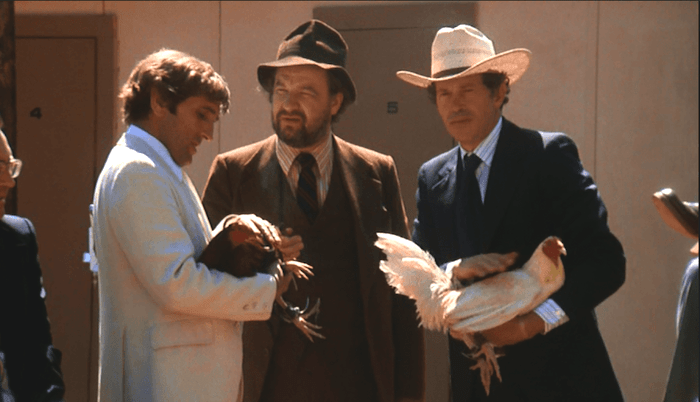
Brad reviews COCKFIGHTER (1974), starring Warren Oates!


I read about the movie COCKFIGHTER many years ago, and I remember the review being very positive. I had never watched the film before, but with today being Warren Oates’ birthday and it being available on Amazon Prime, I decided I’d finally watch it. 

Directed by Monte Hellman and based on Charles Willeford’s 1962 novel, COCKFIGHTER introduces us to Frank Mansfield (Warren Oates), a man completely obsessed with the southern “sport” of cockfighting. As we meet him, he’s in the process of losing a bet and a cockfight with Jack Burke (Harry Dean Stanton). The loss isn’t just a setback, it costs him all of his cash, his truck, his trailer, and his current girlfriend Dody White (Laurie Bird). We also notice in these early scenes that Frank only communicates through sign language and writing notes. It seems that he’s been living under a self-imposed vow of silence. Two years earlier, on the eve of the big, season-ending cockfighting grand finale, Frank’s big-mouthed braggadocio caused him to lose his prized cock, and the prestigious “Cockfighter of the Year” medal in a meaningless hotel bet, also against Jack Burke. Frank vows not to speak again until he wins that medal. Coming up with cash in the only way he can by selling his family’s home, Frank buys a new cock named White Lightning from Ed Middleton, played here by the film’s writer Charles Willeford. Armed with new fowl and a new, capital rich partner named Omar Baradansky (Richard B. Shull), Frank will not let anything stop him, including the love of his life Mary Elizabeth (Patricia Pearcy) or an axe wielding competitor (Ed Begley, Jr.), from being named “Cockfighter of the Year” and finally regaining his voice and the respect he desires!

COCKFIGHTER definitely has some things going for it. First and foremost, Warren Oates is so good in the lead role as the obsessed man who puts success in cockfighting above anything else in his life, including every other person. He literally sells the family home out from under his alcoholic brother Randall (Troy Donahue) in order to fund his next cock purchase after he’s gone bust. This sets up quite the sight gag for such a gritty and realistic film as a large truck and trailer drives away the family home taking up the entire state highway. When his long time fiancé asks him to give up cockfighting, he just gets up, leaves her shirtless and heads back out on the circuit. He writes her a letter from the road and tells her he loves her, but he also makes it clear that life without cockfighting is a life that he’s unwilling to live. Oates’ Frank Mansfield is not the kind of person you’d ever want to depend on in life, but he’s also an uncompromising individual who is determined to live life wholly on his own terms, accepting of the successes and failures that come with it. I watched the film because it features Warren Oates, and after having done so, I can say that his performance is truly special. 

COCKFIGHTER is one of those movies that makes us feel like we’re watching real people, and that’s kind of fascinating even if they reside in a world that we don’t really want to live in. The primary credit for that has to go to director Monte Hellman and Oscar winning cinematographer Nestor Almendros (DAYS OF HEAVEN). The restraint that is shown in the storytelling, as well as the sweaty, ramshackle authenticity of the Georgia locations, brings the story to life. The supporting cast also does its part to create the world of COCKFIGHTER. Harry Dean Stanton as Jack Burke, Frank’s primary rival in the cockfighting game, is excellent as you might expect, and he seems a lot like a regular guy. I really like Richard B. Schull, who plays Frank’s outgoing and talkative partner Omar. His friendly and gregarious personality seems a little untrustworthy at first, but he turns out to be the most likable person in the film. And finally, I want to shoutout Charles Willeford. Not only did he write the source novel and screenplay for COCKFIGHTER, he also gives a solid performance as Ed Middleton, an old-timer in the game who treats Frank with honesty and decency when he’s hit rock bottom. 

With all the positive things I’ve said above, I have to address the graphic depiction of cockfighting in COCKFIGHTER. This was the 70’s, and the scenes shown here are real and were very difficult for me to watch. It’s not fun to see animals fight and kill each other, and this is coming from a person who loves fried chicken and is not particularly an animal lover. The scenes are presented as matter of fact and in service of the story, but that still doesn’t make them easy to watch. Director Monte Hellman has gone on record to express his personal disgust at even filming these scenes. While a movie made in the 1970’s probably couldn’t have been made without these sequences, I just wanted to make it clear that this film is probably unwatchable for a lot of people.

Overall, COCKFIGHTER is a relic of the 1970’s. It’s a gritty and realistic film, featuring a great central performance from Warren Oates. It’s also an ethically troubling film that features real animal on animal violence. Based on that I don’t necessarily recommend the film. Rather, I just want to share my own thoughts, and you can determine if you want to watch it or not. That’s what I’ve tried to do above. 

Days of Paranoia: The Anderson Tapes (by Sidney Lumet)


In 1971’s The Anderson Tapes, Sean Connery stars as Duke Anderson.

Duke is a career criminal, a safecracker who has just spent ten years in prison.  He’s released, alongside Pops (Stan Gottlieb), who spent so much time behind bars that he missed two wars and the Great Depression, and the quirky Kid (Christopher Walken, making his film debut).  Duke immediately hooks up with his former girlfriend, Ingrid (Dyan Cannon), and decides to rob the luxury apartment building where Ingrid is now living.

Of course, Duke will have to put together a crew.  It’s not a heist film without a quirky crew, is it?  Duke recruits the Kid and Pops.  (The Kid is happy to be in the game but he’s not a fan of violence.  Pops, meanwhile, has none of the skills necessary for living in the “modern” world and would much rather return to prison.)  Duke also brings in the flamboyant Tommy Haskins (an overacting Martin Balsam) and driver Edward Spencer (Dick Anthony Williams).  Duke goes to the mob for backing and Pat Angelo (Alan King) gives it to him on the condition that he take along a sociopathic racist named Socks (Val Avery) and that Duke kills Socks at some point.  Duke reluctantly agrees.

So far, this probably sounds like a conventional heist film.  Director Sidney Lumet mixes comedy and drama with uneven results but, overall, he does a good job of ratcheting up the tension and The Anderson Tapes is a good example of one of my favorite mini-genres, the “New Yorkers will be rude to anyone” genre.  At first glance, Sean Connery seems to be playing yet another super smooth operator, a confident criminal with a plan that cannot fail.  Duke seems like a criminal version of James Bond,  However, as the film progresses, we start to suspect that things might be getting away from Duke.  When Duke has to go the Mafia for support and is told that killing Socks is now a part of the job, we see that Duke isn’t as in-control of the situation as we originally assumed.  This is the rare Sean Connery film where he has someone pushing him around.

(Apparently, Connery took this role as a part of his effort to escape being typecast as Bond.  Perhaps that explains why Duke seems like almost a deconstruction of the James Bond archetype.)

Of course, what really lets us know that Duke isn’t as in-charge as he assumes is the fact that four different law enforcement agencies are following his every move.  From the minute he gets out of prison, Duke is being watched.  The apartment is bugged.  Security cameras records his every move.  Once the heist begins, we’re treated to flash forwards of breathless news reports.  The Anderson Tapes is less a heist film and more a portrait of the early days of the modern Surveillance State.  Of course, none of the agencies make any moves to stop Duke because doing so would reveal their own existence.  The film really does become a portrait of a government that has gotten so big and intrusive that it’s also lost the ability to actually do anything.

The Anderson Tapes is entertaining, even if it’s not really one of Lumet’s best.  Connery is, as always, a fascinating screen presence and it’s always entertaining to see a young Christopher Walken, showing early sings of the quirkiness that would become his signature style.  The Anderson Tapes is a portrait of a world where you never know who might be listening.

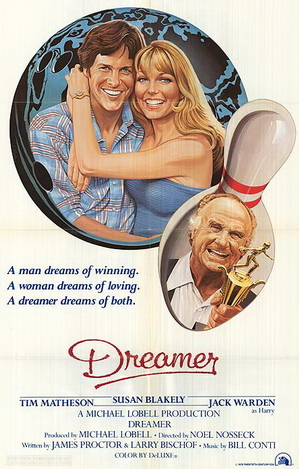
Lisa Cleans Out Her DVR: Dreamer (dir by Noel Nosseck)


(I am currently trying to clean out my DVR!  I recorded this 1979 sports film off of FXM on February 1st!)

In Dreamer, Tim Matheson plays a character named Harold Nuttingham.  His nickname is Dreamer.  Do you think it’s possible that Harold has a dream!?  Well, it would probably be a really cruel nickname if he didn’t!

Dreamer lives in small town Illinois.  He loves to bowl.  He spends all of his time down at the local bowling alley, where everyone knows him and they all love him and his dreams of becoming a professional bowler.  His mentor is named Harry White (Jack Warden) and runs the pro shop.  Harry dreamed of being a famous, champion bowler but his dreams didn’t come true.  But now he can help Dreamer’s dreams work out.  Everyone loves the fact that Harry is helping Dreamer.  Dreamer’s girlfriend is named Karen Lee (Susan Blakely).  She loves that Dreamer loves bowling but she is frustrated because everyone keeps telling Dreamer that it would be a mistake to take her to his games.  Karen might bring bad luck.

Everyone in his hometown loves Dreamer but the Professional Bowling Association (which apparently is an actual thing) doesn’t love Dreamer.  They don’t want to let Dreamer compete on a professional level.  Or, at least, they don’t until Dreamer meets with them personally and shows off his amazing bowling skills.  Then they love Dreamer.

Even though Dreamer is the new guy on the professional circuit, the audiences love him.  And all the other professional bowlers love him, even when they lose to him.  Everyone loves Dreamer, perhaps because everyone loves a dreamer…

Are you getting the impression that Dreamer might be one of the most positive movies ever made?  Well, it is.  Hardly anyone says a bad word about anyone in Dreamer.  Nobody tells Dreamer to give up.  Dreamer never really suffers from any self-doubt, though he does injure his thumb at one point.  There is a moment of tragedy towards the end of the movie but it’s one of those tragedies that leads to better things.  You can’t have light without a little darkness, though Dreamer seems to suggest that you can come awfully close.

Normally, films get on my nerves when they’re overwhelmingly positive but I can’t really complain about a movie like Dreamer.  It’s just so earnest and sincere.  There’s no real conflict and there’s no real drama but everyone in the movie is just so damn likable that you almost feel guilty for wishing something unexpected would happen.  Dreamer struggles and fails to make bowling cinematic but Dreamer’s a nice guy so you wish him the best.

Perhaps the most interesting thing about Dreamer is that it was directed by Noel Nosseck, who also directed an incredibly odd little grindhouse film called Best Friends.  Best Friends, which I recommend tracking down, is almost the anti-Dreamer.  Watch Best Friends to have your faith in humanity destroyed and then follow it up with Dreamer so your faith can be restored.

Or don’t.  It’s really up to you.

Life is a Beach #4: Spring Break (dir by Sean S. Cunningham)


I think I may have made a mistake.  When I started reviewing beach films, I did so because it’s currently spring break for thousands of college students across the country and, right now, they’re all probably having a good time on the beach.  Unfortunately, what I didn’t consider was that watching and reviewing these films would make me start to wish that I was currently there with them.

Don’t get me wrong.  It’s not that I want to go hang out on the beach and party and flirt and get high and live for the moment and … well, no, actually, that’s exactly what I wish I was doing right now.  None of the beach films that I’ve watched so far have been good exactly but they do all get at a larger truth.

We all need some sort of spring break.

That’s certainly the theme of the 1983 comedy, Spring Break.

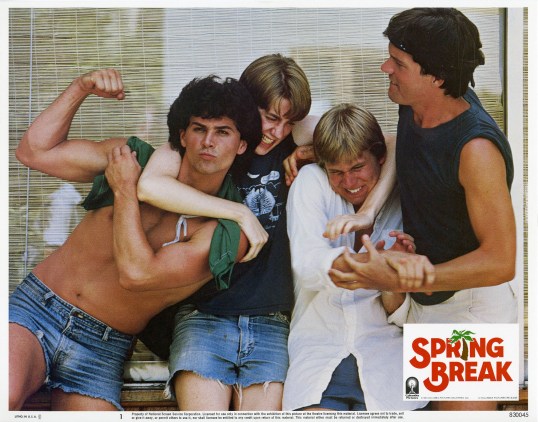
The heroes of Spring Break

The heroes of Spring Break

Perhaps the most surprising thing about Spring Break is that, unlike Malibu Beach and The Beach Girls, it was not produced by Crown International Pictures.  It certainly feels like a Crown International movie.  The film is a largely plotless collection of scenes, all of which take place over the course of spring break in Ft. Lauderdale.  It starts out as a comedy and then gets strangely dramatic towards the end.  It features a lot of nudity for male viewers but luckily, it has two hot guys for me so it all works out in the end.

Two nerdy students, Nelson (David Knell) and Adam (Perry Lang) go down to Florida for spring break.  Nelson does this despite the fact that he had promised that he would spend spring break working on his politically ambitious stepfather’s campaign.  When Nelson and Adam’s picture ends up in the paper, Nelson’s stepfather (Donald Symington) sends his operatives down to Florida to basically kidnap Nelson and drag him home.  Along the way, the stepfather also somehow gets involved in a plot to take over the motel where Nelson and Adam are staying.

Uhmmm…what?

Yes, it doesn’t make much sense but then again, the plot is never that important in these type of films.  What is important is that the motel is overbooked and, as a result, Nelson and Adam find themselves roommates with two hot guys from New York, Stu (Paul Land) and O.T. (Steve Bassett).

One thing that I did like about this movie is that it didn’t waste any time pretending that Stu and O.T. wouldn’t become best friends with Nelson and Adam.  Instead, the four of them start bonding as soon as they meet and they were all best friends within the first 15 minutes of the film.  Yay for another successful bromance!  But seriously, it is kind of sweet.

And it’s also fortunate because, once Nelson is kidnapped and held prisoner on a boat by his stepfather, who better to rescue him than two guys from Brooklyn?

Yes, it’s all pretty stupid but, as far as teen sex comedies from the early 80s are concerned, this is one of the better of them.  At the very least, Knell and Lang are both likeable and Land and Bassett are both hot and that really is about the best that you can hope from a film like this.  Add to that — and this is a theme that I seem to keep returning to as far as these beach films are concerned — Spring Break is a time capsule.  Though Spring Break was released before I was born, I feel like, having seen it, that I now have some firsthand experience of what it was like to be alive in 1983.

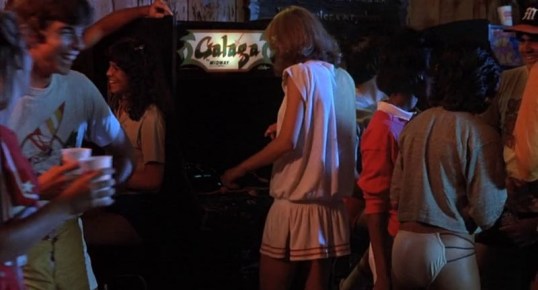
So 80s....

So 80s….

As I mentioned at the start of this review, Spring Break feels like a Crown International Picture but, actually, it was released by Columbia Pictures.  And it was directed by Sean S. Cunningham, who is probably best known for directing the original Friday the 13th!  Harry Manfredini even provided the music for both films.  That said, the fun-loving teenagers of Spring Break come to a much happier end than the ones at Camp Crystal Lake.