The 2013 film, Online, opens with a bunch of male co-workers going out for pizza. They’re celebrating the promotion of John Wild (Morgan Ayers), who has gone from being a preacher’s kid to being the youngest executive at their company. Before they dig into the pizza, one of the older men says a quick blessing over it….
Yes, it’s one of those films!
John has a well-paying job, a big house, and a beautiful and supportive wife named Mary (Kelsey Sanders). For most people, that would probably be enough to be happy for at least a few years but not for John! John finds himself thinking about his high school girlfriend, Adrianna (Esseri Holmes). John was in love with Adrianna, or at least he thought he was. But then, one day, she told him that her father’s company was forcing them to relocate to France. Both John and Adrianna were heart-broken.
(My family moved around a lot when I was growing up. Whenever my Dad got a new job, we moved to a new town and often a new state. Personally, I would happily trade that month in Tulsa for a few years in France.)
Despite the fact that he’s happily married and he knows that he shouldn’t, John decides to look Adrianna up online. He uses a site called SocialFriends.com because everyone knows better than to run the risk of getting sued by Facebook. (My favorite Facebook’s substitute was Degrassi‘s Facerange.) It turns out that Adrianna has not only returned to America but she also lives nearby!
Unfortunately, Adrianna is married now. Even more unfortunately, her husband is a French cosmetics heir named Pierre (Byron Herlong). Pierre spends all of his time complaining about Americans being materialistic and arrogant. Adrianna replies that, if it wasn’t for those “arrogant Americans,” he would “be speaking German right now.” Boom! You tell him, girl! Pierre doesn’t have a snarky reply for that!
John reaches out to Adrianna. They have dinner at a fancy restaurant. They talk. They catch up on old times. They eventually share one kiss. Of course, John doesn’t bother to tell his wife about any of this and instead, he just tells a lot of lies about having to work late. However, Mary’s not dumb. She knows that there is something her husband isn’t telling her, especially after the credit card bill comes in and she discovers how much he’s been spending on dinner. Mary’s mother, who has never gotten over being cheated on by her own husband, hires a private detective to follow John around.
John’s mistake, one of his co-workers explains, wasn’t just that he reached out to Adrianna and then lied to his wife about it. John’s mistake is that he allowed himself to dine alone with another woman to begin with!
Online is one of those low-budget indie films that really makes you appreciate directors and editors who know how to keep the action moving at a steady pace because the film was filled with so many slow spots that it was next to impossible for me to really focus on it. My mind kept wandering as I watched the film. I also got a bit annoyed that, while John was given a chance at redemption, Adrianna was not. If John was portrayed as being someone who, in the midst of a mid-like crisis, made a mistake than Adrianna was essentially portrayed as just being a brazen homewrecker. That said, the film did feature Pierre being put in his place and I appreciated that. Arrogant Americans for the win!
On Friday, I watched the episode that was shot in my hometown and, once again, I was disappointed to see how boring my town looks on film. Jon Taffer transformed the bar into a taco place. The owners abandoned the concept as soon as Taffer left. They subsequently went out of business.
Barry (Sunday Night, HBO)
To be honest, I was happy that at least two characters in Barry managed to get a happy ending. I was expecting everyone to be dead by the end of the show but Sally survived and appears to have found some peace. And Fuches seems to have survived as well. Interestingly enough, Sally and Fuches were the only two characters who, in the end, chose to come clean about who they were and what they had done. Barry was killed by his acting mentor, losing his chance at redemption. NoHo Hank died while still in denial about killing Christobal. And Cusineau ended up doing life in prison and being portrayed as being not only a villain but also as being British in the inevitable movie version of Barry’s life. Barry was a great and often unsettling show.
Beavis and Butt-Head (Paramount Plus)
Young Beavis trained for combat! Old Beavis …. well, old Beavis and Butt-Head are depressing no matter what they do. This week, they tried to get vasectomies because they thought that would make them more appealing to soccer moms. It’s always kind of depressing when a Young Beavis and Butt-Head vignette is followed by one that shows what type of life they have waiting for them.
Dirty Pair Flash (YouTube)
I watched an episode of this anime on Saturday morning. I had no idea what was going on but there were a lot of monsters and a lot of things blowing up. It was fun!
On Monday, I finally finished binging Hang Time. I’ve written up all my reviews and they’ll be dropping on weekly basis through September. Read my latest review here!
The Marvelous Mrs. Maisel (Prime)
I watched the first episode of the final season on Saturday morning. I look forward to binging the rest of the season over the upcoming week. I’ll share my thoughts once I’ve finished watching.
This week, I watched the first sixteen episodes of this classic 80s cop show. My reviews will start dropping in September. For now, I’ll just say that I’m enjoying the show.
New Wave Theatre (YouTube)
I watched an episode of this 80s cable access show on Saturday morning. It was a Christmas episode. It was a bit bizarre. I did enjoy some of the bands that played.
Night Music (YouTube)
I watched an episode of this 90s talk-and-music show on Friday night. The music was great and, for the most part, the bands and musicians were all previously unknown to me. It was educational in the best way.
A Small Light (Hulu)
I watched the first episode of this miniseries on Thursday. I’m going to watch the rest of the episodes over this upcoming week so I’ll save my thoughts until after I’ve experienced the entire show.
The second season is over and I’m still sorting out how I feel about it. I enjoyed the first few episodes but then I found myself gradually growing more annoyed with the show and the characters. The inconsistent pacing particularly got on my nerves. Killing off Natalie, the character to whom I most related, is definitely not going to make me remember this season fondly. I’m at the point now that whenever Lotte pops up, whether it’s the past or the present version of the character, I want to throw something at the screen. Still, it’s an intriguing premise and, as frustrated as I get with the show, it’s worth watching for the cast alone.
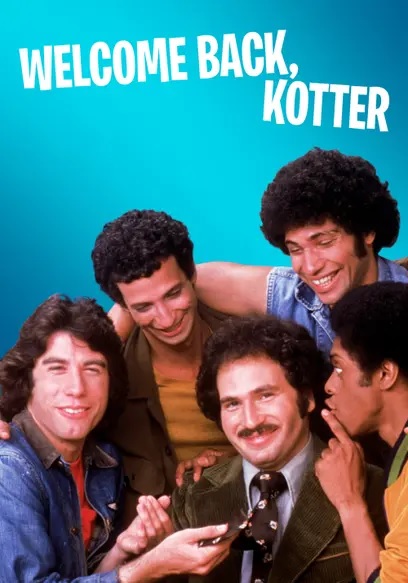
Welcome to Retro Television Reviews, a feature where we review some of our favorite and least favorite shows of the past! On Saturdays, I will be reviewing Welcome Back Kotter, which ran on ABC from 1975 to 1979. The entire show is currently streaming on Tubi!
Well, I don’t have anyone but myself to blame.
Ever since I started doing these retro television reviews, people have been suggesting that I should review an old 70s sitcom called Welcome Back, Kotter. I only knew a few things about Welcome Back, Kotter. I knew that it was the show that made John Travolta a star. I knew that it was Marcia’s favorite show on The Brady Bunch Hour. I knew that Gabe Kaplan played Gabe Kotter, a teacher who returned to his old Brooklyn neighborhood to teach a bunch of students known as the “Sweathogs.” (Bleh! What an unappealing nickname.) It didn’t sound like something I wanted to watch but, being the polite person that I am, I always said, “If it’s ever streaming somewhere, I will.” The unspoken assumption, of course, was that the show would never be streaming anywhere.
Then, one day, I looked at Tubi and….
Again, I have no one to blame but myself.
As for the show, it was based on the stand-up routines of its star, Gabe Kaplan. It followed former Sweathog Gabe Kotter (played, of course, by Kaplan) as he tried to teach a new generation of Sweathogs at James Buchanan High in Brooklyn. Gabe was married to Julie (Marica Strassman). They lived in a small Brooklyn apartment and Gabe was constantly forcing his wife to listen to corny jokes about his family. At the school, Gabe’s principal was Mr. Woodman (John Sylvester White), a former history teacher who disliked the Sweathogs.
As for the Sweathogs themselves, there were several but only four were really important.
Vinnie Barbarino (John Travolta) was the handsome but dumb one.
Freddie Washington (Lawrence Hilton-Jacobs) was the cool basketball player who would often say, “Hi, there” in a very deep voice.
Juan Epstein (Robert Hegyes) was the one most likely to kill someone.
Arnold Horseshack (Ron Pallilo) was the nerdy one with the high-pitched voice. In Kaplan’s original stand-up routine, his nickname was Arnold Horseshit but I doubt that was ever mentioned on the show.
And, of course, there was the theme song. Welcome Back, Kotter was written and performed by John Sebastian, whose previous claim to fame was appearing on the stage at Woodstock while stoned out of his mind.
Okay, let’s do this thing.
Episode 1.1 “The Great Debate”
(Dir by Bob LaHendro, originally aired on September 9th, 1975)
The very first episode of Welcome Back, Kotter opens with teacher Gabe Kotter (Gabe Kaplan) making out with his wife, Julie (Marcia Strassman), on the couch in their little Brooklyn apartment. Kotter suddenly stops kissing his wife so that he can tell her a joke about the time his uncle slept in the same bed as his secretary and told her that if she wanted to be “Mrs. Kotter for the night,” then she should get out of bed and close the bedroom window herself. Julie laughs. Personally, if my romantic partner stopped kissing me specifically so he could tell an adultery joke, I don’t know if I would laugh. I’d probably be more like, “What are you trying to tell me with that?”
Fortunately, the theme song starts up and rescues the audience from that awkward moment.
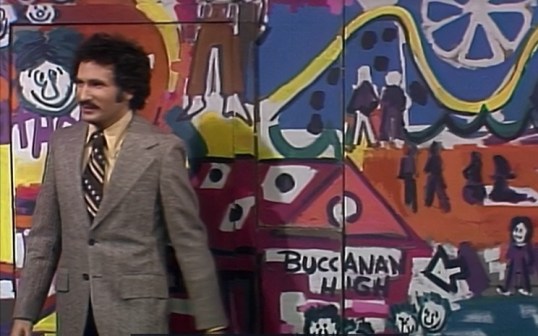
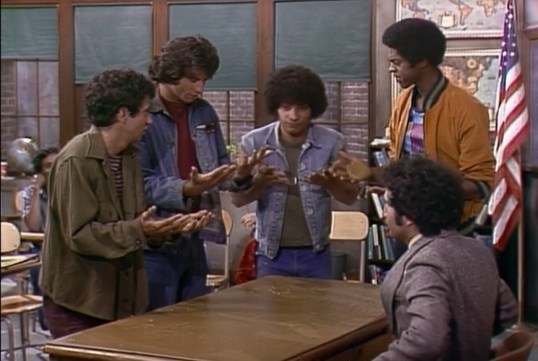
The next day, Gabe goes to work at James Buchanan High School. He teaches the remedial class, which is populated by underachieving students who have been nicknamed “the Sweathogs.” Gabe discovers that the Sweathogs have painted a rather garish mural on the wall of the classroom.
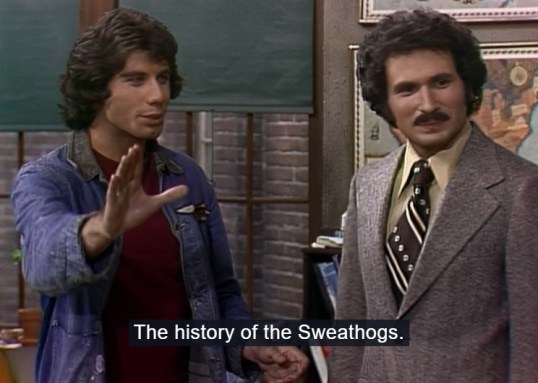
Vinne Barbarino (John Travolta) gets up and explains what the mural’s about.
Gabe is impressed by the fact that young John Travolta is a hundred times better looking and charismatic than anyone else in the school. But Gabe still insists that the Sweathogs wash off the mural. The Sweathogs agree, before revealing that they also painted the top of Gabe’s desk.
In the teacher’s lounge, Alex (James Woods) makes fun of Gabe’s stupid students. Gabe make fun of Alex for writing plays with names like “Fiddler On My Sister.” Alex says that his debate class can defeat Gabe’s class. Gabe accepts the challenge and….
Wait a minute! JAMES WOODS!?
Yes, that is indeed a youngish James Woods playing Alex, the school’s pretentious drama teacher. Woods is okay in the role. There’s not a whole lot to be done with the character as he’s pretty much just an uptight strawman who is there to be humiliated by Kotter and his class.
As for the debate itself, the resolution is that “Humans are naturally aggressive.” Alex’s class argues in the negative while Kotter’s class argues in the positive. Alex’s class is uptight and wears sweaters. The Sweathogs show up in garish costumes. With the help of Epstein (Robert Hegyes), Barbarino argues that Jack the Ripper and Atilla the Hun prove that people are naturally aggressive. When Mr, Woodman (John Sylvester White), who is moderating the debate, says that they need a timekeeper, Sweathog Arnold Horschack (Ron Pallilo) enthusiastically volunteers.
“Can he tell time, Mr. Kotter?” a flustered Woodman asks and I’ll admit that I did laugh. John Sylvester White delivered the line perfectly.
Sweathog Freddie Washington (Lawrence Hilton-Jacobs) then makes his case but, because his only experience with public speaking is in church, he gives a sermon. “He isn’t following the rules!” one of Alex’s students shouts.
While Alex’s star debater makes his case, the Sweathogs heckle him so aggressively that the student has a nervous breakdown and starts screaming, “SHUT UP!” at them. As Kotter points out, this proves that humans are naturally aggressive. Woodman announces that “This debate is called on account of dumbness.”
Back at the apartment, Gabe tells Julie a joke about Larry and his pet toad.
I have to admit that I enjoyed this episode quite a bit more than I was expecting to. Lawrence Hilton-Jacobs, John Travolta, Ron Pallilo, and Robert Hegyes had a lot of comedic chemistry as the main Sweathogs and Gabe Kaplan did a good job of projecting a much needed sincerity in the role of Mr. Kotter. He seemed to truly care about his students. This was definitely a good episode to start the series off with.
Episode 1.2 “Basket Case”
(Dir by Bob LaHendro, originally aired on September 16th, 1975)
At the apartment, Gabe tells Julie a joke about how his childhood bully beat up his father.
At school, it’s time for the Sweathogs to take a history exam. Barbarino has all the answers written on his arm but, fortunately, Gabe shows up with water and a paper towel. Horseshack tries to distribute the tests in another classroom but Gabe stops him. Epstein shows up with a note excusing him from the exam because of his bursitis but Gabe tosses the note away as soon as he notices that it is signed “Epstein’s Mother.” Freddie, meanwhile, doesn’t think that grades matter because he’s made the basketball team. In fact, he draws a picture of himself as “Stilt Man” on his test paper.
When Gabe fails Freddy, the basketball coach and Mr. Woodman ask him to reconsider. The Sweathogs ask him to reconsider. And Freddie tells Kotter that he’s not going to take a makeup exam. Kotter challenges Freddie to a basketball game. If Freddie win, he passes. If Kotter, who was basketball star in high school, wins, Freddie retakes the test. Freddie agrees and….
Well, it turns out that a game between a middle-aged, out-of-shape teacher and a high school star athlete goes about as well as you might expect. We don’t see the game but we do see Mr. Woodman and the basketball coach carrying a delirious Kotter into the teacher’s lounge. Freddie apparently destroyed Kotter on the court but he’s so impressed by Kotter’s determination that he agrees to retake the test anyway.
Back at the apartment, Kotter tells Julie a joke about why he never wears hats. Apparently, he felt his head was too big. Poor guy.
Again, this was not a bad episode. I was worried that Kotter would somehow beat Freddie at basketball while the audience went wild but, instead, the episode got laughs by being honest. There was no way Gabe was going to win that game. Interestingly enough, this episode was as much about Gabe dealing with the fact that he was getting older than it was about getting Freddie to take his grades seriously. Lawrence Hilton-Jacobs was particularly strong in this episode. It may have been a comedy but Lawrence Hilton-Jacobs played it like a drama and, as a result, the stakes felt real.
So, the first two episodes of Welcome Back Kotter took me by surprise. Will the rest of the show be this good? We’ll find out over the weeks to come!
This song was written for the 2002 film, Enough. The music video also features scenes from Enough so if you want to watch that particular film but you don’t have two hours to spare, fear not! Here’s the four minute version!
Welcome to Retro Television Reviews, a new feature where we review some of our favorite and least favorite shows of the past! On Fridays, I will be reviewing The Master, which ran on NBC from January to August of 1984. The show can be found on Tubi!
This week, The Master teams up with an old enemy.
Episode 1.4 “Hostages”
(Dir by Ray Austin, originally aired on February 10th, 1984)
“Hi, I’m Max Keller….”
This episode of The Master opens with Max (Timothy Van Patten) flying high above California in a motorized hang glider. Apparently, this is the latest part of Max’s ninja training, though I have to wonder where the hang glider came from and whether or not being able to use a hang glider is a specific ninja skill. The more I think about it, the more it seems that McAllister (Lee Van Cleef) is just leading Max on for his own amusement.
Max spots a woman (Jennifer Runyon, who later took over the role of Marcia Brady in A Very Brady Christmas) who is sitting behind the wheel of an out-of-control car. Apparently, the brakes have failed and the car will soon careen over the side of a cliff! Max swoops down and rescues the woman, minute before her car crashes and explodes.
The woman is Alice Clayton, the extremely talkative daughter of U.S. Senator Sam Clayton (Robert Dowdell). Don’t worry, no one was trying to kill her. The brakes just failed on their own. A grateful Alice invites Max and McAllister to come to a party that the senator is throwing at his hillside mansion.
Soon, Max and McAllister are wearing tuxedos and hanging out at the party. A CIA agent named Malory (one-time Bond star, George Lazenby) recognizes McAllister and accuses him of running a “subversive ninja school.” Meanwhile, by an amazing coincidence, Okasa (Sho Kosugi) — McAllister’s former student who has taken a vow to kill him — also happens to be at the party. He even takes the time to throw a ninja star at McAllister.
But that’s not all! The party is also crashed by a group of terrorists, lead by Serena (Randi Brooks) and Castile (David McCallum). The terrorists kidnaps Alice, her father, and the wives of several European diplomats. The head of the CIA (Monte Markham) orders McAllister and Malory to set aside their differences and to rescue the hostages. Max also decides to help which means that the hang glider makes another appearance as Max soars above the terrorist compound.
Lee Van Cleef’s stunt double gets quite a workout in this episode of The Master. Not only do Okasa and McAllister have a brief fight but McAllister also gets to take on an entire compound full of terrorists. Of course, McAllister wears his full of ninja uniform while doing all of this, all the better to hopefully keep us from noticing that Lee Van Cleef isn’t the one doing all of the kicking and hitting. And I will say that, in this episode, the fights were fairly well-done. The plot was predictable but the fights were probably about as exciting as you could hope from a network television show that aired in the 80s.
Other than the fights, the best thing about this episode was the chance to see George Lazenby playing a character who was Bond in everything but the name. Lazenby himself has said that one of the reasons he struggled with the role of James Bond was because he was too young when he starred in On Her Majesty’s Secret Service. In this episode of The Master, Lazenby is older and a bit more weathered and he’s totally believable as a spy who is tough but who still enjoys the better things in life. As well, David McCallum does a good job as the cynical terrorist, though his character isn’t really given much to do.
I actually kind of enjoyed this episode of The Master. As opposed to the previous three episodes, it focused on the action and it didn’t really have any slow spots. It was a fun episode.
Welcome to Retro Television Reviews, a feature where we review some of our favorite and least favorite shows of the past! On Thursdays, I will be reviewing City Guys, which ran on NBC from 1997 to 2001. The entire show is currently streaming on YouTube!
It’s time to start the final season of City Guys!
Yay!
Seriously, I can’t believe that I’m nearly done with this stupid show. This was the show that launched Retro Television Reviews and I’ve somehow managed to stick with it, despite the fact that Tubi dropped the show and I’m now having to watch it via crappy YouTube uploads. That said, I’m ready to finish up City Guys and move on to a new show.
It may not take me that long to finish up the series because, as I previously mentioned, City Guys is no longer on Tubi. Most of season 5 has been uploaded to YouTube but a few episodes are missing. I will review what’s available. The important thing is that the finale is available so we’ll get to see if the City Guys ever actually graduated from Manny High.
Episode 5.1 “This Old Nerd”
(Directed by Frank Bonner, originally aired on September 8th, 2001)
Season 5 opens with the students of Manny High once again revealing how strangely obsessed they are with their principal. It’s Ms. Noble’s birthday so L-Train, Chris, Cassidy, and Dawn decide to give her an expensive watch as a gift. (These people are way too obsessed with their principal.) L-Train buys a watch from a “bearded woman” that he meets on the street. Ms. Noble is crazy about the watch, which she says looks just like a watch that was recently stolen from her favorite store. (“It was stolen by a man with a beard,” Ms. Noble explains.) Ms. Noble says that she’s going to go by the store to get it fitted for her wrist. The kids freak out, convinced that this will somehow land them in prison.
Instead, it lands Ms. Noble in prison. Ms. Noble is forced to call into Chris and Jamal’s stupid radio show (which is apparently still a thing). Chris, Cassidy, and L-Train head down to the jail to …. what? Bail her out? Why is Ms. Noble wasting her one phone call on the radio show? Why isn’t she calling her husband or a lawyer or a bail bondsman?
Meanwhile, Jamal and Al make a bet as to whether or not Jamal can transform his nerdy friend Vincent into one of the cool kids. Jamal wins the bet but being cool goes to Vincent’s head. Vincent not only wants to be called Vince but he also quits the debate team! Eventually, though, Vince overhears Jamal and Al talking about the bet and he realizes that Jamal was just using him. Jamal apologizes and tells Vince that, to truly be cool, he just has to be himself. Nice message. I bet we’ll never see Vince again.
Anyway, Vince rejoins the debate team and he and Dawn win the debate tournament which, of course, is held on the roof of Manny High. Why does everything have to happen on that roof? That seems like that would be a huge safety violation. I climbed out onto the roof of my high school one time and I got yelled at so this is personal to me.
So yeah …. Season 5 is off to a stupid start! Let’s see if things improve in the second episode.
Episode 5.2 “E-Breakup”
(Directed by Frank Bonner, originally aired on September 8th, 2001)
Al and Dawn break-up yet again! This time, it’s because Al discovered that Dawn was secretly talking to another guy online. (That guy turns out to be L-Train.) Personally, I think they should have broken up after they lost that stupid “best couple competition” to Billy and Ms. Noble at the end of season 4. There are some things that a relationship just can’t survive!
Meanwhile, Chris and Cassidy are upset because Jamal is in a relationship slump and insists on being a third wheel on all of their dates. They conspire to frame Jamal for vandalizing Ms, Noble’s office, which seems like a bit of an overreaction but whatever. Jamal eventually starts dating someone.
I guess the theme of this episode was that everyone at Manny High was a terrible, shallow human being. That sounds about right.
Welcome to Retro Television Reviews, a feature where we review some of our favorite and least favorite shows of the past! On Wednesdays, I will be reviewing the original Love Boat, which aired on ABC from 1977 to 1986! The series can be streamed on Paramount Plus!
This week, The Love Boat sets sail for a thoroughly pleasant cruise. Come on board, they’re expecting you!
Episode 2.16 “Gopher’s Opportunity / The Switch / Home Sweet Home”
(Directed by Roger Duchowny and Allen Baron, originally aired on January 20th, 1979)
I’ve been watching these old episodes of The Love Boat for a while now and I have to say that I’m still not totally sure what it is that Gopher actually does on the ship. Merrill Stubing is the captain and is responsible for the safety of all of the passengers. Julie McCoy is the cruise director and is responsible for making sure everyone is entertained. Adam Bricker is the doctor and is probably responsible for the cruise line getting sued by every patient that he hits on. Isaac Washington is the bartender and is responsible for getting everyone so drunk that they’ll go back to their cabin with the first person who asks. But what does Gopher do?
I know that Gopher is the purser but the show has never really made clear what that means. I know I could look it up on Wikipedia but that’s not really the point. The point is that, while Fred Grandy was certainly likable in the role, the show often seemed to be unsure of what to do with Gopher. His cabin was decorated with posters of old movies but Gopher rarely spoke of being a fan. Instead, while the other crew members fell in love with passengers and got involved in each other’s lives, Gopher was often left as a mere observer.
This episode is unique because it actually allows Gopher to do something. When his old friends, Melody (Elayne Joyce) and Phil (Bobby Van), board the ship, they tell Gopher that they need a manager for their hotel and that they’re offering him the job. Normally, Gopher would never think of leaving his friends on the Pacific Princess but this episode finds him getting on Stubing’s nerves by leaving too many suggestions in the suggestion box. (One suggestion, which Stubing finds to be particularly egregious, is that the boat should have a designated “no smoking” area, which today just sounds like common sense, Can you even smoke on a cruise ship anymore?) Gopher, feeling underappreciated by the Captain, takes the hotel job. But, after he realizes that there’s an attraction between him and Melody, Gopher decides to stay on the boat and instead, he encourages Phil to give the position to Melody. It’s a pretty simple story but it does allow Fred Grandy to do something more than just make wisecracks in the corner. To be honest, the main theme of this story seemed to be that Captain Stubing is an insensitive jerk who doesn’t really appreciate his crew until they threaten to quit.
While Gopher is trying to decide whether to pursue a new career, magician Al Breyer (Ron Palillo, co-star of the latest addition to Retro Television Reviews, Welcome Back, Kotter) comes to the ship as a last-minute replacement for his older brother, Ken (Michael Gregory). Ken’s assistant, Maggie (Melinda Naud), is already on the boat and she’s disappointed when Al shows up instead of Ken. It turns out that Maggie was more than just Ken’s assistant. At first, she refuses to work with Al but she comes around when she discovers that Al is sensitive and nice and basically the opposite of Ken. When Ken does finally show up on the ship, he’s such a sleazeball that you have to kind of wonder what Maggie ever saw in him to begin with. Al responds to Ken’s arrival by locking him in a closet and then he and Maggie leave the boat, arm-in-arm. Hopefully, someone found Ken before he suffocated because, otherwise, Al’s magic career might come to an abrupt end.
Meanwhile, Hetty Waterhouse (Nancy Walker) decides that she’s going to live on the ship. She can do this because she’s a wealthy widow. She books her cabin for the next five years. Oddly, even though the audience has never seen or heard about her before, everyone else on the crew seems to know her and treats her like an old friend. That always bothers me a little, when we’re told that a previously unknown character is apparently everyone’s best friend. Anyway, the main reason that Hetty wants to live on the boat is because she’s in love with Charlie (Abe Vigoda), a cabin steward who has apparently been on the boat for years but who, again, the audience has never seen or hear about before. Charlie is retiring but he wants to get an apartment on dry land. He’s tired of the sea. Hetty gives up her cabin so that she can move into Charlie’s apartment. Awwwww!
This was actually a pretty sweet episode. Gopher finally felt appreciated by the captain. Al and Maggie realized that they were both better than Ken. Hetty and Tessio Charlie found late-in-life happiness together. This was a perfectly charming cruise!
Welcome to Retro Television Reviews, a feature where we review some of our favorite and least favorite shows of the past! On Tuesdays, I will be reviewing the original Fantasy Island, which ran on ABC from 1977 to 1986. The entire show is currently streaming on Tubi!
This week, the Island plays hosts to both a bowling tournament and a circus reunion!
Episode 2.24 “Bowling/Command Performance”
(Dir by Michael Vejar, originally aired on May 12th, 1979)
This week, after spotting the approaching plane, Tattoo attempts to show off the new rocket fuel he’s invented. Unfortunately, the fuel doesn’t work and the rocket doesn’t take off. I guess that’s actually a good thing, considering that there’s a plane flying over the island.
“Let’s greet our guests,” a visibly annoyed Roarke says.
This week, Fantasy Island is playing host to two big events. First, there’s the Fantasy Island Bowling Tournament, in which three of the world’s greatest bowlers will face off against Lou Fielding (Al Molinaro). Lou is not a bowling champion. In fact, he’s not even a very good bowler. I don’t know much about bowling but even I know that the goal is not to get the ball in the gutter. However, Lou’s fantasy is to win the championship. Mr. Roarke plants stories in the local press that Lou has been causing a stir on the European bowling circuit and, at the tournament, Lou discovers that strikes are all that he can roll. Unfortunately, Lou’s fantasy is due to end at midnight and, because of an electrical short, the championship game is delayed until the final morning. Can Lou get the three strikes that he needs, even though he no longer has the benefit of the Island’s magic?
While this is going on, Naomi Gittings (Joan Blondell) is hosting a reunion of all of the people who used to perform in her circus. That’s right …. the Island is crawling with acrobats, lion tamers, and clowns! There’s especially a lot of clowns. But I think most viewers will be more interested in Roddy McDowall, playing the role of a former tight-rope walker named Richard Simmons. Richard used to be on the best but then he lost his balance, fell off his rope, and smashed his leg. Now, he’s a drunk who walks with a limp and is forced to beg his old friends for money. When members of the circus start to get murdered, Richard is the natural suspect. But, as Mr. Roarke reveals, there’s more to this mystery than meets the eye….
I liked this episode. Both of the stories were entertaining and, after last week’s children’s episode, it was kind of nice to once again be dealing with adults. The bowling fantasy had the potential to be too silly for its own good but Al Molinaro and, in the role of his wife, Rue McClanahan played their roles with surprising conviction. The highlight of the episode was Roddy McDowall, giving a serious performance as poor Richard. All in all, this was a good trip to Fantasy Island.
Next week, the second season comes to an end with a second visit to …. ugh …. “the other side of the Island.”