In today’s music video of the day, we visit the Church of the Ramones, where the band is energizing the congregation with a cover of The Chambers Brothers’s Time Has Come Today.
And indeed the time has come. It’s Groundhog Day! For the first time this year, someone is going to tell the future!
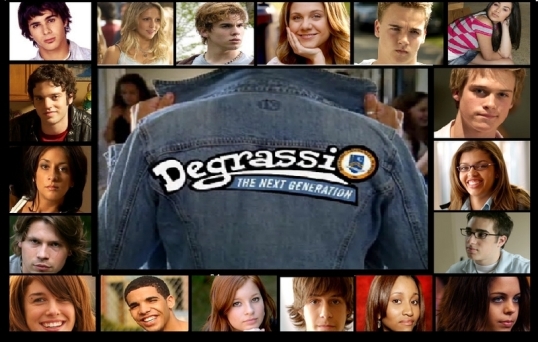
Welcome to Late Night Retro Television Reviews, a feature where we review some of our favorite and least favorite shows of the past! On Sunday, I will be reviewing the Canadian series, Degrassi: The Next Generation, which aired from 2001 to 2015! The series can be streamed on YouTube and Tubi.
This week, several important characters make their first appearances!
Episode 2.4 “Karma Chameleon”
(Dir by Stefan Sciani, originally aired on October 21st, 2002)
This week, Ellie makes her first appearance!
Though she doesn’t do much in this episode, Ellie Nash (Stacey Farber) would go on to become one of the most important characters on Degrassi: The Next Generation. (And Farber herself would go on to have one of the more-successful post-Degrassi careers of the show’s regulars.) When I first watched Degrassi, I related to Ellie, largely because we both had red hair, we both tended to wear black, and we both had a weakness for Craig Manning. (There was another reason why I related to Ellie but I won’t go into that until we reach season 3.) Now that I’ve gotten older, I can see that, in high school, I actually had more in common with the overly dramatic Ashley Kerwin than I did with Ellie but still, Ellie is one of Degrassi’s best characters.
In her first appearance, Ellie refuses to move to another computer, despite Paige ordering her to so that Paige can sit next to Hazel. Later, she provides some sarcastic comfort to Ashley after Ashley’s latest poorly conceived plan blows up in her face. “That went well,” Ellie says and yes, it’s a little bit snarky but that’s what made Ellie so cool. As I said, Ellie doesn’t do much in this episode. (Stacey Farber wouldn’t become a regular until the third season.) But she definitely makes an impression.
As for Ashley, she spends this episode trying to get back into everyone’s good graces. Following Terri’s suggestion, Ashley swallows her pride and apologizes to Paige, Jimmy, and Sean. Everyone seems to be willing to forgive Ashley, except for Paige. Paige continually warns everyone that Ashley is just being manipulative. Jimmy, however, wants to restart his romantic relationship with Ashley. But when Sean calls Ashley and asks her on a date, Ashley happily accepts. Terri says that Ashley is going to hurt Jimmy if she goes out with Sean because Jimmy thinks that he and Ashley are about to get back together.
Ashley rolls her eyes, explains that she’s single, and then tells Terri that “Ter, one day when a guy likes you, you’ll understand how this works.”
AGCK!
I mean, actually, Ashley’s right. She didn’t tell Jimmy that she wanted to get back together again. (She did say that she missed having Jimmy around and I would say that Ashley should have been able to guess how Jimmy would interpret that, given their past relationship.) And there’s no reason why she shouldn’t date Sean Cameron if she wants to. And, for that matter, no one likes Terri.
(At least not yet. Eventually, Terri’s first boyfriend will end putting her in a coma and then shooting up the school but that’s a while off….)
But Ashley definitely could have put things a bit more diplomatically. One reason why I cringe so much watching this is because I can remember saying similar stuff when I was a teenage and not understanding why people got offended until many years later. Ellie never would have said something like that.
Meanwhile, Toby has a girlfriend! Kendra Mason (Katie Lai) loves anime even more than Toby! The only problem is that …. KENDRA IS SPINNER’S ADOPTED SISTER! At first, Toby is terrified to talk to Kendra because of Spinner. But Toby finally finds the courage to stand up to Spinner and tell him that he’s going to talk to Kendra whether Spinner likes it or not. Spinner says that he will disembowel Toby is Toby hurts his sister. Toby says he’s prepared for that. (Toby, never prepare for something like that.) It’s nice that Toby has a girlfriend and can presumably stop whining about Emma liking Seasn. It’s just too bad that Kendra’s going to vanish after this season and never be mentioned again, not even by her protective older brother.
Also, all the boys in school are in love with the new science teacher, Ms. Hatzilakos (Melissa DiMarco). This was Hatzilakos’s first appearance. It’s only one scene of Spinner and Jimmy drooling at their desks. Of course, Ms. Hatzilakos is destined to eventually become principal of Degrassi and her son Peter will eventually enroll as a student, break a lot of hearts and law, and write the deathless song House Arrest.
Anyway, Jimmy gets mad at Ashley. Sean gets mad at Ashley and calls off their date. Paige tells Terri that she has to make a choice between four years of being popular or four years of being an outcast and Terri decides to be popular. Ashley breaks down crying as her school picture is taken. So ends another happy episode of Degrassi!
Oh, this episode. It’s actually pretty good for an Ashley episode. And the freeze frame of Ashley getting her school picture taken as a tear sloppily rolls down her face? That’s image pretty much sums up Degrassi perfectly.
Next week, Spinner is a part of a science experiment and …. well, this would never happen on American television.
Welcome to Retro Television Reviews, a feature where we review some of our favorite and least favorite shows of the past! On Sundays, I will be reviewing Homicide: Life On The Street, which aired from 1993 to 1999, on NBC! It can be viewed on Peacock.
This week …. someone’s getting married!
Episode 4.20 “The Wedding”
(Dir by Alan Taylor, originally aired on May 10th, 1996)
Kevin Lungo, a Baltimore radio host, is found dead. The previous day, he announced on his program that he was not only in favor of abortion but he was in favor of requiring any pregnant woman with an IQ of less than 100 to have one. Did that comment lead to him being gunned down in a parking lot?
(When this episode aired, 100 was considered to be an “average” IQ. Now, the average IQ is considered to be 90. That’s not a good thing.)
We never really find out. The case is handled by Giardello and Kay and, while Kay has never heard of Lungo, it turns out that Giardello used to enjoy listening to him. (Hopefully, Giardello disagreed with Lungo’s pro-eugenics stance.) When the radio station offers a $5,000 reward for any tips, someone calls in and give the name of the “killer.” When Giardello and Kay follow-up on the tip, the suspect pulls a gun and is shot dead by Giardello.
Giardello feels guilty about the shooting. He tells that Kay that, when he was younger, he was able to shoot well-enough that he could simply wound a suspect, instead of killing him. Making it even worse is that the dead man has an alibi. The call was just a practical joke between friends. “Why did you have to kill him!?” the dead man’s friend wails.
Back at the squad room, Lewis shocks everyone by announcing that he’s getting married to a woman that they’ve never heard of. While he doesn’t invite any of his co-workers to the wedding, he does ask them to attend a reception at the Belvedere Hotel. He tells Pembleton to order and pay for the flowers. He asks Russert to arrange for the band and an open bar and asks if she would be willing to cover the cost. (“Until my next paycheck,” Lewis assures her.) Munch assumes that Lewis is lying. Most of the squad room suspects that Lewis is lying. But they give him the benefit of the doubt and show up for the reception.
Also going to the reception is Carrie, the very glamorous sister of Kay Howard. Carrie is visiting from Florence and soon, both Kellerman and Bayliss are shamelessly flirting with her. An actress named “Margaret May” is credited as playing Carrie. Of course, Margaret May is actually Melissa Leo.
With the exception of Giardello and Kay (who are still working the Lungo murder), all of Lewis’s colleagues show up at the ballroom. Even the crusty forensics examiner, Scheiner (Ralph Tabakin), shows up. “Do you want to dance?” he asks Russert’s daughter. “NO!” she replies.
But where’s Lewis? Lewis is missing. Was Munch right? Pembleton, who is there with his very pregnant wife, is not amused. As Brodie films him, Pembleton announces that he is going to kill Lewis and he will never get caught because of his experience as a homicide detective….
Fortunately, Lewis shows up before Pembleton gets his gun. And accompanying Lewis is his new wife, Barbara Shivers (Karen Williams)! The reception is a huge success. The band plays. Kellerman and Bayliss both try to hold onto Carrie’s attention. Scheiner watches as Russert’s daughter proceeds to dance with everyone but him. Finally, Giardello and Kay show up. Kay warns Bayliss that Carrie is dangerous. Bayliss asks why. Kay says that Carrie likes to play game and she just does whatever feels good. Bayliss looks intrigued….
Mary Pembleton’s water breaks on the dance floor as she goes into labor! (In a nice twist, Mary Pembleton was played by Andre Braugher’s real-life wife, Ami Brabson.) As the episode ends, even Giardello smiles. For all the ugliness in the world, there is still hope.
I loved this episode! Homicide’s greatest strength was its ensemble and here, everyone gets a chance to show off. Yaphet Kotto reminds us of what an imposing actor he truly was, though my favorite Giardello moments continue to be the times when he allows himself to get amused by the absurdity of it all. What really made this episode was for me was that, even with the wedding reception and Mary going into labor, the episode never allowed itself to be sentimental. For most of the episode, everyone is skeptical about Lewis getting married and, having watched Meldrick Lewis for four season, I was skeptical too! In the end, the episode earned its right to emotionally satisfying through smart storytelling and good acting.
Today is National Freedom Day, which celebrates the anniversary of President Lincoln singing the joint House and Senate resolution that proposed the 13th amendment to the U.S. Constitution.
Today’s song of the day is a favorite of mine and I think it deserves to be heard by more people. Here is Michael Fredo with Free.
Ain’t never had a day, never had a day Ain’t never had a day, never had a day
Rising up, the morning sun Walking down the street, oh, my day has just begun I’m feeling fine, what’s come over me? Ain’t never had a day when I feel so, feel so
Feel so free Ain’t never had a day, what’s come over me, baby? Feel so free, yeah Ain’t never had a day, what’s come over me?
I thought this day would never ever end I felt so high (Felt so high) I’d do it all again (I’d do it all again) I can’t explain what’s been in my heart It’s not about a girl (It’s not about a girl) It’s about my day and how it started
Feel so free Ain’t never had a day, what’s come over me, baby? Feel so free, yeah Ain’t never had a day when I can fly so, fly so
Oh, oh, oh, oh I’ve waited for you so long and I cannot say goodbye So come and fly with me I’ll take you to a place that you would rather be
The day is done, the night is here I look up to the sky with stars perfectly clear The moon is full, I praise the Lord For another day that we can say, we can say hey
Oh, oh, oh, ain’t never had a day, what’s come over me, baby? Feel so free, yeah Ain’t never had a day when I can, when I can groove with you Never had a day, never had a day Ain’t never had a day, what’s come over me, baby? Feel so free, yeah
The 1976 film, The Eagle Has Landed, takes place during World War II.
The year is 1943 and, with the war turning against Germany, Heinrich Himmler (Donald Pleasence, in a chilling turn) orders Colonel Max Radl (Robert Duvall) to come up with a plan to kidnap Winston Churchill. When Radl learns that Churchill is scheduled to visit a small, coastal British village, he recruits a cynical member of the IRA, Liam Devlin (Donald Sutherland), to travel to the village and make contact with a Nazi sleeper agent, Joanna Grey (Jean Marsh). While Devlin sets up the operation in Britain and falls in love with Molly Prior (Jenny Agutter), Radl recruits disillusioned Colonel Kurt Steiner (Michael Caine) to lead the mission to kidnap Churchill.
At first the village is welcoming to Steiner and his men, who are disguised as being Polish paratroopers. However, it doesn’t take long for the plan to fall apart. Soon, Steiner and his men are holding the villagers hostage in a church while battling a group of American soldiers led by the incompetent Colonel Clarence Pitts (Larry Hagman) and Captain Harry Clark (Treat Williams). Meanwhile, in Germany, Radl learns that Hitler did not actually authorize the mission to kidnap Churchill and that he has been set up as the scapegoat in case the mission fails.
The Eagle Has Landed can seem like a bit of an odd film. For a film that was released in the same year as Network, All The President’s Men, and Taxi Driver, The Eagle Has Landed feels rather old-fashioned and almost quaint in its storytelling. This was the final film to be directed by John Sturges, a director who started his career in the 1940s and whose best-known films included The Magnificent Seven and The Great Escape. Sturges’s direction is efficient but not at all flashy. (It’s a film that feel like its very much a product of the mid-60s as opposed to the mid-70s.) The story plays out at a deliberate pace, one that leaves no doubt that the film was based on a novel. In fact, it sometimes feels as if the film itself should have chapter headings. The film holds your interest but it’s hard not to feel that a film that should have been an epic action film has instead been turned into something far less ambitious.
Sturges works with an ensemble cast, with no one member of the cast really dominating over the other. (I guess if the film has a main character, it would be Donald Sutherland’s Liam Devlin but, for all the time that’s devoted to him, he actually doesn’t do that much once the action starts.) The cast is full of good actors, though a few of them are miscast. Neither Michael Caine nor Robert Duvall make much of attempt to sound German. As a member of the IRA, Donald Sutherland sounds as Canadian as ever. Fortunately, Caine, Duvall, and Sutherland are all strong-enough actors that they can make an impression even with somewhat distracting accents. Treat Williams is a bit bland as the heroic American but Larry Hagman generates a few chuckles as Williams’s amazingly dumb commanding officer. The important thing is that ensemble is strong enough to hold the viewer’s attention.
The Eagle Has Landed is an old-fashioned but still entertaining film. The actors are fun to watch, the action scenes are fairly exciting, and it ends with a clever twist, one that was apparently historically accurate. It’s a well-done historical melodrama, even if it’s never quite as epic as it aspires to be.
Today’s song of the day could probably double for a scene that I love but that’s okay. I’ve always loved the Nothing Ever Happens On Mars song from Waiting to Guffman.
(Mars? “Where’s that!?”)
It’s such a marvelous scene. Yes, it captures the absurdity of regional theater but it also captures the underlying sweetness of it as well. We may laugh but it’s still hard not to be touched by how much the members of the audience love it.
And, in the contest of the show, it’s a nice reminder that we’re not that different. Martians get bored with their hometown as well!
When I heard that the actress Catherine O’Hara had passed away, I immediately thought of Waiting For Guffman.
I know that a lot of people immediately thought of Schitt’s Creek. And I imagine that a lot of people thought of her as the desperate mother in Home Alone. And definitely, there are a lot of people on twitter who are posting clips of her work on SCTV right now. But I’m a theater nerd and, when you’re a theater nerd, Waiting for Guffman pretty much feels likes watching your life on film.
The entire cast of Waiting for Guffman is brilliant. It’s definitely the most emotionally satisfying of all of Christopher Guest’s mockumentaries. But I’ll have a special place in my heart for Catherine O’Hara and Fred Willard as the community theater superstars. Today’s scene that I love features O’Hara and Willard giving the audition of a lifetime in Waiting For Guffman.
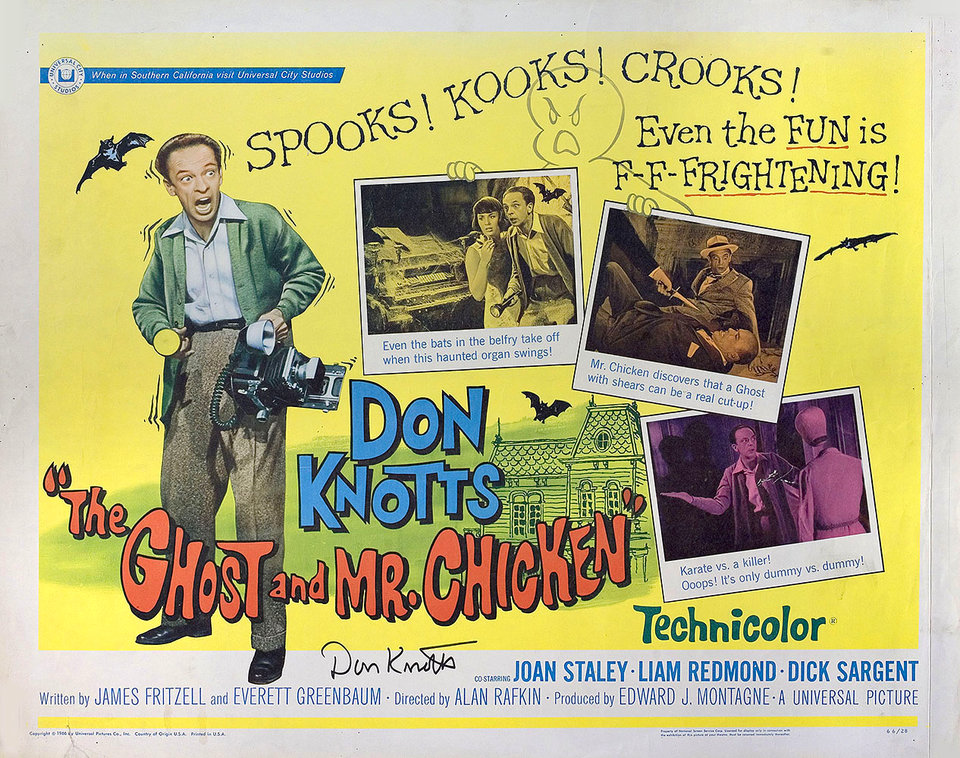
I love Don Knotts. I’m one of those people who have watched every episode of THE ANDY GRIFFITH SHOW (1960-1968) multiple times. And while it’s true that there are good episodes in the last three seasons, the series was at its best when Sheriff Andy Taylor and his sidekick Barney Fife were serving the townsfolk of Mayberry, North Carolina during the first five seasons. In Barney Fife, Don Knotts created one of the best characters in television history, earning five Emmy Awards in the process. When Don Knotts left the series at the height of its popularity, the first movie he made was THE GHOST AND MR. CHICKEN!
In THE GHOST AND MR. CHICKEN, Knotts plays Luther Heggs, a meek typesetter at a small-town newspaper in Rachel, Kansas, who dreams of being a serious reporter but is treated like a joke by nearly everyone around him. When the town prepares for the 20-year anniversary of an unsolved murder at the supposedly haunted Simmons Mansion, Luther unexpectedly gets a chance to prove himself. He volunteers to spend the night alone in the mansion to see if it really is haunted. As you might expect, Luther is scared out of his mind as he hears banging on the walls, discovers secret passageways, and observes blood-stained organs playing themselves. The night culminates with Luther seeing a portrait of poor Mrs. Simmons with gardening shears piercing her throat! By surviving the night, and then telling the truth about what he experienced, Luther just may uncover a real crime being committed behind all of this “supernatural” activity!
Since Don Knotts left THE ANDY GRIFFITH SHOW to pursue a movie career, I’m glad to report that his decision to star in THE GHOST AND MR. CHICKEN was a really good choice. His performance is a masterpiece of physical comedy. Sure, Knotts trembles, shakes and delivers his lines in his awkward, nervous way for a lot of laughs, but he also provides a vulnerability that really makes you root for him. Knotts knew how to play lovable losers in a way that shows a quiet decency. He may actually be scared, and he may seem like a real pushover, but he also finds the courage to do the right thing even when it’s not easy. This was true for Barney Fife, and it’s also true for Luther Heggs in THE GHOST AND MR. CHICKEN.
Aside from Don Knotts, THE GHOST AND MR. CHICKEN has a solid supporting cast! Joan Staley is very beautiful as Luther’s love interest, Alma. Staley was a Playboy Playmate in 1958, so I can definitely see why Luther is in love. I like the fact that her Alma is more than just a pretty face. Rather, she’s one of the few people who sees Luther as more than a joke, which makes her even more appealing. Meanwhile, Luther’s newsroom boss (Dick Sargent) and office rival (Skip Homeier) never miss an opportunity to be condescending. The director Alan Rafkin directed 27 episodes of THE ANDY GRIFFITH SHOW, so he definitely knows how to get the best comedy out of Knotts and the rest of his cast. He also keeps the tone light, with the haunted house set pieces playing out like gentle, kid-friendly chills rather than anything truly scary. The blood-stained organ / garden shears sequence in the mansion is especially effective, with Don Knotts perfectly walking the line between raging fear and slapstick comedy. Signaling that there was a big audience for Don Knotts in the movies, THE GHOST AND MR. CHICKEN proved to be a box office hit, taking the number one spot during its first week of release, and grossing about eight times its budget!
Ultimately, THE GHOST AND MR. CHICKEN endures because it understands the special qualities of its star. Don Knotts is funny, and he’s also human. He may be scared out of his mind, but he also has decency and an ability to find courage when he must. In that way, it’s a comfort movie, a should-be Halloween staple, and finally, a reminder that sometimes the bravest person in the room is the one who can’t quit shaking.
 Through the Shattered Lens