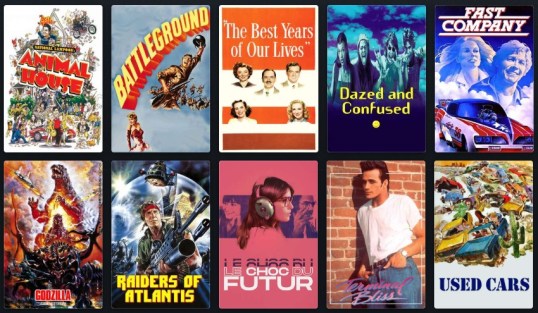
Here are ten films that I recommend checking out this weekend. These films are all streaming so, if you’re stuck inside due to weather or crippling depression, give them a shot!
In Memory of My Dad
This Memorial Day is going to be a difficult one for me because it’s also going to be the one-year anniversary of the car accident that eventually led to my Dad passing away last year. These first two films, I’m recommending in his memory. One of them was a favorite of movie of his. The other movie is one that makes me think about him and my mom whenever I watch it.

First off, National Lampoon’s Animal House (1978) was one of my Dad’s favorite movies. He saw it in theaters when it was first released and, whenever he would come across the film on television, he would get the biggest smile on his face. I love this film, too. I reviewed it a few years ago but, for here, I’ll just say that this film works as both the quintessential college comedy and also as a surprisingly touching portrait of friendship. As Dean Wormer, John Vernon set the standard for heartless authority figures for years to come. Tim Matheson, Peter Riegert, Tom Hulce, Stephen Furst, Kevin Bacon, Karen Allen, Bruce McGill, James Daughton, Mark McGill, BELUSHI! For the record, my favorite member of Delta House was always Hoover. Animal House is currently on Prime.
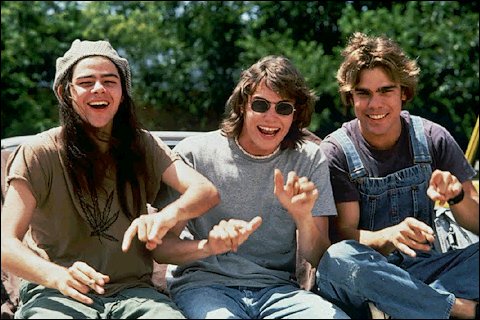
Secondly, I have to mention Dazed and Confused (1993). Richard Linklater’s portrait of life in 1970s Texas has long been a favorite of mine. There’s a lot of reasons, from the clever dialogue to the genuinely funny moments to the performances of the truly amazing cast. Matthew McConaughey may have been the one to become a star but the film is full of great performances, from everyone from Jason London to Parker Posey to Wiley Wiggins and Michelle Burke to Cole Hauser and Ben Affleck to Adam Goldberg and Anthony Rapp to Nicky Katt …. well, you get the idea. Linklater has sometimes said that he regrets that the film didn’t have more “serious” moments but I think he’s being a bit too hard on himself and the film. There’s a definite sense of melancholy to Dazed and Confused. These characters have no idea what’s waiting for them in the future. This film always makes me think of my Mom and Dad because it’s about their generation. (My Dad once told me that the film was very accurate.) Whenever I watch this film, I’m reminded that everyone was young once and, eventually, everyone gets older. Dazed and Confused is on Prime.
For Memorial Day
Memorial Day is an often misunderstood holiday. It was first celebrated after the Civil War and it’s meant to be a time to honor those who sacrificed their lives defending the United States. It’s mean to be a time of sober reflection but that’s not currently our nation’s strong suit.
I’m not a huge fan of war films but I do like Battleground (1949), a simple but moving portrait of a platoon of soldiers fighting during the Battle of the Bulge. Battleground, made when World War II was a very fresh memory, is a touching and realistic portrait of combat, one that focuses on the humanity of the soldiers involved. No one is presented as being superhuman or as an indestructible action hero. Instead, they’re vulnerable, frequently frightened, and often frustrated. At the same time, they’re also putting their life at risk for their country and battling one of the greatest evils that the world has ever known. Battleground is a tribute to American soldiers and those who sacrificed their lives to battle the Nazis. Amongst the ensemble cast, young Ricardo Montalban stands out as a tragic soldier. For now, Battleground can be viewed on YouTube.

The Best Years Of Our Lives (1946) won the Oscar for Best Picture of 1946 and, while I would have given the Oscar to It’s A Wonderful Life, The Best Years Of Our Lives remains a powerful portrait of returning veterans and their struggle to adjust to life during peacetime. Fredric March, Dana Andrews, and Harold Russell return from combat and find themselves surrounded by friends and family who have no way of understanding what they experienced while serving their country. Wonderfully directed by William Wyler and featuring a brilliant cast, The Best Years Of Our Lives is a moving film, one that reminds us that the scars of war don’t disappear once the shooting stops. The film is streaming on Pluto and Peacock.
For All You Car Fans
The Indianapolis 500 is scheduled for this Sunday. Personally, I like cars and I like the people who aren’t afraid to drive fast.
Fast Company (1979) is one of the many 70s films to be made about racing. It’s certainly not the first to feature William Smith as a driver who loves speed and taking risks. What sets Fast Company apart is that it was directed by David Cronenberg. It’s a film that Cronenberg did for the money and it was also the first time that he worked with two important future collaborators, actor Nicholas Campbell and cinematographer Mark Irwin. Even though there’s not much of Cronenberg’s signature stye here, he does show himself to be an adroit genre director. The cars are fast, the races are well-shot, and John Saxon shows up as the villain. Fast Company is on Tubi.
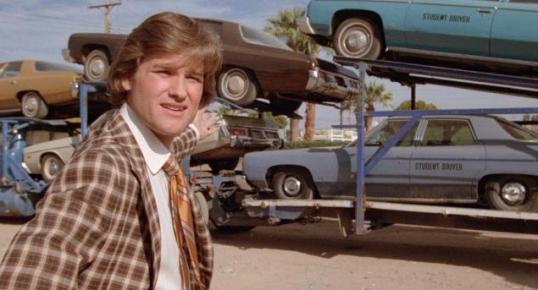
Used Cars (1980), an early film from Robert Zemeckis and screenwriter Bob Gale (who celebrates a birthday tomorrow), is one of my favorite films, a hilarious and shameless comedy that features Kurt Russell, Jack Warden, and Gerrit Graham at their absolute best. Russell, at a time when he was still struggling to establish himself as something more than a Disney star, gives a wonderful and charismatic performance as a used car salesman with political ambitions. This film is worth seeing for his suit alone! Jack Warden plays twin brothers, one good and one bad. Never look away when Gerrit Graham is in a scene because, even when he’s in the background, he can make you laugh. This ends with one of the greatest chase scenes ever directed. Used Cars is on Tubi and you definitely need to watch it if you haven’t already.
Odds and Ends

Of all the films that I’ve ever seen at SXSW, Shock of the Future (2019) remains my favorite. Starring Alma Jodorowsky as a musician living in 70s Paris, Shock of the Future pays tribute to the female pioneers of electronic music. Needless to say the soundtrack is wonderful but, beyond that, Shock of the Future is a film that captures the joy that comes from creativity and artistic expression. It’s a film that will leave you wanting to create something wonderful. Shock of the Future is on Tubi.
Terminal Bliss (1992) is a portrait of teenagers with too much money, too many drugs, and not much of a conscience. It’s a film that wears its influences on its sleeve but, at the same time, director Jordan Alan (who was 19 at the time) does a good job of capturing the ennui and detachment that dominates his character’s lives. This is a flawed film but worth seeing for Luke Perry’s performance as a young sociopath. After years of only being available in a French-language dub, the English-version of Terminal Bliss is currently on YouTube.
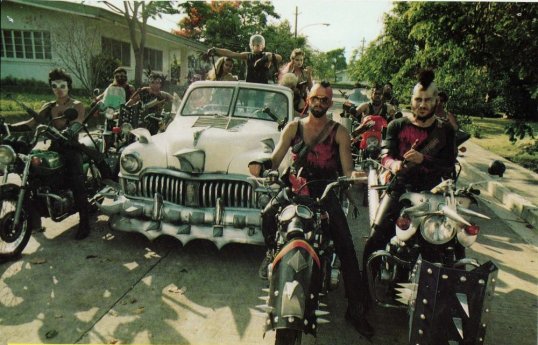
Ruggero Deodato’s Raiders of Atlantis (1983) may not be as well-known as Deodato’s Cannibal Holocaust or The House on the Edge of the Park but it’s still an entertainingly weird mix of Atlantis, Miami Vice, Mad Max, and Raiders of the Lost Ark. The Atlanteans return to land of the living and, for some reason, they’re riding motorcycles and dressing like wannabe punk rockers. It makes no sense but Deodato keeps the action moving and the cast is a who’s who of Italian exploitation, featuring Christopher Connelly, Tony King, Ivan Rassimov, Bruce Baron, and George Hilton! The soundtrack is wonderfully over-the-top. It can be found on Tubi!
Godzilla vs Destoroyah (1995) is one of the best Godzilla films and, unfortunately, it’s one that often seems to get overlooked. Godzilla is at his most fearsome and destructive and Destoroyah is a more than worthy opponent. The members of the Godzilla Task Force all get to wear cute uniforms. Godzilla vs Destoroyah is available on Tubi.
Have a wonderful weekend!




 Through the Shattered Lens