Since today is Raymond Chandler’s birthday, it seems appropriate that our song of the day should come from the best of the Philip Marlowe films.
Since today is Raymond Chandler’s birthday, it seems appropriate that our song of the day should come from the best of the Philip Marlowe films.
Welcome to Late Night Retro Television Reviews, a feature where we review some of our favorite and least favorite shows of the past! On Tuesdays, I will be reviewing Pacific Blue, a cop show that aired from 1996 to 2000 on the USA Network! It’s currently streaming everywhere, though I’m watching it on Tubi.
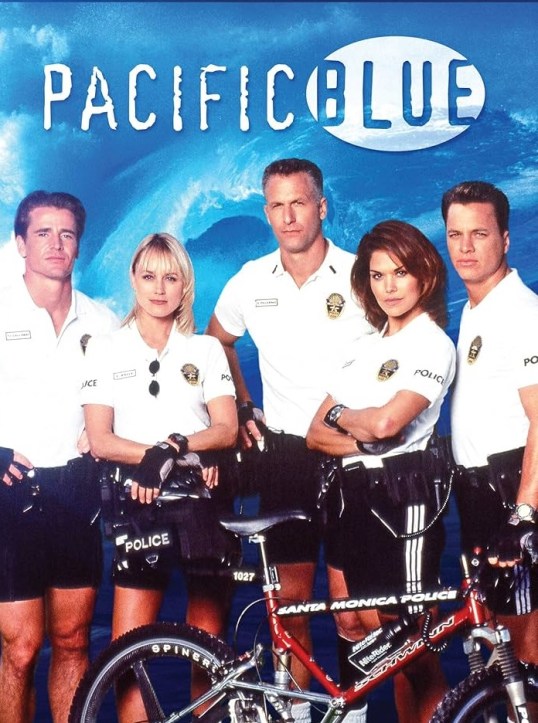
This week, TC is pissed off because he’s expected to do his job.
Episode 2.12 “Wheels of Fire”
(Dir by Gary Winter, originally aired on November 17th, 1996)
Two Russian mobsters are shaking down businesses on the boardwalk. Only Ed Tarlow (Richard Redlin), a paraplegic who owns a “head shop,” is willing to testify against them. This means that he gets two undercover bicycle cops assigned to his shop to provide protection. TC and Cory get the assignment but it turns out that TC doesn’t want to protect Ed because he feels that Ed is selling drug paraphernalia and that Ed “is a cop hater.”
Hey, TC — it’s your job, idiot. You’re supposed to help everyone on the boardwalk, regardless of how you feel about them personally.
Still, TC spends most of the episode pouting. It’s mentioned that he’s also worried about studying for his upcoming sergeant’s exam but if TC is too immature to protect Ed without bitching about it than maybe TC doesn’t deserve a promotion. TC is also upset because his girlfriend wants to go out-of-state so that she can enroll in a graduate program, become a sex abuse counselor, and help rape victims. Because how dare she try to help other women without checking with TC first, right? TC IS THE WORST!
Eventually, Palermo rolls up and tells TC that Ed is a decorated veteran who was paralyzed by a cop during an anti-war protest. TC realizes that he misjudged Ed and he finally stops pouting enough to catch the Russian mobsters. But you know what? It shouldn’t matter how Ed ended up in wheelchair and it also shouldn’t matter whether or not he’s a veteran. TC’s job is to protect people from crime! Ed has got two Russian mobsters trying to kill him. TC should be protecting Ed because that’s HIS. DAMN. JOB!
Meanwhile, three woman are secretly beating up creepy men on the boardwalk. One of the women is a rape survivor and the other two women claim that they are getting vengeance for her. What is the deal with this show not only using rape as a plot point but also trivializing it in the process? Chris Kelly eventually arrests the women and does her thing where she glares at everyone.
Palermo’s 15 year-old daughter goes to Del Toro and asks “type of condom do guys like.” It turns out that she’s thinking about having sex with her 19 year-old boyfriend. Del Toro’s answer should have been, “Your boyfriend is old enough to buy his own condoms.” Instead, Del Toro convinces her to hold off on having sex until he can check out her boyfriend. Her boyfriend turns out to be a nice guy but still, a 19 year-old dating a 15 year-old is kind of weird. (It’s less the age difference and more the maturity difference. Four years isn’t that big a deal when it’s something like a 26 year-old and a 22 year-old. But this is the difference between someone starting high school and someone starting college.) It’s also statutory rape, though no one seems to be too concerned about that.
Anyway, Palermo finds out so guess which couple isn’t going to be having sex for a long time?
This was another stupid episode of Pacific Blue. Again, the problem isn’t just that the cops all look stupid on their bicycles. It’s also that the cops represent everything that people hate about cops. Chris and TC are both self-righteous and immature. (When someone complains about Chris nearly running someone over on her bicycle, Chis replies that she’s doing her job.) It gets annoying after a while.
This week’s episode served as a reminder to never depend on anyone riding a bike.
Welcome to Retro Television Reviews, a feature where we review some of our favorite and least favorite shows of the past! On Tuesdays, I will be reviewing the original Fantasy Island, which ran on ABC from 1977 to 1984. Unfortunately, the show has been removed from most streaming sites. Fortunately, I’ve got nearly every episode on my DVR.
This week, the tyranny of Laurence continues.
Episode 7.2 “The Big Switch/Hooker’s Holiday”
(Dir by Bob Sweeney, originally aired on October 15th, 1983)
Shelley James (Melinda Culea) is a high-priced call girl who comes to Fantasy Island looking for an escape from her life. For one weekend, she wants not only a normal life but also a chance to meet a man who will love her without paying her for sex. Luckily, Brad Jacobs (Richard Hatch) is also on the Island!
This is the type of fantasy that Fantasy Island handled well in the past. It doesn’t work out quite as well this episode became Mr. Roarke’s new servant (there’s no other word for him), Laurence, makes some rather snarky and judgmental comments about Shelly and her profession (asking at one point whether she’s on the Island for a fantasy or to give someone a fantasy) and it just feels totally wrong. One of the good things about Fantasy Island was that Roarke never judged the people asking for fantasies. He may have warned them about what they would discover. Sometimes, he manipulated them to help them discover something important about themselves. But once you were allowed to come to the Island, Roarke didn’t judge you and neither did Tattoo. In fact, Tattoo was probably even less judgmental than Roarke. Tattoo knew what it was like to be judged. Laurence, on the other hand, is a snooty British butler and seems personally offended by Shelley’s presence on the Island. (Eventually, after she shares her tragic backstory, he comes around but still, it shouldn’t take a sad story to get people to treat each other with decency.) Laurence is the type of employee who would keep me from wanting to visit the Island. I fear he would tell me that my skirt was too short or something.
As for the other fantasy, Laura Walter (Katharine Helmond) feels that her husband George Walter (Vic Tayback) is a chauvinist and she’s right. She wants him to experience what it’s like to be a woman so Roarke arranges for them to switch bodies. Laura is in George’s body and George is in Laura’s body but for some reason, the show dubs their voices so, whenever George speaks, we hear Laura’s voice and whenever Laura speaks, we hear George’s voice. It’s a bit awkward. Why would their voice switch too? Anyway, Laura discovers that women tend to toss themselves at George and George discovers that his business partner is a lech.
It’s the final season and final seasons often feel uninspired. That was certainly the case with this episode. Even the reliable Ricardo Montalban seemed bored with it all. In the end, it’s just not as much fun without Herve Villechaize around.
This video reminds me of visiting my family across America when I was younger. I love rain in the country.
Enjoy!
Welcome to Late Night Retro Television Reviews, a feature where we review some of our favorite and least favorite shows of the past! On Mondays, I will be reviewing CHiPs, which ran on NBC from 1977 to 1983. The entire show is currently streaming on Prime!
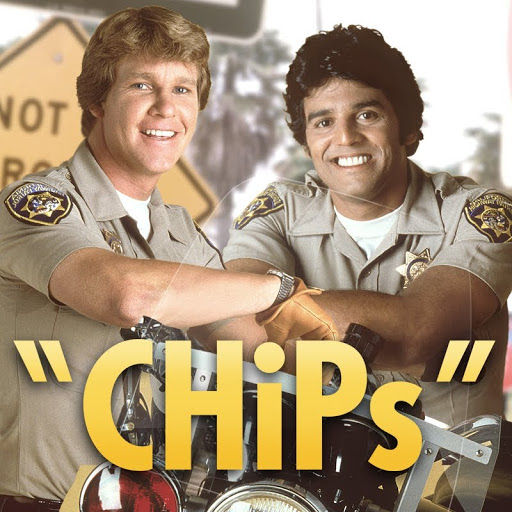
This week, Ponch brings us all closer together.
Episode 4.4 “The Poachers”
(Dir by Barry Crane, originally aired on October 19th, 1980)
In the beautiful hills surrounding Los Angeles, Jon and Ponch (but mostly Ponch because, as of the start of season four, this is The Ponch Show) pursue two poachers (Robert F. Lyons and Michael Gwynne). However, Ponch is not the only one after the poachers. A Native American grandfather named Nathan (Michael Ansara) is in the hills with his grandson (Tony Raymond) and, together, they shoot arrows at the poachers.
Hey, that’s attempted murder!
Well, no matter. No one like poachers, least of all me.
While Ponch captures the poachers and befriends the grandfather, the rest of the Highway Patrol spend their time at the drag strip and try to win races and set records. Ponch insists that he should be the one allowed to represent the force on the track and he’s probably right because he’s Ponch and this is The Ponch Show. Instead, Sgt. Getraer — who technically outranks Ponch but who knows how long that will last — takes to the track himself and amazes everyone with his speed. Woo hoo! Meanwhile, poor Baker stands in the background and perhaps remembers how, when the show started, he actually got to do stuff other than follow Ponch around.
This episode was nothing special. It was well-intentioned with its anti-poaching storyline but it also featured even more cliches than usual. Michael Ansara was himself not Native American. He was born in Syria. The actors who played his son and his grandfather were also not Native American, at least not as far as I could detect from their IMDb profiles. In short, this was an episode about the wisdom of Native Americans that doesn’t appear to have featured any actual Native Americans.
All that said, it was nice to Robert Pine get to have some fun with the role of Sgt. Getrear. Pine’s tough-but-fair performance as Getraer has often been this show’s secret weapon and, in this episode, he at least got to smile for once. He earned it!
Welcome to Retro Television Reviews, a feature where we review some of our favorite and least favorite shows of the past! On Mondays, I will be reviewing Miami Vice, which ran on NBC from 1984 to 1989. The entire show can be purchased on Prime!

This week …. I don’t even know how to describe it.
Episode 4.12 “The Cows Of October”
(Dir by Vince Gillum, originally aired on February 5th, 1988)
A cannister of bull seamen has been stolen from a Miami lab and the feds (represented by Harry Shearer) want it back before it falls into the hands of the Cubans. Switek assists. Izzy shows up to broker the deal. Gerrit Graham plays a shady person who we are told is from Texas. (His accent is more Arizona.) Philip Michael Thomas wears a cowboy hat. Don Johnson is largely absent until the final scene. One gets the feeling that Johnson hated every minute of this episode while Thomas just seemed to be having fun.
This episode was, without a doubt, the stupidest episode of Miami Vice ever filmed. And listen, I will admit that I haven’t seen every episode. I’ve still got a season and a half to go. There seems to be a general online consensus that the final two seasons of Miami Vice were not good at all. I’m sure I have many dumb episodes ahead of me. But I cannot — as much as I try — imagine any episode that could be as a dumb as the Vice Squad abandoning the war on drugs so that they could keep the Cubans from getting their hands on a cannister of bull semen.
Miami Vice has always been as its best when its been surrealistic, cynical, and gritty. I would argue that Miami Vice really does not need to do comedic episodes. For the first three seasons, nearly every episode ended with an innocent person either dead or forever embittered. At its best, Miami Vice was not a happy show. It was a show where Crockett and Tubbs drove around in the dark, loaded their guns, and Phil Collins sang in the background. When Collins sang, “I can feel it coming in the air tonight,” he was not talking about bull semen. At least, I hope he wasn’t. (Oh, Lord….)
I really don’t know what to make of season 4. Trudy’s going to space. Crockett’s married. The Vice Squad is searching for bull semen. Yet somehow, through it all, Castillo continues to just stare at the floor and speak through gritted teeth. Like seriously, shouldn’t Castillo be concerned about all this weird stuff going on?
I didn’t care much for this episode. Searching for bull semen is a Pacific Blue thing. Miami Vice needs to handle real cases and leave all that other stuff for the bike cops.
Today’s song of the day comes the 1967 winner for Best Picture, Norman Jewison’s In The Heat of the Night.
“It’s Miley!” as they used to say on The Soup.
Enjoy!
Welcome to Late Night Retro Television Reviews, a feature where we review some of our favorite and least favorite shows of the past! On Sunday, I will be reviewing the Canadian series, Degrassi High, which aired on CBC and PBS from 1989 to 1991! The series can be streamed on YouTube and Tubi

In yourself, you must believe….
Episode 2.11 “Showtime Part 2”
(Dir by Kit Hood, originally aired on January 28th, 1991)
The students of Degrassi High struggle to move on from the suicide of Claude Tanner. The talent show goes on, with all of the money raised being given to Claude’s parents. Snake, for his part, goes to therapy and stays home from school. When Joey visits him, Snake mentions that, when he found Claude, half of his face was missing. Meanwhile, Caitlin is haunted by visions of Claude, smiling and trying to hand her a flower.
This episode was not quite what I was expecting. Instead of embracing the melodrama (as Degrassi: The Next Generation would have), this episode is low-key and realistic about showing the ways that people deal with grief and trauma. Snake is understandably shaken but what makes his scene so poignant is that he’s obviously struggling to pretend like he isn’t or that life can go back to normal after what he’s seen. I spent this entire episode waiting for Caitlin to breakdown. She didn’t and really, I have to commend the show for that because I sometimes think we put too much pressure on people to release all of their emotions before they’re ready to do so. Caitlin is still emotionally number and it’s going to be a while before she’s ready to really talk about what happened. And that’s okay! Sometimes, it takes a while. It’s only now, nearly a year after he died, that I’m really starting to realize how depressed I’ve been over the past year. All those times that I thought I was moving on, I was really just distracting myself from the pain. And now, with that one year anniversary approaching, I find myself crying at the most random of times. It’s not pleasant. My heart hurts on most days. But I know that eventually, I’ll make it through. Everyone grieves in their own way and apparently, this is the way that I grieve.
This was a good Joey episode. Not only did Caitlin agree to tutor him in his science class but Wheels finally paid back the money that he stole from Joey’s mother. During their study session, Joey and Caitlin talked about the suicide, with Joey asking if Caitlin knew Claude. I guess the show’s writers forgot that, last season, Joey was intensely jealous over Caitlin and Claude’s relationship. Still, regardless of that continuity error, the scenes between Joey and Caitlin were well-written, well-acted, and emotionally honest.
In other words, this was a good episode. I’ve seen a lot of shows that have dealt with suicide. I’ve rarely seen any that dealt with it as well and as honestly as Degrassi High.
Here Comes Shark Week
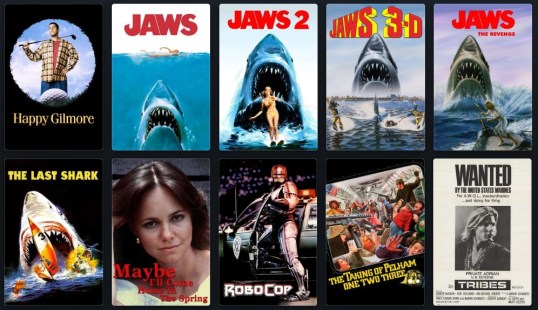
This upcoming week is Shark Week. At the risk of making the most obvious recommendation ever, Jaws (1975) is currently on Netflix. I doubt that I need to sell anyone on the film. Jaws is one of those films that everyone accepts is a classic. I’ll just say that every time that I watch Jaws, I’m surprised at how well it has held up over the years. I watched it a few weeks ago while flying to Hawaii and, even when viewed in less than ideal conditions, it still held my attention and made me jump a little. To be honest, I sometimes miss the Spielberg who directed Jaws. It’s such a fun and scary movie, all the more so because it was made by a director who clearly lived for film. Jaws is currently streaming on Netflix.
Jaws 2 (1978) does not get the same respect as the first Jaws, nor does it deserve it. That said, I can’t help but kind of like Jaws 2. If the first Jaws has a timeless quality to it, Jaws 2 is proudly a product of the 1970s. Jaws 2 has some pacing issues but it also features Roy Scheider going totally crazy at the end of the film. After giving a fairly subdued performance in the first Jaws, Scheider went all out for Jaws 2. Just listen to him yell at that shark! Jaws 2 is also on Netflix.
Jaws 3 (1983) is a bit of a guilty pleasure, largely because it was originally filmed in 3-D and the special effects are charmingly bad. Roy Scheider does not return for this one but Dennis Quaid shows up as Chief Brody’s son. This film was shot at SeaWorld Orlando but the main message seems to be, “Stay away from Seaworld!” For the record, I relate to Lea Thompson’s character. It can be viewed on Netflix!
The makers of Jaws: The Revenge (1987) decided to see what would happen if they made a Jaws film that centered on the least interesting character from the first film. With Chief Brody having died of a heart attack and one of her sons having been eaten by a shark, Mrs. Brody heads down to the Caribbean and is apparently followed by a shark. Its dumb but Michael Caine is charming and I’m a completist at heart. If you’re going to watch one this week, you might as well watch all four! Jaws: The Revenge is on Netflix.
Great White (1981) is an Italian film that was also released under the title The Last Shark. Directed by Enzo G. Castelleri, Great White was so similar to Jaws that Universal actually sued the filmmakers in an attempt to keep the film from being released in the States. To me, that’s always seemed like an overreaction. There were hundreds of Jaws rip-offs released after 1975. Great White is actually a pretty entertaining film. James Franciscus and Vic Morrow team up to take on a giant shark. The shark eats a helicopter. This film can currently be viewed on YouTube.
In Praise of Joseph Sargent
Jaws: The Revenge was directed by Joseph Sargent. Sargent would have been a hundred years old on July 22nd. Sargent was a classic, no-nonsense director who could handle many different genres. Here’s a few Sargent films that are not Jaws: The Revenge.
The Taking of Pelham One Two Three (1974) is probably Sargent’s best film. Four criminals hijack a subway train. The police spend their time negotiating, arguing, and searching. It’s certainly my favorite example of the “New Yorkers Will be Rude To Anyone” genre. Featuring great performances from Walter Matthau, Robert Shaw, Jerry Stiller, and Martin Balsam, this is one of the great New York heist films. It can be viewed on Tubi.
Maybe I’ll Come Home In The Spring (1972) is a personal favorite of mine, a made-for-television film featuring a young Sally Field as a hippie who returns home and David Carradine as her controlling boyfriend. This is a lowkey but effective look at life in the suburbs and it features an excellent performance from Sally Field. It can be viewed on Tubi.
Tribes (1970) features Jan-Michael Vincent as a peace-loving hippie who is drafted and Darren McGavin as the drill sergeant who tries to turn him into a soldier. Jan-Michael Vincent is absolutely gorgeous in this film. It can be viewed on YouTube.
Odds and Ends
Paul Verhoeven celebrated a birthday a few days ago. The original (and still the best) Robocop (1987) is available on Tubi. Much like Jaws, it’s a film that has stood the test of time and survived countless imitations.
Finally, with the sequel due to be released on the 25th, this week is a great time to amuse yourself with the original Happy Gilmore (1996)! I love this film and I make no apologies for it. Bob Barker beating up Adam Sandler? Seriously, how can you not love this film? Personally, I’ve always felt bad for Shooter McGavin. Making him hit that ball off of Richard Kiel’s foot? Totally unfair! Happy Gilmore is streaming on Netflix.
Click here for last week’s movies!
 Through the Shattered Lens