Book Review: Hollywood Rat Race by Ed Wood, Jr.


Are you a teenager in the late 50s or the early 60s?

Are you planning on running off to Hollywood to become a star?

Do you need someone to tell you what to expect once you find yourself on the Boulevard of Broken Dreams?

Hollywood’s most successful director — the one and only Ed Wood, Jr. — is here to help!

Okay, maybe I’m going a little bit overboard with the hyperbole here.  Though Ed Wood is today best known for being played by Johnny Depp in a Tim Burton film, he was not just a movie character!  Nor was just a filmmaker!  Ed Wood was also an author.  When Wood didn’t have the money to make a movie, he would write a book.  In fact, it’s speculated that Wood actually made more money writing books than he did making movies.

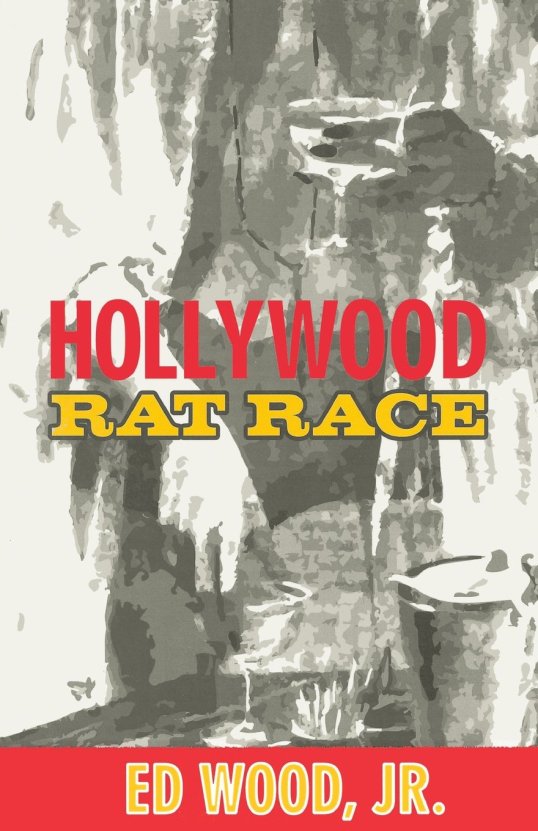
Unfortunately, the majority of these books have been lost to time.  The ones that survive are generally either sex manuals or pulpy novels about hitmen who love to wear angora.  However, Hollywood Rat Race was Wood’s attempt to write, in the first person, about the industry and the city that he both loved and hated.  Hollywood Rat Race is Wood’s warts-and-all look at the film industry.  It’s his guide for how to make it in Hollywood.

What is Wood’s advice?

Be physically attractive.  Do whatever the director tells you to do.  Don’t be shocked when an executive chases you around a desk.  Sleep your way to the top if you have to but just be aware that no one will respect you once you get old.  Wood presents Hollywood as being a cold and unfeeling place but, at the same time, he also describe working in movies and television as the greatest career that anyone could hope for.  Wood will often start a chapter on a cautionary note but his enthusiasm for Hollywood always wins out in the end.  Reading the book, you realize that Wood loved the business too much to reject it, even if it did often reject him.

Hollywood Rat Race is not, despite what is claimed on the book’s back cover, a memoir.  Not really.  Yes, Wood does mention that he was friends with Bela Lugosi.  And he does talk about how Tom Tyler came out of retirement to appear in Plan 9 From Outer Space.  He mentions thar another member of his stock company didn’t complain about being attacked by an octopus in Bride of the Monster.  But those looking for juicy behind-the-scenes stories will be disappointed.  Instead, the book gives the impression that every experience Wood ever had with an actor or a film was a positive one.  Rather touchingly, it’s kind of easy to see Hollywood Rat Race as representing the Hollywood that Ed Wood dreamed of, as opposed to the Hollywood where Wood eventually went broke and drank himself to death.

Hollywood Rat Race was not published in Wood’s lifetime.  He wrote it shortly after the release of Plan 9 but the book was not published until after Tim Burton’s film reignited interest in Wood in 1994.  It’s a good book for all of he Wood completists out there.

And, before anyone asks, yes — he does recommend wearing an angora sweater to your next audition.
Lisa Watches An Oscar Winner: Ben-Hur (dir by William Wyler)


Ben-Hur

I’m actually kind of upset with myself because, at one point, I was planning on spending all of February watching TCM’s 31 Days of Oscars and reviewing all of the best picture nominees that showed up on the channel.  Unfortunately, I ended up getting busy with other things (like Shattered Politics, for instance) and it was only tonight that I finally got a chance to sit down and watch TCM.  Oh well, maybe next year! But for now, I’m just going to watch and review as much as I can before the month ends.

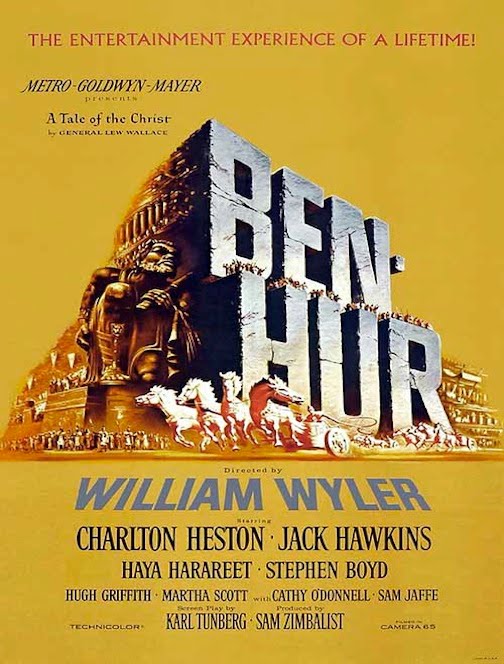
With that in mind, I just spent four hours watching the 1959 best picture winner Ben-Hur.

In many ways, Ben-Hur feels like a prototypical best picture winner.  It’s a big epic film that obviously cost a lot to produce and which features a larger-than-life star surrounded by a bunch of a memorable character actors.  It features two spectacular set pieces and some human drama that’s effective without being particularly challenging.  It’s a film that deals with big themes but does so in a rather safe way.  Perhaps not surprisingly, it’s a film that, today, is often dismissed as being old-fashioned and simplistic and yet it’s still a lot of fun to watch.

Opening with no less of an event than the birth of Jesus, Ben-Hur tells the story of Judah Ben-Hur (Charlton Heston), a wealthy Jewish aristocrat who, as a young man, was best friends with a Roman named Messala (Stephen Boyd).  When Messala is named as the new commander of the local Roman garrison, he is upset to discover that Ben-Hur is more loyal to his religion than to the Roman Empire.  Feeling personally rejected by his best friend (and perhaps more, as there are a lot of theories about the subtext of their relationship), Massala frames Ben-Hur for the attempted assassination of Judea’s governor.

Over the next 220 minutes, we watch as Ben-Hur goes from being a prisoner to a galley slave to the adopted son of a Roman general (Jack Hawkins) and finally one of the best chariot racers in ancient Rome.  Throughout it all, he remembers a mysterious man who once attempted to give him a sip of water.  Meanwhile, Ben-Hur’s family has been imprisoned and afflicted with leprosy.  Appropriately, for a film that opened with the Nativity, it ends with the Crucifixion, during which Ben-Hur’s struggle to save his family also comes to a climax.

Ben-Hur is undoubtedly flawed film.  (Among the film that were nominated for best picture of 1959, my favorite remains Anatomy of Murder.)  The film runs about an hour too long, some of the supporting actors give performances that are a bit too over-the-top, and the entire film is so reverential that in can be difficult for modern audiences, especially in this age of nonstop irony, to take it seriously.  In the lead role, Charlton Heston is always watchable and has a strong physical presence but you never quite believe that he’s the thinker that the script insists that he is.  There’s nothing subtle about Heston’s performance but, then again, there’s nothing subtle about the film itself.

And yet, if the film struggles to connect on a human level, Ben-Hur still works as a spectacle.  The gigantic sets and the ornate costumes are still impressive to look at.  The film’s two big action sequences — a shipwreck and the chariot race — are still exciting and thrilling to watch.  Ben-Hur may be dated but you can still watch it and understand why it was so popular with audiences in 1959 and, though I may not agree with a lot of the decisions, I can see why the Academy honored Ben-Hur with a record 11 Oscars.  It’s the type of spectacle that, in 1959, could only have been found on the big screen.  By honoring Ben-Hur, the Academy was honoring the relevance of the Hollywood establishment.

In the end, Ben-Hur may not hold up as well as some best picture winners but it’s still worth watching.

http://www.youtube.com/watch?v=enfWkWJZZ5U

Film Review: Nightcrawler (dir by Dan Gilroy)


Nightcrawler


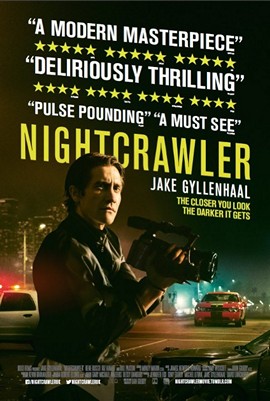
The new film Nightcrawler tells the story of a strange man named Lou Bloom (played, in the performance of his career, by Jake Gyllenhaal).  From the minute that we first see Lou, we can tell that there is something off about him.  He is a bit too quick to smile and his friendly manner is sharply contrasted with his sunken features.  He watches the world with shifty eyes that are surrounded by dark circles that make it appear as if he hasn’t slept for weeks.  (And it is interesting to note that, at no point during the film, do we actually see him sleep.  He’s always awake.)  When he speaks, it’s in an optimistic and ingratiating tone that can barely disguise the fact that everything he is saying is a cliché.  He speaks in the language of self-help books and inspirational speakers.  What’s interesting is that as empty as Lou’s constant patter may be, he always sounds as if he believes every single word of it.

Despite the fact that Lou is on screen during every minute of Nightcrawler, we learn very little about his background.  We don’t learn where he was born.  We don’t know how he eventually came to be the person that he is at the start of the film.  He has no family.  He has no friends.  He lives in a small apartment that is distinguished only by how anonymous it ultimately is.  The only thing we really know for sure about Lou is that he watches a lot of television.  In one of the few moments in the film where Lou actually lets down his guard, he tries to have a conversation with a reporter on a screen despite the fact that the reporter can not hear a word that he is saying.

Lou is first introduced stealing and selling scrap metal.  When he’s confronted by a security guard, Lou smiles and says a few friendly words before suddenly attacking the guard and throwing him to the ground.  Disturbingly, we never find out what exactly Lou did with that security guard but, when we next see Lou, he’s wearing the guard’s watch.

However, Lou has bigger plans than just being a common thief.  When he comes across a car accident, he sees a freelance video journalist (also known as a nightcrawler) filming the police.  When Lou finds out how much money he can make by simply filming human misery and then selling the footage to a local news station, Lou trades a stolen bicycle for a radio scanner and cheap camcorder.

After several nights of struggling to get some good footage and discovering that the police don’t like nightcrawlers, Lou manages to get some footage of a dying shooting victim.  He sells the footage to a local news station and meets Nina (an excellent Rene Russo), the station’s news director.  Nina is impressed with the footage and encourages Lou to find more.  She explains to him that she needs crime and disaster footage.  She needs footage that will both scare and intrigue her white middle-class audience — violence in the suburbs, families being threatened, and — most importantly — white people being victimized by minorities.  As she tells Lou,  “The perfect story is a screaming woman with her throat cut, running down a street in a good neighborhood.”

Soon, Lou is finding a lot of success as a nightcrawler, to the extent that he even gets an intern named Rick (Riz Ahmed) to serve as his assistant.  Rick is an interesting character and Riz Ahmed gives an excellent performance, one that is overshadowed by the more flamboyant performances of Gyllenhaal and Russo but which is just as important.  In many ways, RIck serves as the film’s conscience.  Alone among the film’s characters, Rick has a sense of morality but, unfortunately, he’s not observant enough to realize that he’s the only one.

Lou is a complete and total sociopath but Gyllenhaal gives such a compelling performance that you often forget until Lou gives you no choice but to remember.  As the film progresses, it becomes obvious that both Lou and Nina depend on bad news for their very existence and, in Lou’s case, he’s not above creating the news that he covers.

Marking the directorial debut of veteran screenwriter Dan Gilroy, Nightcrawler is a hyperkinetic portrait of society at its absolute worst.  As some reviewers have pointed out, Nightcrawler is often a bit heavy-handed when it comes to portraying the vacuousness of television news but then again, have you watched your local station recently?  Have you looked at any of the clickbait articles that are floating around the internet?  If Nightcrawler portrays television news as being shallow and hypocritical — well, why shouldn’t it?  The usual suspects will claim that Nightcrawler‘s portrayal of televised media is flawed but we all know the truth, don’t we?  Even if the film’s satire is heavy-handed, it still captures a larger and undeniable truth.

Not only is Nightcrawler a thought-provoking look at our paranoid society but it also features Jake Gyllenhaal’s best performance.  Gyllenhaal reportedly lost 20 pounds for the role and his commitment to the role pays off as he turns Lou into a truly fascinating monster,  making him the most compelling sociopath this side of Christian Bale’s Patrick Bateman.

Admittedly, the film does have a few flaws.  A scene in which Lou is seen cutting a van’s brake line almost inspired me to shout out, “Direct to video!” because it seriously felt as if it belonged in a lesser film.  (Every direct-to-video thriller features a scene of someone tampering with brakes.)  But, overall, Nightcralwer is one of the best films of the year so far.

Nightcrawlerfilm

Film Review: A Cry In The Night (dir by Frank Tuttle)


cryinthenight01f

Thanks to TCM, I’ve gotten the chance to discover a lot of old films that I, otherwise, would have probably never even heard about.  One of those films is A Cry In The Night, a low-budget, 1956 crime story that I randomly came across last month.

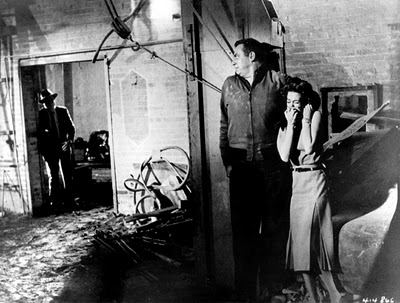
Harold Loftus (Raymond Burr) has issues.  He lives in a shack, he’s totally dominated by his overbearing mother, and he spend most of his time secretly peeping at couples who are parked at the local lover’s lane.  When he comes across Liz (Natalie Wood) and her boyfriend Owen (RIchard Anderson), he overpowers Owen and kidnaps Liz.  Now, Owen must work with Liz’s overprotective policeman father, Dan (Edmond O’Brien), to track down Harold and Liz.  Making things difficult is the fact that Dan blames Owen for the kidnapping and simply cannot bring himself to accept that his daughter was actually “one of those girls” who spent her Saturday night sitting in a car and sharing chaste kisses with her boyfriend.

(Seriously, the film made it sound like this was the worst possible thing that a girl could do with her time.  I’m not sure if Dan was supposed to come across like a reactionary or if this was just a case of the film having been made in 1956.  Personally, if that’s what the 50s were like, I’m glad I wasn’t born until the 80s.)

As directed by Frank Tuttle, A Cry In The Night tells its story in a stark, no-nonsense, semi-documentary manner.  (There’s even narration at the beginning and end of the film.)  O’Brien bellows his way through the role and Anderson’s colorless performance does little to make Owen seem like any less of a wimp.  However, Raymond Burr makes for a disturbingly plausible pervert and Natalie Wood is well-cast as Liz.  The film came out a year after Rebel Without A Cause and, watching her performance in A Cry In the Night, you can tell why Natalie Wood was Hollywood’s favorite vulnerable teenager.

I have to admit that I love films like A Cry In The Night, not so much because they’re great films (and, while always watchable, A Cry In The Night is certainly not a great film), but because they’re totally a product of their time.  As opposed to the big budget extravaganzas that were churned out by the Hollywood studio system during the 50s and 60s, low-budget B-movies like A Cry In The Night were designed to exploit contemporary headlines and contemporary concerns and, therefore, provide a lot of insight into what was going on with the American psyche at the time.

A Cry In The Night combines several themes that ran through the majority of the films of the period.  In the role of Harold, Raymond Burr is the epitome of the 1950s weirdo.  As opposed to the normal, all-American boys who make out with their girls in cars, Harold can only bring himself to lurk about and attempt to catch a peek of what normal society does on Saturday night.  When he kidnaps Liz, he’s not only threatening Natalie Wood, he is by extension attacking America itself.  Meanwhile, Liz’s boyfriend comes across like the type of intellectual liberal who probably cast two ballots for Adlai Stevenson while her father is definitely an Eisenhower man.   Boyfriend and father do not get along at first but what’s important is that they set aside their difference so that they can vanquish the other.  By the end of the film, the father is willing to invite the boyfriend to dinner and the boyfriend has learned that sometimes, you have to be willing to fight.

For those of you who keep crying about how the solution for all of America’s problems lie in bipartisan compromise, A Cry In The Night is the film for you!

For the rest of us, A Cry In The Night is an occasionally entertaining time capsule.