Scenes I Love: Reggie Bannister in Phantasm


I read yesterday that Reggie Bannister, one of the most beloved horror character actors out there, isn’t doing too well.  He has gone into hospice care.  Those words — “hospice care” — will always bring a tear to my eye.  My Dad went into hospice care last year and died a month later, which I was told was longer than most people survive in hospice.  Being the naive idiot that I was, I have to admit that, up until the end, I was still expecting my Dad to make a full recovery and just magically get out of bed.  Sadly, that’s just not the way these things work.  Hospice is end-of-life care and any medical professional who doesn’t make that clear while recommending it is doing a disservice to not only their patients but also their families.

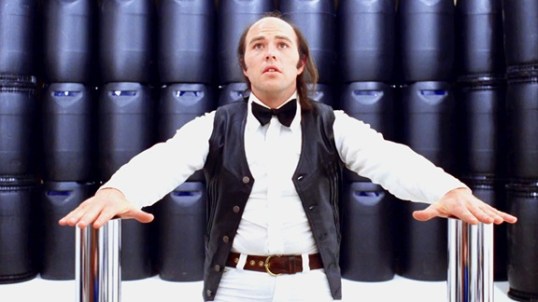
Reggie Bannister is best-known for his appearances in the work of Don Coscarelli.  He’s one of those actors who just makes you smile whenever he appears on screen.  Anyone who has watched Phantasm loves Reggie, with his ice cream truck and his guitar and his whole laid back vibe.  Today’s scene that I love is a simple but wonderfully human moment from 1978’s Phantasm, featuring Bill Thornbury and the great Reggie Bannister.

The Demolitionist (1995, directed by Robert Kurtzman)


In the future, America is overrun by crime.  Mad Dog Burne (Richard Grieco) and his brother, Little Henry (Randy Vasquez) escape from California death row.  Mayor Eleanor Grimbaum (Susan Tyrell) wants the Burne brothers captured and she wants to be able to show the voters that she’s tough on crime.  When brave police officer Alyssa Lloyd (Nicole Eggert) is killed by Mad Dog Burne’s gang, she is brought back to life in cyborg form by Prof. Crowley (Bruce Abbott) and, after a training montage, she is let loose on the streets as a police-backed vigiliante.

The Demolitionist owes an obvious debt to Robocop, with Nicole Eggert miscast as an expressionless cyborg who launches a one-woman/one-machine war on crime.  The main problem is that The Demolitionist has none of Robocop‘s wit or its subversive subtext.  Nicole Eggert is no substitute for Peter Weller and Richard Grieco is no Kurtwood Smith.  “Booker’s a good cop!” I said whenever Grieco showed up.

The only interesting this is about the cast, which is full of horror veterans.  Jack Nance plays the prison priest who counsels the Burne brothers before they escape their scheduled executions.  Reggie Bannister plays the warden.  Sarah Douglas plays  a surgeon.  Joseph Pilato is one of Mad Dog’s followers.  And playing Mad Dog’s second-in-command is none other than Tom Savini.  Finally, the city’s most popular journalist is played by Heather Langenkamp!

The Demolitionist demolishes almost the entire town but she still can’t come up with any way to make this stale Robocop rip-off feel fresh.


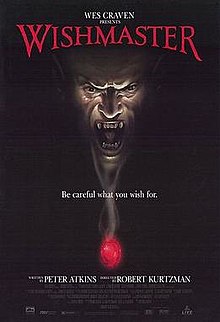
Horror Film Review: Wishmaster (dir by Robert Kurtzman)


Do you all remember Wishmaster?

Played by Andrew Divoff, the Wishmaster was a genie (or a djinn) who made his film debut in the 1997 film of the same name. The Djinn’s schtick is to randomly approach people and say something like, “Would you like to be rich?” or “Would you like all of your enemies to suffer?” He grants wishes but he does so in ironic ways. So, if you say want to be rich, you might very well turn into someone named Rich who is on the verge of getting hit by a bus. If you say that you want to escape from your mundane life, you might end up in a straight-jacket under water, struggling to perform one of Harry Houdini’s signature escapes.

I rewatched Wishmaster a few months ago and what I immediately discovered was the the Djinn wasn’t really that good at his job. He pretended to be clever in the way that he would fool humans but, honestly, it often seemed less like he was tricking people and more like he really wasn’t playing fair. Take the security guard who made the mistake of wishing for an escape. As I just mentioned, The Djinn immediately put him underwater in a straight-jacket. But the guard’s wish was not to have to escape. The guard’s wish was to simply escape. So, putting him in a life-and-death situation and telling him to figure it out for himself wasn’t fulfilling the guard’s wish. It just seemed like the Djinn wanted to drown someone and he decided to use his wish-granting job as an excuse.

The guard, by the way, was played by Tony Todd, one of the many horror icons who appeared in small roles in Wishmaster. (Today, Tony Todd is best known for the Final Destination films but, when Wishmaster came out, he was known for playing the Candyman.) Among the other cameos:

From Phantasm, Angus Scrimm provided the narration while Reggie Bannister played an unlucky pharmacist.

From Friday the 13th, Kane Hodder played a security guard who made the mistake of saying that he wished he could see the Djinn try to walk straight through him.

Day of the Dead’s Joseph Pilato played a crane operator.

John Carpenter vet George “Buck” Flower played an angry homeless man.

Sam Raimi’s brother, Ted Raimi, showed up long enough to get crushed by a crate.

And finally, Robert Englund played the somewhat pretentious professor who was responsible for bringing the Djinn to America in the first place.

As you can probably guess by looking at all of the cameos, Wishmaster is not a film that’s meant to be taken seriously. It’s often deliberately campy. Wes Craven may have produced it and was undoubtedly responsible for recruiting many of the actors who appeared in it but the film’s direction was handled by special effects maestro, Robert Kurtzman and he puts more emphasis on the visual effects than on any sort of serious exploration of the somewhat random series of events that make up the film’s storyline. Of course, when seen today, the film’s special effects look a bit cheap but, for many viewers (like me!), that’s actually a part of the film’s grisly charm.

Wishmaster does have a plot but it’s not particularly important. The Djinn tries to make Alexandra (Tammy Lauren) make three wishes so that he can unleash the forces of Hell. Why he spends all of his time granting wishes to other people instead of just concentrating on Alex is never really explained. It may be an often dumb movie but it’s also undeniably entertaining when taken on its own terms. Andrew Divoff is enjoyably sinister as the Djinn, playing the character with a sarcastic wit to go along with his evil schemes. It’s a fun movie to watch, even if it does feel like it was basically slapped together in a handful of days.

You should always be careful what you wish for but Wishmaster is still an entertaining piece of 90s horror.

(Author’s Note: Wow, this is embarrassing.  Right after I posted this review, I discovered that I previously reviewed Wishmaster in 2018!  Whoops!  Well, it’s nice to see that my thoughts on the film have remained consistent. — LMB)
Review: Bubba Ho-Tep (dir. by Don Coscarelli)


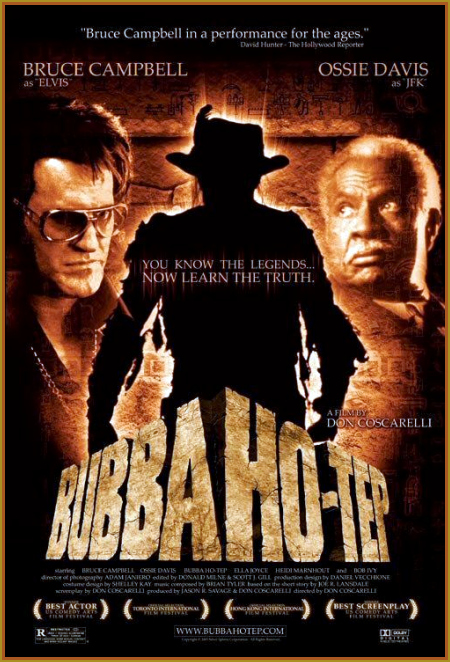
Bubba Ho-Tep was one of those film projects which just screamed out “can’t lose” the moment it the people who were going to be attached to it were announced. I mean for people who grew up watching horror movies and other such fun things during the 80’s would know of the name Don Coscarelli. His Phantasm franchise scared and creeped out a large number of young kids and teenagers as they grew up during the 1980’s. Author Joe R. Landale is not as well-known for the unread but he also brings big smiles to people who also like their stories to be full of quirky humor, dry sarcastic wit in addition to pulp-style horror and thrills. But the major coup this film had which made all genre fans suddenly smile and grin like fools has to be hearing that genre-veteran and B-movie extraordinaire Bruce Campbell taking on the role of an aging Elvis Presley.

The movie was released in very limited screens in the summer of 2002. In fact, the movie really only got shown during the summer genre film festivals which dealt with genre movies like horror, sci-fi and other so-called low-brow genre projects which the more elitist film goers tend to shun. Luckily I wasn’t too elitist enough to be able to find Bubba Ho-Tep playing in the San Francisco Film Festival. To say that what I saw was pure cheesy fun would do the film a disservice. While it’s true that the film had it’s moment of horror, I mean it is a movie about a soul-sucking Egyptian Mummy let-loose in a Texas retirement home. What I was surprised to see as I watched through Bubba Ho-Tep was just how much more than a cheesy B-movie horror flick it turned out to be.

The film pretty much brings up the scenario of how it would be if the real Elvis Presley was still alive, in his 70’s and wasting away in a Texas retirement home. That the Elvis Presley who passed away sitting on a toilet at Graceland was actually an impostor who switched places with the real Elvis after the genuine article decided all the fame, groupies and excessiveness of being The King was just too much and wanted a break from it all. So, the real Elvis lost his chance to switch back with his double and thus ended up forgotten in a Texas retirement home where the employees and caregiver treat him like a child and don’t believe him when he tells them he is the real deal. To make matters worse he now has to deal with a cowboy hat and boots wearing Egyptian mummy whose sole source of nourishment are the souls of the old retirees who inhabit the retirement home. The way the mummy sucks the souls from its victims become a running joke within the film. Let’s just say it doesn’t try sucking the souls out through the old folks’ mouth or nose.

Bruce Campbell has always been a mainstay of the B-movie scene. His popularity as being “The Man” who has inhabited such iconic cult characters such as Ashley “Ash” Williams of Evil Dead fame has made him a well-known actor to genre fans everywhere. Campbell could’ve easily hammed it up in the role of the aging Elvis Presley in Bubba Ho-Tep. No one would’ve faulted him for such an over-the-top performance, but instead of going that route he instead plays the role with such an understated and subtle style which made the character more human and sympathetic. Campbell’s nuanced performance also turned a horror-comedy into something more sentimental and sad. Bubba Ho-Tep had turned into a horror-comedy which had a unique and sympathetic look at how the elderly have been treated and seen more as nuisances and less than human. It doesn’t help that their cries for help once the mummy targets them for feeding fall on deaf ears as those hired to help them consider their pleas as the senile ramblings of someone whose mental facilities have long left them.

Campbell’s performance as “The King” was supported quite well by the great, late Ossie Davis whose role as an elderly black man who thinks he’s John F. Kennedy brings new meaning to the film cliche: buddy movie. Davis’ character truly believes that he was and is President Kennedy who was turned black through some conspiracy by Lyndon B. Johnson to save his life. At first, we the audience are in on the joke but due to Davis’ wonderful performance we begin to believe that he may be right. If cowboy-attired Egyptian mummies and an aging Elvis look real why not him. The interplay between Campbell and Davis makes for some great acting and comedy. Without these two men the film would’ve been relegated to the direct-to-video level of filmmaking. Instead what we get is a wonderfully crafted film which despite its pedigree still became one of the better films of 2002.

Don Coscarelli does a fine job of balancing the scenes of comedy and horror with poignancy without ending up with a film that’s too maudlin for its own good. It’s a good sign that one of the 80’s master genre directors has found a nice project to show that he hasn’t lost the edge and skill when it comes to making genre movies. He has also shown with Bubba Ho-Tep that one can have a horror-comedy without drowning it in gore (which this movie had a surprisingly little of) and juvenile slapstick. Even joke sequences involving aging Elvis’ penis with it’s unidentifiable growth made for genuine laughs instead of laugh for laughs sake. The same goes for the double entendre from JFK involving his Ding Dong snack. I think with anyone else at the helm of this picture the movie would’ve fallen either too much into gorehound territory on one side or inane slapstick comedy on the other end.

In the end, Bubba Ho-Tep was one of those rare little genre gems which transcends its genre pedigree and beginnings without meaning to. Like I said with the convergence of Coscarelli, Lansdale, and Campbell making the project happen this was one little movie that was bound to not fail. I highly recommend this movie to anyone who hasn’t seen it. Despite it’s silly sounding title the movie is more than just the sum of its cover.