Review: Sicario (dir. by Denis Villeneuve)


“You should move to a small town where the rule of law still exists. You will not survive here. You are not a wolf. And this is the land of wolves now.” — Alejandro

Sicario is one of those thrillers that doesn’t just try to get your pulse up; it wants to leave you sitting there afterward, uncomfortable and a little hollowed out. Set in the murky world of the U.S.–Mexico drug war, it follows an idealistic FBI agent pulled into a “by any means necessary” operation and slowly realizing she’s basically a pawn in a much bigger, much uglier game. It’s not a movie about slick heroes taking down bad guys so much as a slow, grim spiral into the realization that the system is rigged on every level, and that’s where the film is both at its most impressive and its most uncompromising. Overall, it leans heavily positive as a piece of craft—beautifully shot, superbly acted, tightly directed—and its refusal to blink at where its story logically leads is a big part of what gives it power.

The basic setup is simple enough: Kate Macer, played by Emily Blunt, is an FBI agent used to doing things by the book, raiding cartel safe houses in Arizona with her partner Reggie. After a grisly opening operation that turns up corpses hidden in the walls and a deadly booby trap, she’s recruited into a joint task force helmed by Josh Brolin’s Matt Graver, a flip‑flop‑wearing CIA type who treats international borders and legal constraints as suggestions. The team’s official mission is to go after a cartel lieutenant, Manuel Díaz, but very quickly Kate realizes she’s only being told a fraction of what’s really going on. The more she pushes for answers, the more obvious it becomes that Matt and his mysterious associate Alejandro (Benicio Del Toro) are running their own agenda and using her badge and presence as cover.

From the start, Denis Villeneuve frames this story as a descent, and he does it by locking us into Kate’s perspective for most of the film. We’re as confused and kept in the dark as she is: we don’t fully know why the team is crossing into Juárez, why everyone is so tense at the border, or what the deeper objective is besides “disrupt the cartel.” That choice pays off in a huge way during the film’s standout sequences, whether it’s the convoy inching through traffic surrounded by armed federales or the nighttime tunnel infiltration lit by thermal and night‑vision photography. Those scenes aren’t just “cool action beats”; they’re engineered to make you feel boxed in and outmatched, like violence could erupt at any second and no one really has control. Even when nothing is technically happening, you can feel the nerves jangling under the surface.

One of the most striking things about Sicario is how it weaponizes space. The way the film uses its wide, open desert vistas isn’t just pretty scenery—it adds this creeping, suffocating dread to everything, as if the characters are tiny figures swallowed up by forces they can’t hope to understand or control. Those long shots of trucks threading their way across the landscape, or helicopters gliding over seemingly endless scrub, make the world feel vast, ancient, and totally indifferent to whoever’s spilling blood on it today. In those moments, the movie almost channels a kind of Lovecraftian horror, the same cosmic, indifferent menace that Cormac McCarthy managed to weave through his Westerns, where the land itself feels old, hostile, and utterly unmoved by human morality or suffering. It’s not supernatural, but that sense of something bigger, colder, and permanent presses down on every decision these characters make.

Roger Deakins’ cinematography is a huge part of why that dread lands so well. The desert is captured in these wide, ominous skyline shots with tiny vehicles creeping along the horizon, giving Sicario a sense of menace that feels baked into the environment. Even the daylight scenes feel threatening, all washed‑out heat and harsh sun flattening everything into a kind of moral no‑man’s‑land. Then the movie flips into night, and suddenly you’re plunged into infrared and silhouettes, which fits perfectly with the story’s obsession with secrecy and invisible lines being crossed. This is one of those films where you could watch with the sound off and still feel the tension just from how the images are composed, but the use of space and light also nudges the movie into that McCarthy‑adjacent territory where the West is less a backdrop and more a silent, malevolent presence.

The performances match that level of craft. Emily Blunt plays Kate as tough and competent, but not in a superhero way—she’s brave, but she’s also human, constantly trying to reconcile what she’s seeing with what she believes law enforcement is supposed to be. You can see the frustration mounting as she keeps demanding clarity and hitting a wall of smirks, deflections, and “you’ll understand later.” Benicio Del Toro, meanwhile, walks off with the film as Alejandro, this quiet, haunted figure who initially seems like just another operative but reveals layers of trauma and ruthlessness as the story goes on. The script is smart about keeping his backstory mostly hinted at until late in the film, which makes it all the more chilling when you finally see what he’s really there to do. Josh Brolin is the third pillar, playing Matt as casually flippant on the surface but utterly cold about collateral damage, the kind of guy who laughs through briefings because he already knows the moral lines are going to be erased.

On a thematic level, Sicario is very much about complicity and the idea that in this particular “war,” there are no clean hands. Kate comes in thinking she’s going to help nail cartel leadership through some kind of legal, targeted operation; what she slowly figures out is that the task force is really trying to destabilize one cartel to empower another, consolidating power into a more “manageable” single organization. That logic—“create one devil we can deal with instead of many we can’t”—is chilling, and the movie doesn’t really offer a comforting counterargument. Instead of pulling back or softening that stance, it commits to showing what that philosophy looks like in practice, all the way to the bitter end. By the time Alejandro reaches his personal endgame and we see what “justice” looks like in this world, any illusions about moral clarity are gone, and the film refuses to apologize for following that line through.

Where some films might hedge their bets or try to inject a last‑minute note of optimism, Sicario is deliberately straight‑backed about where its story logically leads. The CIA needs Kate’s FBI status to legitimize their operation on U.S. soil, but they don’t actually want her input; she’s there to sign off and be lied to, not to shape policy. Every time she pushes back—like when she tries to build a traditional case after the task force raids a cartel‑connected bank—she’s shut down because “that’s not what this mission is.” Even the brief subplot with the corrupt local cop Silvio is there to underline how the drug war trickles down: this isn’t just cartel bosses and shadowy agents, it’s working‑class people pulling double duty as mules because they’re desperate, and they end up as expendable as anyone else. Rather than treating that as background noise, the movie leans into the bleak implications and lets them sit with you.

The same goes for Kate’s arc. Some viewers see the film as sidelining its female lead in the third act, shifting the narrative fully over to Alejandro just when things are coming to a head. Structurally, that is what happens: the viewpoint tilts from Kate’s confused horror to Alejandro’s mission, and she becomes more of a witness than an active participant. But that shift feels of a piece with the movie’s overall approach—she has been outmaneuvered and used from the start, and Sicario isn’t interested in pretending otherwise just to deliver a more empowering or conventionally satisfying ending. There’s something bracing about the way the film sticks to its guns here; it says, “this is the world we’ve shown you for two hours, and this is how someone like Kate gets treated in it,” and then follows through.

All of this could have tipped into empty cynicism if the film didn’t feel so precise and purposeful. Jóhann Jóhannsson’s score, all pounding, low‑end rumble and ominous strings, practically turns the highway scenes into horror set‑pieces; it feels like the sound of something massive grinding forward that you can’t stop. Villeneuve keeps the pacing deliberate but never sluggish, using long stretches of quiet to make the explosions of violence feel random and brutal instead of exciting. Even small scenes, like Kate’s attempted hookup with a local cop who turns out to be on the cartel payroll, are staged to underline how deeply compromised everything is. There’s no safe space, no “off the clock” moment where the larger conflict doesn’t intrude, and the movie doesn’t pretend there is just to make you feel better walking out.

If you go into Sicario looking for a clean, cathartic crime thriller where the good guys outsmart the bad guys, you’ll probably come away irritated or even angry. The movie’s whole point is that those categories don’t really apply in this corner of the world, and it’s committed enough to that idea that it never gives you an easy out. But if you’re up for something more sobering—an incredibly well‑crafted, morally grim look at the drug war with standout work from Blunt, Del Toro, Brolin, Deakins, and Villeneuve—it’s a pretty exceptional ride. Its worldview is harsh, but it’s also coherent and honestly pursued, and that level of conviction is a big part of why the film lingers. It may not be the kind of movie you “enjoy” in a traditional sense, but it’s one that sticks with you, and in this genre, that counts for a lot.

Film Review: Sicario (dir by Denis Villeneuve)


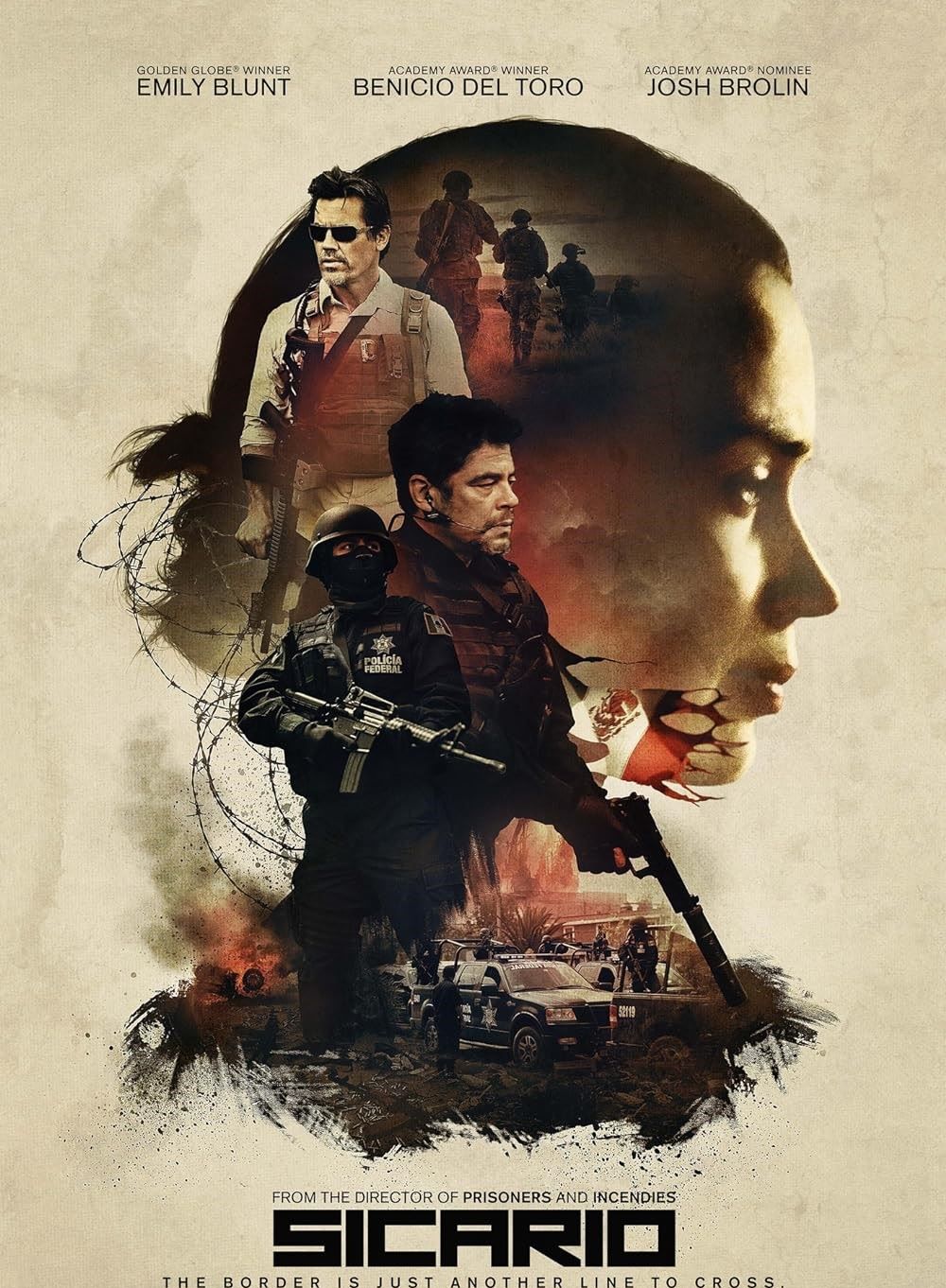
Sicario_poster

If you told me that I had to describe the new film Sicario in just one word, that word would be “overwhelming.”

And then I’d get really mad at you for making me sum up my feelings about Sicario in only one word.  Sicario is a great film, one of the best of the year so far.  It’s a film that works as both an exciting thriller and an examination of the grim reality of the Mexican Drug War.  It’s a film that may anger you and it certainly won’t leave you feeling very optimistic as far as the endless, corrupt, and unwinnable war on drugs is concerned.  And, ultimately, it is a very overwhelming viewing experience, one that quite literally left me breathless.

And what’s frustrating is that I really can’t tell you as much about Sicario as I might want to.  Sicario is a film about secrets and, if I reveal even one secret, I risk messing up the experience of watching the film for you.  And that’s something that I would never want to do because Sicario is a film that deserves and needs to be seen and experienced.  And this is a film that you should go into with as little advanced knowledge as possible.

So, I’m going to ask you trust me here.  I’m going to ask you to believe me when I tell you that Sicario is a great film but that I can’t tell you the exact reasons why.  It’s a film that comes at you disguised as being a typical action film and then it sets about defying every single expectation that you might have.  I have been so conditioned by watching so many action films that I constantly found myself assuming that I knew what would happen next.  And, nearly every time, Sicario proved me wrong.

Here’s what I can tell you.  Kate Marcer (Emily Blunt) is a FBI agent who, after discovering an Arizona house that is full of dead bodies, is assigned to a joint task force that has been tasked with taking down a Mexican drug lord.  Kate finds herself working for Matt Graver (Josh Brolin), who works for a government agency that he consistently refuses to name.  Idealistic and naive, Kate is shocked by Graver’s ruthless methods and confused as to why she’s even been assigned to work with him.  (Kate continually complains that Graver’s operation seems to have no purpose and that his methods are often illegal.  Graver usually just smirks in response.)  Also working with Graver is the enigmatic Alejandro (Benicio Del Toro), a Columbian lawyer who says few words and is surprisingly good with a gun.

Up until the film’s final 30 minutes, we see nearly the entire story through Kate’s eyes.  And, much like Kate, we spend much of the film confused.  We struggle to figure out just what exactly it is that Graver is trying to accomplish and just how exactly Alejandro fits into his plans.  Emily Blunt gives a great performance as Kate but, at the same time, the film cleverly subverts our expectations about what we expect to happen with her character.  After all, we’ve seen Looper.  We’ve seen Edge of Tomorrow.  And when Sicario begins, we have every reason to expect that this is going to be another film where Emily Blunt is going to kick everyone’s ass.  And, make no doubt about it — Emily Blunt does get to kick some ass in this film but this film suggests that, in the end, it doesn’t matter if you kick everyone’s ass.  Certain things just cannot be changed.

And then there’s Josh Brolin, who is wonderfully glib as Matt Graver.  You distrust him as soon as he appears on-screen but he still remains a compelling enigma.  But, ultimately, this film belongs to Benicio Del Toro.  If there was any doubt that Del Toro is one of the greatest actors working right now, Sicario should dispel it.  When we first meet Alejandro, he seems like he’s just a burned out shell of a man.  We look at him and we assume certain things about his character and we think we know exactly what is going to happen with him.  At first, Del Toro gives such a quiet and introverted performance that it’s almost easy to forget about him.  But then, as Sicario reaches its violent and thought-provoking conclusion, Del Toro suddenly steps forward and take over the entire film.  Even after we learn his big secret, Alejandro (and Del Toro) continues to surprise us.  It’s a great performance and it will be a great injustice if Del Toro is not, at the very least, nominated for an Academy Award.

Along with Del Toro, the other great stars of the film are cinematographer Roger Deakins and the director, Denis Villeneuve.  Villeneuve may not be a household name but he’s one of the best directors working today.  He’s a filmmaker who can use the conventions of genre (the action genre in this film, the mystery genre in Prisoners) to tell a story about how people are living now and why things are the way that they are.  (In many ways, Denis Villeneuve is Steven Soderbergh without all the pretentious affectations.)  Villeneuve’s skill as a director is on full, thrilling display in four separate set pieces, each of which is full of heart-pounding tension and sudden violence.  As for Roger Deakins, he captures images of Mexico and the south Texas that feel almost alien in their ominous beauty.

Sicario is one of the best films of the year.  See it!

Shattered Politics #94: Persecuted (dir by Daniel Lusko)


Persecuted-2014-poster

It may seem strange that I would choose to end my series of reviews of films that feature politics and politicians by reviewing Persecuted, an obscure film from 2014.  After all, Shattered Politics started out with D.W. Griffith’s Abraham Lincoln.  Over the past three weeks, I’ve reviewed everything from Mr. Smith Goes To Washington to The Phenix City Story to Dr. Strangelove to The Godfather to Nashville to Once Upon A Time In America to The Aviator.  I have been lucky enough to review some of the greatest films ever made.  And now, at the end of this series, I find myself reviewing Persecuted, a film that has a score of 0% over on Rotten Tomatoes.

Consider that for a moment.

As I sit here typing out this sentence, not a single critic has given Persecuted a good review.  And I will admit right now that I’m not going to be the first.  Persecuted is cheap-looking, heavy-handed, melodramatic, histrionic, foolish, silly, preachy, predictable, strident, and just about every other possible criticism that comes to mind.  If the film is redeemed by anything, it’s that it is full of good actors who do the best that they can with characters that are either seriously underwritten or ludicrously overwritten.

Persecuted takes place in the near future.  Sen. Donald Harrison (Bruce Davison) has written something called the Faith and Fairness Act, which would basically require churches to provide equal time to other religions and would make it illegal to suggest that only one religion has all the answers.  How exactly that would work, I’m not sure.  However, a big part of Harrison’s bill is that, in exchange for giving up any claim to having all the answers, churches will now get money from the federal government.  As a result, a lot of church leaders have sold out and announced their support for the bill.

However, evangelist John Luther (James Remar) refuses to support the bill.  As we’re told when Luther first appears, he’s a recovering alcoholic and drug addict who used to be a professional gambler.  But then he found faith and he’s now the most popular man in the country.  Or, at least, he is until he’s drugged by the government and framed for murdering a prostitute.

So now, Luther is on the run.  He has to evade capture, prove his innocence, and reveal the truth about Harrison and his shadowy backers.  Helping Luther out is his father, an Episcopalian priest who is played by former real-life Presidential candidate Fred Thompson.  (Thompson, incidentally, is a very good actor and brings a lot of conviction and authority to his role.)  Not helping Luther are the former leaders of his church, one of whom is played by character actor Dean Stockwell.

I’ll admit right now that, as familiar and talented as all four of them may be, James Remar, Bruce Davison, Fred Thompson, and Dean Stockwell are hardly big stars and you really can’t blame any of them for presumably taking a job strictly for the money.  That said, it’s still odd to see such good actors appearing in a film like Persecuted and they all deserve at least a little bit of credit for doing their best with the material that they had to work with.  However, my favorite performance came from Brad Stine, who plays glib preacher who betrays Luther.  Stine is just so sleazy and hyperactive that he’s a lot of fun to watch.

Now, while Persecuted is obviously a faith-based film, it’s plot actually has more in common with the paranoia movies of the 70s than it does with Left Behind.  John Luther is a guy who knows the truth and has been framed as a result and he spends nearly the entire film on the run.  If anything, this is a film that will probably appeal more to conspiracy theorists than to Christians.  But, judging from the film, the conspiracy that’s trying to destroy John Luther doesn’t appear to be very competent.  How else do you explain that John Luther — the most famous man in the world — manages to easily evade capture despite the fact that he spends most of the film wandering around in broad daylight with dried blood on his face.  At one point, he even calls his wife and has a conversation with her.  “Ah!” I thought, “this is where we’ll discover that the conspiracy is listening in on the conversation!”  But no, that didn’t happen.  In fact, his wife talked to him while, in the background, two cops searched their house.  “The police are looking for you,” the wife says but neither one of the police officers seems to hear her.  Apparently, it didn’t seem to occur to any of them that John Luther might call his wife.  For a paranoia film to work, you have to feel like the film’s hero is in constant danger and Persecuted never succeeded in doing that.  How can anyone be scared of a conspiracy that can’t even handle the basics?

Persecuted is not a good film but, in its own unfortunate way, it is a relevant one.  Much as how the first film I reviewed for Shattered Politics, D.W. Griffith’s Abraham Lincoln, told us a lot about America in the 1930s, Persecuted tells us a lot about how America is viewed by its citizens in the 21st Century.  Persecuted is a film that insists that our leaders can’t be trusted, that your friends will betray you if ordered to do so by those in authority, and that everything bad will come disguised as something good.  It’s not exactly an optimistic view of politics or America but then again, these are the times that we live in.  It’s been a long time since Billy Jack went to Washington.  It’s been even longer since Mr. Smith first showed up.

Now, instead, all we have is Bruce Davison telling us, “You thought you were bigger than the system and you’re not!”

And, on that note, Shattered Politics comes to an end!  I’ve had a lot of fun writing this series of 94 reviews and I hope that you’ve enjoyed reading them!  If there’s any conclusion that I think can be drawn from these 94 films, it’s that politicians will always betray you and politics will always depress you but movies will always be there to lift you back up.

If I had to choose between voting and watching a movie, I would pick a movie every time.  Fortunately enough, I live in a country where I am allowed to do both.

Trailer: Riddick (Red Band)


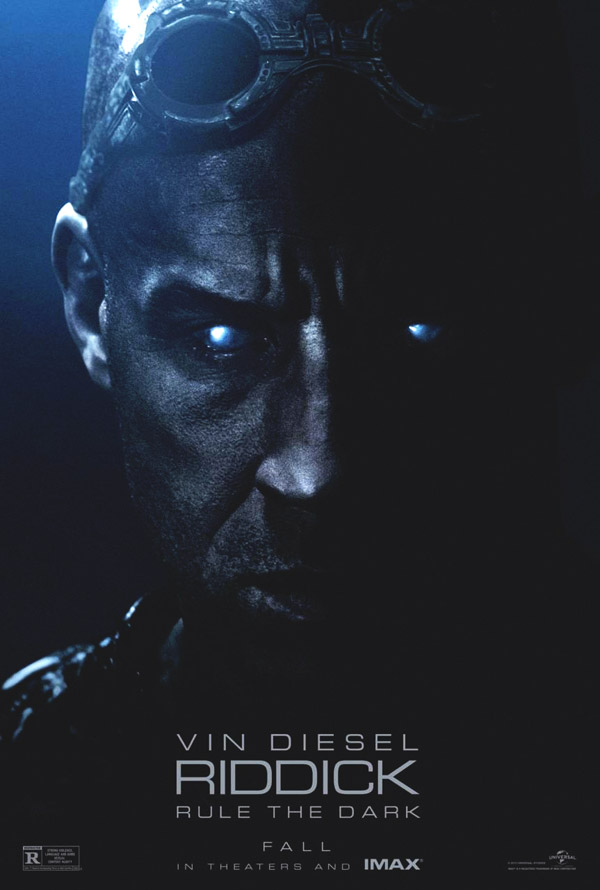
Riddick

In 2000, a small little scifi-horror film came out starring that guy from Saving Private Ryan. We didn’t really recognize him as the household name of Vin Diesel we know now. It was still that guy who was in that Spielberg WWII film. Pitch Black was a modest success, but modestly enough that a sequel was greenlit right after with a much bigger budget. This sequel was less scifi-horror and more of an epic scifi film that was trying to be the Dune of it’s time. The Chronicles of Riddick wasn’t a modest success this time around and plans for a third film to finish off the trilogy never got off the development stage.

Vin Diesel has since become a big star of some caliber with his Fast and Furious franchise. With the success of the latest film in that franchise it looks like Universal had given the Diesel the go-ahead to make a third film in his scifi franchise simply titled, Riddick.

With a more modest budget than the second film, Riddick looks to return Vin Diesel’s character back to something more similar and thus safe. Riddick is back on a death world of a planet inhabited by dangerous critters who mayor may not hunt once an prolonged darkness sets in. Riddkc must also deal with a pesky band of mercenary bounty hunters after his hide. Where the second film tried to build on the character’s background and further his story in a space opera-like way this red band trailer shows that Riddick is best when playing the anti-hero who may or may not be the villain as well as the hero of the story.

Riddick is set for a September 6, 2013 release date.