The 1963 film, The Cardinal, opens with an Irish-American priest named Stephen Fermoyle (Tom Tyron) being instituted as a cardinal.
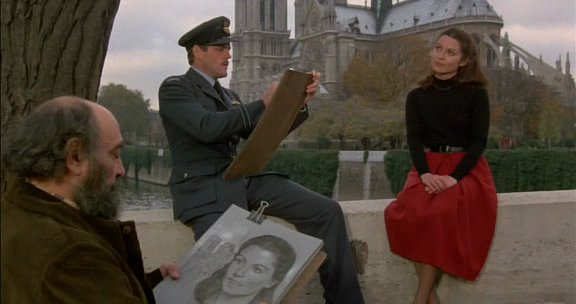
In a series of flashbacks, we see everything that led to this moment. Stephen starts out as an overly ambitious and somewhat didactic priest who, over the years, is taught to be humble by a series of tragedies and mentors. It’s a sprawling story, one that encompasses the first half of the 20th Century and, as he did with both Exodus and Advice and Consent, Preminger tells his story through the presence of several familiar faces. Director John Huston plays the cardinal who takes an early interest in Stephen’s career. Burgess Meredith plays a priest with MS who teaches Stephen about the importance of remaining humble and thankful. When Stephen is in Europe, Romy Schneider plays the woman for whom he momentarily considers abandoning his vows. When Stephen is assigned to the American South, Ossie Davis plays the priest and civil rights activist who teaches Stephen about the importance of standing up for those being oppressed. In the days leading up to World War II, Stephen is sent to Austria to try to keep the local clergy from allying with the invading Nazis. Stephen also deals with his own family drama, as his sister (Carol Lynley) runs away from home after Stephen counsels her not to marry a good Jewish man named Benny (John Saxon) unless Benny can be convinced the convert to Catholicism. Later, when his sister becomes pregnant and Stephen is told that she’ll die unless she has an abortion, Stephen is forced to choose between his own feelings and teachings of the Church. Along the way, performers like Dorothy Gish, Cecil Kellaway, Chill Wills, Raf Vallone, Jill Haworth, Maggie McNamara, Arthur Hunnicut, and Robert Morse all make appearances.
All of the familiar faces in the cast are used to support Tom Tryon and Tryon needs all the support that he can get. Despite Otto Preminger’s attempts to make Tom Tyron into a star, Tryon eventually retired from acting and found far more success as a writer of the type of fiction that Stephen Fermoyle probably would have condemned as blasphemous. Tryon gives a stiff and unconvincing performance in The Cardinal. The entire film depends on Tryon’s ability to get us to like Stephen, even when he’s being self-righteous or when he’s full of self-pity and, unfortunately, Tryon’s stiff performance makes him into the epitome of the type of priest that everyone dreads having to deal with. Tryon gives such a boring performance that he’s overshadowed by the rest of the cast. I spent the movie wishing that it would have spent more time with John Saxon and Burgess Meredith, both of whom give interesting and lively performances.
The Cardinal is a long and rather self-important film. The same can be said of many of Preminger’s films in the 60s but Exodus benefitted from the movie star glamour of Paul Newman and Eva Marie Saint and Advice and Consent was saved by an intelligent script. The Cardinal, on the other hand, is a bit draggy and makes many of the same mistakes that many secular films make when they try to portray Catholicism. Oddly enough, The Cardinal received more Oscar nominations than either Exodus or Advice and Consent. Indeed, Preminger was even nominated for Best Director for his rather uninspired work here. Considering the number of good films for which Preminger was not nominated (Anatomy of a Murder comes to mind), it’s a bit odd that The Cardinal was the film for which he was nominated. (Of course, in 1944, the Academy got it right by nominating Preminger for his direction of Laura.) The Cardinal is largely forgettable, though interesting as a type of self-consciously “big” films that the studios were churning out in the 60s in order to compete with television and the counterculture.


 Through the Shattered Lens