4 Shots From 4 Films is just what it says it is, 4 shots from 4 of our favorite films. As opposed to the reviews and recaps that we usually post, 4 Shots From 4 Films lets the visuals do the talking!
Today is Jack Nicholson’s 88th birthday!
Though he has pretty much retired from acting, Jack Nicholson remains a screen icon with a filmography that is a cinema lover’s dream. He’s worked with everyone from Roger Corman to Stanley Kubrick to Milos Forman to Martin Scorsese and, along the way, he’s become a symbol of a very American-type of rebel. Though often associated with the counter-culture, his style has always been too aggressive and idiosyncratic for him to be a believable hippie. Instead, he’s one of the last of the beats, an outsider searching for meaning in Americana.
Over the course of his career, Nicholson has won three Oscars and been nominated for a total of 12. He’s the only actor to have been nominated in every decade from the 1960s to the 2000s. He is an actor who epitomizes an era in filmmaking, actually several eras. It’s been 15 years since he last appeared in a movie but Jack Nicholson will never be forgotten.
4 Shots From 4 Jack Nicholson Films
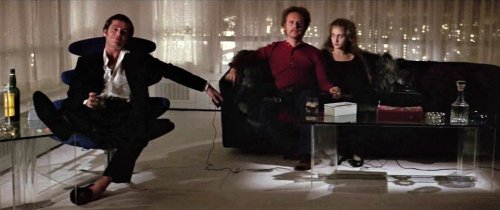
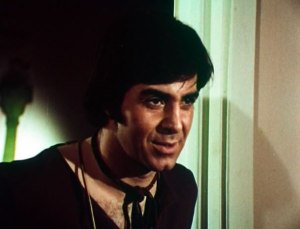
Psych-Out (1968, dir by Richard Rush, DP: Laszlo Kovacs)
Carnal Knowledge (1971, dir by Mike Nichols, DP: Giuseppe Rotunno)
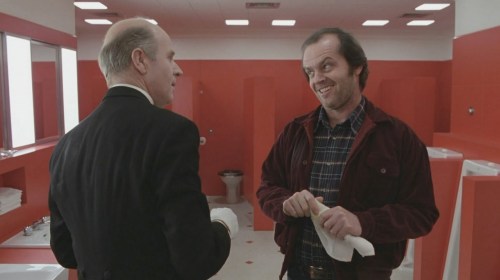
The Shining (1980, dir by Stanley Kubrick, DP: John Alcott)
The Departed (2006, dir by Martin Scorsese, DP: Michael Ballhaus)
6 Shots From 6 Films is just what it says it is, 6 shots from 6 of our favorite films. As opposed to the reviews and recaps that we usually post, 6 Shots From 6 Films lets the visuals do the talking!
Today, we pay tribute to the year 1968! It’s time for….
6 Shots From 6 1968 Films
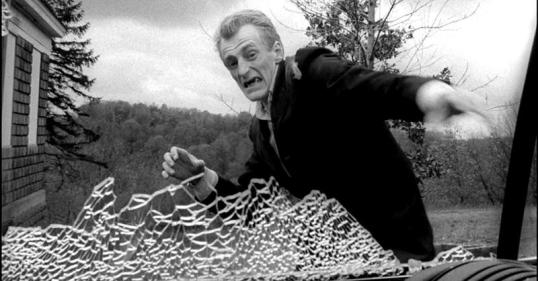
Night of the Living Dead (1968, dir by George Romero, DP: George Romero)
Petulia (1968, dir by Richard Lester, DP: Nicolas Roeg)
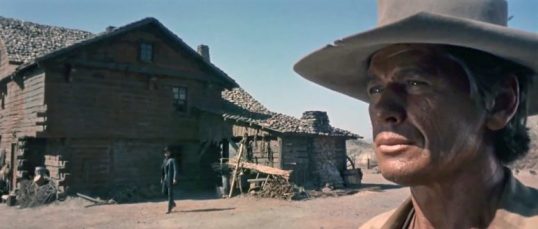
Once Upon A Time In The West (1968, dir by Sergio Leone, DP: Tonino Delli Colli)
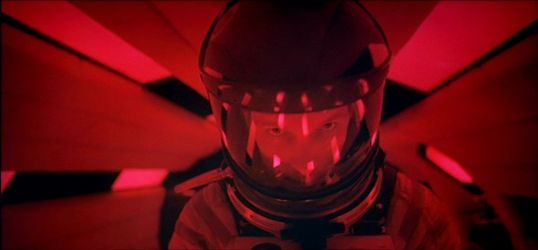
2001: A Space Odyssey (1968, dir by Stanley Kubrick, DP: Geoffrey Unsworth)
Psych-Out (1968, dir by Richard Rush, DP; Laszlo Kovacs)
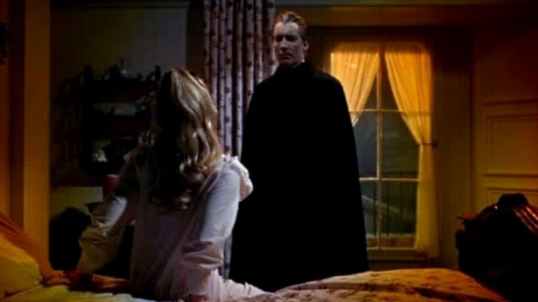
Dracula Has Risen The Grave (1968, dir by Freddie Francis, DP: Arthur Grant)
There’s a scene in the 1968 film, Psych-Out, in which a group of hippies are talking to be a liberal-minded minister, asking him if a mysterious figure known as “The Seeker” has even come by his church. The minister tells them that he has not seen the Seeker, though he has heard of him. As the hippies politely leave the church, one of them accidentally brushes past a middle-aged woman. Though the hippie politely apologizes, the woman is still obviously disgusted by his presence in the church. She asks her companion how the minister can possibly allow people who “dress like that” into the church.
As the woman complains, the camera focuses in on the stained glass window directly over her shadow. There’s Jesus and the disciples. They’ve all got beards. They all have long hair. They’re all wearing simple clothing …. oh my God, they’re hippies!
That’s actually one of the more subtle moments to be found in Psych-Out, an entertainingly heavy-handed film about hippies and wanderers in California. Psych-Out was made at the height of the counter culture. It was filmed on location in the San Francisco neighborhood of Haight-Ashbury, where both the love and the clothes are free and no one is about judging anyone else’s thing. Into this neighborhood comes Jenny Davis (Susan Strasberg), who has run away from home and who is looking for her brother, Steve (Bruce Dern). Jenny may have been raised in a conservative household but she’s eager to embrace the counter-culture. Jenny is also deaf but she can read lips. She also has the police looking for her but fear not! The residents of Haight-Ashbury look after one another! They have to, considering that there are still cops and even a few rednecks hanging out around the neighborhood.
No sooner has Jenny arrived in San Francisco than she falls in with a 30-something hippie named Stoney (Jack Nicholson, with a pony tail). Stoney is a member of a band, along with Elwood (Max Julien) and Ben (Adam Roarke). Even though Stoney says that he doesn’t care about material goods, he’s still eager to become a rock star. Stoney also says that he doesn’t want to get tied down by any commitments. He wants to do his own thing. He may sleep with Jenny but that doesn’t mean that either one belongs to the other. Stoney may say that but he certainly gets jealous when he sees Jenny talking to the local guru, Dave (Dean Stockwell). Dave calls Stoney for being a phony. “You may be righteous but you’re not hip,” Dave tells him. Can Stoney become both righteous and hip before the film ends? Can Jenny find her brother? Will the band get signed to a recording contract and will the menacing junkyard rednecks ever see the errors of their fascist ways?
Today, of course, Jack Nicholson is probably the main reason why most people would want to see Psych-Out. Ironically, for a figure who is so identified with the counter-culture, Jack Nicholson did not make for a very convincing hippie. A lot of that is because Nicholson’s trademark sarcasm (which is on full display in Psych-Out, as this is a far more typical Nicholson performance than the one that would make him a star a year later in Easy Rider) owed more to the beats than to the hippies. Nicolson’s persona always had more in common with Jack Kerouac than Abbie Hoffman. In Psych-Out, he comes across as being too much of a natural skeptic to fit in with the free-spirited hippies all around him. Nicholson is fun to watch because he’s Jack Nicholson but you never buy him as someone who would really want to live in a commune where no one has any possessions and money is frowned upon.
Dean Stockwell, on the other hand, is a totally believable hippie guru though, to his credit, his still brings some welcome wit to his role. The script may call for him to recite some fairly shallow platitudes but he does so with just enough of a smile to let use know that not even Dave takes himself that seriously. As for the rest of the cast, Bruce Dern gets to do his spaced-out routine and Henry Jaglom, who would later become an insufferably self-important director, plays an artist with huge sideburns who tries to chop off his hand while having a bad trip. Jenny is horrified but everyone tells her not to judge. Susan Strasberg is sympathetic as Jenny and is convincing as a deaf character. Unfortunately, the film doesn’t give her much to do other than walk around San Francisco with a dazed expression on her face and stare lovingly up at Jack Nicholson.
Psych-Out‘s greatest value is probably as a time capsule. It was filmed on location and it features actual hippies. Watching it is like getting a chance to step into a time machine and go back to San Francisco in 1968. Of course, judging from this film, San Francisco in 1968 wasn’t that appealing of a place but still, Psych-Out remains an entertainingly silly historical document. Just a year after the release of Psych-Out,Charles Manson and his followers would come out of the canyons and the Altamont Free Concert would end in murder and the 60s would come to an abrupt end. Watching Psych-Out, it’s hard to believe all of that was right around the corner.
4 Shots From 4 Films is just what it says it is, 4 shots from 4 of our favorite films. As opposed to the reviews and recaps that we usually post, 4 Shots From 4 Films lets the visuals do the talking!
Today is Jack Nicholson’s 83rd birthday!
It’s been ten years since Jack Nicholson last appeared in a movie, the forgettable How Do You Know. Rumor has it that he’s basically retired from acting, though it’s said that Nicholson himself has denied it. However, whether he’s working or not, he remains a screen icon with a filmography that is a cinema lover’s dream. He’s worked with everyone from Roger Corman to Stanley Kubrick to Milos Forman to Martin Scorsese and, along the way, he’s become a symbol of a very American-type of rebel. Though often associated with the counter-culture, his style has always been too aggressive and idiosyncratic for him to be a believable hippie. Instead, he’s one of the last of the beats, an outsider searching for meaning in Americana.
Over the course of his career, Nicholson has won three Oscars and been nominated for a total of 12. He’s the only actor to have been nominated in every decade from the 1960s to the 2000s. If he ever writes his autobiography, you know that we’ll all run out and buy a copy. When the day comes that Jack Nicholson is no longer with us, it will truly be the end of an era.
Happy birthday, Jack Nicholson. May you have many happy returns!
There’s a lot of good stuff being broadcast this month, so it’s time once again to make some room on the ol’ DVR. Here’s a quartet of capsule reviews of films made in that mad, mad decade, the 1960’s:
THE FASTEST GUITAR ALIVE (MGM 1967; D: Michael D. Moore) – MGM tried to make another Elvis out of rock legend Roy Orbison in this Sam Katzman-produced comedy-western. It didn’t work; though Roy possessed one of the greatest voices in rock’n’roll, he couldn’t act worth a lick. Roy (without his trademark shades!) and partner Sammy Jackson (TV’s NO TIME FOR SERGEANTS) peddle ‘Dr. Ludwig Long’s Magic Elixir’ in a travelling medicine show, but are really Confederate spies out to steal gold from the San Francisco mint to fund “the cause” in the waning days of the Civil War. The film’s full of anachronisms and the ‘comical Indians’ aren’t all that funny…
Apparently, as I sit here in my underwear and glasses, the Earth is about as close to the moon as it will ever get. Because of that, the moon is huge out in the night sky. Or at least that’s what I’m hearing. It looks pretty normal to me but anyway, this is being referred to as being “Supermoon.” I’m not sure why. If I stood less than an inch from your face, would that suddenly make me Super Lisa?
Of course, a gigantic full moon would bring a werewolf film with it. This is one of the thousand or so biker films to come out in the late 60s and early 70s. These films were interesting mostly from the point of view of how they mixed other genres with the biker conventions. Werewolves on Wheels did it with lycanthrophy.
Actually, since it’s a supermoon, we better include two werewolf-themed trailers. This is for the Werewolf of Washington, starring Dean Stockwell. For some reason, I’ve actually got several copies of this on DVD (I think this is one of those films that somehow found its way into the public domain) but I’ve yet to actually sit down and watch it. I think my hesitation has to do with the fact that it appears to be a political satire and it was made in the 70s. That sounds like a combination for boredom, to be honest.
But before Jack Nicholson could become a hippie, he was a sinister gunman in Monte Hellman’s existential grindhouse western, The Shooting. The Shooting, which co-stars Warren Oates and Millie Perkins, is an unacknowledged classic and a movie that I’m going to have to review one of these days. Perkins, by the way, was married to none other than Dean Stockwell.
And then, 7 years later, Hellman, Oates, and Perkins reunited to make an odd little film called Cockfighter. This is another film I have to review though I also have to say that, as a former country girl who has actually seen a few cockfights, cockfighting is right up there with dogfighting as far as sickening sadism is concerned.*
And, of course, while some people in the south were going to cockfights, others were apparently getting killed by redneck lawmen in films like the ’74 classic, Macon County Line.
In honor of Supermoon, I’m going to include two extra trailers. Seriously, don’t ever doubt that Lisa loves you.
While rural audiences (probably made up of people I’m distantly related to) spent 1974 cheering police brutality and animal cruelty, urban grindhouse audiences were enjoying films like this one.
Finally, since we’re under a supermoon, here’s the trailer for Jesus Franco’s infamous (and frequently banned) slasher Bloody Moon. I haven’t seen Bloody Moon (copies aren’t that easy to find) but seriously, the involvement of Jesus Franco tells me all I probably need to know.**
—–
*If you’ve got a cock, use it to spread love, not hate.
** Well, we’ll see about that. I just ordered a copy off of Amazon.
During my freshman year of college, my roommate Kim often used to tell me that we were born several decades too late. If only, she often lamented, we could have grown up in the 1960s and been part of that legendary counter-culture. Her logic was that we both considered ourselves to be anti-establishment, we both felt society needed to be changed, and we both liked to get high on occasion.
I can see her point but honestly, I would never had made it as a hippy or, for that matter, even as a quasi-hippy. For one thing, I hate being outdoors. I’ve got too many allergies and crickets freak me out. While I support free love, I don’t support practicing it with people who don’t shower on a regular basis. I’m not going to argue with any woman who feels the need to burn her bra but quite frankly, I don’t want to wake up one day and discover that I can touch my boobs with my big toe. Actually, that whole idea of running around day after day without any underwear on is just gross. I don’t even want to think about it.
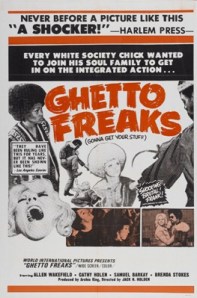
So, no, I could never have been a member of the 60s counter-culture. But that doesn’t mean that I can’t watch the hundreds of films — some well-known but most incredibly dated and obscure — that have been made about and during that era. Indeed, whatever knowledge I have the 1960s pretty much comes from my movie collection and movies like Ghetto Freaks.
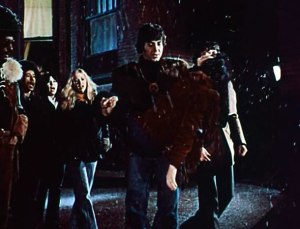
The production history of Ghetto Freaks is rather obscure. Just to judge from the clothes and the dated lingo, it was originally filmed in 1969 or 1970. The film, which is nearly plotless, was shot in Cleveland, Ohio. I’ve never been to Cleveland (or Ohio, for that matter) and Ghetto Freaks — with its cold and gray urban landscape — hardly makes it look inviting. Still, the fact that it was shot on location and that no attempt was made to hide the decay there, does bring an unexpected rawness to the movie. Whether it was by intention or just the result of a low budget, director Robert Emery does manages to make the film’s ugliness oddly compelling.
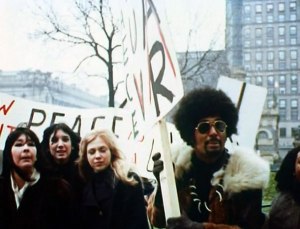
The movie opens up with a bunch of hippies talking to a bunch of older people. If you’ve seen any of the protest films of the 60s or 70s then you’ve already seen this scene a hundred times. The hippies are told to get haircuts. The hippies make the standard response about Jesus having long hair. Fortunately, the cops arrive before the scene turns into the 2nd act of Bye Bye Birdie.
This is the 1st of many awkward, predictable scenes in Ghetto Freaks. Fortunately, this movie was smart enough to follow its bad scenes with good ones. So, once the pigs have released him, the head of the hippies (a ruggedly handsome former drug dealer named Sonny) spends his night hanging out at a rather dingy club.
How to describe the Club Sequence? Well, you really have to see it to understand why I can’t get it out of my head but it all comes down to the a rather hyperactive singer who performs at the club. This singer performs two songs. The first features the immortal lyrics “My name is Mousey and I feel lousy.” The second is an odd cover of the MC 5’s seminal “Kick Out The Jams,” (though, in the film, the song is kicked off by the singer shouting “Kick out the jams, brothers and sisters!” as opposed to the actual “Kick out the jams, motherfucker!”) The two musical performances are energetic and — as opposed to the earlier “protest” scene — entertaining to watch and the singer’s flamboyance contrasts interestingly with the club’s drabness.
Of course, there’s more going on in the bar than just the music. Sonny talks to the other members of his hippy commune. He also turns down a chance to return to his old career of dealing drugs on the street. These conversations have a rather nice, breezy air to them. For the most part, the actors all give surprisingly natural performances and the dialogue — no longer full of platitudes — is occasionally even memorable.
One other important thing happens at the bar. Sonny spots a pretty young woman named Diane who is fighting with her obviously upper class parents. Sonny finds the time to invite her to drop by the old commune before she is dragged away by mom and dad.
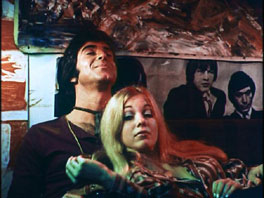
Later that night, Diane makes her way to the hippie pad currently occupied by Sonny and 14 other hippies. She and Sonny have a long talk about why Sonny and friends live the way that they do. And I do mean long. The conversation seems to drag on forever and it doesn’t help that everything Sonny says is a platitude along the lines of “War is bad for children and other living things.” Fortunately, this scene is made barely tolerable by the fact that Sonny and Diane are both played by likable performers. Sonny’s has a rugged charisma about him and Diane comes across as sincerely nice. I haven’t ever seen either one of these actors (or for that matter, anyone in Ghetto Freaks) in any other movies and that’s a shame because the movie does boast some memorable performances.
Anyway, even as Sonny explains his world view to her, Diane is dropping acid for the first time. Naturally this leads to a huge orgy in which the members of the commune dance around naked while Sonny and Diane make love on the floor.
(I have to admit I got a little bit jealous of Diane here because, back when I used to do that sort of thing, I never had a trip that resulted in an orgy. I saw my face melting occasionally but never an orgy. It makes me wish I had a “I Dropped Acid and All I Got Was A Lousy Flashback” t-shirt.)
As you might guess, the Ghetto Freaks orgy is the film’s best known scene. Along with all the nude hippies dancing (and, credit to the film, all the hippies are seen nude and not just the females), we also get a lot of dark blue lighting and psychedelic music playing the background. While undeniably erotic, there’s also something rather disturbing about the whole scene. First off, with all the weird camera angles and nude onlookers, the scene immediately made me think about the Satanic “dream” sequence from Rosemary’s Baby. Secondly, seen today, it’s painfully obvious that the film’s hero is essentially taking the virginity of a girl who has been drugged.
Oh, there’s one other interesting thing about the orgy sequence. Are you wondering yet why this movie about a bunch of white hippies is called Ghetto Freaks? Well, it’s because of what happens towards the end of the orgy. Suddenly, we’re no longer watching Sonny rape Diane while a bunch of nude hippies dance. Instead, we’re confronted with the image of a tall, glowering black man who handles a knife while several women we’ve never seen before parade past him. I don’t know how to explain just how odd and jarring this two-minute sequence is. Beyond the fact that we’ve never seen any of these characters before (and we won’t see them after), the scene itself is obviously shot on completely different film stock from the rest of the movie. The only thing that connects it to anything we’ve seen before is that droning orgy music which continues to play (albeit in rather muted form) in the background. Yes, this sequence was inserted into the movie after it had already been filmed. The producers, obviously wondering how they’d ever make their money back, inserted this scene featuring this unnamed black man so that they could then market this nearly entirely white film as a blaxploitation film. That man and his “followers” are the Ghetto Freaks of the title and they’re in the film for all of two minutes.
Following the orgy, we are treated to a day in the life of a hippy commune. Diane accompanies Sonny, Mousey, and the whole gang on a day full of passing out an underground newspaper, panhandling, and getting harassed by the pigs. Meanwhile, the neighborhood drug dealers, angry that Sonny won’t agree to push their drugs, are plotting their own revenge on our counter-culture Adonis. If you think all of this eventually leads to a tragedy you can see coming from miles away, you’re right.
Even though it’s hard (actually impossible) to top a drug-induced orgy sequence, the second part of the film does feature two memorable scenes. The 1st one features the members of the commune (what should one call them? Communers, maybe? Communists?) standing out in the street, trying to convince people to give them money for copies of a free, underground paper. Shot in a documentary,cinéma vérité -style, this scene is appears to unscripted and features the cast interacting with actual human beings. As such, the reactions (most negative but some surprisingly positive) are authentic as opposed to idealized. The cast themselves turn out to be surprisingly skilled at improvisation and this sequence features the film’s best dialogue (which could be considered back-handed praise when you consider that the scene was unscripted). It helps that the scene was obviously shot on a very cold day and the cast was obviously suffering for their “art.” (Diane, in a surprisingly endearing moment, keeps asking people to look at how blue her frozen hands are.) I’m not a big fan of panhandlers in general but this film does succeed in making it look like very hard work.
The 2nd sequence occurs at the end of the film, even as the end credits are rolling. If the panhandling sequence represents the best of Ghetto Freaks, this 2nd sequence represents, perhaps, the worst. Following the film’s sudden violence of the movie’s “tragic” conclusion, the actors suddenly go from grim-faced to smiling like a bunch of Broadway understudies who have just learned that the entire cast of the latest Grease revival was aboard a plane that crashed while landing. They start hugging each other (except, of course, for the character who dies at the end of the film. She just keeps lying there on the sidewalk) and giving each other high fives as the camera pulls back to reveal — yes, you guessed it! — the movie’s director and his crew. There’s a forced whimsy to this and it’s hard not to imagine the director smirking as he talks about how much he loves Jean-Luc Godard. Reminding the audience that they’re actively watching a movie (as opposed to reality) was, of course, one of the French New Wave’s major contributions to the language of cinema. Unfortunately, in Ghetto Freaks, it just feels like a forced attempt at trendiness. (If Ghetto Freaks was made today, it would be in 3-D.)
As I stated previously, my entire knowledge of the 60s counter-culture pretty much comes from how it was depicted in the movies of the era. One of the things that I’ve always found interesting about these movies is that, regardless of whether the movie is a classic like Easy Rider or a big budget misfire like Getting Straight or even a Roger Corman B-movie like Psych-Out, they are all essentially so middle class in their attitude towards women. Again and again, the message of many of these films seems to be that everyone should be allowed to “do their own thing” as long as they don’t have a vagina. However, those of us who do were continually portrayed in much the same way that we were portrayed in almost every film released before and after 1967. To be female means that you can either be worshipped or you can be punished but never dare to be an individual. (For the most obvious example of this, check out Getting Straight, a film in which activist Elliott Gould pretty much spends two hours screaming at Candice Bergen for daring to have opinions of her own.)
This is a trend that continues in Ghetto Freaks. For all the talk about how Sonny and his commune are all about freedom and allowing people to be themselves, it doesn’t change the fact that the female members are pretty much there to be pretty and sexually available to whoever wants them for the night. Diane is accepted into the group not because she rejected the values of society but because she has sex with Sonny. Add to this a scene earlier in the film in which our hero Sonny jokes about how his best friends “big-titted” sister was raped by a black man (“She was asking for it,” Sonny assures her brother who eventually agrees) and you end up with a very contradictory message. I don’t necessarily have problem with the characters themselves being sexists. To be honest, I prefer an honest sexist to a liberated liar. What’s annoying is that this movie, like a lot of other so-called “counter-culture” films, does not seem to be aware of the double standard.
In true exploitation film-tradition, Ghetto Freaks was released and re-released under several different names. Seeing as how much of the film plays out like a community theater production of Hair, the film originally had the much more appropriate title of The Age of Aquarius. When that title didn’t exactly work wonders, the film was retitled The Love Commune. Again, this was an appropriate (if rather banal) title that failed to attract an audience. Finally, the film’s producers spliced that footage into the middle of the orgy scene and, hoping to appeal to the blaxploitation audience, renamed the movie Ghetto Freaks.
And it worked.
When it comes to exploitation, freaks will beat lovers any day.
Ghetto Freakswas released on DVD by one of my favorite companies, Something Weird Video. As is typical with SWV, the DVD is actually a double feature. The second movie is an earlier, drug-centered movie called Way Out. Technically, it’s a far better movie than Ghetto Freaks but it’s also a lot less fun.







 Through the Shattered Lens