Since today is Presidents Day, my scene that I love features one of my favorite fictional presidents! In this scene from 1964’s Dr. Strangelove, President Merkin Muffley (Peter Sellers) attempts to explain why something funny might happen with the bomb to his Russian counterpart.
Sellers reportedly based President Muffley on Adlai Stevenson, the self-styled “rational intellectual” who twice ran for President against Dwight Eisenhower.
Ah, Eisenhower. There’s a President that I wish I could have voted for.
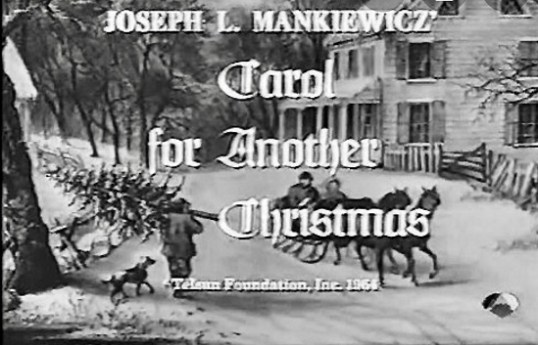
Daniel Grudge (Sterling Hayden) is a wealthy American industrialist who served in World War II and who, despite seeing first hand the horrors of Hiroshima, still believes that war is sometimes the only answer. He spends his Christmas Eve sitting in darkened study, thinking about his dead son (who was killed in combat) and listening to an old record. When his nephew, Fred (Ben Gazzara), stops by, it leads to an argument about American foreign policy. (Who stops by their uncle’s house on Christmas Eve to argue politics?) Fred is do-gooder. Daniel Grudge hates do-gooders.
So, naturally, it’s time for Daniel Grudge to be visited by three ghosts! The Ghost of Christmas Past (Steve Lawrence) takes Grudge first to a troop ship that is full of coffins, representing the dead of World War I. Then he forces Grudge to relive his own callous reaction to Hiroshima. Grudge sees how his actions upset the nurse (Eva Marie Saint) who was traveling with him. The Ghost of Christmas Present (Pat Hingle) invites Grudge to eat a feast in front of a camp full of refugees. The Ghost of Christmas Future (Robert Shaw) takes Grudge to the future where, after a devastating nuclear war, a buffoonish leader (Peter Sellers) encourages his followers to continue to make war and to live only for themselves. Grudge watches as his former butler (Percy Rodriguez) is murdered for advocating for peace. Back at his mansion, Fred shows up again and Grudge must now decide …. will he support the work of the United Nations?
YEEEEESH! What a heavy-handed movie! Really, I guess I shouldn’t be surprised at how unsubtle the film’s message was. Originally made for television, A Carol For Another Christmas was actually co-produced by the United Nations. It was the first of four UN-produced films that aired on ABC between 1964 and 1966. Seen today, with all that we know about the UN’s signature mix of corruption and incompetence, the film’s message seems almost laughably naïve. “Only the UN can bring peace,” the film says. Tell that to Israel, the next time that the UN passes a resolution condemning it for existing and defending itself. Say that only the UN can make the world a better place when some of the worst dictatorships on the planet are sitting on the Human Rights council.
The heavy-handed message aside, A Carol For Another Christmas was full of talent both behind and in front of the camera. This was the only TV movie to be directed by Joseph L. Mankiewicz and, whatever else one might say about the film, he was responsible for some intriguingly moody shots. The script was written by Rod Serling who, unfortunately, allowed his didactic tendencies to get the better of him and wrote a film where characters didn’t have conversations as much as they just gave speeches. The cast, however, is uniformly strong. Sterling Hayden, Robert Shaw, and Steve Lawrence are obvious stand-outs. Pat Hingle does fine until his role is diminished to one long harangue. Playing the so-called “Imperial Me,” Peter Sellers brings so much needed unpredictability to the film, even if his character is saddled with the film’s most heavy-handed moment. The Imperial Me teaches his followers that the individual is more important than the state and that everyone should focus on “me” instead of “we.” Cutting-edge satire this is not and again, there’s something rather offensive about the UN being held up as humanity’s last hope against rampant individualism.
This is very much a film of its time. The fear of nuclear war runs through every frame. The disillusionment that came with the assassination of John F. Kennedy is present in the film’s open-ended conclusion. What good is convincing one man when the rest of the world continues to think for itself? the film seems to be asking. Dickens, I think, would probably say that Serling missed the point of A Christmas Carol and it’s hard not to feel that Dickens would be correct.
Peter Sellers was a brilliant actor and comedian while also being a childish and selfish human being who, because he was always performing, never really developed a personality of his own.
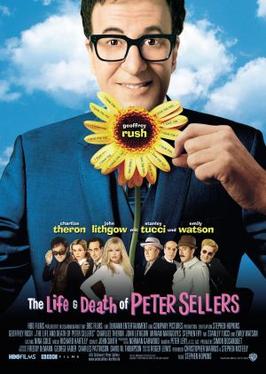
That’s the argument made by The Life and Death of Peter Sellers, which stars Geoffrey Rush as Sellers. The film follows Sellers from his success with The Goon Show to his subsequent collaborations with Stanley Kubrick (Stanley Tucci) and Blake Edwards (John Lithgow). Sellers becomes an international star but remains a deeply unhappy person, cheating on his wives, emotionally abusing his son, and being difficult on set. The film makes the argument that that the only person that Sellers truly loved was his doting mother (played by Miriam Margoyles) and that, having been born into a show business family, performing was the only thing that he was capable of doing. Even the few times when he’s shown to be a decent father, husband, or friend, it’s suggested that he’s just acting the role. Rush plays Sellers as being someone who is incapable of understanding how other people think so, whenever he has to interact with them, he simply imitates what he’s seen others do. Just look at the scene where he attempts to flirt with Sofia Loren by grinning up at her like a character in a romantic comedy.
The problem with a film like this is that, because he’s portrayed as being so selfish and immature, it’s hard to make Peter Sellers into a character that you would want to spend any time with. The narrative goes from one Sellers tantrum to another. Stephen Hopkins livens things up by including fantasy sequences where Sellers is taunted by some of his best-known characters, driving home the point that there wasn’t much to Sellers beyond the characters that he played and reminding us of both Sellers’s talent and Geoffrey Rush’s as well. There are also frequent monologues from Rush, dressed up like the other characters in the movie and discussing their relationship with Peter Sellers. Sometimes it works and sometimes it doesn’t. Rush does a good job playing Stanley Tucci playing Stanly Kubrick but when he’s made up to look like Miriam Margoyles, the conceit gets too ridiculous to work.
The main reason to see the film is for the performances, especially Emily Watson as Sellers’s first wife and Stephen Fry as Sellers’s “spiritual advisor.” Stanley Tucci is an inscrutably brilliant Stanley Kubrick while John Lithgow is a hyperactive and crass Blake Edwards. Finally, Geoffrey Rush is a marvel as Peter Sellers. Rush has a difficult job, making an extremely unlikable character compelling but he succeeds despite not always being helped by the film’s script or direction.
Like the man it portrayed, The Life and Death of Peter Sellers is flawed but filled with enough talent to watchable.
2016 is an election year and things are looking pretty grim right now. It’s enough to make you throw your hands up in frustrating and demand that someone push the reset button. However, things could always be worse. From the world of film, here are 8 President so incompetent, corrupt, and sometimes murderous that they will make you long for the dull mediocrity of a Jeb Bush or a Martin O’Malley.
1) The President (William Devane) in The Dark Knight Rises (2012)
You’re the leader of the free world and a masked terrorist has just launched a deadly attack on a major U.S. city. He has blown up a major sporting event on national television. He has killed the mayor. He is allowing a crazy sociopath to preside over show trials. The terrorist demands that you neither send troops into the city nor do you aid anyone who is trying to leave. What do you? If you are the President played by William Devane in The Dark Knight Rises, you say, “Okay,” and then breathe a sigh of relief when Batman turns out not to be dead after all. William Devane also played JFK in The Missiles of October and President James Heller on 24. Neither of them would have backed down to Bane as quickly as the President in The Dark Knight Rises.
2) The President (Billy Bob Thornton) in Love Actually (2003)
This President thinks that he can bully the world until he makes the mistake of getting on the bad side of the new British Prime Minister (Hugh Grant). How are you going to call yourself the leader of the free world when even Hugh Grant can make you look like a fool?
3) The President (Donald Pleasence) in Escape From New York (1981)
Hey, Mr. President, when Snake Plisskin nearly gets killed trying to save your life, you might want to try showing a little gratitude. Escape From New York ends with Snake asking The President who he feels about all the people who died rescuing him from New York. When the President can only mutter a few words of regret, Snake responds by destroying the tape that would have presumably prevented World War IV. Way to go, Mr. President! Would it have killed you to shed a few crocodile tears, at least over the fate of Cabbie?
4) The President (Cliff Robertson) inEscape From L.A. (1996)
The President from Escape From New York was practically Lincolnesque compared to the jerk who succeeded him. A theocrat who claimed to have an open line to God, this President banned smoking, drinking, cursing, red meat, guns, atheism, pre-marital sex, and everything else that made life fun. Anyone who disagreed got exiled to the island of California. Good thing that Snake Plisskin was still around to set things straight, even if it did mean that Florida ended up getting conquered by Cuba. Why doesn’t Snake ever run for President?
5) President Thomas J. Whitmore (Bill Pullman) in Independence Day (1996)
In a word, overrated. Yes, President Whitmore did lead the army that repealed the alien invaders but he would not have had to do that in the first place if he had prevented the Earth from being invaded in the first place. How many warning signs did the Whitmore administration ignore until it was too late? And how much funding did his administration cut from the military that the Air Force was left in such poor shape that they could get shown up by Randy Quaid in a crop duster? As for Whitmore’s famous speech and the battle that followed, a sequel to Independence Day is coming in June so he must not have done that good of a job of scaring the aliens off.
6) President James Dale (Jack Nicholson) in Mars Attacks! (1996)
At least President Whitmore got a chance to redeem himself by leading the battle against the invaders. James Dale did not even get that far. After foolishly believing everyone who told him that the aliens came in peace, he made the mistake of offering his hand in friendship and ended up with a flag sticking out of his chest.
7) President Alan Richmond (Gene Hackman) in Absolute Power (1997)
Not only did President Richmond think that he could get away with murder, he also thought he could outsmart Clint Eastwood. Big mistake. Clint Eastwood is no Hugh Grant.
8) President Merkin Muffley (Peter Sellers) in Dr. Strangelove: Or How I Learned To Stop Worrying And Love The Bomb (1964)
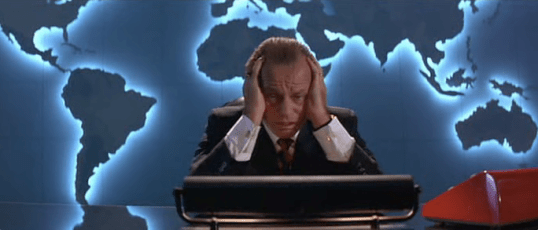
Mixing the raw charisma of Adlai Stevenson and the phone skills of Bob Newhart, President Merkin Muffley attempts to stop the end of the world and fails miserably. He even allows the Soviet ambassador to get a picture of the Big Board! But don’t worry. President Muffley may have failed to prevent nuclear war but he will not allow there to be a mineshaft gap!
When this election year get you down, just remember: things could always be worse!
As a general rule, I don’t watch the news. However, a few nights ago, I made an exception and I watched CNN. The reason was because it was snowing in New York City and apparently, CNN anchorman Don Lemon was broadcasting from something called the Blizzardmobile. I just had to see that!
Well, the Blizzardmobile turned out to be huge letdown. I was hoping for something like the Snowpiercer train but instead, it just turned out to be a SUV with a camera crew and a pompous anchorman who hilariously kept insisting that he was knee-deep in a blizzard when even a Texas girl like me could tell that the Blizzardmobile was only encountering a few snow flurries.
So, I flipped around to see if any of the other news stations had anyone in a blizzardmobile. What I discovered was that only CNN had a blizzardmobile but one thing that every news station did have was a panel of experts. An anchorperson would say something like, “What does the future look like?” and the panel of experts would tell us what the future looked like to them. What I found interesting was that I had no idea who these experts were but yet I was supposed to just believe that their opinions were worth considering.
I mean, for all I knew, those experts could have just been people who were spotted wandering around New York at night. But, because they were introduced as experts and looked directly at the camera whenever they spoke, they were suddenly authoritative voices.
Oddly enough, the very next night, I watched a movie from 1979 that dealt with the exact same issue.
Being There tells the story of Chance (Peter Sellers), a dignified, middle-aged man who lives in Washington, D.C. and works as a gardener for a wealthy older man. Chance cannot read. Chance cannot write. Chance goes through life with a blank smile on his face. Chance has never experienced the outside world. Instead, he spends all of his time working in the old man’s garden and obsessively watching TV. When the old man dies, Chance finds himself exiled from the house. Wandering around Washington D.C., Chance asks a random woman to make him dinner. He politely speaks with a drug dealer who pulls a knife on him. Finally, he finds himself entranced by a window display of televisions. Backing away from the window, Chance stumbles into the street and is struck by a car.
Though he’s not seriously injured, the owner of the car, Eve Rand (Shirley MacClaine), insists that Chance come back to her mansion with him so that he can be checked out by her private physician (Richard Dysart). As they drive back to the house, Eve asks Chance for his name.
“Chance the Gardner,” Chance replies.
“Chauncey Gardiner?” Eve asks.
Chance blankly nods.
Back the house, Chance meets Eve’s husband, Ben (Melvyn Douglas). Ben is a wealthy industrialist who is dying of leukemia. Ben takes an immediate liking to Chance. Because Chance is wearing the old man’s suits, everyone assumes that Chance is a wealthy businessman. When Chance says that he had to leave his home, they assume that his business must have failed due to government regulation. When Chance talks about his garden, everyone assumes that he’s speaking in metaphors.
Soon, Ben is introducing Chance to his friend, Bobby (Jack Warden). Bobby happens to be the President and when he quotes Chance in a speech, Chance the Gardner is suddenly the most famous man in the country. When he appears on a TV talk show, the audience mistakes his emotionless comments for dry wit. When he talks about how the garden reacts to different seasons, they assume that he’s an economic genius. By the end of the film, Bobby has become so threatened by Chance’s popularity that he’s been rendered impotent while wealthy, rich men plot to make Chance the next President of the United States.
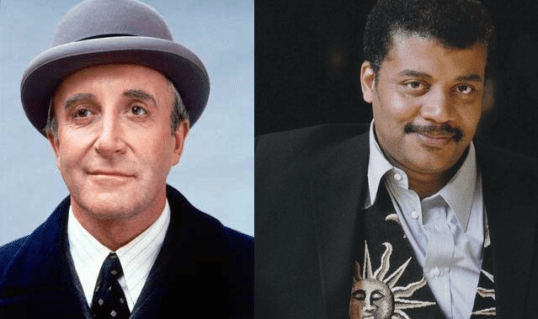
In many ways, Chauncey Gardiner was the Neil deGrasse Tyson of his era.
Being There is a one joke film and the idea of someone having no emotional skills beyond what he’s seen on television was probably a lot more mind-blowing back in 1979 than it is in 2015. But I still enjoyed the film. Peter Sellers gave a great performance as Chance, never sentimentalizing the character. As well, the film’s point is still relevant. If Being There were made today, Chance would be the subject of clickbait articles and Facebook memes. (Chauncey Gardiner listed his ten top movies and number 8 will surprise you! Or maybe This boy asked Chauncey Gardiner about his garden and his response was perfect.)
At its best, Being There is a film that will encourage you to question every expert you may see. Especially if he’s just stepped out of a blizzardmobile…
“Gentlemen! You can’t fight here! This is the war room!” — President Merkin Muffley (Peter Sellers) in Dr. Strangelove: Or How I Learned To Stop Worrying And Love the Bomb (1964)
The next time you hear someone bragging about how their favorite politician is an intellectual who always acts calmly and rationally, I would suggest that you remember the example of President Merkin Muffley, one of the many characters who populate the 1964 best picture nominee, Dr. Strangelove or How I Learned To Stop Worrying and Love the Bomb.
As played by Peter Sellers, Merkin Muffley is the epitome of rational political action. Speaking in a steady (if somewhat muffled) midwestern accent and always struggling to remain calm and dignified, Muffley keeps order in the War Room as the world edges closer and closer to apocalypse.
Just consider, for example, this scene where President Muffley calls the Russian leader (the nicely named Dimitri Kissoff) and explains that a little something silly has happened.
As Muffley explains in the above scene, Gen. Jack D. Ripper (Sterling Hayden) has gone crazy. Convinced that the Russians have been sapping his precious bodily fluids, Gen. Ripper has ordered a nuclear strike on Russia. Unfortunately, Russia has built a Doomsday Machine that, should Russia be bombed, will destroy the world.
While Muffley is at fist skeptical about a doomsday machine, his advisor, Dr. Strangelove (also played by Peter Sellers), explains that the doomsday machine not only exists but that it’s actually a pretty good idea. The wheelchair-bound Dr. Strangelove speaks in a German accent and appears to have lost control over the left side of his body. At random moments, his left arm shoots up in a Nazi salute. At other times, his hand tries to strangle him. Making these surreal moments all the more memorable is the fact that nobody in the War Room seems to notice or question them.
And, while it’s always tempting to dismiss a character like Dr. Strangelove as being an over-the-top caricature, the fact of the matter is that, following the end of World War II, several Nazi scientists ended up working for the U.S. government. In many ways, the U.S. space program was the creation of a bunch of real-life Dr. Strangeloves.
Of course, President Muffley and Dr. Strangelove aren’t the only roles played by Peter Sellers in this film. Sellers also plays Lionel Mandrake, a British officer who — as the result of an office exchange program — happens to be at Burpelson Air Force Base at the same time that Gen. Ripper orders the attack on Russia.
As famous as his Sellers’s performances as Dr. Strangelove and President Muffley may be, I actually think Mandrake is his best performance in the film. In many ways, Mandrake is the audience’s surrogate. He’s the one who gets to hear Ripper’s rambling explanation for why he launched an attack on Russia. He’s the one who has to try to convince the hilariously unhelpful Col. Bat Guano (Keenan Wynn) to help him find a quarter so he can call the Pentagon.
(“You’re gonna have to answer to the Coca-Cola company,” Guano says, before shooting open a Coke machine to get change.)
Sellers plays Mandrake as a parody of the traditional, stiff upper lip British army officer. Not only does that allow some great humor as Mandrake keeps a calm demeanor while listening to Ripper’s increasingly crazed monologue but it also allows Mandrake to be the only sane man in the movie.
(Of course, the whole point of Dr. Strangelove is that the world’s become so insane that one sane man can not make a difference. )
Sellers earned a best actor nomination for playing three different roles and he deserved it but, for me, the two best performances in the film come from Slim Pickens and George C. Scott.
Pickens, of course, is the bomber pilot who ends up riding an atomic bomb like a bull in a rodeo. As a character, Maj. Kong may be a bit too much of a spot-on stereotype but Pickens brings such sincerity to the role that it doesn’t matter. Oddly enough, you feel almost happy for him when he rides that bomb to his death. You know that’s exactly how he would have wanted to go out.
And then there’s George C. Scott, playing the role of Gen. Buck Turgidson. From the safety of the War Room, Turgidson looks forward to nuclear war and worries when President Muffley invites the Russian ambassador to join them. (“But he’ll see the big board!” Turgidson exclaims.) Turgidson is both hilariously stupid and hilariously confident. Perhaps my favorite Turgidson moment comes when he trips, falls, and stands back up without once losing his paranoid train of thought.
(Though he doesn’t have a big role, James Earl Jones makes his film debut in Dr. Strangelove. The way he delivers the line “What about Major Kong?” makes me laugh every time.)
50 years after it was first released, Dr. Strangelove remains a comic masterpiece of a nightmare, a film that proves that political points are best made with satire and not sermons.
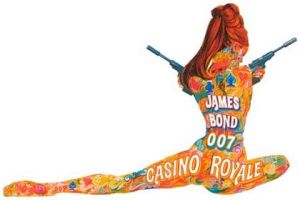
As you probably already know, we here at the Shattered Lens have been counting down the days until the American release of Skyfall by reviewing every single film in the James Bond franchise. Today, we take a look at the first non-EON Bond film, the epic, psychedelic 1967 spoof Casino Royale.
Where to begin?
When Ian Fleming’s first James Bond novel, Casino Royale, was published in 1953, veteran Hollywood producer Charles K. Feldman bought the film rights. However, Feldman didn’t buy the rights to Fleming’s subsequent novels and was forced to sit by and watch as Albert Broccoli and Harry Saltzman had unexpected success with Dr. No and the subsequent EON-produced Bond films. Much as Kevin McClory did with Thunderball, Feldman first attempted to co-produce a serious adaptation of Casino Royale with Broccoli and Saltzman. However, when Feldman, Broccoli, and Saltzman couldn’t come to an agreement on how each side would be compensated in the proposed production deal, Feldman decided to make Casino Royale on his own. He also decided that, instead of trying to compete with EON by making a “straight” James Bond film, his version of Casino Royale would be a satirical extravaganza.
Feldman’s vision of James Bond is apparent from Casino Royale’s opening credits. While the credits are definitely based on the iconic openings of the EON Bond films, they’re also designed to play up the fact that Casino Royale — in the grand tradition of the Hollywood studios at their most excessive — is meant to be a big budget, all-star extravaganza.
Casino Royale actually starts out with a pretty clever premise. It seems that the name “James Bond,” is simply a code name that has been assigned to several British spies over the years. As M (played by John Huston, who also directed the first third of the film), explains it, the name “James Bond” strikes such fear in the hearts of Britain’s enemies that the name must be kept alive.
(Speaking for myself, this is an idea that I kinda wish that the official James Bond series would adopt. If nothing else, it would certainly explain how Pierce Brosnan and Daniel Craig could possibly be the same person.)
The original James Bond (played by David Niven) has long since retired to his stately country estate, where he spends his time playing the piano and complaining about how the agents who have inherited his name are sullying his reputation with excessive womanizing and violence. It turns out the Sir James Bond is a man renowned for his “celibate image.” At the start of the film, Bond is asked to come out of retirement by not only M but the heads of the CIA, KGB, and French secret service as well. SMERSH, an organization of female assassins that’s led by the mysterious Dr. Noah, has been eliminating agents worldwide and only the original (and very chaste) Bond can defeat them. Bond, however, refuses and M responds by ordering a mortar attack on Bond’s estate. The estate is blown up but so is M and Bond soon finds himself returning to London as the new head of MI6.
Interestingly enough, David Niven was one of the actors who was considered for the role of James Bond in Dr. No. Reportedly, Ian Fleming was quite enthusiastic for Niven to take the role but, by the time that Dr. No went into production, Niven was considered to be too old. There’s a nice bit of irony here in seeing David Niven playing a retired James Bond who spends a good deal of the film complaining about the men who have subsequently assumed his name.
Once Niven takes over MI6, he orders that, in order to confuse SMERSH, all British agents (including female agents) will be known as James Bond. The rest of the film is divided into episodes that feature these new James Bonds battling SMERSH and the mysterious Dr. Noah.
Among these agents, there’s the handsome Coop (played by Terrence Cooper) who has been trained to resist all sexual temptations.
There’s Mata Bond (Joanna Pettet), the daughter of Sir James Bond and Mata Hari.
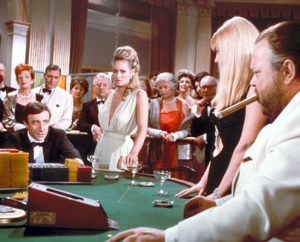
There’s Vesper Lynd (Ursula Andress) who is sent to seduce and recruit the expert gambler Evelyn Tremble (Peter Sellers) so that Tremble can beat SMERSH agent Le Chiffre (Orson Welles) at the Casino Royale.
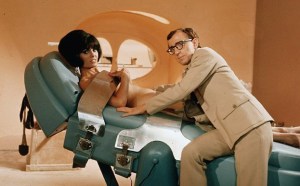
Best of all, there’s Sir James Bond’s nephew, Jimmy Bond. Jimmy Bond is played by Woody Allen and … well, let’s just take a look at Jimmy’s first scene in the film:
Casino Royale had a notoriously troubled production history and most of those troubles seemed to center on Peter Sellers. While the film was designed to be a broad, slapstick comedy, Sellers reportedly insisted on trying to play his role straight and even rewrote his lines to make his scenes more dramatic. Welles eventually grew so disgusted with Sellers that he refused to be in the same room with him. This caused quite a bit of difficulty since Sellers was in almost every scene that featured Welles. Eventually, Sellers walked off the film and the film had to be hastily (and awkwardly) rewritten to account for his sudden absence.
When one watches Casino Royale today, it’s hard to escape the conclusion that Sellers was essentially correct. While most of Casino Royale often feels disjointed and incoherent, the scenes featuring Sellers, Andress, and Welles are some of the strongest in the film. Sellers’ dramatic approach doesn’t negate the film’s comedy. If anything, it makes the comedy even stronger because Sellers actually seems to be invested in the reality his character, regardless of how ludicrous a situation that character may find himself in.
When I watched Casino Royale, I was struck by the stark contrast between the parts of the film that worked and the parts that didn’t. This is a movie that truly swings from one extreme to another. Either the film’s satire is working brilliantly (mostly in the scenes featuring Woody Allen and Peter Sellers) or it’s falling completely flat (like in an extended sequence that features Deborah Kerr as a SMERSH assassin).
I found myself laughing more at the little scenes than the big set pieces. For instance, I loved it when David Niven embraces Miss Moneypenny (Barbara Bouchet) just to be then told that she’s actually the daughter of the original Miss Moneypenny. I don’t know much about the actor Terrence Cooper (though, according to Wikipedia, he was also a contender to take the role of James Bond in the official series) but I enjoyed the brief sequence where Moneypenny “tests” him to see if he can take on the Bond identity. Unfortunately, the film doesn’t really have enough of these small, clever moments.
Ultimately, I found that Casino Royale works best when viewed as a time capsule. Casino Royale was made at a time when the established major Hollywood studios (and veteran producers like Charles K. Feldman) were struggling to remain relevant. Foreign films (including, it must be said, the James Bond films) were challenging the common assumptions of what could and what couldn’t be shown on-screen and the studio system reacted by trying to make films that would appeal to younger audiences while also reassuring older audiences that the movies hadn’t really changed that much. The end result were films like Casino Royale that featured the occasional psychedelic sequence along with cameos from old (and safe) Hollywood stars like George Raft, William Holden, and Charles Boyer. Casino Royale is the type of self-indulgent film that could only have been made in 1967 and, as such, it’s a valuable time capsule for all of us cinematic historians.
I also have to admit that, as excessive as Casino Royale may be, I happen to love excess. Casino Royale might be overlong and occasionally incoherent but the costumes are simply to die for. The film is a visual feast, if nothing else.
Casino Royale was released to scathing reviews and terrible box office but, in the years since, it has become something of a cult favorite. Our own Trash Film Guru has identified Casino Royale as his favorite Bond film. Myself, I found the film to be extremely flawed and yet oddly fascinating to watch. Casino Royale is a total mess and that is both its greatest flaw and greatest strength.
Tomorrow, we’ll return to the official James Bond series by taking a look at You Only Live Twice.

 You’re the leader of the free world and a masked terrorist has just launched a deadly attack on a major U.S. city. He has blown up a major sporting event on national television. He has killed the mayor. He is allowing a crazy sociopath to preside over show trials. The terrorist demands that you neither send troops into the city nor do you aid anyone who is trying to leave. What do you? If you are the President played by William Devane in The Dark Knight Rises, you say, “Okay,” and then breathe a sigh of relief when Batman turns out not to be dead after all. William Devane also played JFK in The Missiles of October and President James Heller on 24. Neither of them would have backed down to Bane as quickly as the President in The Dark Knight Rises.
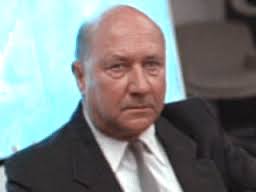 Hey, Mr. President, when Snake Plisskin nearly gets killed trying to save your life, you might want to try showing a little gratitude. Escape From New York ends with Snake asking The President who he feels about all the people who died rescuing him from New York. When the President can only mutter a few words of regret, Snake responds by destroying the tape that would have presumably prevented World War IV. Way to go, Mr. President! Would it have killed you to shed a few crocodile tears, at least over the fate of Cabbie?
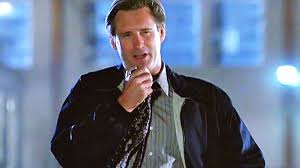 In a word, overrated. Yes, President Whitmore did lead the army that repealed the alien invaders but he would not have had to do that in the first place if he had prevented the Earth from being invaded in the first place. How many warning signs did the Whitmore administration ignore until it was too late? And how much funding did his administration cut from the military that the Air Force was left in such poor shape that they could get shown up by Randy Quaid in a crop duster? As for Whitmore’s famous speech and the battle that followed, a sequel to Independence Day is coming in June so he must not have done that good of a job of scaring the aliens off.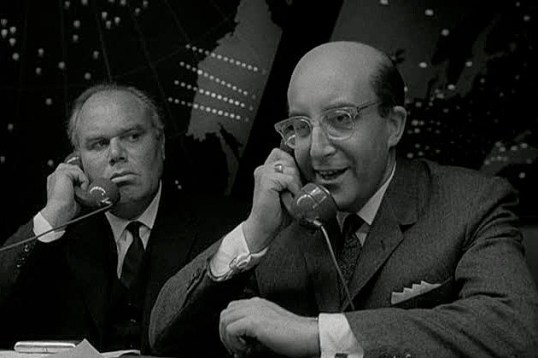

 Through the Shattered Lens