For tonight’s horror on television, we have the 11th episode of Hammer House of Horror! This atmospheric episode features Kathryn Leigh Scott as a woman who fears that she is being haunted by the ghost of a would-be rapist that she earlier killed. Simon MacCorkindale plays her husband, who has secret of his own.
This episode originally aired on November 22nd, 1980.
In the third episode of Hammer House of Horror, Denholm Elliott plays an estate agent who finds himself having a series of nightmares about his wife (Pat Heywood) and his secretary (Lucy Gutteridge) and a murder that may or may not have happened on Friday the 13th. This episode is an enjoyably surreal trip into the subconscious.
In the UK, Rude Awakening originally aired on September 27th, 1980.
In this episode of Hammer House of Horror, Julia Foster plays a tabloid reporter who is assigned to investigate an unconventional weight loss program. Foster discovers that weight loss is actually the last thing that the clinic is concerned with. This is an enjoyable macabre episode, one the features a particularly nasty twist.
The Thirteenth Reunion originally aired in the UK on September 20th, 1980.
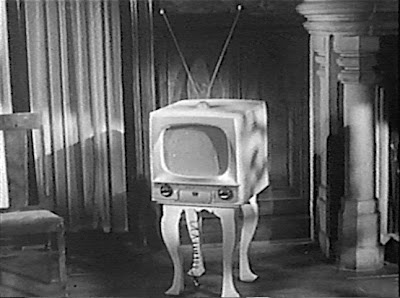
Peter Brock (Michael Bryant) is the leader of a team of researchers who work for an electronics company that is trying to come up with a new recording technique to keep up with their Japanese competitors. Peter and his team move into an old Victorian mansion that is said to be haunted. After Jill Greeley (Jane Asher) thinks that she’s seen a ghost, Peter theorizes that the stone walls of the mansion have actually recorded everything that has happened at the location over the years, like a security tape. Some people, like Jill, are sensitive enough to pick up on the images of the past. Other people, like Peter, are so determined to use what he calls The Stone Tape to his own advantage that it leads to tragedy.
The script for The Stone Tape was written by Nigel Kneale, who was also responsible for creating Quatermass. As he did with his Quatermass stories, Kneale took an otherwise standard horror story and added an interesting scientific twist. Peter is a classic villain who makes the mistake of thinking that he can control that which he does not understand. Ghosts and spirits may just be recordings of past events but that doesn’t mean they can’t hurt you. There’s a lot of screaming in The Stone Tape but there’s also some very interesting ideas, good acting, and intelligent directing from Peter Sasdy. First broadcast by the BBC in 1972, The Stone Tape is a classic ghost story, creepy and clever with a killer ending.
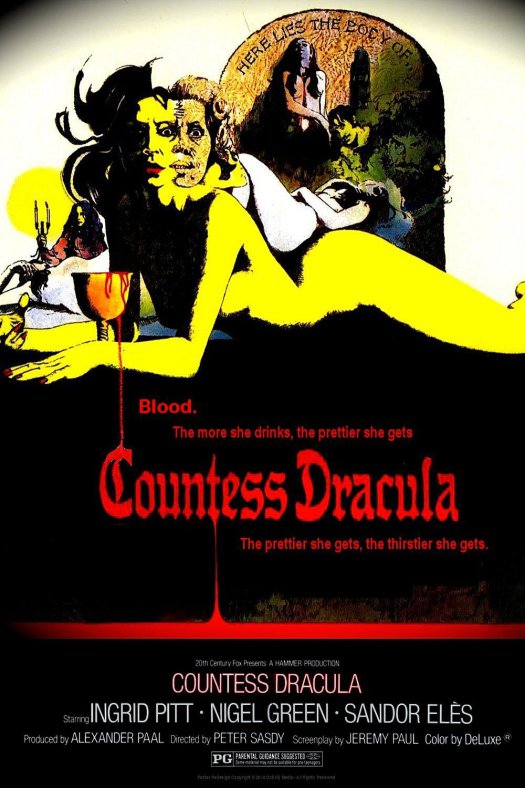
Iconic Ingrid Pitt became a horror fan favorite for her vampire roles in the early 1970’s. The Polish-born actress, who survived the horrors of a Nazi concentration camp as a child during WWII, played bloodsucking lesbian Carmilla in Hammer’s THE VAMPIRE LOVERS, based on the classic story by J. Sheridan LeFanu, and was a participant in the Amicus anthology THE HOUSE THAT DRIPPED BLOOD opposite Jon Pertwee in that film’s best segment. Finally, Ingrid sunk her teeth into the title role of COUNTESS DRACULA, a juicy part where she’s not really a vampire, but a noblewoman who gets off on bathing in blood, loosely based on the real life events of Hungarian Countess Elizabeth Bathory.
Portrait of the real Elizabeth Bathory
Bathory (1560-1614) was the most infamous female serial killer in history, officially found guilty of 80 murders, yet a diary allegedly found puts the count as high as 650!…
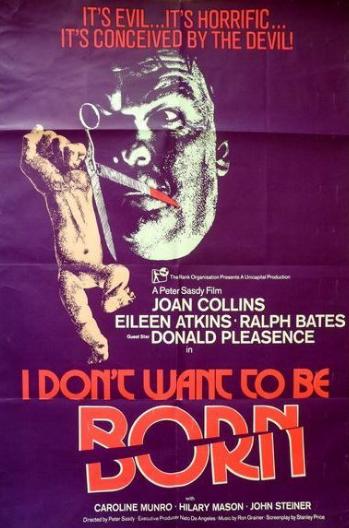
Now, admittedly, that dialogue is never heard in the 1975 British horror film, I Don’t Want To Be Born. However, if I had heard that particularly exchange in this film, I would not have been surprised. That’s just the type of movie that I Don’t Want To Be Born is. It’s a thoroughly ludicrous, totally ridiculous movie and what makes it all the more memorable is that it doesn’t seem to realize how silly it all is. This is a batshit crazy movie that tells its story in the most serious way possible. This damn film is almost somber, it’s so serious.
Lucy (played by Joan Collins) is a stripper who performs her act with a perverted dwarf named Hercules (George Claydon). When Hercules tries to force himself on Lucy, he is tossed out of the club by Tommy (who is played by John Steiner, a good actor who somehow always turned up in movies like this one.) After she and Tommy make love, Lucy is confronted by Hercules who curses her, telling her that she will have a baby “as big as I am small and possessed by the devil himself!”
Oh, Hercules, you weirdo.
9 months later, Lucy’s life has somehow completely changed. She’s no longer a dancer. Now, she’s married to a rich Italian named Gino (played by Ralph Bates, speaking in a bizarre accent). When Lucy has her baby, it’s a long and difficult delivery. The baby is huge! Not only is he huge, but he also has a bad temper and unnaturally sharp nails. The first time that Lucy holds him, he attacks her. Whenever the baby is introduced to anyone new, he responds by biting them. When Tommy drops by to take a look at the baby that might be his son, he ends up with a bloody nose!
But that’s not all this baby can do! Anytime he’s left alone in a room, the room ends up getting destroyed. Eventually, he apparently figures out how to climb trees and how efficiently slip a noose around the neck of anyone who walks underneath him. And don’t think that you can escape this baby simply because you’re taller and faster. One unfortunate person is decapitated, even though he’s standing at the time. How did the baby reach his neck? Who knows?
Does this baby need an exorcism? Lucy’s sister-in-law, Sister Albana (Eileen Atkins), certainly believes that it does! As Lucy thinks about whether the baby’s behavior is in any way odd, she glances over at the baby and — OH MY GOD! The baby has Hercules’s face!
And it just keeps going from there. Again, I feel the need to repeat that this film is meant to be taken very seriously. The script may be full of awkward and clichéd dialogue but most of the cast attempts to act the Hell out of it. Speaking of the cast, there’s a lot of familiar horror people in this one. Along with John Steiner, there’s also Caroline Munro and Donald Pleasence. Those three give performances that somehow manage to remain credible, perhaps because they had the experience necessary to understand what type of movie they were in. But the rest of the cast … you feel bad for them because they’re just trying so hard.
It’s a terrible movie but it’s so weird that I have to recommend that everyone see it once. If for nothing else, see it for the scene where Hercules responds to an attempt to exorcise the baby by swaying drunkenly on the stage. It’s weird and it’s hard for mere words to do it justice.
“No wonder this baby didn’t want to be born!”
That line is also nowhere to be found in this movie. It’d be nice if it was, though.
The 1971 Hammer film Hands of the Ripper tells the story of Anna (Angharad Rees), a woman living in Victorian England who has a few issues.
What type of issues, you may wonder? Well, first off, she’s the daughter of the infamous serial killer known as Jack The Ripper. When she was just a baby, her father killed her mother while Anna watched from her crib. Now, years later, the teenage Anna is working for a fake medium named Mrs. Golding (Dora Bryan). It’s Anna’s job to stand behind the curtain and provide the ghostly voices whenever Mrs. Golding is holding one of her fake seances.
One such séance is attended by both a sleazy member of Parliament named Dysart (Derek Godfrey) and a progressive psychiatrist named Dr. John Pritchard (Eric Porter). When Mrs. Golding’s ruse is discovered, she decides to “give” Anna to Dysart. However, this plan falls apart when Anna suddenly goes crazy, grabs a fireplace poker, and murders Mrs. Golding. Dysart flees the scene, leaving Anna, who claims to have no memory of attacking anyone, with John. Assuming that he can cure her, John takes Anna in and set her up at his house.
Well, it turns out that curing Anna will not be quite as easy as John assumed. For one thing, Anna is extremely repressed and often refuses to open up to him. Also, there’s the fact that Anna keeps killing people. Whenever anyone stands to close to Anna or kisses her on the cheek, Anna goes into a trance and hears her father’s voice demanding that she kill. John, convinced that he can save Anna, continues to cover up every murder.
I really wasn’t expecting much from Hands of the Ripper. In fact, I have to admit that the main reason I dvred it off of TCM was because I thought this might be the film in which Klaus Kinski played Jack the Ripper. I was wrong, of course. The Kinski Jack the Ripper film was called Jack the Ripper and it was directed by Jess Franco. Hands of the Ripper, on the other hand, is a Hammer film that was released in 1971, at a time when Hammer was struggling to stay relevant in an ever-changing cinematic landscape. Perhaps that’s why the murders in Hands of the Ripper were gory, even be the bloody standards of Hammer Films.
Interestingly enough, though the film was made over 40 years ago, the murders themselves remain quite shocking. I can only imagine how audiences in 1971 reacted to them. The scene where Anna suddenly attacks a housekeeper made me flinch, as did a later scene in which one of Anna’s victims stumbled out onto a crowded street, minus an eye. Angharad Rees gave a good performance as Anna, one that keeps you guessing as to whether or not she’s just crazy or if maybe she really is possessed by the spirit of her father.
Hands of the Ripper is a good Hammer film, one that combines the usual Hammer tropes with a bit more psychological depth than one might expect. This is one to keep an eye out for.
Two years after being temporarily destroyed at the end of Dracula Has Risen From The Grave, Dracula returned in 1970’s Taste The Blood of Dracula! Returning in the role and uttering only a handful of lines, Christopher Lee gave one of his most intimidating performances in the role of everyone’s favorite vampire.
Picking up where Dracula Has Risen From The Grave ended, Taste the Blood of Dracula opens with a sleazy merchant named Weller (Roy Kinnear) upsetting his fellow passengers during a carriage ride through Eastern Europe. After they forcefully toss him out of the carriage, Weller comes across a crucifix-impaled Dracula. Weller watches as Dracula dissolves into red dust. Weller gathers up the dust and Dracula’s ring and brooch.
A few months later, the plot picks up with three wealthy men in England. Hargood (Geoffrey Keen), Paxton (Peter Sallis), and Secker (John Carson) pretend to be charitable church goers but, in reality, they spend most of their spare time down at a wonderfully ornate brothel. One night, at the brothel, they meet a disgraced nobleman named Courtley (Ralph Bates), who was disinherited for attempting to hold a black mass. Intrigued by Courtley’s promise to give them an experience that they’ll never forget, the three men agree to purchase Dracula’s blood from Weller.
When they go to meet Courtley in a desecrated church, things suddenly go wrong. Courtley attempts to force the three men to drink from a goblet containing a mix of his and Dracula’s blood. After all three of the men refuse, Courtley himself drinks the blood. The men respond by beating Courtley to death and then fleeing from the church. After the men are gone, Courtley’s dead body transforms into a now living Dracula. Dracula announces that those who have destroyed his servant will now be destroyed themselves.
And he proceeds to do just that, turning the men’s children into vampires and then commanding them to kill their parents. Among those possessed are Alice (Linda Hayden), Hargood’s daughter for whom the film suggests Hargood may have incestuous feelings. Alice is in love with Paul (Anthony Corlan), the son of Paxton. When both Alice and his sister Lucy (Isla Blair) disappear, Paul sets out to find them and instead, comes across Dracula…
Taste the Blood of Dracula features Dracula at his cruelest (which, of course, makes it all the more ironic that his main motivation here is to avenge the death of his servant). Whereas Dracula could probably very easily kill all three of the men himself, his decision to use their children to get his revenge adds a whole new level of horrific ickiness to the film. Fortunately, none of the three men are particularly likable but still, it’s hard not to be disturbed when you’re confronted by the image of a vampirized daughter driving a stake into her own father’s heart.
But then again, that’s a part of the appeal of the old Hammer films, isn’t it? Hammer films actually “go there” in a way that the period’s American horror films would probably never quite dare.
As for Taste the Blood of Dracula, there’s a lot to recommend it. Director Peter Sadsy keeps the action moving, both the sets and the supporting cast are properly baroque, and how can you go wrong with Christopher Lee playing Dracula? Christopher Lee is one of those actors who could do so much with just a glare and the fact that his Dracula says very little only serves to make him all the more intimidating and frightening.
Christopher Lee, of course, has never made a secret of the fact that he didn’t particularly care much for the Hammer Draculas, often complaining that the films failed to stay true to the spirit of Bram Stoker’s conception of the character. Undoubtedly, Lee does have a point and the Hammer Draculas did decline in quality over the years. (Just wait until we get to Dracula A.D. 1972.) But Taste the Blood of Dracula is still a pretty effective vampire film. Hammer’s Dracula may not have been Stoker’s Dracula but, as played by Lee, he still dominates our dreams and nightmares.
“I guess I’m not the only who has had to fuck her way to the top!” — Jerilee Randall (Pia Zadora), accepting an award at The Awards Ceremony in The Lonely Lady (1983)
When I first started doing research on which movies were worthy of being considered for inclusion in this series about embracing the melodrama, I had no idea that it would eventually lead to me watching the worst film ever made.
However, that is exactly what happened. 1983’s The Lonely Lady is without a doubt the worst film that I have ever seen. Normally, this is where I would say that the film is entertaining specifically because it is so bad but no, this movie just terrible. Is it so bad that its good? No, it’s just bad. Is it one of those films that you simply have to see to believe? Well, that depends on how much faith you have in God. Does the film at least have a curiosity value? Well, maybe. As bad as you think this movie may be, it’s even worse.
Seriously, to say this film is a piece of crap is to do a disservice to crap.
The Lonely Lady tells the story of Jerilee Randall (Pia Zadora, who also played the girl martian in the classic Santa Claus Conquers the Martian), an aspiring writer who learns about the dark side of Hollywood. The movie opens with Jerilee graduating from Valley High School and receiving a special prize for being the school’s most promising English major. Now, from the very beginning, we run into several issues. Number one, Pia looks way too old to be in high school and the fact that they decided to put her hair in pig tails doesn’t change the fact. Number two, Pia Zadora is even less convincing as a writer than she was as a girl martian.
At the graduation party, Joe (played by Ray Liotta, of all people) violates Jerilee with a garden hose, in an amazingly ugly scene that pretty much sets the tone for the rest of the film. No longer an innocent optimist, Jerilee moves out to Hollywood where she ends up married to award-winning screenwriter Walter Thornton (Lloyd Bochner). When she secretly helps Walter rewrite his latest script (she replaces a long monologue with two lines of dialogue: “Why!? Why!?”), Walter grows jealous and starts to taunt her by holding up a garden hose. Jerilee and Walter divorce and Jerilee ends up sleeping with everyone else in Hollywood in an attempt to get a screenplay of her own produced. Eventually, this leads to Jerilee having a nervous breakdown in which the keys of her typewriter are replaced with the accusatory faces of everyone in her life…
Bleh! You know what? Describing this plot is probably making The Lonely Lady sound a lot more interesting than it actually is. Imagine if Beyond The Valley Of The Dolls was meant to be taken seriously and you have a pretty good idea what The Lonely Lady is like.
Furthermore, I’ve seen a lot of films that claim to be about writers. Occasionally, we get lucky and the writer is played be an actor who you could actually imagine writing something worth reading. (Perhaps the best recent example would be Paul Dano, who was completely believable as a critically acclaimed writer in Ruby Sparks.) However, most of the time, we end up with actors who you can hardly imagine having the either the discipline or the intellectual ability to write anything worth reading. And then, in the case of The Lonely Lady, we get Pia Zadora who is not only unbelievable as a writer but also as a human being as well. Watching her performance, you’re shocked that she can remember to breathe from minute to minute, much less actually write anything longer than her first name.
I know it’s a pretty big claim to say that one movie is the worst ever made. So, feel free to watch The Lonely Lady and then let me know if you agree.
(Be warned — this movie is NSFW and generally sucks.)
Originally broadcast in the UK on September 27th, 1980, this episode of Hammer House Of Horror deals with a sleazy real estate agent (played by Denholm Elliot) who finds himself besieged by dreams about seducing his assistant Lolly (Lucy Gutteridge) and murdering his wife Emily (Pat Heywood).
Featuring an outstanding lead performance from Elliot and strong direction from Peter Sasdy, this is a good one.





 Through the Shattered Lens