Back to the Beach: MUSCLE BEACH PARTY (AIP 1964)


gary loggins's avatarcracked rear viewer

muscle1

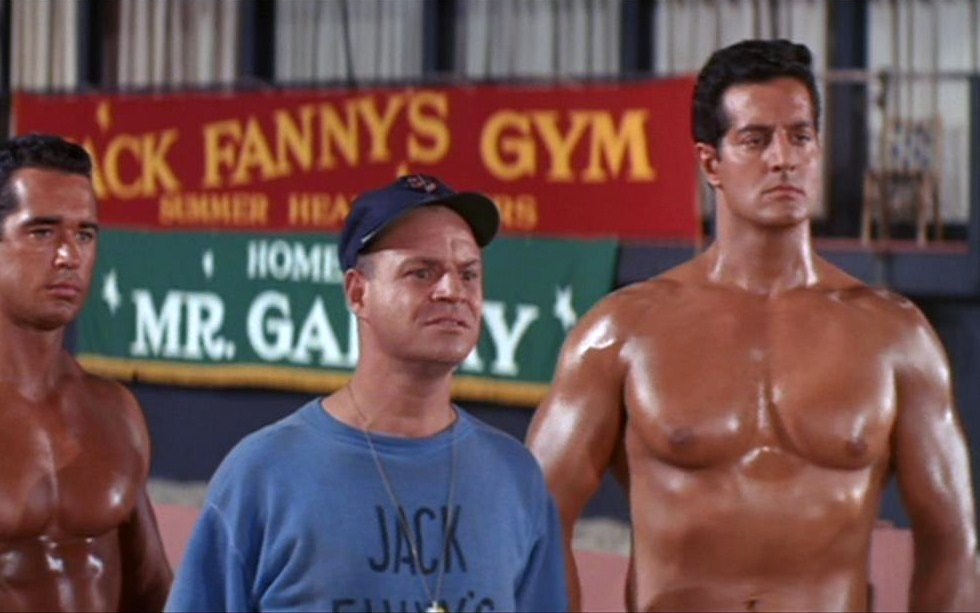
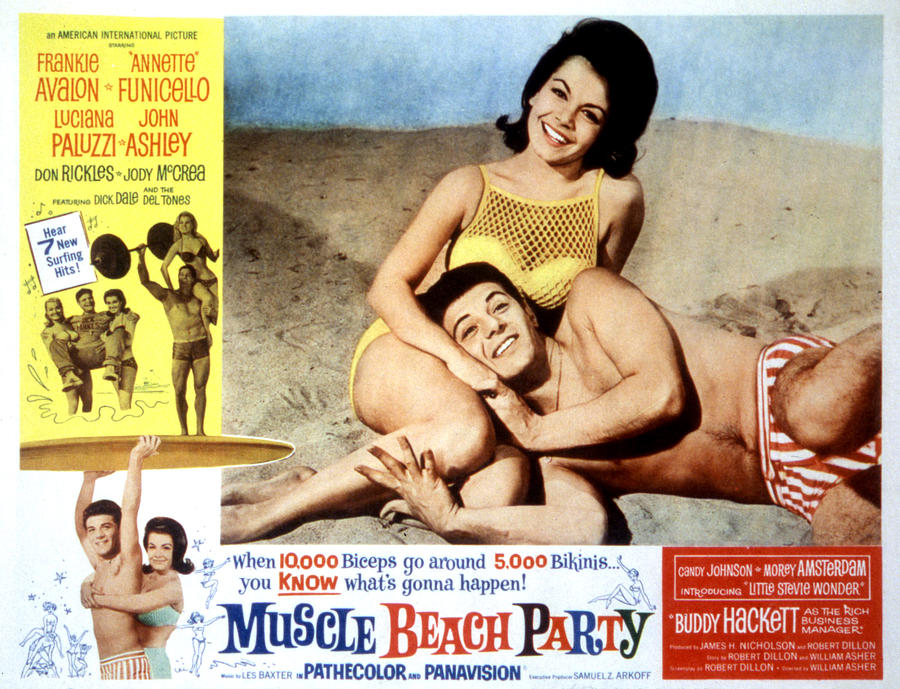
The “Beach Party ” gang’s back and so’s the familiar formula in MUSCLE BEACH PARTY, second in the American-International series. It’s Easter vacation and Frankie Avalon is still horny, Annette Funicello’s still waiting for marriage, and a beautiful foreign woman is again coming between them. This time it’s Lucianna Paluzzi as Countess Julie, a rich heiress who wants to make Frankie a singing star and her personal property.

muscle3

Eric Von Zipper and his Rats aren’t around this time, replaced by a bunch of bodybuilders led by trainer Jack Fanny (the inimitable Don Rickles). Julie first sets her sights on “Mr. Galaxy” Flex Martian, but dumps him when she spies Frankie. This leads to war between the surfers and the musclemen, with the inevitable slapstick melee. Flex is played by Rock Stevens, a real-life bodybuilder who muscled his way through a few Italian peplum films before reverting to his real name of Peter Lupus and…

View original post 338 more words

The Fabulous Forties #18: The Chase (dir by Arthur Ripley)


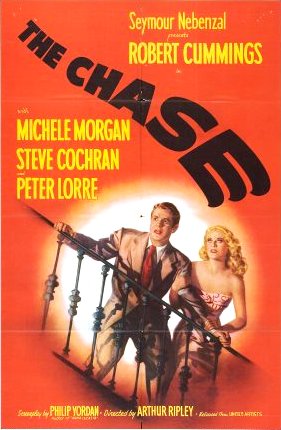
The_Chase_1946_posterThe 18th film in Mill Creek’s Fabulous Forties box set was 1946’s The Chase, which turned out to be a pretty nifty little film noir.  Did I actually just use the word nifty in a film review?  Yes, I did but then again, everyone should use the word “nifty” at least once in their lives.

The Chase tells the story of Chuck Scott (Robert Cummings), whose life is anything but nifty.  When we first meet him, he’s standing outside in the rain, staring into a restaurant, and enviously watching the people eating inside.  Chuck is a returning serviceman.  He helped to win World War II but he’s now returned to a society that has changed in his absence.  He has no money, he has no home, and he suffers from what we would today call PTSD.

Things change for Chuck when he finds the wallet of a man named Eddie Roman (Steve Cochran).  He returns the wallet, discovering that Eddie not only lives in a mansion but he also has a sinister henchman named Gino (Peter Lorre!).  Eddie is so impressed that Chuck returned the wallet and didn’t try to steal any of the money that he offers to put Chuck on the payroll.

Soon, he is working as Eddie’s driver.  Of course, Eddie has an accelerator installed in the backseat, so that he can control how fast the car is going.  Eddie enjoys freaking Chuck out by randomly speeding up the car.  Along with being a spectacularly bad passenger, Eddie also turns out to be a gangster.

When Chuck meets the mysterious Lorna (Michele Morgan), it’s love at first sight but there’s a big problem.  Lorna happens to be married … to Eddie!  Chuck and Lorna flee to Cuba, with Eddie and Gino in pursuit…

Or do they?

Chuck, it turns out, has been suffering from nightmares since he returned from the war.  Often times, he wakes up with amnesia.  Are Eddie, Gino, and Lorna real or are they just figments of Chuck’s dream state?  Is Chuck really living in a film noir or is he just dreaming that he is?

The Chase is an effectively dark little film noir, one that will keep you guessing.  Steve Cochran appears to be having a lot of fun as the cheerfully sociopathic Eddie (and it’s interesting to note that, in the same year as The Chase, Cochran had a supporting role in another film about the struggles of returning servicemen, the Oscar-winning Best Years Of Our Lives) and, of course, Peter Lorre is great as Gino.  Michele Morgan is both sympathetic and enigmatic as Lorna and Robert Cummings does a good job of playing a man who is never quite sure whether he’s awake or he’s asleep.

The Chase is a classic mix of film noir and psychological melodrama.  Watch it below!

Cleaning Out The DVR #25: The Maltese Falcon (dir by John Huston)


(For those following at home, Lisa is attempting to clean out her DVR by watching and reviewing 38 films by this Friday.  Will she make it?  Keep following the site to find out!)

220px-Falconm

I would love to see a remake of The Maltese Falcon with Bill Murray in the role of Sam Spade.  Well, maybe not the Bill Murray of today because he’s getting a little bit too old to play a hard-boiled private detective who is as good with his fists as his brain.  Instead, I’m thinking more of Lost In Translation era Bill Murray, when he was no longer young but could still probably beat up any sniveling punk who came at him with a gun.

Now, that may sound crazy to some but think about it.  Bill Murray is one of the great deadpan snarkers and so is Sam Spade.  Last night, when I watched the famous 1941 version of The Maltese Falcon (the story was filmed twice before, once with Bette Davis as the femme fatale), I was struck by how much of the film really was a comedy.  It may have been a murder mystery that featured death and betrayal and a lot of people getting beaten up but, ultimately, The Maltese Falcon is really about Sam Spade reacting to all of the crazy and strange people around him.  No matter how weird things get, Spade always responds with a smirk and a quip.  It’s a role that, at times, seems to be tailor-made for an actor like Bill Murray.

Bill Murray wasn’t around in 1941 but fortunately, Humphrey Bogart was.  Humphrey Bogart may have grown up wealthy and attended private schools but, on screen, nobody was tougher than Humphrey Bogart and nobody was better at delivering sarcastic, snark-filled dialogue.  After spending years as a villainous supporting actor, Humphrey Bogart got his first starring role when he played Sam Spade in The Maltese Falcon.  His performance, of course, would set the standard by which all future cinematic private eyes would be judged.

And, of course, Spade was tough and he was cynical and he has that wonderful moment at the end of the film where he explains that nobody’s going to make a “sap” out of him.  But for me, Bogart’s best moments come when Spade is alone and thinking.  It’s at those times that Spade suddenly becomes a human being.  A slight smirk comes to his lips, almost as if he’s sharing a private joke with the audience.  You can tell that he’s thinking to himself, “Can you believe how weird my life is?”

And it is indeed a weird life.  The film opens with Spade’s partner, Miles Archer (Jerome Cowan), being murdered.  The police believe that Archer was murdered by a man named Thursby and that Thursby was subsequently murdered by Spade.  Spade, however, suspects that both Archer and Thursby were killed by his latest client, a woman who introduced herself as Ruth Wonderly (Mary Astor).  Except, of course, that’s not her real name.  Her real name is Brigid O’Shaughnessy and, as she admits to Spade, Thursby was her partner.  She claims that Thursby must have murdered Archer but that she doesn’t know who could have possibly killed Thursby.

What’s particularly interesting about all this is that no one really seems to be that upset about Archer’s death.  Spade’s main motivation for investigating the murder is to clear his name and there are several lines of dialogue that reveal how little regard he had for Miles.  In fact, when Archer’s widow (Gladys George) suggests that Spade might be Archer’s killer, you can understand why she might think that.  But then again, that’s the world of The Maltese Falcon.  Only the tough survive.  Getting sentimental or allowing yourself to care is the biggest mistake you can make.

The murders are connected to the hunt for a valuable statue of a bird.  (This is the famous Maltese Falcon of the title.)  As Spade tries to clear his name in the two murders, he also finds himself getting caught up with a strange group of treasure hunters.  There’s the obsequious Joel Cairo (Peter Lorre).  There’s the ruthless “fat man,” Kasper Gutman (Sidney Greenstreet).  And then there’s Wilmer (Elisha Cook, Jr.), Gutman’s young henchman who spends the entire film trying to convince everyone that he’s tougher than he appears.  Wilmer is a born patsy.  Whenever Spade gets annoyed, he beats up Wilmer.  And he usually smiles afterward.

Along with being the directorial debut of John Huston, The Maltese Falcon was also one of the first great film noirs.  It’s one of the most influential films ever made and, even seen today, it’s a lot of fun.  You really can’t go wrong with Bogart, Astor, Greenstreet, Lorre, and Cook all in the same movie.  Bill Murray may never get a chance to play Sam Spade but that’s okay.  Humphrey Bogart’s the only Sam Spade we really need.

The Maltese Falcon was nominated for best picture.  However, it lost to How Green Was My Valley, a film that literally seems to take place in an entirely different universe from The Maltese Falcon.

Steampunk Disney: 20,000 LEAGUES UNDER THE SEA (Walt Disney Productions 1954)


gary loggins's avatarcracked rear viewer

twenty1

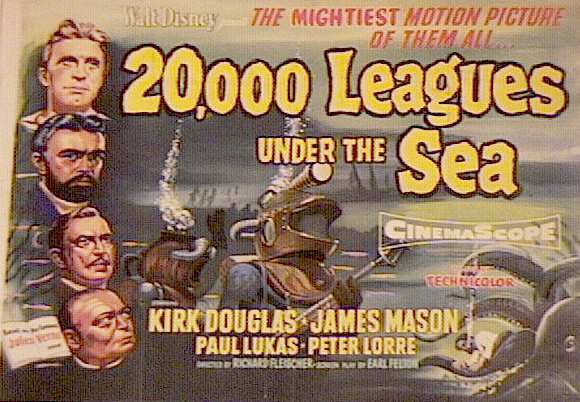
When TCM aired this movie last week, I just had to watch. It was one of my favorites as a kid, and I was curious to see how well it held up with the passage of time. To my delight, 20,000 LEAGUES UNDER THE SEA is even more enjoyable in adulthood, a joyous sci-fi adventure film thanks to the fine cast and the genius of Walt Disney.

twenty2

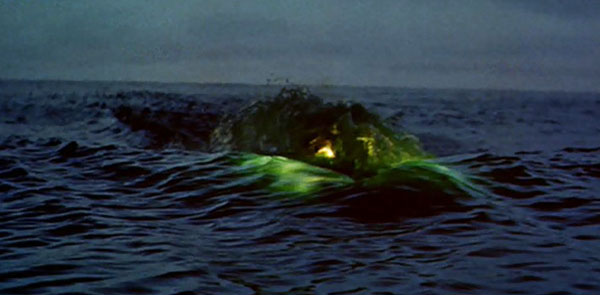
Based on the Jules Verne novel, 20,000 LEAGUES UNDER THE SEA takes us back to 1868, where rumors of a sea monster attacking ships are running rampant. Eminent scientist Professor Aronnax and his protégé’ Counseil are invited to join a voyage to investigate the matter, along with the free-spirited harpoonist Ned Land. They encounter the beast and are shipwrecked, only to discover the monster is actually a fantastic, futuristic submarine, The Nautilus. The sub is commanded by Captain Nemo, who picks up Aronnax, Counseil, and…

View original post 383 more words

Cleaning Out The DVR #5: Around The World In 80 Days (dir by Michael Anderson)


Last night, as a part of my effort to clean out my DVR by watching and reviewing 38 movies in 10 days, I watched the 1956 Best Picture winner, Around The World In 80 Days.

Based on a novel by Jules Verne, Around The World In 80 Days announces, from the start, that it’s going to be a spectacle.  Before it even begins telling its story, it gives us a lengthy prologue in which Edward R. Murrow discusses the importance of the movies and Jules Verne.  He also shows and narrates footage from Georges Méliès’s A Trip To The Moon.  Seen today, the most interesting thing about the prologue (outside of A Trip To The Moon) is the fact that Edward R. Murrow comes across as being such a pompous windbag.  Take that, Goodnight and Good Luck.

Once we finally get done with Murrow assuring us that we’re about to see something incredibly important, we get down to the actual film.  In 1872, an English gentleman named Phileas Fogg (played by David Niven) goes to London’s Reform Club and announces that he can circumnavigate the globe in 80 days.  Four other members of the club bet him 20,000 pounds that he cannot.  Fogg takes them up on their wager and soon, he and his valet, Passepartout (Cantinflas) are racing across the world.

Around The World in 80 Days is basically a travelogue, following Fogg and Passepartout as they stop in various countries and have various Technicolor adventures.  If you’re looking for a serious examination of different cultures, this is not the film to watch.  Despite the pompousness of Murrow’s introduction, this is a pure adventure film and not meant to be taken as much more than pure entertainment.  When Fogg and Passepartout land in Spain, it means flamenco dancing and bullfighting.  When they travel to the U.S., it means cowboys and Indians.  When they stop off in India, it means that they have to rescue Princess Aouda (Shirley MacClaine!!!) from being sacrificed.  Aouda ends up joining them for the rest of their journey.

Also following them is Insepctor Fix (Robert Newton), who is convinced that Fogg is a bank robber.  Fix follows them across the world, just waiting for his chance to arrest Fogg and disrupt his race across the globe.

But it’s not just Inspector Fix who is on the look out for the world travelers.  Around The World In 80 Days is full of cameos, with every valet, sailor, policeman, and innocent bystander played by a celebrity.  (If the movie were made today, Kim Kardashian and Chelsea Handler would show up at the bullfight.)  I watch a lot of old movies so I recognized some of the star cameos.  For instance, it was impossible not to notice Marlene Dietrich hanging out in the old west saloon, Frank Sinatra playing piano or Peter Lorre wandering around the cruise ship.  But I have to admit that I missed quite a few of the cameos, much as how a viewer 60 years in the future probably wouldn’t recognize Kim K or Chelsea Handler in our hypothetical 2016 remake.  However, I could tell whenever someone famous showed up on screen because the camera would often linger on them and the celeb would often look straight at the audience with a “It’s me!” look on their face.

Around The World in 80 Days is usually dismissed as one of the lesser best picture winners and it’s true that it is an extremely long movie, one which doesn’t necessarily add up to much beyond David Niven, Cantinflas, and the celeb cameos.  But, while it may not be Oscar worthy, it is a likable movie.  David Niven is always fun to watch and he and Cantinflas have a nice rapport.  Shirley MacClaine is not exactly believable as an Indian princess but it’s still interesting to see her when she was young and just starting her film career.

Add to that, Around The World In 80 Days features Jose Greco in this scene:

Around The World In 80 Days may not rank with the greatest films ever made but it’s still an entertaining artifact of its time.  Whenever you sit through one of today’s multi-billion dollar cinematic spectacles, remember that you’re watching one of the descendants of Around The World In 80 Days.

Insomnia File #1: The Story of Mankind (dir by Irwin Allen)


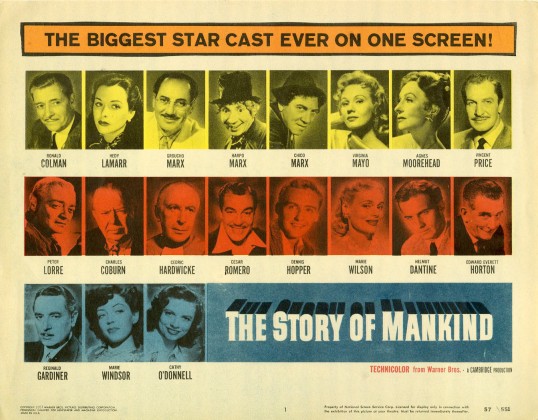
Story of Mankind

What’s an Insomnia File?  You know how some times you just can’t get any sleep and, at about three in the morning, you’ll find yourself watching whatever you can find on cable?  This feature is all about those insomnia-inspired discoveries!

If, last night, you were suffering from insomnia at 3 in the morning, you could have turned on TCM and watched the 1957 faux epic, The Story of Mankind.

I call The Story of Mankind a faux epic because it’s an outwardly big film that turns out to be remarkably small on closer inspection.  First off, it claims to the tell the story of Mankind but it only has a running time of 100 minutes so, as you can imagine, a lot of the story gets left out.  (I was annoyed that neither my favorite social reformer, Victoria C. Woodhull, nor my favorite president, Rutherford B. Hayes, made an appearance.)  It’s a film that follow Vincent Price and Ronald Colman as they stroll through history but it turns out that “history” is largely made up of stock footage taken from other movies.  The film’s cast is full of actors who will be familiar to lovers of classic cinema and yet, few of them really have more than a few minutes of screen time.  In fact, it only takes a little bit of research on the imdb to discover that most of the film’s cast was made up of performers who were on the verge of ending their careers.

The Story of Mankind opens with two angels noticing that mankind has apparently invented the “Super H-Bomb,” ten years ahead of schedule.  It appears that mankind is on the verge of destroying itself and soon, both Heaven and Hell will be full of new arrivals.  One of the angels exclaims that there’s already a housing shortage!

A celestial court, overseen by a stern judge (Cedric Hardwicke) is convened in outer space.  The court must decide whether to intervene and prevent mankind from destroying itself.  Speaking on behalf on humanity is the Spirit of Man.  The Spirit of Man is played by Ronald Colman.  This was Colman’s final film.  In his heyday, he was such a popular star that he was Margaret Mitchell’s first choice to play Rhett Butler in Gone With The Wind.  However, in The Story of Mankind, Colman comes across as being a bit bored with it all and you start to get worried that he might not be the best attorney that mankind could have hired.

Even more worrisome, as  far as the future of mankind is concerned, is that the prosecutor, Mr. Scratch, is being played by Vincent Price.  Making his case with his trademark theatrics and delivering every snaky line with a self-satisfied yet likable smirk on his face, Vincent Price is so much fun to watch that it was impossible not to agree with him.  Destroy mankind, Mr. Scratch?  Sure, why not?  Mankind had a good run, after all…

In order to make their cases, Mr. Scratch and the Spirit of Man take a tour through history.  Mr. Scratch reminds us of villains like the Egyptian pharaoh Khufu (John Carradine) and the Roman Emperor Nero (Peter Lorre, of course).  He shows how Joan of Arc (Hedy Lamarr) was burned at the stake.  The Spirit of Man argues that, despite all of that, man is still capable of doing good things, like inventing the printing press.

And really, the whole point of the film is to see who is playing which historical figure.  The film features a huge cast of classic film actors.  If you watch TCM on a semi-regular basis, you’ll recognize a good deal of the cast.  The fun comes from seeing who tried to give a memorable performance and who just showed up to collect a paycheck.  For instance, a very young Dennis Hopper gives a bizarre method interpretation of Napoleon and it’s one of those things that simply has to be seen.

And then the Marx Brothers show up!

They don’t share any scenes together, unfortunately.  But three of them are present!  (No, Zeppo does not make an appearance but I imagine that’s just because Jim Ameche was already cast in the role of Alexander Graham Bell.)  Chico is a monk who tells Christopher Columbus not to waste his time looking for a quicker way to reach India.  Harpo Marx is Sir Isaac Newton, who plays a harp and discovers gravity when a hundred apples smash down on his head.  And Groucho Marx plays Peter Miniut, tricking a Native American chief into selling Manhattan Island while leering at the chief’s daughter.

And the good thing about the Marx Brothers is that their presence makes a strong argument that humanity deserves another chance.  A world that produced the Marx Brothers can’t be all bad, right?

Anyway, Story of Mankind is one of those films that seems like it would be a good cure for insomnia but then you start watching it and it’s just such a weird movie that you simply have to watch it all the way to the end.  It’s not a good movie but it is flamboyantly bad and, as a result, everyone should see it at least once.


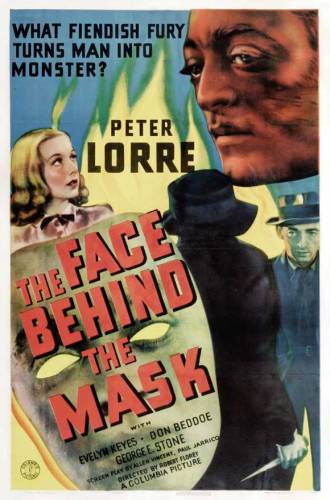
Revisiting an Old Fiend: THE FACE BEHIND THE MASK


the-face-behind-the-mask-1941-dvd-peter-lorre-evelyn-keyes-1189-p

Recently I switched from cable to DirecTV. As part of my package, I’ve officially joined the DVR generation. This is like being in heaven for an old movie buff like myself. Now I can record films of interest no matter what time they’re on and enjoy them at my leisure. Especially those older black & white gems that air mainly in the wee-wee hours. I can catch up with some classics I’ve only read about over the years but never had the opportunity to view, and those I only have vague memories of watching decades ago on snowy looking UHF channels.

THE FACE BEHIND THE MASK falls into the latter category. This 1941 Columbia film was directed by the criminally underrated Frenchman Robert Florey and stars everybody’s favorite madman Peter Lorre. The movie’s a very early example of 40s film noir, as was another Lorre vehicle, 1940’s  STRANGER ON THE THIRD FLOOR.

Lorre plays Janos Szabo, a newly arrived Hungarian immigrant watchmaker, come to America to find work and live the American dream. He’s befriended by police Lt. O’Hara (Don Beddoe), who buys the naïve newcomer a five dollar lunch and directs him to the Excelsior Palace, a low rent hotel. When another border’s negligence causes the joint to go up in flames, Janos is trapped inside, and suffers a horrible disfigurement.

O’Hara feels responsible for the poor guy’s plight and writes a message on one of his calling cards for Janos to contact him when he’s released from the hospital. Now unable to find work due to his terribly scarred visage, Janos goes to the waterfront, contemplating suicide. He meets up with a petty crook named Dinky, who takes a liking to Janos. Dinky has a safe job lined up but falls ill, and asks Janos to take his place. The Hungarian, good with his hands, takes care of business, When Dinky’s former comrades Benson and Watts show up wanting to know why they weren’t in on the score, the four decide to form a crime gang, with Janos (now nicknamed Johnny) as the ringleader. A crime wave ensues, baffling the police, and putting O’Hara under pressure to end the larcenous spree quickly as possible.

Janos wants the illicit dough so he can have plastic surgery and restore his features. A rubber mask is made from his passport photo for him to wear until the doctor returns. When the doc (an uncredited cameo by Frank Reicher, KING KONG’s Captain Englehorn)  finally does see Janos, he informs him that the facial nerves have suffered too much damage, and it would take fifteen years before any progress could be made!

Disheartened, Janos leaves the doctor’s office, where he (literally) bumps into Helen Williams. Helen is blind, but she can sense the goodness still inside the scarred master criminal. Eventually, Janos comes clean to her about his face, but not his illegal activities. Helen is played by the beautiful Evelyn Keyes, best known as Scarlet O’Hara’s Younger Sister (the name of her autobiography) in GONE WITH THE WIND.

Now in love with Helen, and with plenty of money stashed away, Janos decides to leave his life of crime behind and settle down in the country. This doesn’t sit well with his former cronies, especially Jeff, the gang’s new leader. When the cop’s calling card (remember?) is found in Janos’s old desk, they fear their former boss has turned stool pigeon. The gang beats and tortures Dinky, the only one who knows Janos’s whereabouts. Dinky spills the beans, and Jeff and company pay a visit to Janos and his new bride. While Jeff delivers a warning, the gang plants a bomb in his car, connected to the radio. Dinky gets dumped to the side of the road, badly beaten and shot, but manages to get to a phone and warn Janos. But it’s too late. While Helen’s unpacking the car, she wants to hear some music, turns on the radio, and KA-BOOM! She sadly dies in Janos’s arms.

Dinky’s still alive though, and tells Janos the gang has chartered a plane and are going on the lam. They take to the air and head west, unaware that Janos has ambushed the pilot and is flying the plane. He lands them smack in the middle of the Arizona desert and tells them he’s stranding them all there to die a slow, painful death. Soon after, O’Hara gets a hot tip (pun intended!)and flies west to discover a gruesome tableau. The gang members are all dead, including Janos, who’s been tied to the plane’s wing. O’Hara finds an explanation note in his little friend’s pocket, along with the five bucks for the lunch O’Hara bought him long ago.

Lorre is superb as a man trapped in circumstances beyond his control, showing a wider range of emotion beyond his standard pop-eyed psychopath roles. Keyes is also good as the doomed Helen, proving she could’ve been a much bigger star with better roles. FACE BEHIND THE MASK features plenty of familiar faces from the Mighty Columbia Arts Players brigade (Beddoe, George E Stone, Cy Schindell, John Tyrell, George McKay). The film’s a brisk 75 minutes of entertainment for lovers of 40s cinema in general, and Lorre in particular. The name Janos, by the way, was obviously inspired from the Roman god Janus, always depicted with two faces!

I’m glad I got to rewatch this movie and enjoy it without all that UHF snow.. I’ve got plenty more lined up in the DVR, and look forward to sharing my impressions of them with you, dear reader. So get that popcorn ready and let’s go to the show!

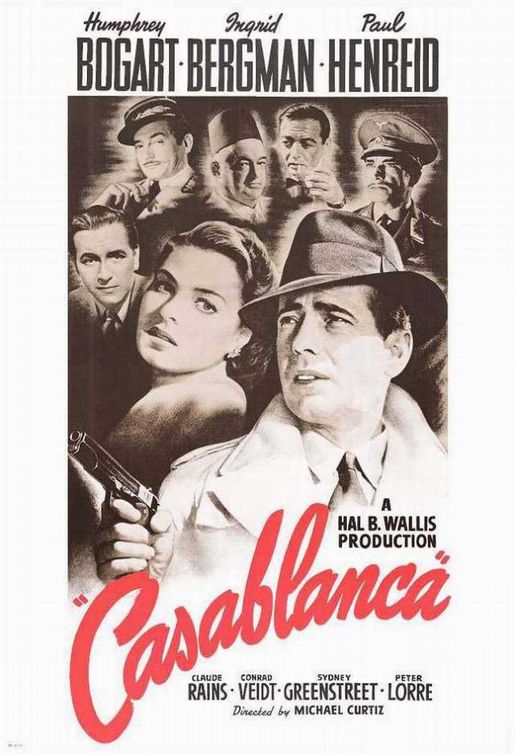
Embracing the Melodrama Part II #15: Casablanca (dir by Michael Curtiz)


CasablancaPoster-Gold

(This review contains spoilers but seriously, you should know all of this already.)

Is there anything left to be said about Casablanca?

Probably not.

As a film reviewer, I’m not supposed to admit that.  I’m supposed to come up with some sort of new, out-of-nowhere, batshit crazy way to look at Casablanca.  I’m supposed to argue that Rick was actually meant to be a survivor of abuse or that Victor Laszlo was some sort of precursor to President Obama or something.  Or, if that doesn’t work, I’m supposed to intentionally troll everyone by writing something like, “10 reasons why Casablanca is overrated” or “I hate Casablanca and I don’t care who knows it!”

But I’m not going to do that.

The fact of the matter is that Casablanca is as good a film as everyone says it is.  It is a film that everyone should see.  It is a film that quite rightfully was named best picture of 1943.  It deserves to be celebrated.  It deserves to be seen.  In fact, stop reading this review right now and go watch it.  Don’t let me waste another second of your time.

The thing with Casablanca is that it’s such an iconic film that everyone knows what happens, regardless of whether they’ve actually watched the entire film or not.  They know that the film takes place in Casablanca during World War II.  They know that Casablanca is full of refugees, spies, and people who are hiding from their past.  They know that Casablanca is policed by the charmingly corrupt Capt. Louis Renault (Claude Rains).  They know that Major Strasser (Conrad Veidt) is the Nazi in charge.  (I nearly said that Strasser was the “evil Nazi in charge” but when you identify someone as a Nazi, is it really necessary to add that they’re evil?)  They know that Rick (Humphrey Bogart) is the American expatriate who owns Rick’s Cafe Americain and that everyone comes to Rick’s.  They know that Rick’s slogan is that he doesn’t stick his neck out for anyone but they also know that his cynicism hides the fact that he’s still in love with Ilsa (Ingrid Bergman).  They know that when Ilsa shows up at Rick’s and needs him to help her husband, Victor Laszlo (Paul Henreid), escape from Occupied Europe, Rick is forced to decide whether or not to get involved in the resistance.

And, whether you’ve seen the film or not, you know that it all ends on a foggy airstrip.  Ilsa wants to stay in Casablanca with Rick but Rick tells her that she has to get on the plane with Laszlo because, if she doesn’t, she’ll regret it.  Ilsa goes with Laszlo, leaving Rick behind.

And it may have been the right thing to do but how many viewers would have done the same if they had been in Ilsa’s high heels?  Throughout the entire movie, we hear about how wonderful Laszlo is but, whenever he actually shows up on screen, it’s always a little bit surprising to discover just how boring a character Victor Laszlo really is.  Unlike the troubled and deceptively cynical Rick, there’s not much going on underneath the surface with Laszlo.  Just as Rick overshadows Laszlo, Bogart’s performance overshadows Paul Henreid’s.  Bogart and Bergman have all the chemistry and the charisma.  Henreid, on the other hand, comes across as stiff and a little dull.  But, as the film suggests, World War II was not a time for self-doubt and self-interest.  World War II was a time when the world needed straight-forward, determined men like Victor Laszlo.

And, if the world needed Laszlo and Laszlo needed Ilsa, then that meant Ilsa had to get on that plane.

That said, I’ve always liked to think that Ilsa ended up leaving Laszlo in 1945 and immediately made her way back to Morocco.  Rick and Ilsa belonged together.

But until Ilsa comes back, Rick has his friendship with Renault.  “Louis,” he says, “I think this is the beginning of a beautiful friendship.”  Did Bogart realize, when he delivered that line, that literally thousands of people would be repeating it decades later?  Bogart’s performance is probably one of the most imitated performances of all time.  Anyone who sees Casablanca thinks that they can talk about gin joints and hills of beans in Bogart’s trademark style.  Of course, they can’t and it’s a testament to the power of Bogart’s performance that it remains effective even after being endlessly imitated.

On Valentine’s Day of 2014, I saw Casablanca at the Alamo Drafthouse in Austin.  It was an amazing and romantic experience.  See Casablanca on the big screen.  It’ll make you love life and bring life to your love.

Needless to say, Casablanca is an intimidating film to review.  So, I’ll just say this: Casablanca is even better than you think it is.  If you haven’t seen it, go watch it.  If you have seen it, go watch it again.

Just resist the temptation to say, “Play it again, Sam,” in your best Bogart-like voice.

Because, seriously, Rick never actually says that line.

Horror on the Lens: The Boogie Man Will Get You (dir by Lew Landers)


Today’s horror on the lens is a short horror comedy from 1942.  In The Boogie Man Will Get You, Winnie Slade (Miss Jeff Donnell) buys an old house from Prof. Billings (Boris Karloff) with plans to covert it into a hotel.  However, one of the conditions of the sale is that Prof. Billings and his servants be allowed to live on the property.  What Winnie doesn’t know is that Prof. Billings had been conducting experiments on traveling salesman.  He hopes to turn them into supermen who can then be sent overseas to fight the Nazis.  (Kind of like Capt. America, when you think about it…)  However, his experiments have yet to be successful and have mostly just resulted into a lot of salesman being buried out in the rose garden…

However, things start to look up for Prof. Billings when he meets Dr. Lorencz (Peter Lorre), who is not only a doctor but also a mayor, sheriff, and dog catcher.  Seriously, Dr. Lorencz can do it all….

The Boogie Man Will Get You is a fun little time capsule of the time in which it was made.  For horror fans, it is mostly interesting because it features both Boris Karloff and Peter Lorre.  Both Karloff and Lorre appear to be having a lot of fun parodying their usual screen images.

Enjoy!

The Name’s Bond, Jimmy Bond: Casino Royale (1954)


Hi there!  On November 9th (which just happens to be my birthday, by the way), the latest James Bond film will opening here in the States.  The early reviews of Skyfall have been nothing sort of amazing, with several critics declaring it to be the best Bond film ever.  Well, time will tell.  The fact of the matter is that many of those same critics said the exact same thing about Quantum of Solace before it was actually released.

That said, the James Bond franchise seems to be one of the few things that everyone on this planet has in common.  It seems that everyone has seen (and loved) at least one Bond film.  There’s a reason why Skyfall is going to be the number one film in the world despite having a totally generic title.  For over 50 years, people have loved Bond.

Here at the Shattered Lens, we’re observing the 50th anniversary of the James Bond franchise by reviewing every single James Bond film that’s ever been made.  In the days leading up to the American release of Skyfall, we’ll be taking a look at every single adventure that the cinematic James Bond has had.  Everything from the good to the bad to the ugly.

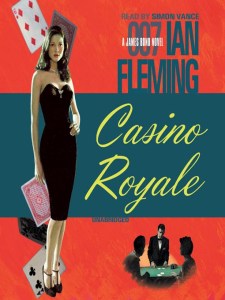
Everyone knows that Sean Connery made his debut of James Bond in 1962’s Dr. No but what they may not know is that Sean Connery was not the first actor to play James Bond.  James Bond made his first appearance 8 years earlier when an American television show called Climax! presented a 48-minute adaptation of Ian Fleming’s first Bond novel, Casino Royale.

In this version of Climax!, James Bond was known as Jimmy Bond and he was about as American as you can get.  (Felix Leiter, meanwhile, was now English and named Clarence Leiter).  Jimmy Bond was played by Barry Nelson, an actor who is probably best known for playing the blandly friendly hotel manager in Stanley Kubrick’s The ShiningCasino Royale’s villain, Le Chiffre, was played by none other than Peter Lorre.

This version of Casino Royale was initially meant to serve as a pilot for a weekly television series but, perhaps fortunately, the Climax version of Casino Royale didn’t get much attention when it was originally aired.  According to Sinclair McKay’s authoritative Bond book, The Man With The Golden Touch, this version of Casino Royale was forgotten about until a copy of it was discovered in the 1980s.  By that time, of course, everyone knew that James Bond was English and that Felix Leiter was American.

Thanks to YouTube, I’ve seen the Climax! Casino Royale and it’s a curiosity.  If Dr. No hadn’t launched the James Bond film franchise, there would be little reason to watch this version of Casino Royale.  It moves a bit slowly, is way too stagey, and it reveals that, contrary to what we’ve all heard, live television was not always the greatest thing on the planet.  Not surprisingly, this adaptation contains none of the brutality or the moral ambiguity that makes Fleming’s novel such a fun read.  American television audiences would not see Jimmy Bond strapped naked to a chair and an American television show would never end with the hero saying, “The bitch is dead.”  The best you can say about this version of Casino Royale is that Peter Lorre makes for a good villain (in fact, of the three versions of Casino Royale, the television version is the only one to feature an effective Le Chiffre) and Barry Nelson would have made a good Felix Leiter.

That said, I still find the television version of Casino Royale to be fascinating from a historical point of view.  This is the type of show that you watch for curiosity value.  This is the type of show that you watch so that you can think about how different things could have been.

So, presented for your viewing pleasure, here’s the original version of Casino Royale:

Coming tomorrow: The James Bond film franchise gets off to its proper start with … Dr. No!