For today’s horror on the lens, we have The Beast Must Die. In this 1974 film, millionaire Tom Newcliffe (Calvin Lockhart) invites a group of people to spend the weekend at his mansion. Tom explains that one of them is a werewolf and therefore “must die.”
But who is the werewolf? Tom has come up with several werewolf tests but, actually, it turns out that the easiest way to discover the identity of the werewolf is to just let the werewolf kill everyone who isn’t a werewolf. Or, at least, that’s the way it seems to me.
The best thing about The Beast Must Die is that it features a 30-second werewolf break where the audience is encouraged to announce who they think the werewolf is before the actual solution is revealed!
Seriously, many movies would be greatly improved with a werewolf break.
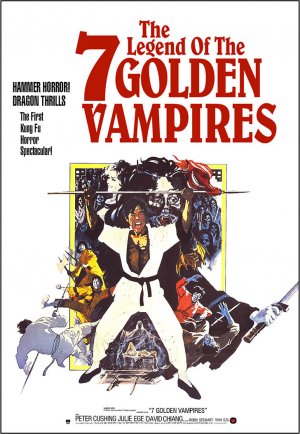
As some of our more frequent readers may remember, I shared the 1974 Dracula-martial arts hybrid The Legend of the 7 Golden Vampires as one of our horrors on the lens last October. Judging from the comments that I got last year, this was apparently one of the more popular films that we featured.
And why not? The film is one of those rather ludicrous movies that really could have only been made in the early 1970s. It combines two genres that really should not go together — martial arts and the Hammer Dracula series — and somehow, it all works. Don’t get me wrong. The film doesn’t make a bit of sense. I’ve seen it a few times and I still have a hard time following just what exactly is going on. But you don’t watch a film called The Legend of the 7 Golden Vampires for the plot. This is one of those movies that you watch for the style. Fortunately, The Legend of the 7 Golden Vampires is all about style.
The Legend of the 7 Golden Vampires is the final entry in Hammer’s Dracula series. Or, at least, it might be. It all depends on whether or not you consider 7 Golden Vampires to actually be a part of the series. I do but quite a few people don’t.
Why the controversy?
Well, first off, Christopher Lee does not appear in this film. Much as he did with Brides of Dracula, Lee read the script and announced that he would not be returning to play Dracula. Of course, when Lee refused to appear in Brides of Dracula, Hammer responded by creating an entirely new vampire for Prof. Van Helsing to battle. This time, however, they simply recast the role. An actor by the name of John Forbes-Robertson took on the role of Dracula and, unfortunately, he gave a rather bland and unmemorable performance. If Lee’s Dracula seemed to be motivated by rage, Forbes-Robertson is merely petulant.
The other issue that purists have with the film is that it violates the continuity of the previous Dracula films. The film opens in 1805 and features Dracula leaving his castle for China, where he will spend the next 100 years as the leader of the infamous 7 Golden Vampires. The problem with this, of course, is that there had already been 7 other films that established that Dracula spent the 19th Century going between England and Eastern Europe.
It would be easy to declare that 7 Golden Vampires has nothing to do with the other Hammer Films except for the fact that Peter Cushing returns of Prof. Van Helsing. When the film opens, Van Helsing is in China, lecturing to skeptical students about the legend of the 7 Golden Vampires. After one lecture, Van Helsing is approached by a man (David Chiang), who explains that the 7 Golden Vampires have been attacking his village. Van Helsing agrees to help the man vanquish the 7 Golden Vampires and, along the way to the village, he even tells some stories about his previous battles with Dracula.
So, here’s my theory. The Legend of the 7 Golden Vampires does take place in the same continuity as the Christopher Lee Dracula films but I do not believe that the vampire played by Forbes-Robertson is actually Dracula. I think he’s just an upstart who has claimed the infamous name while the actual Dracula is inconvenienced.
As for the film itself, it works far better than you might expect. At the time 7 Golden Vampires went into production, Hammer was struggling to survive with their once racy products now seen as being rather tame when compared to what other studios were releasing. 7 Golden Vampires was a co-production between Hammer and the Shaw Brothers, which means that the film was full all of the gothic trappings that I love about Hammer while also featuring all of the martial arts action that fans of the Shaw Brothers would have expected. It’s an odd combination that works exactly because it is so unexpected.
Finally, one word about the 7 Golden Vampires. Not only are they far more desiccated than the average Hammer vampire but whenever they ride up on their horses, they’re filmed in slow motion, just like the zombies from Amando De Ossorio’s Blind Dead films. As a result, those 7 Golden Vampires are pure nightmare fuel.
The Legend of the 7 Golden Vampires may have been the final entry in Hammer’s Dracula franchise but at least the series went out on a memorable note.
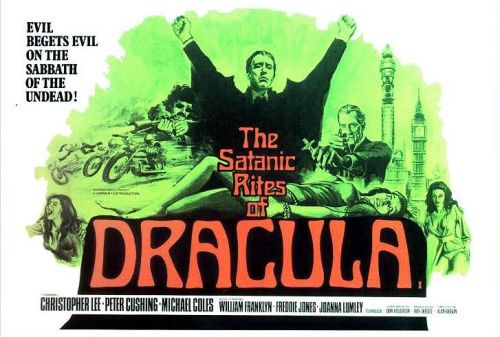
First released in 1973 and, like Dracula A.D. 1972, set in what was then the present day, The Satanic Rites of Dracula was the 8th entry in the Hammer Dracula series. It was also the last to feature Christopher Lee in the role of Dracula and that perhaps is why, judging by some of the other reviews that I’ve read online, The Satanic Rites is one of the more reviled entries in the series.
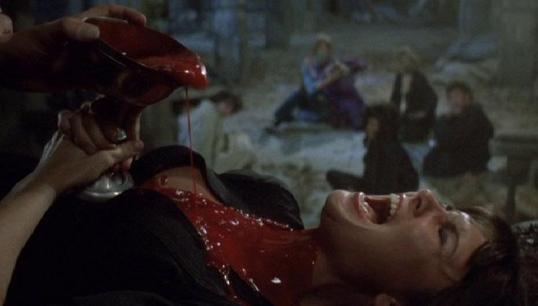
Judging from a lot of those reviews, the attitude seems to be that The Satanic Rites of Dracula was so bad that it was the film that made Christopher Lee say, “No more!” Reportedly, Lee felt that the film itself was both poorly written and that it was too violent. And, even though the film is rather tame by the standards of today’s horror films, The Satanic Rites is still probably one of the more extreme entries in the series. The film features a graphic and drawn-out flashback in which we see a naked woman sacrificed by a Satanic cult, a scene that’s bloody even by the standards of Hammer. Later, when Jessica Van Helsing (played by Joanna Lumley, who took the role over from Dracula A.D. 1972‘s Stephanie Beacham) is menaced by a pack of female vampires, the vampires literally claw at her body like wild animals. And finally, when one of Dracula’s brides is staked, blood literally splashes across the screen.
Christopher Lee was not a fan of The Satanic Rites of Dracula and neither are a lot of critics but you know what? I think The Satanic Rites of Dracula is actually rather underrated. If nothing else, it’s certainly far more unpredictable than some of the far more critically embraced Dracula films.
Satanic Rites opens with a British secret agent (Maurice O’Connell) escaping from a country house in which he had previously been held prisoner. Though he’s fatally wounded during the escape, the agent manages to tell his superiors that, at the house, he witnessed a Satanic ritual that involved some of the most important people in the British government. Since one of the accused occultists is a government minister, the secret service passes the case on to Scotland Yard’s Inspector Murray (Michael Coles, reprising his role from Dracula A.D. 1972) and then provide him with clandestine assistance. (Or something like that. To be honest, I get the feeling that the main reason Murray was called in was to maintain some continuity between Dracula A.D. 1972 and The Satanic Rites of Dracula.) Murray suspects that vampires may be involved so he calls in Lorrimar Van Helsing (Peter Cushing).
After discovering that his old friend, scientist Julian Keeley (Freddie Jones), is a part of the cult, Van Helsing deduces that it’s all part of huge conspiracy headed by none other than Dracula himself. The plan is to release a mutated form of bubonic plague and wipe out humanity.
Why is Dracula planning on destroying humanity?
Van Helsing theorizes that this might be Dracula’s way of committing suicide. By wiping out humanity, Dracula will no longer have anyone to feed upon and his undead existence will finally end. And, if nothing else, you have to admit that is a pretty interesting motivation!
How can you not enjoy a film that’s as strange as The Satanic Rites of Dracula? It may not be a typical Hammer Dracula film and it may be a bit too obviously an attempt to revitalize a fading franchise by tossing everything that was then trendy at it but so what? This is one of those movies that could have only been made at a certain point in time by a certain group of filmmakers and, as such, it’s valuable as both history and entertainment.
Christopher Lee may have hated The Satanic Rites of Dracula but he’s being way too hard on the film. If nothing else, it provided a nice excuse for Christopher Lee and Peter Cushing to face off and how can you not appreciate that?
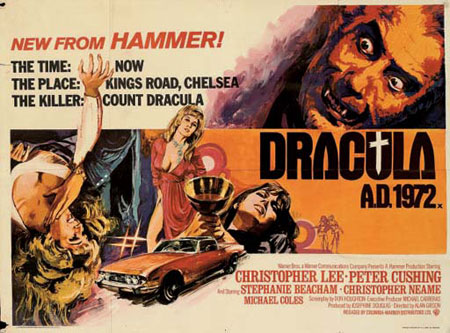
Dracula A.D. 1972 opens in 1872 with a genuinely exciting fight on a runaway carriage that ends with the death of both Count Dracula (Christopher Lee) and his nemesis, Prof. Van Helsing (Peter Cushing). However, as Van Helsing is buried, we see one of Dracula’s disciples (played by Christopher Neame, who had an appealingly off-kilter smile) burying Dracula’s ashes nearby. The camera pans up to the clear Victorian sky and, in a sudden and genuinely effective jumpcut, we suddenly see an airplane screeching across the sky.
Well, it’s all pretty much downhill from there. Suddenly, we discover that a hundred years have passed and we are now in “swinging” London. The city is full of red tourist buses, hippies wearing love beads, and upright policemen who always appear to be on the verge of saying, “What’s all this, then?” We are introduced to a group of hippies that are led by a creepy guy named Johnny Alculard (also played — quite well, actually — by Christopher Neame). One of those hippies (Stephanie Beacham) just happens to be the great-great-granddaughter of Prof. Van Helsing. Apparently, she’s not really big on the family history because she doesn’t notice that Alculard spells Dracula backwards. Then again, her father (played by Peter Cushing, of course) doesn’t either until he actually writes the name down a few times on a piece of a paper.
Anyway, the film meanders about a bit until finally, Alculard convinces all of his hippie friends to come take part in a black mass. “Sure, why not?” everyone replies. Well, I don’t have to tell you how things can sometimes get out-of-hand at black mass. In this case, Dracula comes back to life, kills a young Caroline Munro, and eventually turns Johnny into a vampire before then setting his sights on the modern-day Van Helsings.
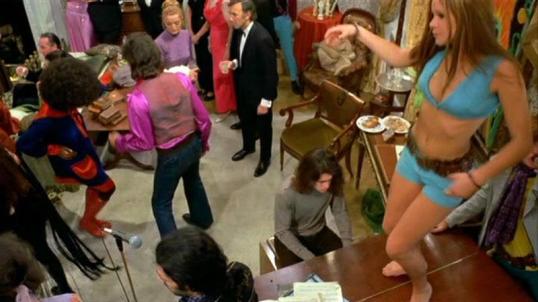
Dracula A.D. 1972 was Hammer’s attempt to breathe some new life into one of its oldest franchises and, as usually happens with a reboot, its critical and (especially) commercial failure ended up helping to end the series. Among even the most devoted and forgiving of Hammer fans, Dracula A.D. 1972 has a terrible reputation. Christopher Lee is on record as regarding it as his least favorite Dracula film. And the film definitely has some serious flaws. Once you get past the relatively exciting pre-credits sequence, the movie seriously drags. There’s a hippie party sequence that, honest to God, seems to last for about 5 hours. As for the hippies themselves, they are some of the least convincing middle-aged hippies in the history of fake hippies. You find yourself eagerly awaiting their demise, especially the awkward-looking one who — for some reason — is always dressed like a monk. (Those crazy hippies!) But yet…nothing happens. All the fake hippies simply vanish from the film. Yet, they’re so annoying in just a limited amount of screen time that the viewer is left demanding blood. Add to that, just how difficult is it to notice that Alculard is Dracula spelled backwards? I mean, seriously…
To a large extent, the charm of the old school Hammer films comes from the fact that they’re essentially very naughty but never truly decadent. At their heart, they were always very old-fashioned and actually quite conservative. The Hammer films — erudite yet campy, risqué yet repressed — mirrors the view that many of my fellow Americans have of the English. For some reason, however, that Hammer naughtiness only works when there’s the sound of hooves on cobblestone streets and when the screen is populated by actors in three-piece suits and actresses spilling out of corsets. Dracula A.D. 1972 did away with the support of the corset and as a result, the film is revealed as a formless mess with all the flab revealed to the world.
Still, the film isn’t quite as bad as you may have heard. First off, the film — with its middle-aged hippies — has a lot of camp appeal. It’s the type of film that, once its over, you’re convinced that the term “groovy” was uttered in every other scene even though it wasn’t. As with even the worst Hammer films, the film features a handful of striking images and Christopher Neame is surprisingly charismatic as Alculard.
As with the majority of the Hammer Dracula films, the film is enjoyable if just to watch the chemistry between Christopher Lee and Peter Cushing. Both of these actors — so very different in image but also so very stereotypically English — obviously loved acting opposite of each other and whenever you see them on-screen together, it’s difficult not to enjoy watching as each one tried to top the other with a smoldering glare or a melodramatic line reading. As actors, they brought out the best in each other, even when they were doing it in a film like Dracula A.D. 1972. In this film, Cushing is like the father you always you wished you had — the stern but loving one who protected you from all the world’s monsters (both real and cinematic).
As for Lee, he’s only in six or seven scenes and he has even fewer lines but, since you spend the entire film wondering where he is, he actually dominates the entire movie. Lee apparently was quite contemptuous of the later Hammer Dracula films and, oddly enough, that obvious contempt is probably why, of all the Draculas there have been over the years, Lee’s version is the only one who was and is actually scary. F0rget all of that tortured soul and reluctant bloodsucker crap. Christopher Lee’s Dracula is obviously pissed off from the minute he first appears on-screen, the embodiment of pure destructive evil. And, for whatever odd reason, the purity of his evil brings a sexual jolt to his interpretation of Dracula that those littleTwilight vampires can only dream about. Even in a lesser films like Dracula A.D. 1972, Christopher Lee kicks some serious ass.
So, in conclusion, I really can’t call Dracula A.D. 1972 a good film nor can I really suggest that you should go out of your way to see it.. I mean, I love this stuff and I still frequently found my mind wandering whenever Cushing or Lee wasn’t on-screen. However, it’s not a terrible movie to watch if you happen to find yourself trapped in the house with 90 minutes to kill.
“My master is dead but he left instructions that the house should always be ready for visitors.”
“Who was your master?”
“His name was Count Dracula…”
— A snatch of dialogue from Dracula, Prince of Darkness (1966)
Dracula, Prince of Darkness is notable for many reasons.
First off, this movie marked Christopher Lee’s return to the role that he played 8 years earlier in The Horror of Dracula. After being forced to make one Dracula film without Dracula, Hammer Films was finally able to make a direct sequel to The Horror of Dracula.
As a result of Lee returning, this was also the first of the Hammer Draculas to feature the previously destroyed Lord of the Vampires being revived through a splash of blood. This was a plot element that all subsequent films in the series would feature and, to a certain extent, you have to admire Hammer’s efforts maintain some form of continuity. Whereas it would have been easy enough to just have Dracula show up with no explanation as to why he’s back, the Hammer films at least tried to make sure everything followed some sort of identifiable logic. (Or, at least they did until Dracula A.D. 1972 but we’ll get to that movie later…)
This was the first Dracula film not to feature (with the exception of the footage from Horror of Dracula that opens the film) Peter Cushing in the role of Van Helsing. And while the film probably would have been improved by the presence of Cushing, the film does come up with a more than adequate substitute in the form of Andrew Keir’s Father Sandor. Whereas Cushing’s Van Helsing always seemed to be a rather rational vampire hunter, Keir brings a truly demented energy to the role.
And finally, Dracula, Prince of Darkness is probably best remembered for being the Dracula film in which Dracula does not speak. He does hiss a few times but, for the most part, Dracula is silent throughout this entire film and, instead, relies on his servants Klove (Philip Latham) and Ludwig (Thorley Walters) to do most of the talking.
Why Dracula doesn’t speak is a matter of debate. Christopher Lee has claimed that he refused to say any of the dialogue that had been written Dracula while screenwriter Jimmy Sangster wrote, in his autobiography, that Dracula was specifically written to be a silent role. (Or, as Sangster put it, “Vampires don’t chat.”)
Regardless of why Dracula is silent, it actually works quite well. Sangster’s right. Vampires don’t chat and Christopher Lee’s haughty Dracula would be the least likely of all to make small talk. Dracula’s silence both reminds us of the contempt with which he views the living and it also plays up the animalistic aspects of the character. It helps, of course, that Christopher Lee is one of those actors who can do more with one dismissive glare than most actors could do with 20 pages of the most florid and overwritten dialogue.
As for the film itself, it serves as a reminder that the only thing that need happen for evil to be triumphant is for stupid tourists to take a holiday in Transylvania. Ignoring the warnings of practically everyone else on the planet, the Kents — Alan (Charles Tingwell) and wife Helen (Barbara Shelley) and Charles (Francis Matthews) and wife Diana (Suzan Farmer) — spend the night at Dracula’s castle. Dracula’s servant, Klove, murders Alan and drains his blood over Dracula’s ashes. Soon, Helen is a vampire, Diana has been selected to be Dracula’s latest bride, and it’s up to Sandor and Charles to save everyone’s soul.
Dracula, Prince of Darkness is a lot of fun. It’s full of all the usual Hammer touches — melodramatic dialogue, ornate castles, pretty costumes, plentiful gore, unfriendly villagers, and not-quite-brilliant heroes — and, best of all, it’s got Christopher Lee proving that Dracula doesn’t need to speak to be frightening. Subsequent films in the Hammer Dracula series would grow increasingly uneven but Dracula, Prince of Darkness is a worthy entry.
So, imagine this. Two years have passed since your film company released a low-budget film called Horror of Dracula. To the surprise of many, the film became an international hit that not only revived interest in the character of Dracula but also made a star out of an imposing and opinionated actor named Christopher Lee. Naturally, being a smart film mogul, you want to make a sequel to Horror of Dracula. Both director Terrence Fisher and screenwriter Jimmy Sangster have agreed to return to make a second part of the franchise. Now, all you have to do is recruit your star…
…and Christopher Lee doesn’t want to do the film!
There are conflicting reports on just how much Christopher Lee disliked the Hammer Dracula films. Lee, himself, has been inconsistent on the subject, occasionally claiming that he hated all of them and then other times saying that he only disliked the sequels. One thing that does remain consistent is that Lee reportedly feared being typecast as Dracula and, as a result, he initially declined to be a part of any sequel.
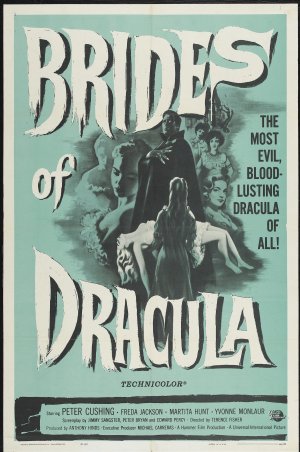
Nowadays, they’d probably just recast the role with Nicolas Cage. But this was the late 50s/early 60s and, instead of recasting, Hammer just made a Dracula film without Dracula. Yes, the film may have been called The Brides of Dracula but, beyond being mentioned in the film’s prologue, Dracula never makes an appearance. For that matter, there really aren’t any brides of Dracula either. There are three female vampires but none of them are turned into vampires by Dracula. Instead, the vampire in question is Baron Meinster (David Peel, who does a pretty good job in the role but who, needless to say, is no Christopher Lee).
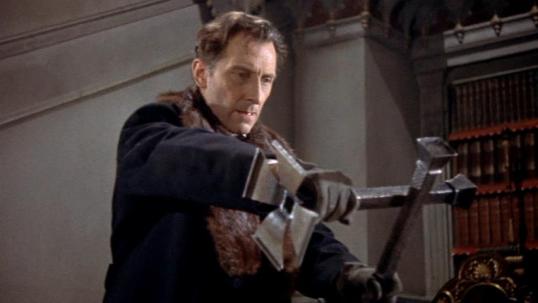
Dracula does not return for The Brides of Dracula but his nemesis Prof. Van Helsing (Peter Cushing) does. Cushing was so well-cast as Van Helsing and brought such a sense of righteous fury to the role that his presence goes a long way towards making up for the absence of Christopher Lee. When you look at and listen to Cushing’s Van Helsing, you’re left with little doubt that this is a man who has dedicated his life to destroying vampires and that he’s quite good at it.
And it’s a good thing that Van Helsing shows up because, regardless of whether Dracula is directly involved or not, Transylvania has some issues. The Brides of Dracula opens with a French school teacher named Marianne (Yvonne Monlaur) finding herself stranded at an old castle. The owner of the castle — Baroness Meinster (Martita Hunt) — allows Marianne to spend the night but asks her to please refrain from releasing her son, Baron Meinster, from the chains that hold him prisoner. Naturally, Marianne does exactly the opposite. She steals a key and sets the Baron free.
Of course, the Baron is a vampire and soon he’s feeding on the inhabitants of a nearby village. The Baron has also decided that Marianne should be his bride. Will Prof. Van Helsing be able to save Marianne’s soul and defeat a second vampire? You’ll have to watch the movie to find out!
And you certainly should. Once you get over the fact that Brides of Dracula does not feature Lee’s iconic Dracula, the film itself is surprisingly entertaining, filled with all of the gothic touches, creepy scenery, evil villains, bloody throats, and heaving cleavage that you would expect from a Hammer film. Peel, Hunt, and Monlaur are all well-cast and best of all, Peter Cushing is Dr. Van Helsing!
In short, it’s not bad for a Dracula film that doesn’t actually feature Dracula.
Of all the monsters who have appeared in horror cinema, Count Dracula is perhaps the most iconic. Reportedly, Dracula first appeared on film in 1920, in a silent Russian film that is now considered to be lost. In 1921, he would appear in a Hungarian film called Dracula’s Death and in 1922, he would be renamed Count Orlok for the German masterpiece Nosferatu. Indeed, by the time Bela Lugosi gave his famous performance in Tod Browning’s Dracula, the count had been appearing in films for at least 11 years. In nearly 100 years of filmmaking, a countless number of actors have brought Dracula to life.
We could spend hours debating who was the best Dracula and certainly, there are some worthy contenders. Bela Lugosi brought a continental sophistication to the role, while John Carradine was properly intimidating and theatrical. Udo Kier, Gary Oldman, Thomas Kretschmann, Leslie Neilsen, Zandor Vorkov, and Frank Langella have all played the prince of darkness, to varying degrees of success.
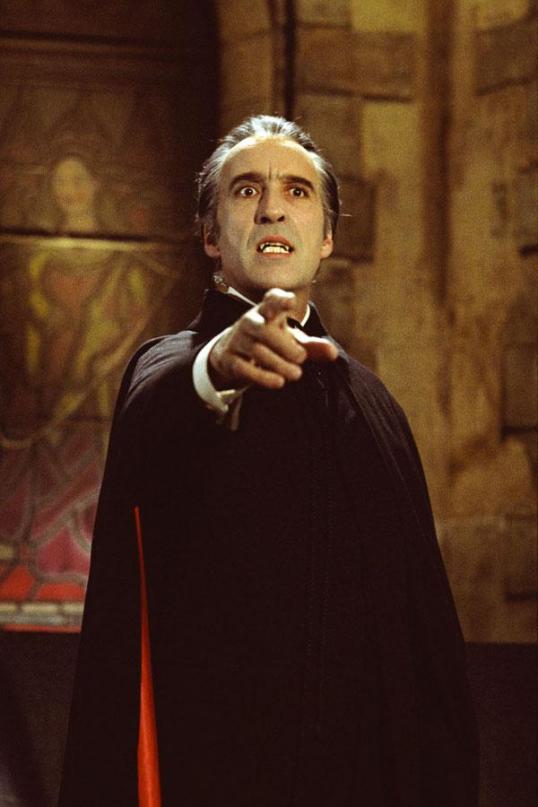
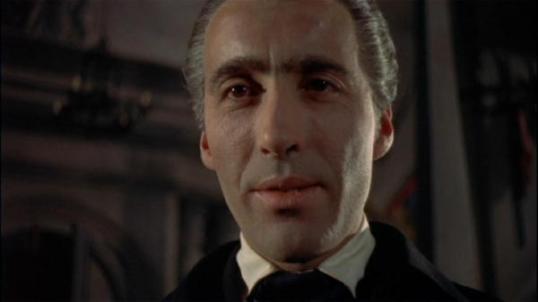
Yet for me, as worthy as any of those actors may be, there is only one true Dracula and he was played by Christopher Lee.
Lee famously played Dracula in seven movies for Hammer Films and, though he has often complained about the quality of these films (especially the later ones, which tended to mix Dracula with hippies), they were largely responsible for making Christopher Lee into the iconic figure that he remains today. It’s also largely due to Lee’s performance that horror fans like me continue to discover and appreciate the films of Hammer today.
As played by Christopher Lee, Dracula was pure evil. Lee’s Dracula had no use for self-pity and one can only imagine what his reaction would have been if he had ever run into the self-torturing vampires of Twilight. Lee’s Dracula had no use for doubt or regret. Instead, he was a determined animal who was driven by a singular lust for blood.
And yet, at the same time, Lee brought an intelligence to the role that was often lacking in previous performances. Lee’s Dracula may have been an animal but he was a cunning animal. Whereas it’s easy for me to imagine escaping from the clutches of Bela Lugosi, I know that if Lee’s Dracula wanted me then he would have me. There’s no escape from Lee’s Dracula. He’s too quick, determined, and intelligent.
His animal nature made Lee’s Dracula frightening but it was his cunning and determination that made him dangerous and, ultimately, even sexy. (While I’ve read that audiences in 1931 swooned over Bela Lugosi, whatever sex appeal he may have had is lost on modern viewers like me.) It has often been argued that Bram Stoker meant for Dracula to be a symbol of all the desires that were repressed by Victorian society. That’s certainly true when it comes to Christopher Lee’s carnal and viscous portrayal of the character.
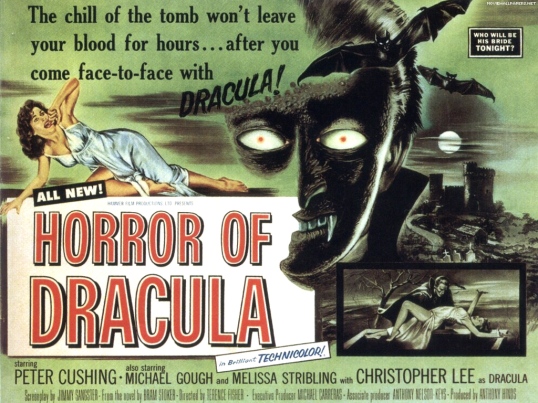
Of the seven Dracula films that Christopher Lee made for Hammer Films, the first remains the best. Released in 1958 and known as Dracula in the UK and the Horror of Dracula in the US, it revitalized the horror genre and helped to make stars of both Christopher Lee and Peter Cushing. Especially when compared to some of the sequels that Hammer subsequently produced, it remains one of the best Dracula films ever made.
The film is a very loose adaptation of Stoker’s original novel. Jonathan Harker comes to Dracula’s castle in Romania. Though posing as a librarian, Harker has actually come to the castle to drive a stake through the heart of both Dracula and his vampire bride. However, no sooner has Harker staked the bride than he’s overpowered and bitten by Dracula. Significantly, all of this occurs within the first 10 minutes of the film. As opposed to certain other Dracula films, Horror of Dracula gets straight to the point. And why shouldn’t it? After all, anyone watching the film already knows that Dracula’s a vampire so why waste time trying to convince us otherwise? We don’t watch Dracula for the familiar story as much as we watch to discover how different filmmakers will choose to tell that story.
When Harker’s colleague, Prof. Van Helsing (played with the perfect amount of intensity by Peter Cushing) shows up at the castle, he discovers that Harker is now a vampire and that Dracula is nowhere to be found.
Dracula, needless to say, is out for revenge. He stalks Harker’s fiancee Lucy, as well as Lucy’s brother Arthur Holmwood (Michael Gough) and his wife Mina (Melissa Stribling). Much as in Stoker’s original novel, Lucy is eventually turned into a vampire and it’s up to Van Helsing and Arthur to stop both her and her new master.
(Of course, in Stoker’s original novel, Harker is not turned into a vampire and instead marries Mina while the aristocratic Arthur is one of Lucy’s three suitors. However, I have to say that I always thought the literary Harker was a bit on the dull side and that Arthur was always my favorite character so I’m happy that he gets to be the hero here.)
If I had to pick one film to epitomize everything that I love about the Hammer brand of horror, it would be Horror of Dracula. As directed by Terrence Fisher, the film moves at an exciting, non-stop pace while the traditionally lush cinematography is almost bombastically colorful. Cushing and Lee, who were the best of friends off screen, make for formidable opponents, with Cushing embodying good just as effective as Lee embodied evil. Though it’s been over 50 years since Horror of Dracula was originally released, the film remains effective and, not coincidentally, a lot of fun.
Quite simply put, this is a film that, for so many reasons, remains a true pleasure to watch.
One final note — I often find myself lamenting that I was born several decades too late and I realize just how true that is whenever I watch a film like Horror of Dracula. Seriously, I would have loved to have been a Hammer girl, showing off my cleavage and getting hypnotized by Christopher Lee.
For today’s entry in the 44 Days of Paranoia, we take a look at one of my favorites of the old school British horror films, 1970’s Scream and Scream Again.
Taking place in the near future, Scream and Scream Again follows three seemingly unconnected stories.
In the first — and, to me, the most disturbing — story, an unnamed London man collapses while out jogging. When he wakes up, he finds himself in a hospital. He is tended to by a nurse who refuses to speak to him. Whenever he falls asleep, his limbs are surgically removed one-by-one. While we never learn much about the man, his scenes are perhaps the most difficult to watch. Everything from the starkness of the hospital to the nurse’s lack of concern and empathy for her patient contributes towards making these some of the most genuinely nightmarish scenes that I’ve ever seen.
While the unnamed jogger is being slowly taken apart, the London police are far more interested in solving the “Vampire Killer” case. Keith (Michael Gothard) is a serial killer who picks up young women in nightclubs and then drinks their blood. When, after an exciting chase, the police finally do catch him, they attempt to handcuff Keith to a car bumper. Keith responds by ripping off his own hand and running into the night. The investigation into Keith eventually leads to an eminent scientist named Dr. Browning (Vincent Price). However, Fremont (Christopher Lee), the head of the British secret service, orders the police to drop the case because Browning is apparently doing very important work for the government.
Meanwhile, in an unnamed country in Eastern Europe, secret police officer Konratz (Marshall Jones) ruthlessly climbs his way to the top of the service by murdering his superiors (including Peter Cushing). When a British spy is captured in his country, Konratz contacts Fremont and offers to exchange the spy for all the information that Scotland Yard has gathered about the Vampire Killer case…
Perhaps the best way to describe Scream and Scream Again would be “joyfully chaotic.” The film’s three separate storylines do all come together during the final ten minutes and the film’s climax does make a lot more sense than it really has any right to but, up until that moment, a lot of the pleasure from Scream and Scream Again comes from seeing just how many different plots and subplots director Gordon Hessler can juggle in one film without losing the audience. Fortunately, Scream and Scream Again is a wonderfully entertaining horror/sci-fi/conspiracy hybrid, one that remains compulsively watchable despite the fact that it often doesn’t make much sense.
Of course, one of the main reasons to see Scream and Scream Again is because it features three icons of horror cinema. Unfortunately, Cushing isn’t on-screen long enough to make much of an impression while Lee basically just has an extended cameo. Vincent Price doesn’t show up until fairly late into the film but once he does, he wastes no time in making an impression. Even by the standard of Vincent Price, his performance in this film is a bit over-the-top.
But you know what?
It’s exactly the performance that this film needs. The film itself is so joyfully chaotic and disjointed that Price fits right in. The triumph of Scream and Scream Again is that it creates (and makes us believe in) a world where it only makes sense that the final solution would lie with Vincent Price.
Finally, Scream and Scream Again serves as a wonderful time capsule for those of us who may be fascinated by the swinging 60s and 70s but, as a result of being born a few decades too late, will never get a chance to experience them firsthand. For us, Scream and Scream Again will always be worth it for the scenes of Keith getting his mod on at a London discotheque.
Scream and Scream Again is a film that everyone should see at least once in their life. Just don’t go jogging afterwards…
Of all the monsters who have appeared in horror cinema, Count Dracula is perhaps the most iconic. Reportedly, Dracula first appeared on film in 1920, in a silent Russian film that is now considered to be lost. In 1921, he would appear in a Hungarian film called Dracula’s Death and in 1922, he would be renamed Count Orlok for the German masterpiece Nosferatu. Indeed, by the time Bela Lugosi gave his famous performance in Tod Browning’s Dracula, the count had been appearing in films for at least 11 years. In nearly 100 years of filmmaking, a countless number of actors have brought Dracula to life.
We could spend hours debating who was the best Dracula and certainly, there are some worthy contenders. Bela Lugosi brought a continental sophistication to the role, while John Carradine was properly intimidating and theatrical. Udo Kier, Gary Oldman, Thomas Kretschmann, Leslie Neilsen, Zandor Vorkov, and Frank Langella have all played the prince of darkness, to varying degrees of success.
Yet for me, as worthy as any of those actors may be, there is only one true Dracula and he was played by Christopher Lee.
Lee famously played Dracula in seven movies for Hammer Films and, though he has often complained about the quality of these films (especially the later ones, which tended to mix Dracula with hippies), they were largely responsible for making Christopher Lee into the iconic figure that he remains today. It’s also largely due to Lee’s performance that horror fans like me continue to discover and appreciate the films of Hammer today.
As played by Christopher Lee, Dracula was pure evil. Lee’s Dracula had no use for self-pity and one can only imagine what his reaction would have been if he had ever run into the self-torturing vampires of Twilight. Lee’s Dracula had no use for doubt or regret. Instead, he was a determined animal who was driven by a singular lust for blood.
And yet, at the same time, Lee brought an intelligence to the role that was often lacking in previous performances. Lee’s Dracula may have been an animal but he was a cunning animal. Whereas it’s easy for me to imagine escaping from the clutches of Bela Lugosi, I know that if Lee’s Dracula wanted me then he would have me. There’s no escape from Lee’s Dracula. He’s too quick, determined, and intelligent.
His animal nature made Lee’s Dracula frightening but it was his cunning and determination that made him dangerous and, ultimately, even sexy. (While I’ve read that audiences in 1931 swooned over Bela Lugosi, whatever sex appeal he may have had is lost on modern viewers like me.) It has often been argued that Bram Stoker meant for Dracula to be a symbol of all the desires that were repressed by Victorian society. That’s certainly true when it comes to Christopher Lee’s carnal and viscous portrayal of the character.
Of the seven Dracula films that Christopher Lee made for Hammer Films, the first remains the best. Released in 1958 and known as Dracula in the UK and the Horror of Dracula in the US, it revitalized the horror genre and helped to make stars of both Christopher Lee and Peter Cushing. Especially when compared to some of the sequels that Hammer subsequently produced, it remains one of the best Dracula films ever made.
The film is a very loose adaptation of Stoker’s original novel. Jonathan Harker comes to Dracula’s castle in Romania. Though posing as a librarian, Harker has actually come to the castle to drive a stake through the heart of both Dracula and his vampire bride. However, no sooner has Harker staked the bride than he’s overpowered and bitten by Dracula. Significantly, all of this occurs within the first 10 minutes of the film. As opposed to certain other Dracula films, Horror of Dracula gets straight to the point. And why shouldn’t it? After all, anyone watching the film already knows that Dracula’s a vampire so why waste time trying to convince us otherwise? We don’t watch Dracula for the familiar story as much as we watch to discover how different filmmakers will choose to tell that story.
When Harker’s colleague, Prof. Van Helsing (played with the perfect amount of intensity by Peter Cushing) shows up at the castle, he discovers that Harker is now a vampire and that Dracula is nowhere to be found.
Dracula, needless to say, is out for revenge. He stalks Harker’s fiancee Lucy, as well as Lucy’s brother Arthur Holmwood (Michael Gough) and his wife Mina (Melissa Stribling). Much as in Stoker’s original novel, Lucy is eventually turned into a vampire and it’s up to Van Helsing and Arthur to stop both her and her new master.
(Of course, in Stoker’s original novel, Harker is not turned into a vampire and instead marries Mina while the aristocratic Arthur is one of Lucy’s three suitors. However, I have to say that I always thought the literary Harker was a bit on the dull side and that Arthur was always my favorite character so I’m happy that he gets to be the hero here.)
If I had to pick one film to epitomize everything that I love about the Hammer brand of horror, it would be Horror of Dracula. As directed by Terrence Fisher, the film moves at an exciting, non-stop pace while the traditionally lush cinematography is almost bombastically colorful. Cushing and Lee, who were the best of friends off screen, make for formidable opponents, with Cushing embodying good just as effective as Lee embodied evil. Though it’s been over 50 years since Horror of Dracula was originally released, the film remains effective and, not coincidentally, a lot of fun.
Quite simply put, this is a film that, for so many reasons, remains a true pleasure to watch.
One final note — I often find myself lamenting that I was born several decades too late and I realize just how true that is whenever I watch a film like Horror of Dracula. Seriously, I would have loved to have been a Hammer girl, showing off my cleavage and getting hypnotized by Christopher Lee.
Today’s episode of televised horror is The Silent Scream, the seventh episode of Hammer House of Horror. It was originally broadcast in the UK on October 25th, 1980.
This episode features an odd pet shop, a youngish Brian Cox playing an ex-con, and — best of all — the iconic Hammer horror star Peter Cushing!
Seriously, how can you do a horror month without featuring at least one appearance from Peter Cushing?


 Through the Shattered Lens