4 Shots From 4 Peter Cushing Films: Hamlet, Doctor Who and the Daleks, Frankenstein Must Be Destroyed, Star Wars


4 Shots from 4 Films is just what it says it is, 4 shots from 4 of our favorite films. As opposed to the reviews and recaps that we usually post, 4 Shots from 4 Films lets the visuals do the talking!

Today is Peter Cushing’s birthday!  This edition of 4 Shots From 4 Films is dedicated to him, his memory, and his career!

4 Shots From 4 Peter Cushing Films

Hamlet (1948, dir by Laurence Olivier)

Doctor Who and the Daleks (1965, dir by Gordon Flemyng)

Frankenstein Must Be Destroyed (1969, dir by Terence Fisher)

Star Wars (1977, dir by George Lucas)


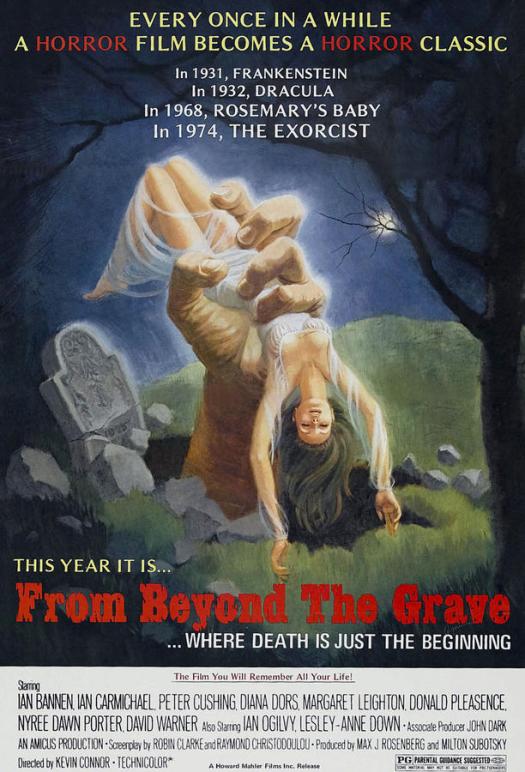
Moldy Horror: FROM BEYOND THE GRAVE (Warner Bros/Amicus 1973)


gary loggins's avatarcracked rear viewer

I’ve discussed the Max Roseberg/Milton Subotsky Amicus horror anthologies before on this blog. All are good, if uneven, little entries in the genre, and FROM BEYOND THE GRAVE is no exception. This was the last of the Amicus tales of terror, a quartet of creepiness based on the work of British horror writer R. Chetwynd-Hayes. I’ll admit I’m not familiar with Mr. Cheywynd-Hayes’s work, so I couldn’t tell you if the movie’s faithful to it or not. I can tell you FROM BEYOND THE GRAVE is about 50/50 in the chills department.

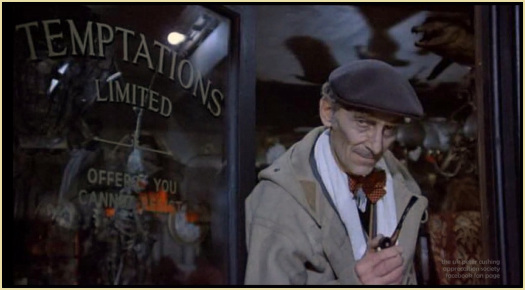
An all-star British cast gives it a game try, though. The segments are linked by horror icon Peter Cushing , looking rather gaunter than usual as the proprietor of Temptations Ltd., an antique shop which serves to set the stories in motion. Unfortunately, the part is a waste of Cushing’s talent; I could see him in any of…

View original post 367 more words

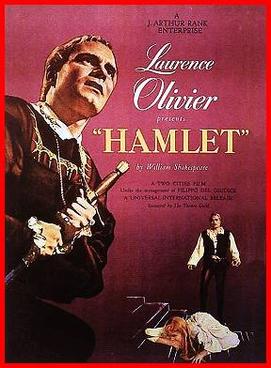
Lisa Reviews An Oscar Winner: Hamlet (dir by Laurence Olivier)


(With the Oscars scheduled to be awarded on March 4th, I have decided to review at least one Oscar-nominated film a day.  These films could be nominees or they could be winners.  They could be from this year’s Oscars or they could be a previous year’s nominee!  We’ll see how things play out.  Today, I take a look at the 1948 best picture winner, Hamlet!)

Hamlet is a film of firsts.

It was the first British production to win the Oscar for Best Picture.  In winning, it beat out three American films (Johnny Belinda, The Snake Pit, and The Treasure of the Sierra Madre) and one other British film (The Red Shoes).

It was also the first adaptation of Shakespeare to win Best Picture.  Of course, it wasn’t the first Shakespeare adaptation to be nominated.  That honor would go to 1935’s A Midsummer Night’s Dream.  Adaptations of Romeo and Juliet would be nominated in 1936, 1961, and 1968.  Henry V (which, like Hamlet, was directed by and starred Laurence Olivier) was a 1946 nominee.  Then there was 1953’s Julius Caesar.  The Dresser featured scenes from Shakespeare.  Shakespeare in Love imagined the circumstances behind the writing of Romeo and Juliet.  However, Hamlet was the first to win.

It also remains the only traditional Shakespearean adaptation to win.  West Side Story updated Romeo and Juliet while Shakespeare in Love … well, let’s just not get into it.

It was the first Best Picture winner to be directed by the man starring in the movie.  Laurence Olivier was nominated for both Best Director and Best Actor.  He lost the directing Oscar to John Huston but he won for his performance as Hamlet.  In winning, he became the first actor to direct himself to an Oscar.

Finally, Hamlet was the first of 24 films to feature both Peter Cushing and Christopher Lee!  In fact, this was Lee’s film debut.  Now, before anyone gets too excited, I should point out that Cushing and Lee don’t actually interact.  In fact, Lee doesn’t even speak in the film.  He appears in the background as a Spear Carrier and it’s pretty much impossible to spot him.  He has no dialogue and wasn’t even listed in the final credits.  From what I’ve read, I don’t think Lee and Cushing even knew each other at the time and, when they later met, they were surprised to learn that they had both appeared in the film.  For his part, Cushing plays Osiric, the courtier who everyone remembers because he had such a cool name.

It’s always fun to play “what if.”  Rosencrantz and Guildenstern do not appear in Olivier’s adaptation of the play.  To modern audiences, that might seem strange but, really, that’s just because we’re all familiar with the two characters from Tom Stoppard’s Rosencrantz and Guildenstern Are Dead.  When Olivier filmed Hamlet, he excised portions of the play in the interest of time.  (Hamlet uncut runs over four hours.  Olivier’s version clocks in at nearly three.)  Rosencrantz, Guildenstern, Fortinbras, and the second gravedigger are all dropped from Olivier’s version and, to be honest, none of them are particularly missed.

And yet … as I watched Hamlet, I found myself wondering what would have happened if Olivier had kept Rosencrantz and Guildenstern around and had cast Cushing and Lee in those roles.  It probably wouldn’t have happened, of course.  Cushing maybe but Lee was a total unknown at the time.  Still, how amazing would that have been?

As for the actual film, Olivier’s Hamlet turned out to be far more cinematic than I was anticipating.  Olivier’s camera snakes through the darkened hallways of Elsinore Castle while Olivier’s Hamlet veers between self-righteous fury and apparent madness as he seeks revenge on his Uncle Claudius (Basil Sydney).  As Hamlet grows more obsessed with death and vengeance, the castle seems to grow darker and the hallways even more maze-like, as if the castle’s changing shape to conform with the turmoil in Hamlet’s mind.  Among the cast, Jean Simmons is poignantly fragile as Ophelia while Eileen Herlie is the perfect Gertrude, despite being 12 years younger than the actor playing her son.  Olivier gives a wonderfully physical performance as Hamlet, killing Polonious with a demented gleam in his eye and literally leaping towards his uncle at the end of the film.

If you’re one of those people who thinks that Shakespeare is boring … well, Olivier’s Hamlet probably won’t change your mind.  One thing I’ve noticed about the “Shakespeare is boring” crowd is that nothing can change their minds.  But, for the rest of us, Olivier’s Hamlet is an exciting adaptation of Shakespeare’s more difficult play.

You won’t miss Rosencrantz and Guildenstern at all.  And seriously, Fortinbras who?

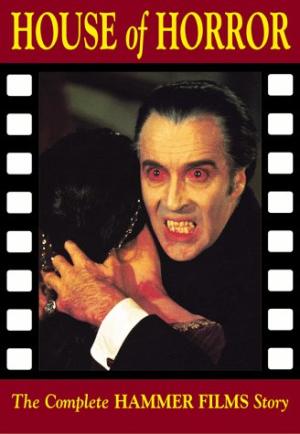
Horror Book Review: House of Horror, edited by Jack Hunter


If you love horror films, you have to love Hammer Films, the British studio that was responsible for some of the best horror films of the 50s, 60s, and 70s.  It was Hammer who brought Dracula, Frankenstein, and the Mummy back to life and who introduced a splash of color to the formerly black and white world of horror.  It was Hammer that first brought horror together with pop art.  And, of course, it was Hammer that made stars out of actors like Christopher Lee and Peter Cushing.

House of Horror was originally published in 1973, as a tribute to Hammer in its waning days.  The copy that I own is a revised edition, one that was published in 2000.  I found it at Recycled Books in Denton, Texas.  (That was quite a shopping trip, by the way.  Not only did I buy House of Horror but I also bought A Taste of Blood: The Films of Herschell Gordon Lewis.)

Anyway, if you’re a fan of Hammer Films, then this is one of those books that you simply have to own.  Not only does it contain interviews with the big four of Hammer (Peter Cushing, Christopher Lee, Terence Fisher, and Michael Carreras) but it also provides a in-depth analysis of Hammer’s Dracula series, its Frankenstein series, and its lesser known science fiction productions.

At the end of the book, there are biographies of some of the members of Hammer’s stock company.  There’s also not only a full list of every film that Hammer ever produced but even a list of Hammer project that never reached the filming stage.  If, as I am, you’re obsessed with film trivia, this book is a must have.

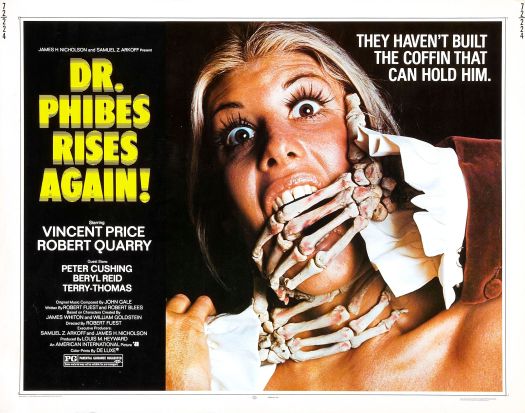
Horror on the Lens: Dr. Phibes Rises Again (dir by Robert Fuest)


Since yesterday’s horror on the lens was The Abominable Dr. Phibes, it only seems logical that today’s should be the sequel to that film, 1972’s Dr. Phibes Rises Again.  Would you believe that, before I actually found the film on YouTube, I thought this film was called Dr. Phibes Rides Again?  Personally, I think Rides Again sounds better than Rises Again but what do I know?

All that matters is that Vincent Price is back!  Be sure to check out Gary’s review of Dr. Phibes Rises Again when you get the chance.

And watch the movie below!

Enjoy!

6 Trailers For The First Of October!


As a part of this October’s horrorthon, I am pleased to announce the return of Lisa Marie’s Favorite Grindhouse and Exploitation film trailers!  This used to be a regular (and fairly popular) feature here on the Shattered Lens.  Unfortunately, a few years ago, I discovered that I had shared almost every worthwhile trailer on YouTube and, as such, it became more of a “special occasion” type of feature.

However, enough time has passed that there are now new trailers on YouTube!  Yay!

So, let’s get things started with 6 Trailers for The First of October!

(Why six?  Because Lisa doesn’t do odd numbers!)

  1. I Drink Your Blood (1971)

Let’s start things off with I Drink Your Blood (1971), a film about what happens when hippies get rabies.  None other than Ryan C, the Trashfilm Guru himself, has described I Drink Your Blood as being one of the greatest grindhouse films of all time.

2. Psychomania (1973)

What’s the best way to deal with blood-crazed hippies?  How about an English motorcycle gang?  This was also the final film of George Sanders.

3. Werewolves on Wheels (1971)

Speaking of motorcycle gangs, you can check out Gary’s review of Werewolves on Wheels by clicking here!

4. The Beast Must Die (1974)

Not all werewolves ride motorcycles!  Some of them terrorize remote locations and are hunted by Peter Cushing, as seen in The Beast Must Die.

5. Shock Waves (1977)

Peter Cushing went from filming The Beast Must Die to appearing in Shock Waves, perhaps the greatest Nazi zombie film ever made.  Check out my review here!

6. The Loch Ness Horror (1982)

However, zombie nazis aren’t the only thing that live in the water!  Just ask the people of Scotland!

What do you think, random hippie with cat?

Vincent Price Goes to Camp in DR. PHIBES RISES AGAIN (AIP 1972)


gary loggins's avatarcracked rear viewer

Since 1971’s THE ABOMINABLE DR. PHIBES  was such a big hit, American-International Pictures immediately readied a sequel for their #1 horror star, Vincent Price. But like most sequels, DR. PHIBES RISES AGAIN isn’t nearly as good as the unique original, despite the highly stylized Art Deco sets and the presence of Robert Quarry, who the studio had begun grooming as Price’s successor beginning with COUNT YORGA, VAMPIRE. The murders (for the most part) just aren’t as monstrous, and too much comedy in director Robert Feust’s script (co-written with Robert Blees) turn things high camp rather than scary.

Price is good, as always, bringing the demented Dr. Anton Phibes back from the grave. LAUGH-IN announcer Gary Owens recaps the first film via clips, letting us know Phibes escaped both death and the police by putting himself in suspended animation. Returning with loyal servant Vulnavia (who’s now played by Valli Kemp, replacing a then-pregnant Virginia North), Phibes…

View original post 369 more words

20 Horror Icons Who Were Never Nominated For An Oscar


Though they’ve given some of the best, iconic, and award-worthy performances in horror history, the actors and actresses below have never been nominated for an Oscar.
Scarlet Diva

  1. Asia Argento

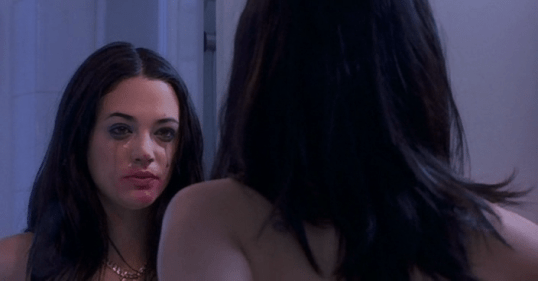
Perhaps because of charges of nepotism, people are quick to overlook just how good Asia Argento was in those films she made with Dario Argento.  Her work in Trauma especially deserves to be reevaluated.  Outside of her work with Dario, Asia gave great, self-directed performances in Scarlet Diva and The Heart is Deceitful Above All Things.

2. Jamie Lee Curtis

“Prom Night!  Everything is all right!”  Did you know that Jamie Lee Curtis received a Genie Nomination for her performance in Prom Night?  That could be because, in 1980, there weren’t that many movies being produced in Canada but still, Jamie was pretty good in that film.  And, of course, there’s a little film called Halloween

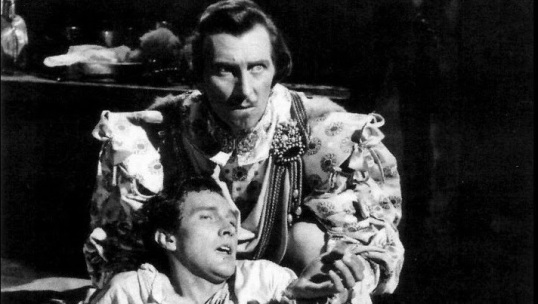
3. Peter Cushing

The beloved Hammer horror veteran did wonderful work as both Frankenstein and Van Helsing.  Personally, I love his odd cameo in Shock Waves.

4. Robert Englund

One, two, Freddy’s coming for you…

5. Lance Henriksen

One of the great character actors, Lance Henriksen gave one of the best vampire performances of all time in Kathryn Bigelow’s Near Dark.

David Hess, R.I.P.

6. David Hess

In just two films — Wes Craven’s Last House On The Left and Ruggero Deodato’s The House On The Edge of the Park — Hess defined screen evil.  If nothing else, he deserved an Oscar for composing The Road Leads To Nowhere.

boris-karloff-1939-the-man-they-could-not-hang

7. Boris Karloff

As our own Gary Loggins will tell you, it’s a crime that Boris Karloff never received an Oscar nomination.  He may be best remembered for Frankenstein but, for me, Karloff’s best performance was in Targets.

8. Camille Keaton

Yes, Camille Keaton did deserve a Best Actress nomination for I Spit On Your Grave.
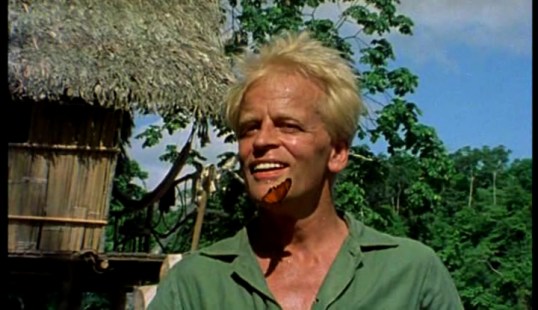
Kinski and Butterfly

9. Klaus Kinski

The notorious and talented Klaus Kinski was never nominated for an Oscar.  Perhaps the Academy was scared of what he would do if he won.  But, that said, Kinski gave some of the best performances of all time, in films for everyone from Jess Franco to Werner Herzog.
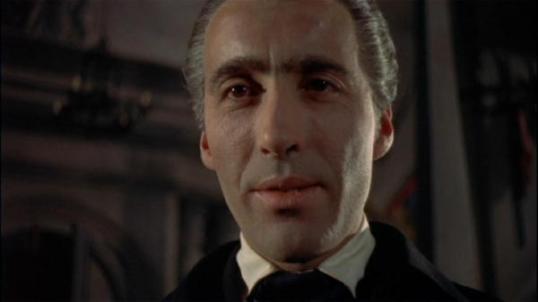
Christopher Lee Is Dracula

10. Christopher Lee

That the amazing Christopher Lee was never nominated is a shock.  Though he will always be Dracula, Lee gave wonderful performances in films of all genres.  Lee always cited the little-seen Jinnah as being his best performance.
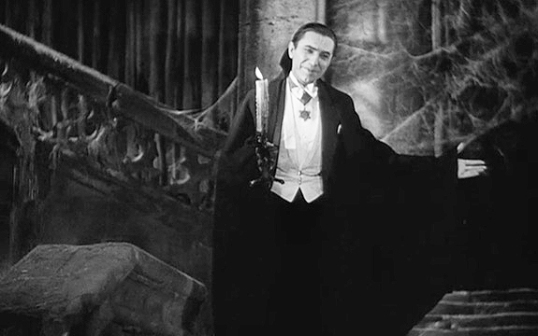
 

11. Bela Lugosi

The original Dracula, Lugosi never escaped typecasting.  Believe it or not, one of his finest performances was in one of the worst (if most enjoyable) films of all time, Ed Wood’s Bride of the Monster.

12. Catriona MacColl

This English actress gave three excellent performances in each chapter of Lucio Fulci’s Beyond Trilogy, with her performance in The House By The Cemetery elevating the entire film.

13. Daria Nicolodi

This Italian actress served as a muse to two of the best directors around, Dario Argento and Mario Bava.  Her award-worthy performances include Deep Red and, especially, Shock.
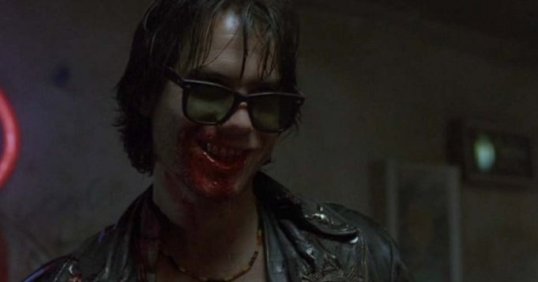
Near-Dark-Bill-Paxton

14. Bill Paxton

This great Texas actor gave award-worthy performances in everything from Near Dark to Aliens to Frailty.  RIP.
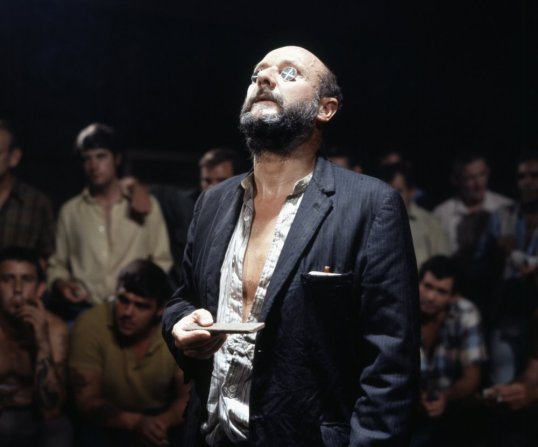
15. Donald Pleasence 

Dr. Loomis!  As good as he was in Halloween, Pleasence also gave excellent performances in Roman Polanski’s Cul-de-Sac and a nightmarish Australian film called Wake in Fright.
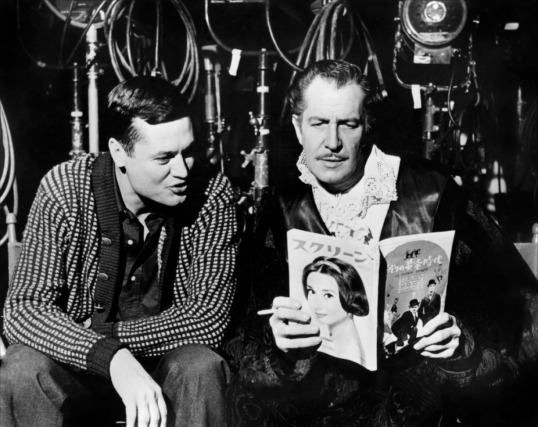
Roger Corman and Vincent Price

16. Vincent Price

The great Vincent Price never seems to get the respect that he deserves.  He may have overacted at times but nobody went overboard with as much style as Vincent Price.  His most award-worthy performance?  The Witchfinder General.

17. Giovanni Lombardo Radice

The greatest of all the Italian horror stars, Radice is still active, gracious, and beloved by his many fans.  Quentin Tarantino is a self-described fan so it’s time for Tarantino to write him a great role.

HenryPortrait

18. Michael Rooker

To many people, this great character actor will always be Henry.

19. Joe Spinell

This character actor will always be remembered for playing the lead role in the original Maniac but he also appeared in some of the most acclaimed films of all time.  Over the course of a relatively short career, Spinell appeared in everything from The Godfather to Taxi Driver to Rocky to Starcrash.  He was the American Klaus Kinski,

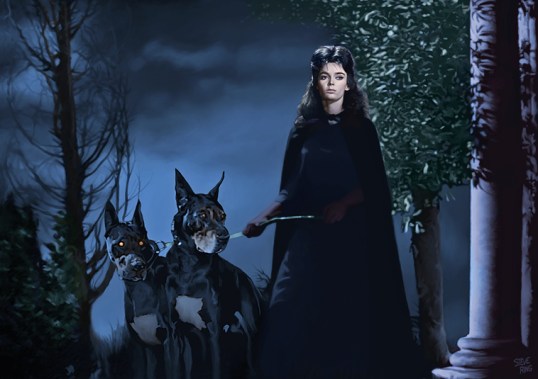
20. Barbara Steele

Barbara Steele has worked with everyone from Mario Bava to Jonathan Demme to David Cronenberg to Federico Fellini.  Among her many excellent performances, her work in Black Sunday and Caged Heat stands out as particularly memorable.
black-sunday

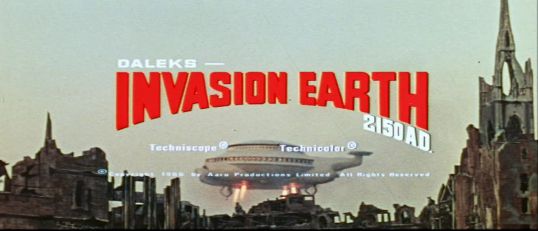
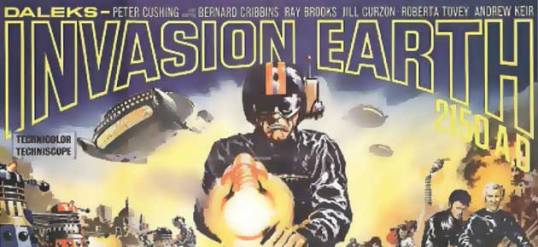
A Movie A Day #54: Daleks — Invasion Earth: 2150 (1966, directed by Gordon Flemyng)


daleks_-_invasion_earth_2150_a-d-_trailer_title

When London Special Constable Tom Campbell (Bernard Cribbins) spots a robbery at a jewelry store, he runs into a police box to call for backup.  But this is no ordinary blue police call box.  Not only is there no phone but it’s bigger on the outside than on the inside and it’s inhabited by Dr. Who (Peter Cushing), an eccentric inventor, and his niece, Louise (Jill Curzon) and his granddaughter, Susan (Roberta Tovey).  The call box is a time machine that’s known as a TARDIS and Tom just happens to stumble in at the exact moment that the Doctor and his family are heading into the future.  When they arrive in London in 2150, they discover that Earth has been conquered by the Daleks.

Daleks — Invasion Earth: 2150 was the second and last Doctor Who film to be produced by Amicus Pictures.  As both a sequel to Dr. Who and the Dalekand an adaptation of the televisions serial The Daleks Invasion of Earth, Daleks — Invasion Earth: 2150 shares many of the same flaws as the first movie.  Of course, the main one is that, as any true Whovian can tell you, the Doctor was not named Dr. Who, he was not human, and he did not invent the TARDIS.  He also never had a niece, at least not one named Louise.  Hearing the Doctor introduce himself as “Dr. Who” just sounds wrong.  The comedic relief also feels as out of place here as it did in Dr. Who and the Daleks but at least Bernard Cribbins’s Tom isn’t as annoying as Roy Castle’s Ian.

mmkjxrxmb0bkyvkaxqvsdbykqfw

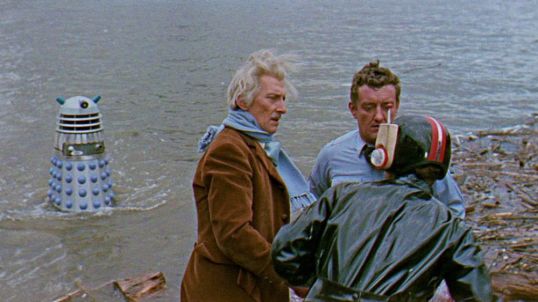
Even taking all of that into consideration, Daleks — Invasion Earth: 2150 is still a clear improvement over the first film.  The futuristic location, with a London made up of the ruins of recognizable landmarks, is well-realized and far superior to the cardboard sets of the Dr. Who and the Daleks.  The moment when the Daleks first appear, rising out of the Thames, is a great Dr. Who moment and, for once, the Daleks comes across like a real threat instead of just oversized salt and pepper shakers with attitude.  Unlike the first film, the Daleks use their “EXTERMINATE” war cry and they exterminate almost everyone that the Doctor and his companions meet.  Since the Daleks are killing Brits instead of Thals, the stakes are higher in Daleks — Invasion Earth: 2150.

Even though he was playing a human version of the character and therefore, cannot be considered canonical, I have always liked Peter Cushing’s interpretation of the character.  Cushing’s firm but grandfatherly Doctor was quite a contrast to William Hartnell’s strict and abrupt version.  (Cushing’s Doctor has always reminded me more of a combination of Patrick Troughton and Jon Pertwee than William Hartnell.)

Daleks — Invasion Earth: 2150 may have been far better than the first film but it was also a flop at the box office, ending plans for any further Dr. Who movies.

daleks-invasion-earth-2150-poster


Oh No SHE Didn’t!! (MGM/Hammer 1965)


gary loggins's avatarcracked rear viewer

she1

…didn’t manage to keep me awake, that is! That’s right, I actually dozed off in the middle of SHE for a good fifteen minutes! This so-called adventure film, a remake of the rousing 1935 Merian C. Cooper production starring Helen Gahagan and Randolph Scott, is based on a novel by H. Rider Haggard, a pretty big-deal adventure novelist back in the day, who also wrote the novels KING SOLOMAN’S MINES and ALLAN QUARTERMAIN. The ’35 version was filled with sumptuous Art Deco sets and a dynamic score by Max Steiner, and proved popular with moviegoers of the day.

she2

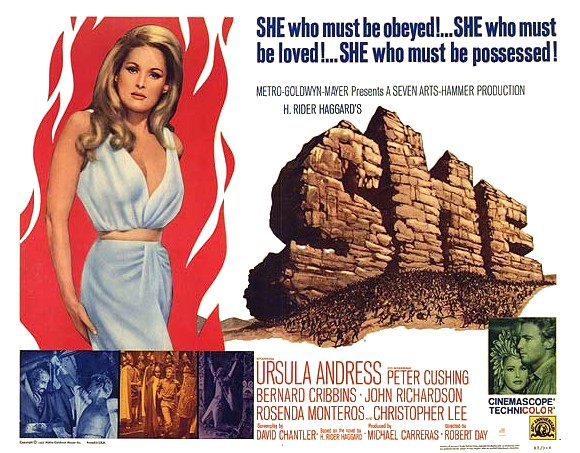
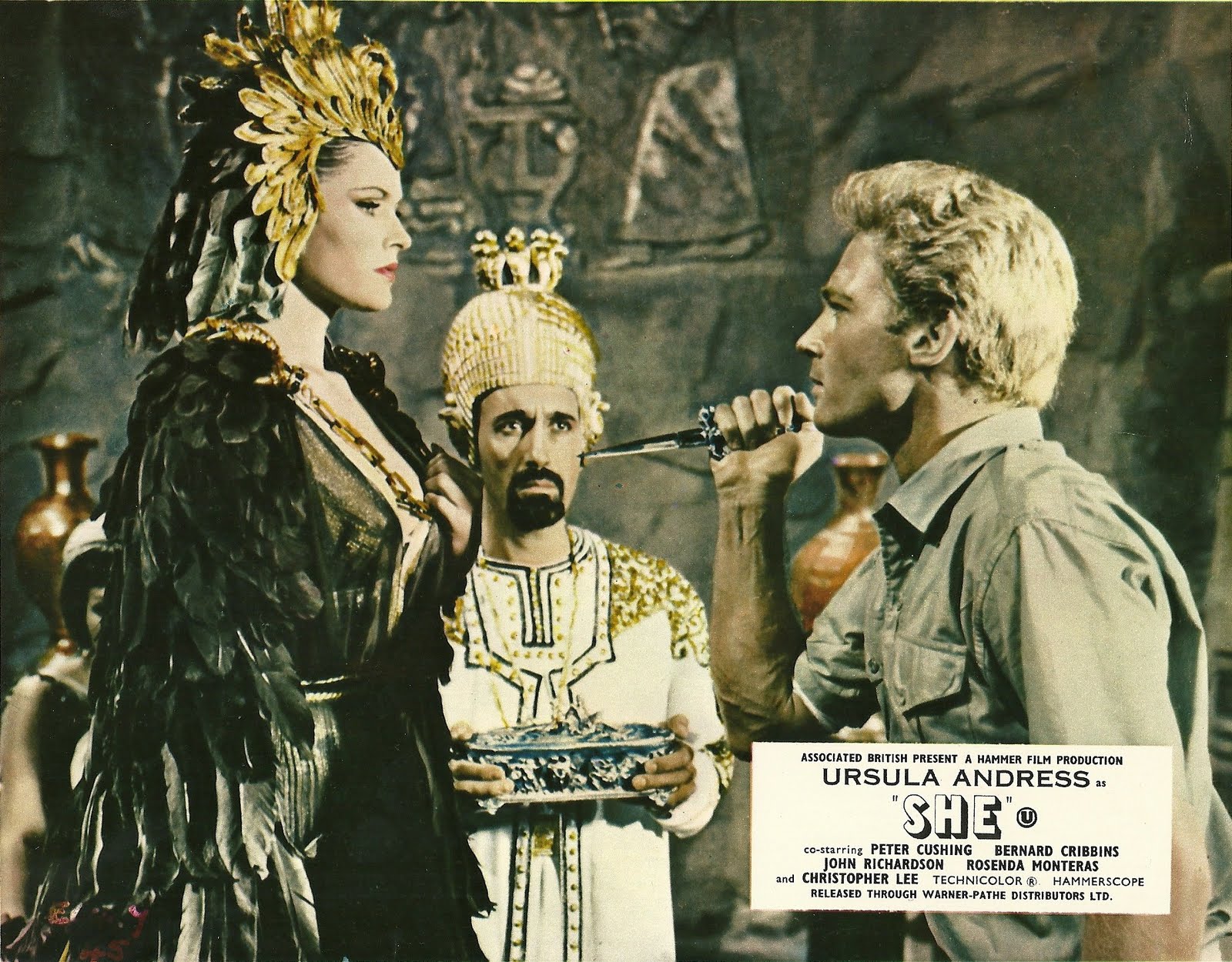
But the times, they do a-change, and so do tastes. Hammer Films decided to do this remake thirty years later, with Ursula Andress in the title role. ONE MILLION YEARS B.C. caveman John Richardson plays Leo Vincey, who’s the spitting image of Queen Ayesha’s long-lost love Kallilkrates. Hammer’s top tag-team Peter Cushing and Christopher Lee are in the cast…

View original post 209 more words