Horror On TV: Hammer House of Horror #7 “The Silent Scream” (dir by Alan Gibson)


Today’s episode of televised horror is The Silent Scream, the seventh episode of Hammer House of Horror.  It was originally broadcast in the UK on October 25th, 1980.

A quick content warning for everyone: This episode features some scenes of animals in distress so I personally would advise viewer discretion.  That said, I simply had to share this episode because it features Peter Cushing’s final performance for Hammer Studios.  He plays a seemingly kindly old man who has a very dark secret.  A youngish Brian Cox plays the ex-con who gets a job working for Cushing.  This is a very unnerving episode with an ending that truly sticks with you.

The TSL Horror Grindhouse: The Beast Must Die (dir by Paul Annett)


You have 30 seconds to decide who is the werewolf.  Is it the professor?  Is it the wife of the big game hunter?  Is it the long-haired hippie who has a history of cannibalism?  Is it the concert pianist?  Is it the diplomat?  Make your guess and then….

This is the challenge that is presented to the viewers of the 1974 film, The Beast Must DieThe Beast Must Die is a werewolf film.  Calvin Lockhart stars as millionaire big game hunter Tom Newcliffe.  Tom has invited a group of people to his English mansion because, according to him, one of them is a werewolf and he plans to hunt down whoever it is.  It’s not a terrible premise and I imagine that, in 1974, it was probably quite revolutionary to cast a black actor as a millionaire with a large British estate.  (In America, the film was marketed as being a blaxploitation film under the title Black Werewolf.)

That said, The Beast Must Die is still best-known for its “Werewolf Breaks.”  At certain points in the film, a stopwatch appears on the screen and a narrator asks us if we’ve figured out who the werewolf is yet.  The viewer is given 30 seconds to make a guess before the film continues.  The “Werewolf Breaks” were apparently added to the film after production was completed and director Paul Annett was not happy about them.  The Beast Must Die is, in many ways, a pretty grim film or, at least, it would be if not for the campy narrator telling us that it’s up to us to solve the mystery.

But you know what?  I like the Werewolf Breaks.  They’re fun and, without them, The Beast Must Die would come across as being a film that takes itself way too seriously.  Calvin Lockhart, who was so good in Melinda, overacts to a tremendous degree as Tom Newcliffe and, as the film progresses, he goes from being merely eccentric to actually coming across as being rather unhinged in his attempts to discover who is the werewolf.  It’s never really clear how he settled on his suspects.  (All of them are described as being in the area of several unexplained deaths but it seems like the same could be said of probably hundreds of other people as well.)  But once he has them at the mansion, he’s determined to keep them there until he figures out which is infected with lycanthropy.  (In this film, the werewolf curse is described as basically being a virus.)

Fortunately, the suspects are played by an interesting gallery of British and American character actors.  Charles Gray plays the shady diplomat.  Malene Clark is Tom’s wife.  Michael Gambon is the pianist while Ciaran Madden plays his wife.  Tom Chadbon plays the hippie cannibal while Anton Diffring shows up as the head of security for the mansion.  Best of all, Peter Cushing plays the professor who is an expert on werewolves.  It’s always a joy to see Peter Cushing in any film.  He’s particularly good here, handling his often overwritten dialogue like the pro that he was.

The Beast Must Die is an uneven film.  The opening sequence, which features Tom testing the mansion’s security systems, seems to go on forever and the plot is full of twists that fall apart if you give them too much thought,  But the Werewolf Breaks made me smile and the supporting cast is a delight.  It’s a fun film to watch during the Halloween season.

Horror Review: Horror Express (dir. Eugenio Martin)


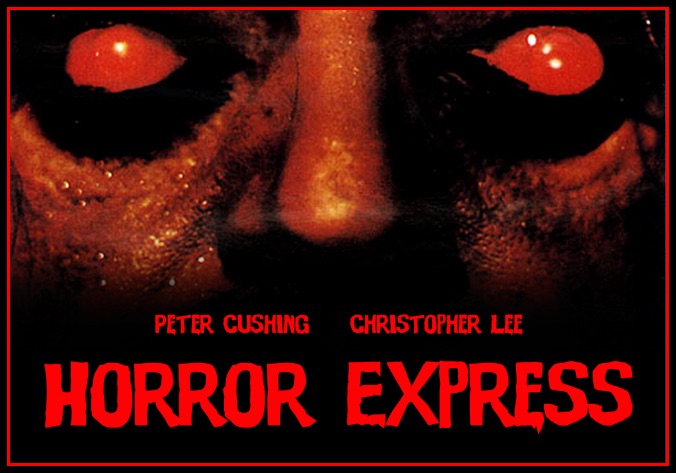
There was one film I saw when I was very young that absolutely terrified me, and even now, decades later, it still has the power to unsettle me and rob me of sleep. That film is Horror Express, a 1972 Spanish-British horror/science fiction hybrid directed by Eugenio Martín. It brought together two titans of gothic horror cinema, Christopher Lee and Peter Cushing—icons of the Hammer Films era—while also featuring Telly Savalas in a sadistic, scene-stealing turn as a volatile Cossack captain.

When Horror Express was released, the horror genre was at a fascinating crossroads. The gothic traditions popularized by Hammer Studios throughout the 1960s were beginning to fade, overtaken by the grittier, bloodier styles of filmmakers like Herschell Gordon Lewis and George A. Romero. By 1968, Romero’s Night of the Living Dead had already shifted the genre toward a darker, more nihilistic tone, paving the way for the grislier excesses that would dominate the 1970s. Martín’s film stood out precisely because it clung to the elegance and atmosphere of Hammer’s gothic aesthetic while incorporating moments of shocking violence and morbid detail. It occupied an unusual in-between space: refined in look and tone yet unnerving in its thematic brutality. Its blend of period atmosphere, science fiction paranoia, and restrained gore made it a fascinating transitional work in horror history.

The premise is simple but chilling. Aboard the Trans-Siberian Express, a British anthropologist (Christopher Lee’s Professor Saxton) transports a recently unearthed specimen—an ape-like, fossilized creature. His colleague, Peter Cushing’s Dr. Wells, becomes reluctantly entangled in the unfolding mystery. Predictably, the specimen is not what it seems; it revives and begins unleashing a series of violent attacks on the passengers. Soon it is revealed to harbor a far more terrifying, alien intelligence capable of killing and inhabiting its victims. This leads to one of the film’s most haunting sequences: the white-eyed, zombie-like corpses, drained of memories and humanity, shambling through the train corridors under the entity’s control. At eight years old, these images struck me as some of the most horrifying I had ever seen, and even today their uncanny blend of gothic atmosphere and science fiction body horror still lingers.

Viewed in retrospect, Horror Express bears a striking resemblance to John W. Campbell’s novella Who Goes There?—the basis for Howard Hawks’ The Thing from Another World and John Carpenter’s The Thing in 1982. Like those stories, it is steeped in paranoia, playing with the idea of an alien intelligence that can absorb knowledge and animate the dead. While it never attains the precision of Carpenter’s later masterpiece, it foreshadows that same blend of claustrophobia, distrust, and escalating dread.

What makes Horror Express unforgettable is its restraint. Rather than leaning on gore, it generates fear through suggestion, atmosphere, and disturbing imagery. The snowy isolation of the Trans-Siberian route reinforces the cold sterility of its alien invader, while the confined train cars become a claustrophobic prison of escalating terror. Over time, the film has slipped into the public domain, making it widely available on streaming platforms and budget DVDs. Though often overlooked in surveys of 1970s horror, it deserves recognition as one of the last great gothic horror films before the torch passed to Craven, Carpenter, and Hooper.

For me, Horror Express remains not just a childhood scare but a cinematic touchstone: a rare piece of science fiction horror bridging two eras, one that manages to terrify without relying on excess gore. It disturbed me at age eight, and even now, watching the blank-eyed corpses lurch through the dim train cars still triggers that same visceral shiver.

Robert Englund as Han Solo? A Little May 4th Trivia


Can you imagine how things might have played out if Robert Englund had played Han Solo?

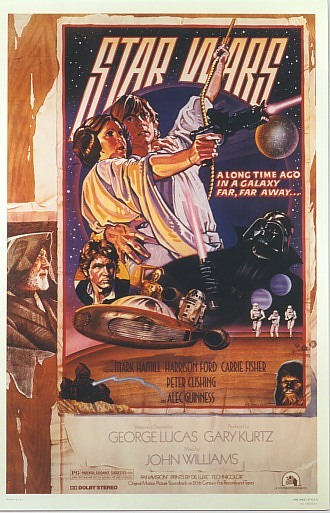
It’s not as far-fetched as it might sound.  In his autobiography, Hollywood Monster: A Walk Down Elm Street with the Man of Your Dreams, Englund mentions that he was one of the many actor who, in 1975, auditioned for a role in the first Star Wars film.  It’s often forgotten that, before he became famous as Freddy Krueger in A Nightmare In Elm Street, Englund was a busy character actor who had roles in several big studio productions in the 70s.  He was definitely a part of the “new Hollywood” that included people like George Lucas, Steven Spielberg, and Jon Milius.

Though Englund doesn’t go into much detail, he does say that he read for the roles of both Han Solo and Luke Skywalker.  At the time, Englund didn’t feel that he was right for either role and he went back to his apartment under the correct impression that he would not be cast.  However, he did feel that his friend and then-roommate Mark Hamill would be a good pick for Luke Skywalker and Englund writes that he encouraged Hamill to try out for the role.

Would Mark Hamill have been cast if Robert Englund hadn’t told him about the audition?  Probably.  Given that Star Wars was Lucas’s follow-up to the very popular American Graffiti, it’s probable that every struggling young actor in Hollywood was hoping to audition.  As well, Hamill was not totally unknown to George Lucas, having early read for a role in American Graffiti.  Still, it’s nice to think that, long before he was cast as Freddy Krueger, Robert Englund may have played a role in casting one of the most successful films of all time.

What would Robert Englund have been like as Han Solo?  He definitely would not have been as grouchy as Harrison Ford’s Han.  Indeed, one of the striking things out about Englund’s pre-Nightmare career was how he was usually cast as friendly characters who were almost shy.  Englund would have been friendlier and rather eccentric Han Solo but I think he would have been entertaining in his way.
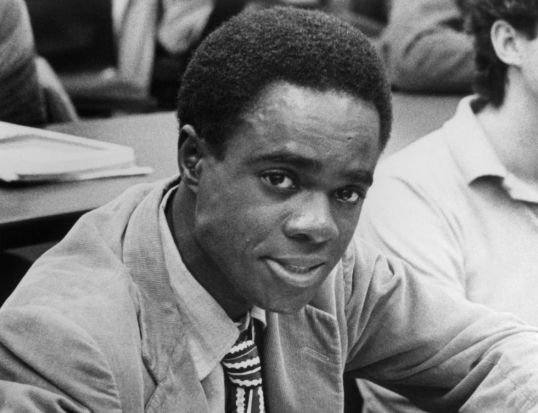
Because of the film’s success, it can be a bit difficult to know who was actually considered for a role in Star Wars.  Lucas has said that he originally wanted to cast Black actor Glynn Turman as Han Solo but he feared audiences would not accept the possibility of an interracial romance between him and Leia, even in a galaxy far away.  (Lucas’s regret over that decision is one of the things that led to the casting of Billy Dee Williams as Lando Calrissian.)  The film’s IMDb trivia page insists that everyone from Al Pacino to Bill Murray to Marlon Brando to Chevy Chase was considered for the role of Han Solo and I have to say that this is a case where I doubt the accuracy of the IMDb.  Harrison Ford, who had originally been hired only to read with people at the auditions, eventually got the role despite telling Lucas, about the script, “You can type this shit but you can’t say it.”
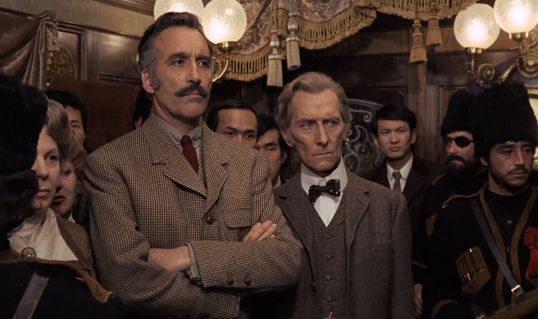
In several interviews, Christopher Lee expressed regret at having turned down the role of Grand Moff Tarkin, which was instead played by Lee’s best friend Peter Cushing.  Interestingly enough, Cushing was also one of Lucas’s choices for Obi-Wan Kenobi so it’s easy to imagine a universe in which Star Wars reunited two Hammer films legends, along with setting box office records.

Famously, Lucas held joint-auditions with his friend Brian De Palma.  De Palma was casting Carrie and just about everyone who read for one of the films also read for the other.  Reportedly, William Katt came close to getting the role of Luke before instead being cast as Carrie’s doomed prom date.  Amy Irving was also a strong contender for Leia, before instead ending up as Sue Snell in De Palma’s film.  Some source that that Sissy Spacek also read for Leia, though I’ve also read that Spacek was not a part of the joint-auditions.  That’s one thing about collecting trivia about classic films.  It’s often hard to know what’s true and what’s just wishful thinking.
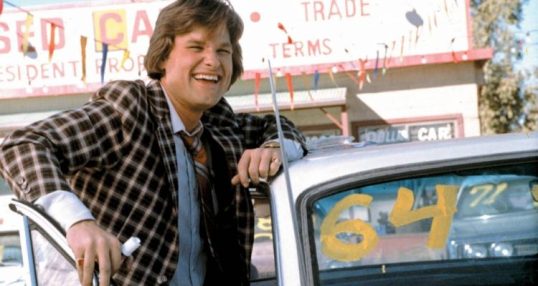
I should mention that another strong contender for Han Solo (and reportedly Luke as well) was Kurt Russell.  It’s actually easy to imagine Kurt Russell as Han and, just as with Englund, it leads to an intriguing game of what if.  Would Kurt Russell have gone on to have Harrison Ford’s career if he had been cast in Star Wars?  Would Russell have gone to play Indiana Jones and Jack Ryan if he had been cast as Han Solo and would Harrison Ford have ended up helping the President to Escape from New York?  Or is it just as possible that Star Wars have not worked without the chemistry of Harrison Ford, Carrie Fisher, and Mark Hamill?  Would a Kurt Russell, Amy Irving, and William Katt version of Star Wars captured the imagination of audiences?

It’s a question to which there is no real answer, a bit like wondering if The Godfather would have been as big a hit if it had starred George C. Scott, Martin Sheen, and Burt Reynolds.  Still, it’s interesting to consider.
Horror Film Review: The Curse of Frankenstein (dir by Terence Fisher)


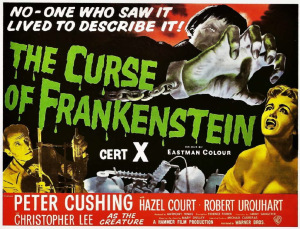
First released in 1957 and one of the films that put Britain’s Hammer Films on the map, The Curse of Frankenstein opens in Switzerland in the 19th century.  It’s a time of superstitious villagers, judgmental priests, aristocrats who dabble in science, and lots of cleavage.  It’s also a time when justice is harsh.  That’s something that Baron Victor Frankenstein (Peter Cushing) has discovered as he sits in a cell in prison, awaiting his execution date.

Baron Frankenstein has been convicted of the murder of a maid named Justine and the public is eager to see this haughty and eccentric aristocrat put to death.  Victor, however, claims that he is innocent of Justine’s murder.  As Victor explains to a visiting priest (Alex Gallier), he is guilty of many things but he didn’t kill Justine.

The story that Frankenstein tells the priest is a familiar one.  Victor inherited the Frankenstein estate when he was fifteen and, having always been interested in science, his hires a scientist named Paul Krempe (Robert Urquhart) to mentor him and ultimately collaborate with him on his experiments.  Even as he falls in love with and become engaged to his cousin, Elizabeth (Hazel Court), Victor becomes obsessed with the idea of creating a human being from perfect parts collected from the dead.

Victor puts his creation together, piece by bloody piece.  He has no trouble using a the body of a robber and the hands and eyes that purchases from the workers at the local morgue.  But when it come time to pick a brain, he wants to use the mind of a distinguished scientist.  Unfortunately, the scientist is still alive so Victor pushes him over a bannister.  That kills the professor but the removal of the brain does not go quite as smoothly as Victor was hoping.  The brain gets damaged when it’s removed.  The Creature (an intimidating Christopher Lee) is eventually brought to life but, with that damaged brain, all it wants to do is destroy and kill.  Victor isn’t happy about that but soon, he discovers that having a killer Creature has its uses.

As opposed to the well-meaning but obsessed version of the character that Colin Clive played in the original Frankenstein, The Curse of Frankenstein presents us with a Baron who is rather unstable from the start.  It’s not just that the Baron is obsessed with bringing the dead back to life.  It’s that he is fully willing to kill people for his experiment.  Perhaps his only redeeming quality could have been his love for Elizabeth but he screws up even that by having an affair with the ill-fated Justine (Valerie Gaunt).  From the start, the Baron’s main obsession is with his own power.  Elizabeth is ultimately just another pawn for him to control.

Considering how evil this film’s version of Baron Frankenstein is, it’s a good thing that he’s played by Peter Cushing.  Cushing gives an intense but charismatic performance as the Baron, capturing not only the character’s ruthlessness but also his fierce intelligence.  The tragedy of the film’s version of the story is not that the Baron’s experiment goes wrong but that the Baron did actually have the potential to do a lot of good for the world.  He’s smart and he’s determined but he’s lacking a conscience.  If anything, the Creature he builds is a representation of his own dark thoughts and desires.  The Baron is an aristocrat and the Creature is built out of common thieves and people who died in debt but they’re both different sides of the same coin.

Gory and fast-paced, The Curse of Frankenstein was a huge hit and it made stars out of both Cushing and Lee.  I tend to prefer Hammer’s Dracula films to its Frankenstein film but The Curse of Frankenstein holds up well as a portrait of what happens when madness and science collide.

Horror On The Lens: Tales From The Crypt (dir by Freddie Francis)


For today’s Horror on the Lens, we have 1972’s Tales From The Crypt, a British anthology film which features The Crypt Keeper (Ralph Richardson) informing five strangers of how they will die.  This classic, all-star film was based on stories that originally appeared in the Tales From The Crypt comic book.

In general, I’m not a huge fan of anthology films but Tales From The Crypt is an exception to that role.  It’s an entertaining collection of macabre stories and the cast is to die for …. maybe literally!

This Amicus-produced movie is probably best remembered for the segment in which Joan Collins is menaced by an evil Santa but the whole thing is good.

Horror On the Lens: The Blood Beast Terror (dir by Vernon Sewell)


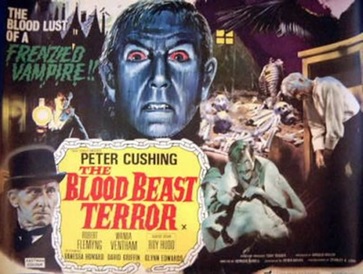
Today’s horror n the lens is the 1968 British film, The Blood Beast Terror!  This film stars the great Peter Cushing and it is perhaps the only film to ever feature a …. WERE-MOTH!

Seriously, how can you resist Peter Cushing and a Were-Moth?

Horror on the Lens: Island of the Burning Damned (dir by Terence Fisher)


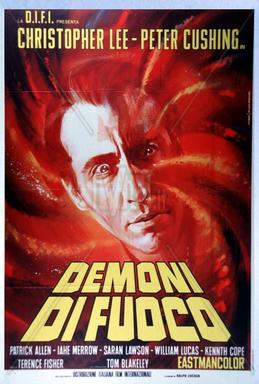
Today’s horror on the lens is a British 1967 science fiction film, featuring the team of Christopher Lee and Peter Cushing and directed by Terence Fisher!

This film is based on a novel that came out in 1959.  It was originally meant to be a movie for British television but, after the script was written, it was decided to instead turn it into a theatrical film.  The film was originally called Night of the Big Heat but, when it was subsequently released in the United States, the title was changed to Island of the Burning Damned.

It’s not October without Peter Cushing and Christopher Lee!

Horror Scenes That I Love: Peter Cushing in Horror of Dracula


Peter Cushing was a horror mainstay who played both heroes and villains, often appearing opposite Christopher Lee.  By most accounts, Cushing was a kind and old-fashioned British gentleman, one who was beloved by both his colleagues and his fans.  Christopher Lee described him as being his best friend and reportedly, never fully recovered from his sadness over Cushing’s death in 1994.

(Cushing’s long screen collaboration actually first started in 1948’s Hamlet, in which Cushing played Osric and Christopher Lee had an uncredited role as a spear carrier.)

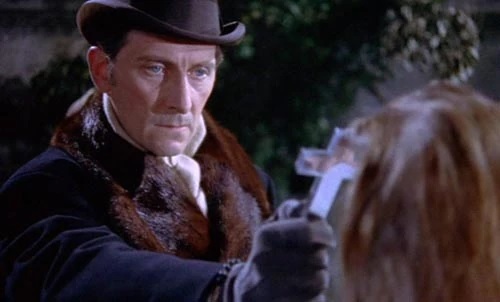
Though Hammer Films often cast Cushing as the mad Baron Van Frankenstein, I preferred his work as the stern but kindly Dr. Van Helsing.  This scene from 1958’s Horror of Dracula, in which Van Helsing drives a stake through Lucy and ends her eternal suffering, features Cushing at his best.  In this scene, we see both Van Helsing’s determination and also some hints of the kindness that Cushing brought to the role.

Live Tweet Alert: Watch Shock Waves with #ScarySocial


Shock Waves (1977, dir by Ken Wiederhorn)


As some of our regular readers undoubtedly know, I am involved in a few weekly live tweets on twitter.  I host #FridayNightFlix every Friday, I co-host #ScarySocial on Saturday, and I am one of the five hosts of #MondayActionMovie!  Every week, we get together.  We watch a movie.  We tweet our way through it.

Tonight, for #ScarySocial, I will be hosting 1977’s Shock Waves!

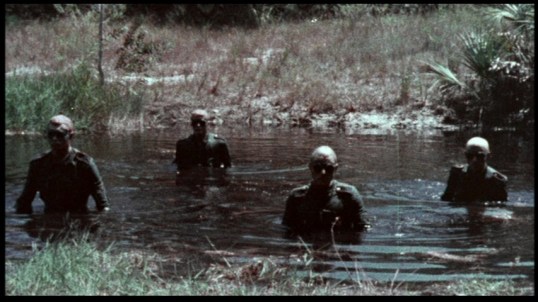
That’s right!  It’s John Carradine, Peter Cushing, and Brooke Adams in the best underwater zombie film ever made!

If you want to join us on Saturday night, just hop onto twitter, start the film at 9 pm et, and use the #ScarySocial hashtag!  The film is available on Prime, YouTube, and a few other streaming sites.  I’ll be there co-hosting and I imagine some other members of the TSL Crew will be there as well.  It’s a friendly group and welcoming of newcomers so don’t be shy.