David Hall (Matthew Faison) is an obnoxious horror writer who invites a group of associates and former friends to spend the night at a “haunted” hotel. He’s invited them because all of them are on the verge of suing him for writing about them in his latest book, The Resort. Over the course of the night, he plays cruel practical jokes on all of them. Finally, someone gets fed up and tosses him over a railing. The police arrest publisher Jordan White (Robert Stack) and charge him with the murder. It’s a good thing that Jordan’s best friend is Perry Mason (Raymond Burr).
Perry uses a cane in this movie and is not that active outside of the courtroom. That means that it’s up to Paul Drake, Jr. (William Katt) to do most of the investigating. As usual, Paul falls for an attractive, younger woman, in this case the hotel’s owner, Susan Warrenfield (Kim Delaney). Every movie features Paul falling for someone and then we never hear about them again. Does Paul have commitment issues?
I enjoyed this Perry Mason mystery. The hotel was a great location and I appreciated that the movie tried to add some horror elements to the story. The Perry Mason movies can be predictable so I always like it when they at least try to do something a little bit different. This was a fun entry in Perry Mason’s career.
Filmed in 1978 but not released until 1984, The Astral Factor tells the story of Roger Sands (Frank Ashmore).
Known as the Celebrity Killer, Roger is a serial killer who murdered women who reminded him of his famous mother. It may seem like Roger is destined to spend the rest of his life in prison but what the legal system didn’t consider is that Roger has the ability to not only move things with his mind but to also turn himself invisible. How did Roger get those powers? Who knows? At one point, Roger’s psychiatrist mentions that Roger was a student of the paranormal. Later, it’s revealed that he had several books about the supernatural in his bedroom. Apparently, Roger figured out how to do it himself.
Anyway, Roger is now invisible and soon, he has escaped from prison. He is determined to kill the five women who testified against him at his trial, both because they remind him of his mother and also because he blames them for sending him to prison. Roger strangles his victims, which in this case means that the actresses playing them have to pretend like they’re struggling with someone who can’t be seen. In fact, Roger spends almost the entire film in a state of invisibility.
How do you catch a killer who can’t be seen? It’s a fair question but police Lt. Charles Barnett (Robert Foxworth) might have the answer. Barnett’s solution involves grabbing a gun and keep firing it until you hit something. That’s a straight-forward solution but The Astral Factor is a pretty straight forward film. The film begins with Roger turning invisible and, to its credit, it doesn’t spend too much time trying to justify or explain Roger’s magical powers. The film understands that all the audience really needs to know is that Roger can’t be seen and that it’s up to Lt. Burnett to find a way to stop his killing spree.
The Astral Factor is a low-budget film, one that is full of formerly prominent performers who obviously showed up to get a quick paycheck. Sue Lyon, Marianne Hill, Leslie Parrish, and Elke Sommer all play potential victims and all of them look like they would rather be doing anything other than appearing in The Astral Factor. Robert Foxworth, to his credit, does his best to give a convincing performance as a level-headed cop who is forced to accept the reality of the paranormal. Not only is he having to investigate a series of murders but he’s having to do it on his birthday. Stefanie Powers plays his girlfriend, Candy. Candy often refers to herself in the third person whenever she’s having a conversation with her boyfriend. I tend to do the same thing so at least there was a character in this movie to whom I could relate. Knowing the rules of the genre, I spent the entire movie expecting Candy to be put in danger and I was actually impressed when my expectations were subverted and that didn’t happen.
With the exception of a few atmospheric scenes and an entertainingly garish and tacky dance number, the film itself has the rather flat look of a made-for-TV movie, though the occasional hint of nudity indicates that it was meant to be a theatrical release. As I mentioned at the start of this review, The AstralFactor was originally filmed in 1978 but it sat on the shelf until 1984. That’s when a slightly shortened version was released under the title The Invisible Strangler. Today, the film is available in countless Mill Creek Box Sets, under its original title and with its original run time restored.
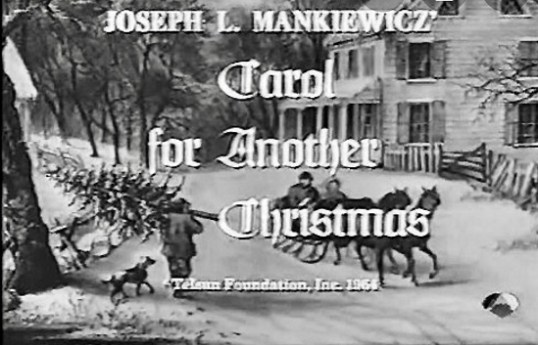
Daniel Grudge (Sterling Hayden) is a wealthy American industrialist who served in World War II and who, despite seeing first hand the horrors of Hiroshima, still believes that war is sometimes the only answer. He spends his Christmas Eve sitting in darkened study, thinking about his dead son (who was killed in combat) and listening to an old record. When his nephew, Fred (Ben Gazzara), stops by, it leads to an argument about American foreign policy. (Who stops by their uncle’s house on Christmas Eve to argue politics?) Fred is do-gooder. Daniel Grudge hates do-gooders.
So, naturally, it’s time for Daniel Grudge to be visited by three ghosts! The Ghost of Christmas Past (Steve Lawrence) takes Grudge first to a troop ship that is full of coffins, representing the dead of World War I. Then he forces Grudge to relive his own callous reaction to Hiroshima. Grudge sees how his actions upset the nurse (Eva Marie Saint) who was traveling with him. The Ghost of Christmas Present (Pat Hingle) invites Grudge to eat a feast in front of a camp full of refugees. The Ghost of Christmas Future (Robert Shaw) takes Grudge to the future where, after a devastating nuclear war, a buffoonish leader (Peter Sellers) encourages his followers to continue to make war and to live only for themselves. Grudge watches as his former butler (Percy Rodriguez) is murdered for advocating for peace. Back at his mansion, Fred shows up again and Grudge must now decide …. will he support the work of the United Nations?
YEEEEESH! What a heavy-handed movie! Really, I guess I shouldn’t be surprised at how unsubtle the film’s message was. Originally made for television, A Carol For Another Christmas was actually co-produced by the United Nations. It was the first of four UN-produced films that aired on ABC between 1964 and 1966. Seen today, with all that we know about the UN’s signature mix of corruption and incompetence, the film’s message seems almost laughably naïve. “Only the UN can bring peace,” the film says. Tell that to Israel, the next time that the UN passes a resolution condemning it for existing and defending itself. Say that only the UN can make the world a better place when some of the worst dictatorships on the planet are sitting on the Human Rights council.
The heavy-handed message aside, A Carol For Another Christmas was full of talent both behind and in front of the camera. This was the only TV movie to be directed by Joseph L. Mankiewicz and, whatever else one might say about the film, he was responsible for some intriguingly moody shots. The script was written by Rod Serling who, unfortunately, allowed his didactic tendencies to get the better of him and wrote a film where characters didn’t have conversations as much as they just gave speeches. The cast, however, is uniformly strong. Sterling Hayden, Robert Shaw, and Steve Lawrence are obvious stand-outs. Pat Hingle does fine until his role is diminished to one long harangue. Playing the so-called “Imperial Me,” Peter Sellers brings so much needed unpredictability to the film, even if his character is saddled with the film’s most heavy-handed moment. The Imperial Me teaches his followers that the individual is more important than the state and that everyone should focus on “me” instead of “we.” Cutting-edge satire this is not and again, there’s something rather offensive about the UN being held up as humanity’s last hope against rampant individualism.
This is very much a film of its time. The fear of nuclear war runs through every frame. The disillusionment that came with the assassination of John F. Kennedy is present in the film’s open-ended conclusion. What good is convincing one man when the rest of the world continues to think for itself? the film seems to be asking. Dickens, I think, would probably say that Serling missed the point of A Christmas Carol and it’s hard not to feel that Dickens would be correct.
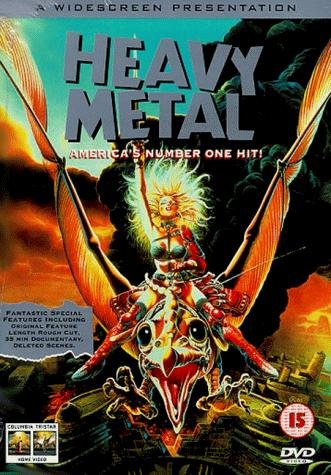
I think I was twelve when I first saw Heavy Metal. It came on HBO one night and I loved it. So did all of my friends. Can you blame us? It had everything that a twelve year-old boy (especially a 12 year-old boy who was more than a little on the nerdy side) could want out of a movie: boobs, loud music, and sci-fi violence. It was a tour of our secret fantasies. The fact that it was animated made it all the better. Animated films were not supposed to feature stuff like this. When my friends and I watched Heavy Metal, we felt like we were getting away with something.
Based on stories from the adults-only Heavy Metal Magazine, Heavy Metal was divided into 8 separate segments:
Soft Landing (directed by Jimmy T. Murakami and John Bruno, written by Dan O’Bannon)
Heavy Metal opens brilliantly with a Corvette being released from a space shuttle and then flying down to Earth, surviving reentry without a scratch. Who, after watching this, has not wanted a Space Corvette of his very own?
Grimaldi (directed by Harold Whitaker)
On Earth, a terrified young girl listens a glowing green meteorite called the Loc-Nar tells her that it is the source of all evil in the universe. This sets up the rest of the film, which is made up of stories that the Loc-Nar tells about its influence. The Loc-Nar is the film’s MacGuffin and, seen today, one of Heavy Metal’s biggest problems is that it has to find a way to force the Loc-Nar into every story, even if it meant sacrificing any sort of consistency about what the Loc-Nar was capable of doing. Even when I was twelve, I realized that the Loc-Nar was not really that important.
Harry Canyon (directed by Pino Van Lamsweerde, written by Daniel Goldberg)
In this neo-noir tale, futuristic cabby Harry Canyon (voiced by Richard Romanus) is enlisted to help an unnamed girl (voiced by Susan Roman) to find the Loc-Nar. Slow and predictable, Harry Canyon does feature the voice of John Candy as a police sergeant who attempts to charge Harry for police work.
Den (directed by Jack Stokes, written by Richard Corben)
Nerdy teenager David (voiced by John Candy) finds a piece of the Loc-Nar and is transported to the world of Neverwhere, where he is transformed into Den, a muscular, bald warrior. As Den, David gets to live out the fantasies of Heavy Metal‘s target audience. On his new planet, Den rescues an Earth woman from being sacrificed, overthrows an evil queen and a sorcerer, and gets laid. A lot. Den is the best segment in Heavy Metal, largely because of the endearing contrast between the action onscreen and John Candy’s enthusiastic narration.
Captain Sternn (directed by Paul Sebella and Julian Harris, written by Bernie Wrightson)
On a space station orbiting the Earth, Captain Lincoln F. Sternn is on trail for a countless number of offenses. Though guilty, Captain Sternn expects to be acquitted because he has bribed the prosecution’s star witness, Hanover Fiste. However, Hanover is holding the Loc-Nar in his hand and it causes him to tell the truth about Captain Sternn and eventually turn into a bloodthirsty giant. Captain Sternn saves the day by tricking Hanover into getting sucked out of an air lock.
Captain Sternn was a reoccurring character in Heavy Metal Magazine and his segment is one of the best. Eugene Levy voices Captain Sternn while Joe Flaherty voices his lawyer and Dean Wormer himself, John Vernon, is the prosecutor. Even National Lampoon co-founder Douglas Kenney provided a voice.
B-17 (directed by Barrie Nelson, written by Dan O’Bannon)
After the Loc-Nar enters Earth’s atmosphere, it crashes into a bullet-riddled World War II bomber, causing the dead crewmen within to reanimate as zombies. Scored to Don Felder’s Heavy Metal (Takin’ a Ride), B-17 is one of the shorter segments and its dark and moody animation holds up extremely well.
So Beautiful and So Dangerous (directed by John Halas, written by Angus McKie)
Nubile Pentagon secretary Gloria is beamed aboard a spaceship that looks like a giant smiley face. While she has sex with the ship’s robot captain, the two crew members (voiced by Harold Ramis and Eugene Levy) pour out a long line of cocaine and shout “Nosedive!” before snorting up every flake. So Beautiful and So Dangerous is so juvenile and so ridiculous that it is actually all kinds of awesome.
Taarna
In the film’s final and most famous segment, Taarna, the blond warrior was featured on Heavy Metal‘s poster, rides a pterodactyl across a volcanic planet, killing barbarians, and finally confronting the Loc-Nar. She sacrifices herself to defeat the Loc-Nar but no worries! We return to Earth where, for some reason, the Loc-Nar explodes and the girl from the beginning of the film is revealed to be Taarna reborn. She even gets to fly away on her pterodactyl. Taarna was really great when I was twelve but today, it is impossible to watch it without flashing back to the Major Boobage episode of South Park.
Much like Taarna, Heavy Metal seems pretty silly when I watch it today. But when I was twelve, it was the greatest thing ever.
The 1968 film The Sweet Ride takes the audience on a ride through Malibu and reminds us all that, in many ways, the 1960s sucked.
The Sweet Ride opens with actress Vicki Cartwright (Jacqueline Bisset) losing her top while swimming in the ocean. While Vicki panics and tries to figure out how to get back to the beach without anyone seeing her breasts, she’s spotted by a surfer named Denny McGuire (Michael Sarrazin). Denny hands her a towel and then leads her back to the beach house that he shares with aging tennis player Collie (Anthony Franciosa) and stoned musician Choo-Choo (Bob Denver).
The rest of the film is a 90 minute tour of California beach life in the late 60s. Despite Collie’s cynical warning against falling in love, Denny does just that, despite the fact that Vicki refuses to tell him anything about her past or even where she lives. Meanwhile, Collie spends his time hustling on the tennis court and the married Choo-Choo pretends to be gay in an attempt to get out of being drafted. (Choo-Choo probably could have gotten out of the draft by pointing out that he appears to be 40 years old but the filmmakers decided to have him walk around with a poodle and speak in falsetto. Just in case you had any doubt that this film was made in 1968…) It’s a mix of comedy, romance, and drama and it’s features footage of some real bands performing in actual Malibu nightclubs and that’s a good thing for all of us history nerds.
And, since The Sweet Ride was made in 1968, the whole film gets progressively darker as it reaches its conclusion. Choo-Choo does get drafted and it’s hard to believe he’ll survive a day in Viet Nam. Collie’s perfect life is revealed to be an empty facade. Denny realizes that his friends are all immature losers. And Vicki ends up getting assaulted by a high-power studio executive (Warren Stevens). It all leads to more violence, disillusionment, and general ennui.
For some reason, The Sweet Ride shows up on FXM fairly regularly. It’s a strange film because it doesn’t really work and yet it’s also compulsively watchable. It tries to be about everything and, as a result, it often feels like it’s about absolutely nothing. And yet, somehow, it remains compelling…
Why is the film compelling despite itself? It’s not because of the main characters, that’s for sure. The boys in the beach house are probably some of the least likable film protagonists in cinematic history. Anthony Franciosa gave some great performances in his career (check him out in A Face in the Crowd and Tenebrae) but Collie is such a smug jerk that you find yourself hoping that someone will just punch him in the face. Meanwhile, Denny tends to come across like a weak-willed and obsessive stalker and Choo-Choo — well, Choo-Choo often seems to be a character in a totally different movie. As for Vicki, her character pretty much exclusively exists to be victimized.
Ultimately, I think The Sweet Ride is watchable because it is such an imperfect time capsule. If I wanted to know what it was like to be alive in the 60s, The Sweet Ride is one of the films that I would watch. It’s not the best film ever made but it is a chance to look into the past.
(Incidentally, The Sweet Ride was directed by Harvey Hart, who also directed the underrated Shoot.)


 I think I was twelve when I first saw Heavy Metal. It came on HBO one night and I loved it. So did all of my friends. Can you blame us? It had everything that a twelve year-old boy (especially a 12 year-old boy who was more than a little on the nerdy side) could want out of a movie: boobs, loud music, and sci-fi violence. It was a tour of our secret fantasies. The fact that it was animated made it all the better. Animated films were not supposed to feature stuff like this. When my friends and I watched Heavy Metal, we felt like we were getting away with something.
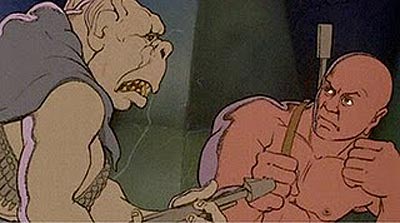 Den (directed by Jack Stokes, written by Richard Corben)
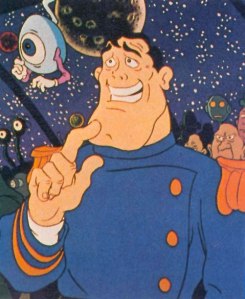 On a space station orbiting the Earth, Captain Lincoln F. Sternn is on trail for a countless number of offenses. Though guilty, Captain Sternn expects to be acquitted because he has bribed the prosecution’s star witness, Hanover Fiste. However, Hanover is holding the Loc-Nar in his hand and it causes him to tell the truth about Captain Sternn and eventually turn into a bloodthirsty giant. Captain Sternn saves the day by tricking Hanover into getting sucked out of an air lock.
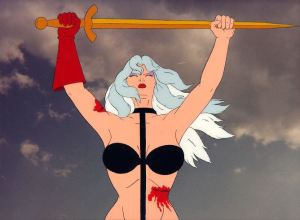 In the film’s final and most famous segment, Taarna, the blond warrior was featured on Heavy Metal‘s poster, rides a pterodactyl across a volcanic planet, killing barbarians, and finally confronting the Loc-Nar. She sacrifices herself to defeat the Loc-Nar but no worries! We return to Earth where, for some reason, the Loc-Nar explodes and the girl from the beginning of the film is revealed to be Taarna reborn. She even gets to fly away on her pterodactyl. Taarna was really great when I was twelve but today, it is impossible to watch it without flashing back to the Major Boobage episode of South Park.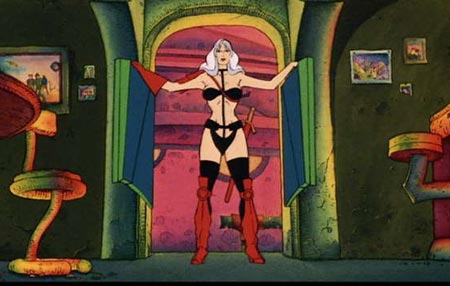

 Through the Shattered Lens