Lisa Reviews An Oscar Nominee: Coming Home (dir by Hal Ashby)


Well, here we are!  It’s January 1st.  In just a few days, the Oscar nominations will be announced and then, on February 9th, the winners will be revealed!  From now until the day of the ceremony, I will be taking a look at some of the films that were nominated for and won Oscars in the past.  As of this writing, 556 films have been nominated for best picture.  I hope that, some day, I will be able to say that I have seen and reviewed every single one of them.

Let’s start things off with the 1978 Best Picture nominee, Coming Home!

Coming Home takes place in California in 1968.  While hippies stand on street corners and flash peace signs, teenagers are being drafted and career military men are leaving for Vietnam and people continue to tell themselves that America is doing the right thing in Indochina, even though no one’s really sure just what exactly it is that’s going on over there.  At the local VA hospital, the wounded and the bitter try to recover from their wartime experiences while struggling with an often heartless bureaucracy and feelings of having been abandoned by their country.

When Marine Corps. Capt. Bob Hyde (Bruce Dern) is deployed to Vietnam, he leaves behind his wife, Sally (Jane Fonda).  Told that she can no longer live on the base while her husband is overseas, Sally gets an apartment, a new car, and eventually a new hairdo.  She also gets a new friend, Vi Munson (Penelope Milford).  Vi smokes weed and is critical of the war in Vietnam.  It doesn’t take long for Sally to start to enjoy the idea of being free and not having to cater to Bob’s every whim.  Sally even ends up volunteering at the local VA hospital.

That’s where she meets Luke (Jon Voight, looking youngish and incredibly sexy), a bitter but sensitive vet who, having gone to Vietnam and returned to the U.S. as a paraplegic, is now outspoken in his opposition to the war.  Luke is also friends with Billy (Robert Carradine), who is Vi’s shell-shocked brother.  When Luke and Sally first meet, they collide in a hallway and Sally gets a bag full of urine spilled on her.  It’s only later that Luke and Sally realize that they knew each other in high school and soon, they’re having an affair.  Luke, who is as gentle a lover as Bob is brutish, brings Sally to her first orgasm in a sensitively-directed scene that should be studied by any and all aspiring filmmakers.

Unfortunately, the problem with having an affair while your husband is away is that, eventually, your husband’s going to come back.  Bob returns from Vietnam and he’s no longer the confident and gung ho officer that he was at the start of the film.  He now walks with a pronounced limp and, like Luke, he’s angry.  However, whereas Luke has channeled his anger in to activism, Bob tries to keep his emotions bottled up.  (He does take the time to give the finger to a few protesters and, considering how obnoxious most of the protesters in this film are, you can’t help but feel that Bob may have had a point.)  When Bob discovers that Luke and Sally have been having an affair, he snaps….

Meanwhile, Billy is having a hard time readjusting to life, Vi is getting picked up by sleazy men in bars, and there’s a ventriloquist who shows up a few times.  There’s a lot going on in Coming Home and, at times, it feels like the film’s trying to cram in too much.  The film often seems a bit disjointed, with semi-documentary footage of Voight hanging out with real paraplegic vets awkwardly mixed in with didactic scenes of Sally turning against the war.

That the love story between Sally and Luke is so effective has far more to do with the performances of Jane Fonda and especially Jon Voight, than it does with anything in the film’s script.  Indeed, the script itself doesn’t seem to be too concerned with who Luke and Sally were before they collided in that hallway and it also doesn’t seem to be all that interested in who they’ll be after the end credits role.  As written, they’re just plot devices, specifically created and manipulated to express the film’s antiwar message.  But then you see Jon Voight’s haunted eyes while he’s listening to a group of vets discuss their experience or you hear the pain in his voice while he talks to a bunch of high school students and it’s those little moments and details that tell you who Luke is.  By that same token, Jane Fonda does a good job of showing each stage in Sally’s liberation, even if you can’t help but feel that the main reason Sally becomes an anti-war feminist is because she’s played by Jane Fonda.

Of course, in the end, the entire film is stolen by Bruce Dern.  You actually end up feeling very sorry for Bob Hyde (and, to the film’s credit, you’re meant to).  It would have been very easy to just portray Bob as being a close-minded pig but the film respects his pain just as much as it respects Luke’s anti-war activism and Sally’s need to be free.  In the end, you actually feel worse for Bob than you do for either Luke or Sally.  Bob is as much a victim of the war as anyone else in the film.

Coming Home was one of the first films about Vietnam to ever be nominated for best picture.  Jane Fonda and Jon Voight both won Oscars but the film itself lost to a far different look at the war in Vietnam, The Deer Hunter.

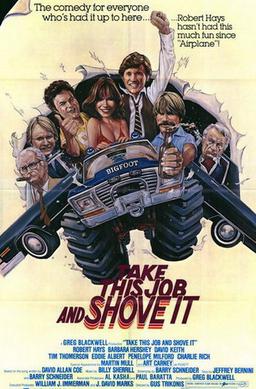
A Movie A Day #259: Take This Job And Shove It (1981, directed by Gus Trikonis)


Originally from a small town in Iowa, Frank Macklin (Robert Hays) is a hotshot young executive with The Ellison Group.  When Frank is assigned to manage and revitalize a failing brewery in his hometown, it is a chance for Frank to rediscover his roots.  His childhood friends (played by actors like David Keith, Tim Thomerson, and Art Carney) may no longer trust him now that Frank wears a tie but it only takes a few monster truck rallies and a football game in a bar for Frank to show that he is still one of them.  However, Frank discovers that the only reason that he was sent to make the brewery profitable was so that his bosses could sell it to a buffoonish millionaire who doesn’t know the first thing about how to run a business.  Will Frank stand by while his bosses screw over the hardworking men and women of the heartland?  Or will he say, “You can take this job and shove it?”

Named after a country music song and taking place almost entirely in places stocked with beer, Take This Job And Shove It is a celebration of all things redneck.  This movie is so redneck in nature that a major subplot involves monster trucks.  Bigfoot, one of the first monster trucks, gets plenty of screen time and, in some advertisements, was given higher billing than Art Carney.

A mix of low comedy and sentimental drama, Take This Job And Shove It is better than it sounds.  In some ways, it is a prescient movie: the working class frustrations and the anger at being forgotten in a “booming economy” is the same anger that, 35 years later, would be on display during the election of 2016.  Take This Job And Shove It also has an interesting and talented cast, most of whom rise above the thinly written dialogue.  Along with Hays, Keith, Thomerson, Bigfoot, and Carney, keep an eye out for: Eddie Albert, Royal Dano, James Karen, Penelope Milford, Virgil Frye, George “Goober” Lindsey, and Barbara Hershey (who, as usual, is a hundred times better than the material she has to work with).

One final note: Martin Mull plays Hays’s corporate rival.  His character is named Dick Ebersol.  Was that meant to be an inside joke at the expense of the real Dick Ebersol, who has the executive producer of Saturday Night Live when Take This Job and Shove It was filmed and who later became the president of NBC Sports?

Shattered Politics #28: Maidstone (dir by Norman Mailer)


Rip Torn in Maidstone

Rip Torn in Maidstone

If you ever find yourself on the campus of the University of North Texas and you need to kill some time, stop by the UNT Library, go up to the second floor, find the biographies, and track down a copy of Peter Manso’s Mailer: His Life and Times.  

Back in December of 2007, at a time when I really should have been studying for my finals, I spent an entire afternoon in the library reading Manso’s book.  I didn’t know much about Norman Mailer, the Pulitzer prize-winning writer and occasional political candidate, beyond the fact that he died that previous November and that a lot of older people who I respected apparently thought highly of his work.  Though Manso’s book had been written 20 years earlier, it still provided an interesting portrait of the controversial author.  It was largely an oral history, full of interviews with people who had known Mailer over the years.  As I skimmed the book, it quickly became apparent that, among other things, Mailer was a larger-than-life figure.

For me, the book was at its most interesting when it dealt with Mailer’s attempts to be a filmmaker.  In the 1960s, Mailer directed three movies.  All three of them also starred Norman Mailer and featured his friends in supporting roles.  All three of them were largely improvised.  And, when released into theaters, all three of them were greeted with derision.

Maidstone, Mailer’s 3rd film, was filmed in 1970.  In the film, Mailer played Norman Kingsley, an avante garde film director who is running for President.  Over the course of one weekend, while also working on a movie about a brothel, Norman meets with potential supporters and debates the issues.  And, of course, shadowy figures plot to assassinate Norman, not so much because they don’t want him to be President as much as they want him to be a martyr for their vaguely defined cause.

Just based on what I read in Manso’s book, it’s hard not to feel that the making of Maidstone could itself be the basis of a good movie.  Mailer essentially invited all of his friends to his estate and they spent 5 days filming, with no script. It was five days of drinking, drugs, and bad feelings.

At one point, actor and painter Herve Villechaize (who would later play Knick Knack in The Man With The Golden Gun) got so drunk and obnoxious that he was picked up by actor Rip Torn and literally tossed over a fence.  The unconscious Villechaize ended up floating face down in a neighbor’s pool.  After fishing Villechaize out of the pool, the neighbor tossed him back over the fence and shouted, “Norman, come get your dwarf!”

Eventually, after five days, filming fell apart.  Some members of the cast were okay with that.  And one most definitely was not..

Fortunately, Maidstone is currently available on YouTube so I watched it last night.  Unfortunately, the film itself is never as interesting as the stories about what went on behind the cameras.  Maidstone is essentially scene after scene of people talking and the effectiveness of each scene depends on who is in it.  For instance, Norman’s half-brother is played by Rip Torn, a professional actor with a big personality.  The scenes with Torn are interesting to watch because Rip Torn is always interesting to watch.  However, other scenes feature people who were clearly cast because they happened to be visiting the set on that particular day.  And these scenes are boring because, quite frankly, most people are boring.

And then you’ve got Norman Mailer himself.  For an acclaimed writer who was apparently quite a celebrity back in the day, it’s amazing just how little screen presence Norman Mailer had as an actor.  Preening for the camera, standing around shirtless and showing off his hairy back along with his middle-aged man boobs, Mailer comes across as being more than a little pathetic.  He’s at his worst whenever he tries to talk to a woman, giving off a vibe that’s somewhere between creepy uncle and super veiny soccer dad having a midlife crisis.

It’s an uneven film but, for the first half or so, it’s at least interesting as a time capsule.  For those of us who want to know what rich intellectuals were like in the late 60s, Maidstone provides a service.  However, during the second half of the film, it becomes obvious that Mailer got bored.  Suddenly, all pretense towards telling an actual story are abandoned and the film becomes about Mailer asking his cast for their opinion about what they’ve filmed so far.

And then, during the final 15 minutes of the film, Norman Mailer decides to have the cameramen film him as he plays with his wife and children.  This is apparently too much for Rip Torn who, after spending an eternity glaring at Mailer and undoubtedly thinking about everything he could have been doing during those five day if he hadn’t been filming Maidstone, walks up to Mailer, says, “You must die, Kingsley,” and then hits Mailer on the head with a hammer.

This, of course, leads to a long wrestling match between Mailer and Torn and, as the cameras roll, blood is spilled and insults are exchanged.  There’s a lot of differing opinions about whether this final fight was spontaneous or staged.  Having seen the footage, I get the impression that Mailer was caught off guard but that Torn probably let the cameraman know what he was going to do ahead of time.

Regardless, it’s hard to deny that the pride of Temple, Texas, Elmore “Rip” Torn, appears to be the one who came out on top.  After the fight, Mailer and Torn have a lengthy argument that amounts to Rip saying that he had to do it because it was the only way that the film would make sense while Mailer replies with some of the least imaginative insults ever lobbed by a Pulitzer winner.

(So basically, Rip Torn won both the physical and the verbal rounds of the fight.)

Anyway, you can watch the entire Rip Torn/Norman Mailer confrontation below.

Now, while the fight is really the only must-see part of Maidstone, it still has considerable value as a time capsule of the time when it was made.  You can watch it below!

Back to School #46: Heathers (dir by Michael Lehman)


heathers-movie-poster

Well, it had to happen.  We have finally reached the end of the 80s with this Back to School series of reviews.  The 80s are often considered to be the “Golden Age of Teen Films,” largely due to the efforts of director-writer-producer John Hughes.  In films like The Breakfast Club and Ferris Bueller’s Day Off, Hughes skillfully mixed teen comedy with teen drama and the end results were some of the best-remembered and most influential films ever made.  At the same time, it’s also can’t be denied that, even as he was dealing with real issues of class differences and sexuality, Hughes also tended to idealize his teenage protagonists.  They were often cast as noble savages, struggling to survive in a world that was exclusively run by cynical and judgmental adults.  In The Breakfast Club, Ally Sheedy says that when you grow up, your heart dies.  That, more than anything, defines the way that most of the great teen films of the 80s tended to view the world.

By the end of the 80s, John Hughes had stopped making films about high school and teenagers and so, it is perhaps appropriate that the final Back to School review of the 80s should be for a 1989 film that often time seems to be taking place on a totally different plant from the films of John Hughes.  If Hughes told us that your heart dies when you grow up, Heathers would seem to suggest that most people’s hearts were never alive to begin with.

Heathers takes place at Westerburg High, a school full of student so rich that their mascot is a Rottweiler.  Westerburg is run by a clique of three mean girls, all of whom are named Heather.  Heather Chandler (Kim Walker) is their leader.  Cheerleader Heather McNamara (Lisanne Falk) is weak-willed and insecure.  And finally, Heather Duke (Shannen Doherty) is the smartest of the Heathers.  She’s also bulimic.  Now, there is a fourth member of the ruling clique but she’s a bit of an anomaly because she’s neither mean nor named Heather.  Instead, her name is Veronica (Winona Ryder) and she is valued for her ability to forge signatures.

Heathers

Since joining the Heathers, Veronica has drifted away from old friends like Betty Finn (Renee Estevez).  And though Veronica quickly realizes that she doesn’t really belong with the Heathers, she doesn’t know how she can break free without also destroying her reputation of Westerburg.  Then, she meets J.D. (Christian Slater), a prototypical rebel with a cause.  J.D. is not only an outsider at Westerburg but he’s proud of it.  Soon, he and Veronica are a couple and J.D. is pulling Veronica into his plans to destroy the social hierarchy of Westerburg High.

When a practical joke arranged by J.D. and Veronica leads to the accidental death of Heather Chandler, J.D. convinces Veronica to forge a suicide note.  As a result, Heather Chandler is canonized by the same students that she previously terrorized.  However, J.D. is not done killing.  With each new death (and with each forged suicide note), a new social hierarchy starts to form at Westerburg until, eventually, J.D. comes up with a plan that owes a bit to the end of Massacre at Central High

fashion-film-volume-8-heathers--large-msg-132147013822

Heathers is a darker than dark comedy and one that I imagine probably could not be made today.  (To be honest, I’m a little bit surprised that it could be made in 1989.)  Seriously, a comedy where one of the main plot points is that students become more popular after everyone has been fooled into thinking they committed suicide?  (Not to mention a scene where a grieving father shouts, “I love my dead gay son!”)  People would get so offended if this film was made today but you know what?  They would be totally missing the point.  The film isn’t making fun of suicide as much as it’s exposing the hypocrisy of a society that only seems to care about people after they die. To me, the most important scenes aren’t the ones where people react to the fake suicides.  Instead, the heart of Heathers‘s dark vision is to be found in the scene where a true outcast like Martha Dunnstock (Carrie Lynn) fails in her attempt to commit suicide and is ridiculed by the same students and teachers who were previously patting themselves on the back at Heather Chandler’s funeral.

Heathers is dark but it’s also a genuinely funny film, filled with great lines and performances.  (“Fuck me gently with a chainsaw,” is my personal favorite.)  It’s a film that still carries quite a satiric bite and a perfect film with which to end the 80s.

8-Heathers-quotes


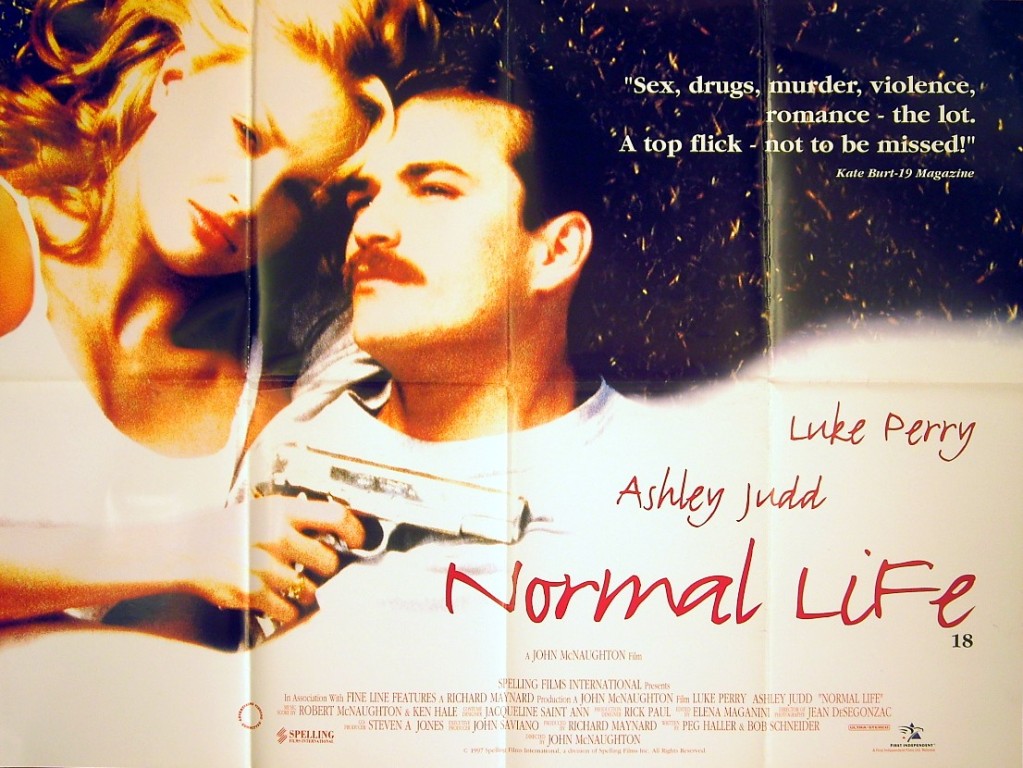
Embracing the Melodrama #44: Normal Life (dir by John McNaughton)


Digital StillCamera

Out of all the sin-in-the-suburbs films that I’ve watched recently, 1996’s Normal Life is one of the best.  Judging from the lack of reviews of this film online, it also appears to be one of the least known.  So, allow me to rectify that by telling you a little about Normal Life.

In Normal Life, Luke Perry plays Chris Anderson, a seemingly naive police officer.  From the minute that we first see Chris, it’s obvious that he’s a cop.  With his thinning hair, his anonymous mustache, and his deliberately calm and controlled manner, there’s no way that Chris could be anything else.

One night, Chris goes out to a bar and sees Pam (Ashley Judd) getting into a fight with her date and cutting her hand.  Chris, playing the hero, bandages it and then asks her for a dance.  For him, it’s love at first sight.  Soon, Chris is taking Pam on dates to the shooting range and, before you know it, they’re married.  Pam, it soon becomes obvious, is emotionally unstable.  She deals with disagreements by threatening to kill herself and trashing the apartment that she shares with Chris.  She makes little secret of how little respect she has for Chris’s family and she often goes out of her way to embarrass him.  However, Chris will never leave her because he’s in love with the idea of being the only one who can save her.  And, even though Pam may not admit it, she wants to be saved.  Chris gives her stability while Pam gives Chris a taste of excitement that his life would otherwise lack.

Unfortunately, even after Chris loses his job, Pam continues to spend money extravagantly.  Soon, in order to support his wife, Chris starts to utilize his law enforcement experience by robbing banks.  Now that they finally have money, they are able to move to a perfect house in the suburbs and Chris is able to pursue his lifelong dream of opening and running a small used bookstore.

However, Pam eventually discovers that Chris is a bank robber and soon decides that she wants to rob a bank with him.  Chris knows that it’s a mistake to involve the unpredictable Pam but, as the film makes clear, he will always chose her happiness over everything else…

Normal Life was directed by John McNaughton, who also directed the seminal serial killer film Henry: Portrait of a Serial Killer.  And while Normal Life is a far less disturbing film than Henry, it does utilize a similar technique of emphasizing just how banal Chris’s suburban lifestyle really is.  When Chris isn’t robbing banks or dealing with his suicidal wife, he’s essentially a rather boring guy who is perfectly happy to spend his days running his little bookstore.  The best scenes in the film are the ones where Chris simply walks to the doorway of his house, the placid calmness of the suburbs providing a strong contrast to what we know is going on inside that house and inside Chris’s head.

Of the two lead performers, Ashley Judd has the showier role and she does give a fantastically brave performance, providing an honest and sympathetic portrayal as a character who is not always pleasant to watch.  Luke Perry, however, is even better.  Whereas Judd is playing a character who is literally incapable of hiding her emotions, Perry has to play a character who keeps all of his emotions hidden.  Judd’s performance is almost totally external while Perry’s performance is largely internal and, when those two techniques come together, it tells us all we need to know about why Chris and Pam are fated to be together.

Normal Life is a film that you need to see.  And you can watch it below!

Embracing the Melodrama #33: Endless Love (dir by Franco Zefferilli)


endless love

Do anyone remember a movie that came out in February that was called Endless Love? If you do, you’ve got a better memory than I do because, even though I saw it, I really can’t really remember much about it beyond the fact that I was disappointed by it. I know I had high hopes because the trailer was damn sexy but the film itself just turned out to be rather bland and forgettable.

Well, the 2014 version of Endless Love may have been forgettable but the same can not be said of the original 1981 version.

Endless Love tells the sweet story of two teenagers who want to have sex.  Well, actually, it’s debatable how sweet the story is  because the boy is a creepy stalker-type and the girl appears to be suffering from Stockholm Syndrome but director Franco Zefferilli directs the film as if he’s bringing to life the greatest romance of all time.  The entire film is full of lush images and the swelling musical score suggests that we should hope that these two end up together, even as the boy is burning down the girl’s house.

(Believe me, I love elaborate expressions of love and romantic feelings as much as the next girl but I draw the line at burning down my house.)

David (Martin Hewitt) and Jade (Brooke Shields) both live in the suburbs of Chicago.  Jade’s parents are aging hippies.  Her father (Don Murray) may smoke weed with the neighborhood teenagers and play the trumpet at wild parties but he’s still very protective of his daughter.  Her mother (Shirley Knight) is far more permissive and open-minded.  Jade’s brother, Keith (played by a really young and dangerous-looking James Spader), is friends with David and invites him to a party at his house.  David meets Jade and soon, the two of them are obsessed with each other.

However, not everyone is happy about their newfound love.  Jade’s father doesn’t trust David.  Keith soon starts saying stuff like, “Just because you’re fucking my sister, that doesn’t make you a part of the family.”  (And, as rude as that may be, it’s really hot when said by a young and dangerous-looking James Spader.)  Meanwhile, David’s mom (Beatrice Straight) doesn’t want David hanging out with a family that she describes as being “a relic of the 60s.”

Eventually, Jade is spending so much time thinking about David that her grades start to suffer and she finds that she can no longer sleep.  She starts stealing her father’s sleeping pills.  When she’s caught in the act, David is forbidden from seeing her until the end of the school year.  “It’s only 30 days,” Jade’s mom promises him.

Well, that’s 30 days too long for David!

Taking the advice of a young arsonist (played, in his film debut and with a notably squeaky voice, by Tom Cruise), David decides to set Jade’s house on fire.  His original plan is to save Jade and her family and be hailed as a hero.  Instead, the fire ends up raging out of control and the house is destroyed.

Arrested for arson, David spends some time in a mental asylum and is legally forbidden from ever seeing Jade or her family again.  Eventually, David gets out of the asylum and that’s when the movie gets really weird…

Endless Love is a really creepy movie that makes the mistake of equating stalking with true romance.  There’s no other way to put it.  Yet, at the same time, Franco Zefferilli’s images are so vividly romantic and Martin Hewitt and Brooke Shields are both so physically attractive (never mind that neither one of them apparently knew how to act back in 1981) that you can’t help but sometimes get swept up in the film’s silliness.  Add to that, the film has a great soundtrack and you also get a chance to see Tom Cruise act like a total jackass.

Check it out below!