“Hello to my little friend!”
Hi, little friend….
BOOM!
The 1983 film, Scarface, is a misunderstood film. As we all know, it’s the story of Tony Montana (Al Pacino), who comes to Miami from Cuba along with his friend, Manny (Steven Bauer). In return for murdering a former member of Castro’s government, Tony is given a job working for Frank Lopez (Robert Loggia). When it becomes obvious that Tony is becoming too ambitious and might become a threat to him, Frank attempts to have Tony killed. However, the assassination attempt fails, Tony murders Frank, and then Tony becomes Miami’s richest and most powerful crime lord. Soon, Tony is burying his face in a mountain of cocaine while making deals with a sleazy Bolivian drug lord named Alejandro Sosa (Paul Shenar). Tony also marries Frank’s mistress, Elvira Hancock (Michelle Pfieffer), though it’s obvious from the start the the only person that Tony truly loves is his sister, Gina (Mary Elizabeth Mastrantonio). Anyway, it all eventually leads to a lot of violence and a lot of death. Even F. Murray Abraham ends up getting tossed out of a helicopter, which is unfortunate since his character was a lot of fun.
Scarface is a famous film, largely because of Oliver Stone’s quotable dialogue and the no holds barred direction of Brian DePalma. However, I think that people get so caught up on the fact that this is a classic gangster film that they miss the fact that Scarface is also an extremely dark comedy. It satirizes the excess of the 80s. Once Tony reaches the top of the underworld, he becomes a parody of the nouveau riche. He moves into a gigantic house and proceeds to decorate it in the most tasteless way possible and there’s something oddly charming about this crude, not particularly bright man getting excited over the fact that he can finally afford to buy a tiger. Towards the end of the film, there’s a scene where Tony rants while lounging in an indoor hot tub while Elvira languidly snorts cocaine and complains about the crudeness of his language and, at that moment, Scarface becomes a bit of a domestic comedy. Tony’s reached the top of his profession, just to discover that it takes more than a live-in tiger and a wardrobe of wide lapeled suits to achieve true happiness. So, he ends up sitting glumly in his office with a mountain of cocaine rising up in front of him. “The world is yours” may be Tony’s motto but it turns out that the world is extremely tacky. For all of his attempts to recreate himself as a wealthy and sophisticated man, Tony is still just a barely literate criminal with a nasty scar and a sour disposition. The only thing he’s gotten for all of his ruthless ambition is an order of ennui with a cocaine appetizer.
I’ve always found Brian DePalma to be an uneven director. He has a very distinct style and sometimes that style is perfectly suited to the story that he’s telling (i.e., Carrie) and sometimes, all of that style just seems to get in the way (i.e. The Fury). Scarface, however, is the ideal story for DePalma’s over-the-top aesthetic. DePalma’s style may be excessive but Scarface is a film about excess so it’s a perfect fit. For that matter, you could say the same thing about Oliver Stone’s screenplay. Stone has since stated that he was using almost as much cocaine as Tony Montana while he wrote the script. The end result of the combination of Stone’s script, DePalma’s hyperactive direction, Pacino’s overpowering lead performance, and Giorgio Moroder’s propulsive score is a film that feels as if every minute is fueled by cocaine. It’s not just a film that’s about drugs. It’s also a film that feels like a drug.
Scarface is a big movie. It runs nearly three hours, following Tony from his arrival in the United States to his final moments in his mansion, taking hundreds of bullets while grandly announcing that he’s still standing. (Even after all of the bad things that Tony has done — poor Manny! — it’s impossible not to admire his refusal to go down.) It’s also a difficult movie to review, largely because almost everyone’s seen it and already has an opinion. Personally, I think the film gets off to a strong start. I think the scenes of Tony ruthlessly taking control of Frank’s empire are perfectly handled and I love the scenes where Pacino and Steven Bauer just bounce dialogue off of each other. They’re like a comedy team who commits murder on the side. I also loved the “Take it to the limit” montage, which belongs in the 80s Cinema Hall of Fame. At the same time, I think the final third of the movie drags a bit and that Tony’s sudden crisis of conscience when he sees that a man that he’s supposed to murder has a family feels a bit forced. It also bothers me that Elvira just vanishes from the film. At the very least, the audience deserved more of an explanation as to where she disappeared to.
But no matter! Flaws and all, Scarface is a violent satire that holds up surprisingly well. Al Pacino’s unhinged performance as Tony Montana is rightly considered to be iconic. Pacino’s gives such a powerhouse performance that it’s easy to forget that the rest of the cast is pretty impressive as well. I particularly liked the wonderfully sleazy work of F. Murray Abraham and Paul Shenar. That said, my favorite character in the film remains Elvira, if just because her clothes were to die for and she just seemed so incredibly bored with all of the violent men in her life. She goes from being bored with Frank to being bored with Tony and how can you not admire someone who, even when surrounded by all Scarface’s excess, just refuse to care?
Scarface is an offer that you can’t refuse.

Previous Offers You Can’t (or Can) Refuse:
- The Public Enemy
- Scarface (1932)
- The Purple Gang
- The Gang That Could’t Shoot Straight
- The Happening
- King of the Roaring Twenties: The Story of Arnold Rothstein
- The Roaring Twenties
- Force of Evil
- Rob the Mob
- Gambling House
- Race Street
- Racket Girls
- Hoffa
- Contraband
- Bugsy Malone
- Love Me or Leave Me
- Murder, Inc.
- The St. Valentine’s Day Massacre

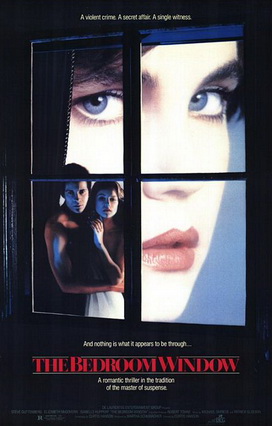 The Bedroom Window opens with quite a quandary. Sylvia (Isabelle Huppert) has just witnessed a woman named Denise (Elizabeth McGovern) being attacked by a serial rapist/killer named Carl (Brad Greenquist). The problem is that the window that Sylvia’s standing at is located in the bedroom of Terry Lambert (Steve Guttenberg). Sylvia is having an extramarital affair with Terry and she knows that there’s no way to tell the police what she saw without also exposing the affair. Terry decides that he’ll go to the police and tell them what Sylvia witnessed but he will claim to have seen it himself.
 Through the Shattered Lens