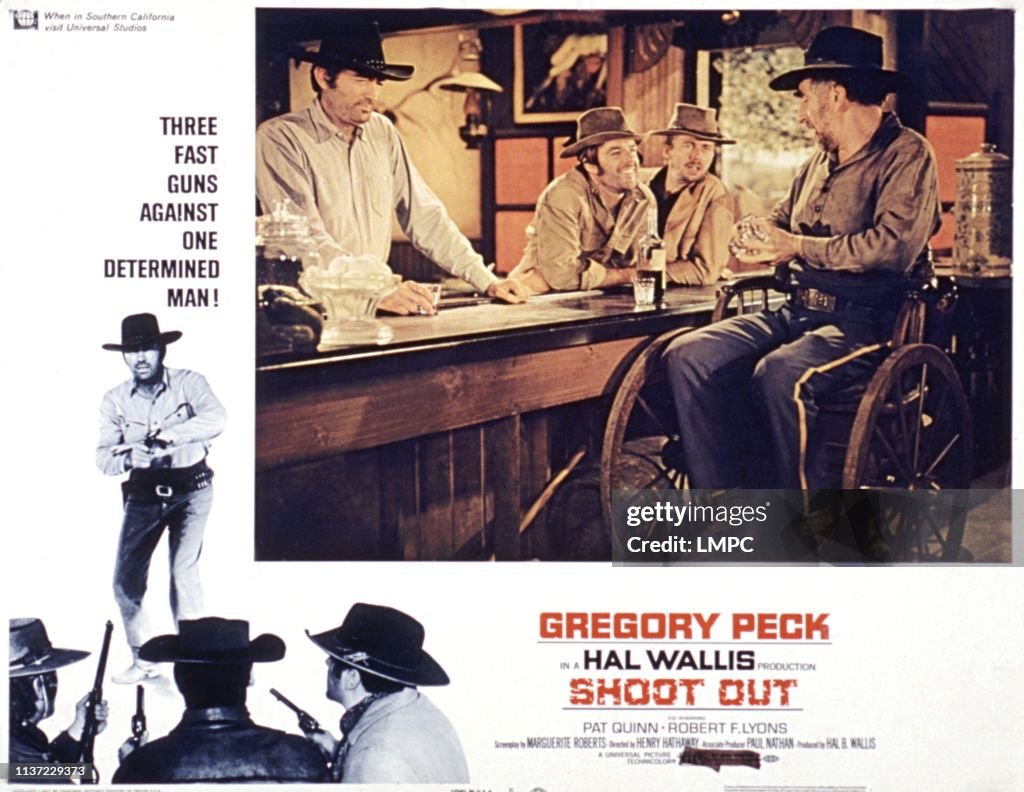
Brad reviews SHOOT OUT (1971), starring Gregory Peck & Robert F. Lyons! 


After serving a stretch at the Canon City penitentiary, Clay Lomax (Gregory Peck) gets out with only one thing on his mind… revenge on his former partner Sam Foley (James Gregory), who shot him in the back during a bank robbery, leaving him to take the rap. Foley isn’t a fool, though, so he’s hired a trio of young punks, Bobby Jay (Robert F. Lyons), Skeeter (John Davis Chandler), and Pepe (Pepe Serna) to surveil Lomax and let him know if he’s heading to his home in Gun Hill with payback on his mind. These guys are about as crazy as it gets, and they make two major mistakes. First, they kill Lomax’s friend Trooper (Jeff Corey) who lets him know where Foley is with his dying breath. Second, they kidnap the prostitute Alma (Susan Tyrell) just because they want to treat her like crap and have fun with her, which turns out to be a dumb move. Interrupting Lomax’s quest for revenge, he finds himself being forced to care for a young child named Decky (Dawn Lyn), who just may be his daughter with a lady back in Kansas City who used to be his “friend.” Looking after Decky, and then meeting and falling for the widow Juliana Farrell (Patricia Quinn), Lomax is soon facing off against his most dangerous foe, the crazed Bobby Joe, as he attempts to protect all these new people that he loves so he can move on with his life. But is it all too late?!!

I love westerns, but I must admit that I’m not the biggest fan of director Henry Hathaway’s SHOOT OUT. Hathaway has directed some of my favorite actors and movies, like Charles Bronson’s debut film with Gary Cooper, YOU’RE IN THE NAVY NOW (1951), along with the Jimmy Stewart film CALL NORTHSIDE 777 (1948) and John Wayne’s Oscar winning TRUE GRIT (1969). Unfortunately, it seems his best years are behind him, and he would only direct one more film after this, the less than excellent black action film HANGUP (1974). This isn’t exactly Gregory Peck’s best work either. Coming nine years after his Oscar winning performance in TO KILL A MOCKINGBIRD (1962), this is definitely not even close to that kind of level. Don’t get me wrong, I do enjoy his turn as Lomax when he’s the wronged outlaw looking for revenge, but I don’t really care at all for his part as the reluctant father figure trying to deal with the six-year-old Decky. I found Dawn Lyn to be more annoying than cute in the role, and this storyline distracted me from the revenge plot that I actually enjoyed. As a co-host of the “This Week in Charles Bronson Podcast,” we had the opportunity to interview Robert F. Lyons, who plays the bad guy, Bobby Jay Jones. I specifically asked him about this film and what it was like working with Gregory Peck. While he enjoyed working with Peck, his response about the film itself was telling…. “The work in there is not my work.” If you’ve watched much of the excellent actor’s work before, you can immediately understand what he means. Lyons goes so over-the-top as the spying outlaw Bobby Jay Jones, that his performance is inconsistent with the bulk of his career. Lyons told us that his performance was orchestrated by Hathaway in a way that he disagreed with, and he essentially disowns his work in the film. You can see a similar vibe with his “gang” that includes the actors John Davis Chandler and Pepe Serna. 

While I’m not a huge fan of the overall direction of the storyline or the focus of some of the main performances in SHOOT OUT, I am appreciative of the genre and the classic western stars that Hathaway cast in supporting roles. I especially enjoy seeing Jeff Corey in the small but pivotal role as the wheelchair bound Trooper, Paul Fix as the train brakeman who delivers Decky and a stack of cash to Lomax, and Arthur Hunnicutt as the ranch owner who barters with Lomax over the price of a pony. Hunnicutt is a particular favorite of mine although his role here is very small. Nominated for an Oscar for his performance in Howard Hawks’ THE BIG SKY (1952), Hunnicutt is from the small town of Gravelly, Arkansas, which is not far from where my own family is from. He even attended the same college that I graduated from, the University of Central Arkansas, which was known as the Arkansas State Teachers College when he (and my dad) went there. And then there is the setup of the revenge scenario at the beginning and the final showdown at the end, classic staples of the western genre. These are enjoyable and satisfying moments as Lomax settles his scores and the bad guys get their comeuppance.

Overall, SHOOT OUT is best enjoyed by fans of old school westerns and star Gregory Peck. It veers aways from the best storylines of the genre and wastes a lot of time with uninteresting melodrama, but it does offer us another chance to see some of our great character actors doing what they do. That means something to me. 

I’ve included our podcast episode with Robert F. Lyons below. He discusses SHOOT OUT at around the 1:00:30 mark.
Music Film Review: The Rocky Horror Picture Show (dir by Jim Sharman)


It feels strange to actually watch The Rocky Horror Picture Show without an audience.

I say this because the film is actually far better known for its fans than anything else.  First released in 1975 to middling reviews and, at first, anemic box office returns, The Rocky Horror Picture Show went on to become the first great cult film.  It’s literally been playing in theaters for 25 years, which has to be some sort of record.  When one sees Rocky Horror Picture Show in a theater, one does not merely sit back and watch in a state of suspended animation.  Instead, most of the audience becomes a part of the show.  They yell, they dance, and many of them return night-after-night.  I have been to two midnight showings of the Rocky Horror Picture Show and I have to admit that it was actually pretty intimidating both times.  The people in the audience — the veterans who knew every line and knew exactly what to do — were, more or less, friendly.  I’ve read some online horror stories about people who felt like they weren’t welcome the first time they attended a showing.  I had the opposite experience.  No one was rude, no one glared.  It was definitely a cliquey group but I felt as if they had earned the right to be in their clique.  No one seemed to be bothered by the fact that I was mostly there just to observe.  (I should also mention that neither showing that I attended demanded that the first-time watchers stand up or go to the front of the theater or anything like that.  Apparently, there’s quite a few people online who got upset over being singled-out as “virgins” and never got over it.)  But it was intimidating in much the same way as meeting a friend of a friend is intimidating or exploring a new town is intimidating.  I was surrounded by people who had a deep connection with each other, one that had been forged by sharing the same experience for years.  It was a communal experience that was actually touching to see, even if I never stopped feeling like an outsider.

It’s interesting to compare the midnight showings of The Rocky Horror Picture Show to the midnight showings of The Room.  I attended several midnight showings of The Room and I have to admit that I eventually soured on them as it became clear that many people were showing up to taunt the film as opposed to enjoying it for the odd, communal experience that it was.  The last few The Room showings that I attended were filled with a hostility that left me feeling a bit uncomfortable.  Whereas The Room’s cult has often felt a bit mean-spirited (as if everyone had gathered together to laugh at Tommy Wiseau for thinking he could make a movie), The Rocky Horror Picture Show‘s cult is based on a genuine love for the film.

As for the film itself, I watched it last month without an audience and I judged it solely as a film.  The pacing is a bit off and, without the group experience, it’s a lot easier to notice that the film’s storyline doesn’t make a bit of sense, though that was undoubtedly deliberate on the part of the filmmakers.  That said, Tim Curry’s performance still gives the film a jolt of energy, recapturing your attention and holding it until the film comes to a close.  (The genius of Curry’s performance as that, as flamboyant as it is, he still plays Dr. Frank-n-Furter as being an actual characters with feelings and emotions.  He doesn’t just coast on attitude.  One need only compare him to Laverne Cox in the 2016 TV production to see how strong Curry’s performance is.)  Susan Sarandon brings some depth to her performance as Janet and, if Barry Bostwick is a little on the dull side of Brad …. well, the heroes who appeared in the film that Rocky Horror sends up were rarely that exciting.  I enjoyed the snarky humor of Richard O’Brien’s performance and the energy that Meat Loaf brought to the production.  Charles Gray, in the role of the Criminologist, really doesn’t get enough credit for holding the film’s disparate parts together.

In the end, when viewed as a film as opposed to a communal experience, The Rocky Horror Picture Show is undoubtedly flawed but it’s still energetic enough to work.  The love for the old sic-fi films comes through and Tim Curry’s uninhibited performance works with or without an audience.  The Rocky Horror Picture Show is a film that brings people together and I hope it continues to do so.

Horror On TV: Hammer House Of Horror Episode #1: Witching Time (dir by Don Leaver)


Hammer House of Horror was a British anthology series that ran for 13 episodes in 1980.  As you can tell by the title, the show was produced by Hammer Films.  Each episode dealt with a different type of horror and featured some of the best actors working in British film and television.

The first episode aired on September 13th, 1980.  Lucinda Jessup (Patricia Quinn), a 17th century witch, escapes from a pack of witch hunters by traveling into the future.  Discovering that her former home is now occupied by a film composer (Jon Finch) and his wife (Prunella Gee) and that the marriage is not a happy one, Lucinda puts her mark  on the composer.  Can the man’s unfaithful wife save him from the witch?  The husband isn’t all that sympathetic and I think that many viewers will probably feel that it might be for the best to just let the witch have him but this is still a well-acted and atmospheric episode.  Keep an eye for Ian McCulloch of Zombi 2 fame as the wife’s lover.

This episode also features some brief nudity so don’t watch it at work.


Embracing the Melodrama Part II #58: An Unmarried Woman (dir by Paul Mazursky)


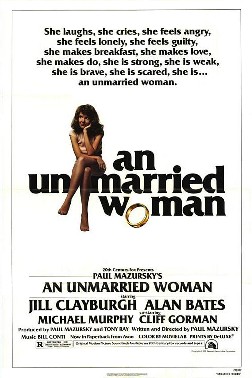
Unmarried_womanI have mixed feelings about the 1978 best picture nominee An Unmarried Woman and I really wish I didn’t because this is one of those films that I really want to love.

Erica (Jill Clayburgh, who did not win the Oscar that she deserved for this film) appears to have the perfect life.  She works at an art gallery in New York.  She has smart, sophisticated friends.  She has an accomplished teenager daughter (Lisa Lucas).  She has a beautiful apartment.  Early on in the film, she wakes up and literally dances from her bedroom to the living room and back again.

And, of course, she has a husband.  His name is Martin and he’s a successful stock broker.  Of course, there are hints that everything might not be perfect.  She and Martin are a cute couple but they’re not exactly passionate.  One need only watch Erica carefully wash dogshit off of Martin’s expensive running shoes to tell who is getting the most out of the marriage.  Add to that, Martin is played by Michael Murphy and, as anyone familiar with 70s cinema knows, Murphy specialized in playing well-dressed, outwardly friendly heels.  And, of course, the film is called An Unmarried Woman and the title can’t be true as long as Erica’s married.

So, you’re not exactly surprised when Martin suddenly breaks down in tears and tells Erica that he’s fallen in love with a younger woman and that he’s leaving her.

The rest of the film deals with Erica’s attempts to adjust to suddenly being an unmarried woman and a single mom.  We follow as she struggles to get back her confidence.  The scenes of Erica dealing with her suddenly rebellious daughter really struck home to me, largely because I’m a rebellious daughter of divorce myself.  There’s a few great scenes of Erica turning to her girlfriends for support.  (Importantly, one of Erica’s friends is happily married, as if the film wants to make sure that we understand that not all marriages are as bad as Erica and Martin’s.)  We watch as Erica starts dating again, having a memorable one-night stand with the obnoxious but oddly likable Charlie (Cliff Gorman).  Finally, she ends up dating a rugged, bearded artist (Alan Bates) and she has to decide whether she wants to remain independent or not.

And it’s all amazingly well-acted and fun to watch but I have to admit that I was a little bit disappointed the first time that I saw An Unmarried Woman.  For some reason, I couldn’t bring myself to like it as much as I wanted.  The more I thought about it, the more clear my issue with it became.

As a character, Eric was simply too wealthy.

As I watched Erica struggle with being an unmarried woman, it was hard for me not to compare her struggles with the struggles that my own mom had to deal with after her divorce.  The film, and specifically Clayburgh’s lead performance, got so much right.  But there’s a difference — a huge difference — between an unmarried woman who has an apartment in Manhattan and a dream job at an art gallery and a woman like my mom who worked multiple jobs, spent hours worrying about how to pay the bills, and who had to do all of this while dealing with four stubborn daughters.  And so, whenever I saw Erica talking to her therapist about how upset she was over suddenly being single, there was a part of me that wanted to say, “Try doing it while living in South Dallas and having to deal with a brat like me.”

The second time that I watched An Unmarried Woman, I was able to better appreciate the film.  Now that I knew that Erica’s experiences were not going to be universal, I could focus on Jill Clayburgh’s great performance in the lead role.  I could marvel at how marvelously wimpy Michael Murphy was in the role of Martin.  I could laugh at Cliff Gorman’s comedic performance.  As for Alan Bates as that bearded artist — well, sorry, that still didn’t work for me.  Eventually, I could accept Erica’s perfect apartment and her perfect job but suddenly introducing a perfect boyfriend who also happened to be a passionate and financially successful painter; it all felt like a bit too much.

But, in the end, An Unmarried Woman is a good film and a valuable historical document of its time.  If for no other reason, see it for Jill Clayburgh’s lead performance.

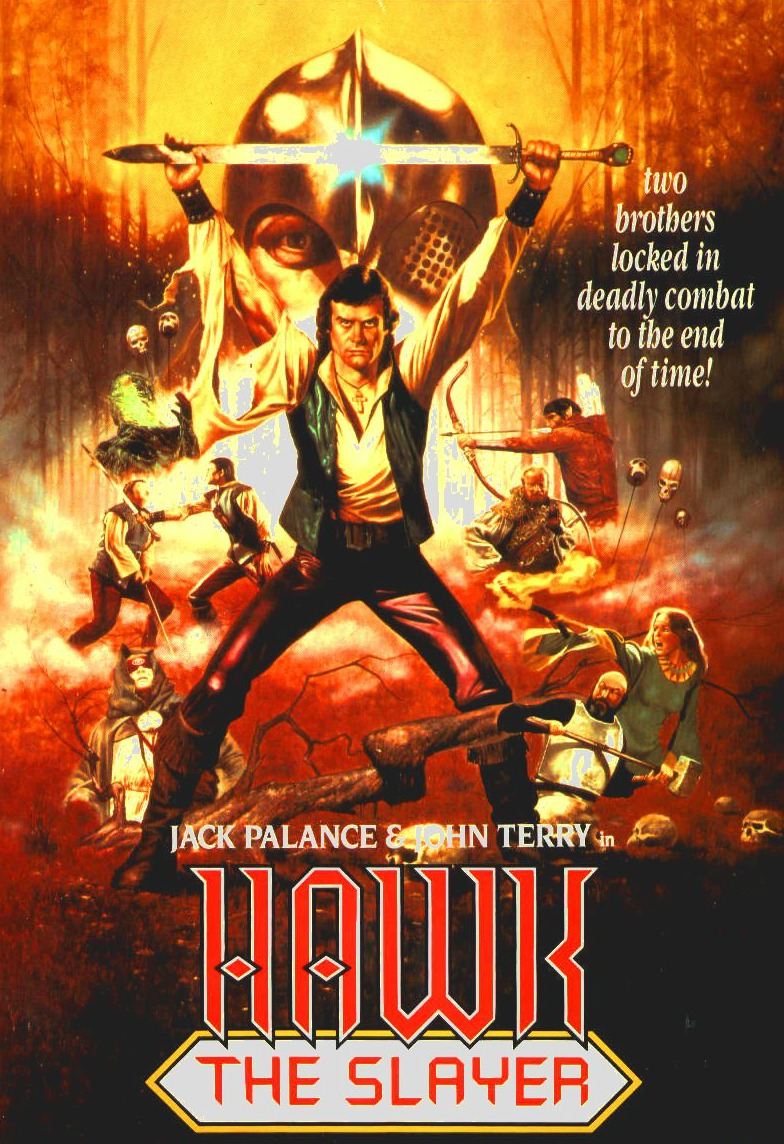
Guilty Pleasure No. 21: Hawk the Slayer (dir. by Terry Marcel)


HawktheSlayer

Tonight was the season finale of Game of Thrones season 4. It was another great piece of storytelling that managed to juggle several subplots and giving each one their own time to shine.

The latest “Guilty Pleasure” is the 1980 epically mind-numbing fantasy film Hawk the Slayer starring the great Jack Palance in the the villainous role of Voltan the evil elder brother to the film’s title character, Hawk the Slayer. This film is in the other side of the quality spectrum of tonight’s Game of Thrones season finale.

Hawk the Slayer was part of the 80’s flood of sword and sorcery films that included such titles as Conan the Barbarian, Beastmaster and Ladyhawke. To say that this film was bad would be an understatement. Yet, I’m quite drawn to it whenever I see it on TV. In fact, it was on syndication that I first saw this when I was just a wee lad. I might have been around 9 or 10 when I came across it halfway through.

Maybe it was the fact that I was just discovering Advanced Dungeons & Dragons, but this film  spoke to me. It had that timeless story of brother against brother. The evil tyrant with legions of evil ne’er do wells against a small band of class-specific heroes and rogues. I mean this had it all. We had the hero of the film who I would probably place in the swordsman class. Then we had Ranulf with his repeating crossbow that would be the band’s rogue. Of course, there’s Gort the giant with his mighty hammer and Baldin the dwarf skilled in the art of the whip. But the one character that really shouted RPG for me throughout this film was Crow the Elf who could fire his bow as fast as any machine gun I’ve ever seen.

I think it’s very awfulness is why I keep returning to it whenever I see it on TV. The acting is atrocious with special effects that even in 1980 would be seen as laughable. The characters themselves were so one-note that one wonders if the person who wrote the screenplay was actually a trained monkey. Yet, the film was fun for all those reasons. It’s one of those titles that one would express as being so bad it’s good. Even now, with childhood several decades past, I still enjoy watching Hawk the Slayer and always wonder when they plan to get the sequel set-up and made.

Oh, the synth-heavy disco-fantasy-western soundtrack was also something to behold.

  1. Half-Baked
  2. Save The Last Dance
  3. Every Rose Has Its Thorns
  4. The Jeremy Kyle Show
  5. Invasion USA
  6. The Golden Child
  7. Final Destination 2
  8. Paparazzi
  9. The Principal
  10. The Substitute
  11. Terror In The Family
  12. Pandorum
  13. Lambada
  14. Fear
  15. Cocktail
  16. Keep Off The Grass
  17. Girls, Girls, Girls
  18. Class
  19. Tart
  20. King Kong vs. Godzilla