Late Night Retro Television Review: 1st & Ten 2.7 “Yinessa’s Interview”


Welcome to Late Night Retro Television Reviews, a feature where we review some of our favorite and least favorite shows of the past! On Wednesdays, I will be reviewing 1st and Ten, which aired in syndication from 1984 to 1991. The entire series is streaming on Tubi.
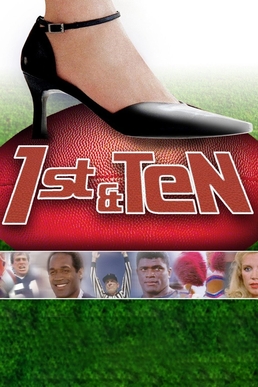
The Bulls are in the playoffs!

Episode 2.7 “Yinessa’s Interview”

(Dir by Burt Brinckerhoff, originally aired on December 30th, 1986)

Last week, training camp finally ended.

This week, the Bulls are in the playoffs!

Wow, we skipped the entire regular season.  Well, that’s okay.  It was obvious from the start that the Bulls were going to make it to the playoffs so why hold off on the inevitable?  Tom Yinessa has led the Bulls to a spot in the Wildcard and woo hoo!

The only problem is that Yinessa hasn’t had time to get laid.  When he does try to make time for Christy (Betsy Russell) — who I guess is his new girlfriend because she wasn’t his girlfriend an episode ago — they are interrupted by reporter Donna Starkey (Brianne Leary), who needs to finish up her interview with Yinessa.  Christy leaves angry but then she returns to make up for Yinessa, just to discover him on the verge of fooling around with Donna.

While all of this is going, the other team tries to fool the Bulls by sending them a fake playbook.  Coach Denardo thinks that it’s genuine but T.D. Parker is like, “I’ll kill you if you use that playbook!  I’ve done it before!”  Also a woman tells Jethro that he’s the father of her son.  Jethro is skeptical but he agrees to get a paternity test.

Donna writes an article about how Yinessa is an unimpressive quarterback.  But the Bulls still win their playoff game by relying on defense.  Mad Dog Smears angrily notes that reporters never want to interview anyone defense …. wait a minute, where’s Dr. Death?  Seeing as how the defense wins the game, this seems like a weird episode not to feature Dr. Death.

The Bulls win their game but Yinessa no longer has a girlfriend.  Womp womp.

This episode was weirdly unsubstantial.  It may be because of how the episodes have been edited for syndication to remove all of the nudity and cursing but 1st & Ten never seems to be able to develop any sort of narrative momentum.  Instead of each episode building towards something, it’s usually just 20 minutes of random events that never seem to really be tied together.  One could say the same thing of life in general, I suppose.

This is my final 1st & Ten review of 2025.  Retro Television Reviews is taken a break for the holidays but this feature will return in January.  My next 1st & Ten review will be on January 7th, 2026.

Paper Lion (1968, directed by Alex March)


Writer George Plimpton (Alan Alda) is a Park Avenue sophisticate who practices “participatory” journalism.  He has already written about pitching in an exhibition all-star game and getting knocked out by Sugar Ray Robinson.  He is having trouble coming up with his next stunt until he goes to Central Park and plays a touch football game with his girlfriend Kate (Lauren Hutton) and his editor, Oscar (David Doyle).  Oscar sees George throwing the ball and decides that George should write about going to a professional football team’s training camp as a player.

George, who fantasizes about throwing the game-winning touchdown, is enthusiastic.  Most of the teams that George approaches are less enthusiastic but finally, the Detroit Lions agree to sign him as a quarterback.  Once the other players realize that George is a writer and not a professional athlete, there’s a lot of resentment.  As Guard John Gordy (playing himself) puts it, he could easily get injured while protecting an inexperienced quarterback like George.  George can always go back to Park Avenue but, for the rest of the players, the game is their life and they don’t like the idea of some outsider coming in and treating it all like a joke.  At first, only the fearsome defender Alex Karras (also playing himself) is willing to support George but eventually, George’s refusal to give up wins over the rest of the team.  They even let him score a touchdown during practice.

When the preseason begins, George waits for his opportunity to take the field.  How many yards can he lose in three plays?

Paper Lion is based on a true story.  In 1963, George Plimpton did attending training camp and play a scrimmage for the Lions and he later wrote a book about the experience.  The movie changes the time period from ’63 to ’67 so that all of the then-members of the Lions could play themselves.  (Though Karras was a friend of Plimpton’s, he was actually suspended during the 1963 season and, unlike in the movie, never joined Plimpton on the practice field.)  The film plays Plimpton’s football career largely for laughs, celebrating every guy’s fantasy of being a sports star while also showing why it’s probably best to leave the actual game to the professionals.  Alan Alda doesn’t imitate Plimpton’s famous Mid-Atlantic accent but he does capture the excitement of a man getting to live out his fantasy.

Paper Lion was made with the full cooperation of the NFL and a good deal of the film’s final third is made up footage that was shot for an actual game.  Seen today, it’s interesting to see how positively Paper Lion portrays both the game and its players and to contrast it with how the game is usually portrayed today.  There’s no talk of steroids or fears of multiple concussions.  All of the players are clean-cut, friendly, witty, and helpful.  Even the training camp hazing is all done is good fun.  Paper Lion introduces us to the nicest people in the world and they’re all football players!

Retro Television Review: Pigs vs. Freaks (dir by Dick Lowry)


Welcome to Retro Television Reviews, a feature where we review some of our favorite and least favorite shows of the past!  On Sundays, I will be reviewing the made-for-television movies that used to be a primetime mainstay.  Today’s film is 1984’s Pigs vs. Freaks!  It  can be viewed on YouTube.

In the late 1960s, a small town is divided between the conservative older generation and their rebellious hippie children.  Former high school football star Doug Zimmer (Patrick Swayze) has just returned from fighting in Vietnam and, unlike many of his former classmates, he is firmly on the side of the establishment.  He wears his hair short.  He has a job as a cop.  He tries to keep his younger sister, Janice (Penny Peyser), from hanging out with hippies like his former best friend, Neal (Grant Goodeve).

Neal is also the son of the local police chief, Frank Brockmeyer (Eugene Roche).  Though Frank and Neal have different political beliefs and Frank is always telling Neal to get a haircut, they still have a respectful relationship.  When Neal complains that cops like Doug and his partner, Sgt. Cheever (Brian Dennehy), are always harassing the hippies who want to play football in park, Frank suggests a football game between the hippies and the police.  When Neal agrees, the game becomes known as “Pigs vs. Freaks.”

While Frank coaches the Pigs and signs a few former athlete as police reservists, Neal recruits his former little league coach, a bearded guru who now goes by the name of Rambaba Organimus (Tony Randall) to serve as the Freak’s coach.  He also places a call to a former football star named Mickey South (Adam Baldwin) and talks him into coming down from Canada to play in the game.  Of course, Mickey is wanted by the FBI for dodging the draft so it might not seem like a great idea for him to risk federal prison for an exhibition football game but no matter!  Who cares that there are now two federal agents watching the Freaks practice?  There’s a game to be won!

Pigs vs. Freaks is an amiable mix of comedy and drama.  Some of the comedy, like Tony Randall’s bearded guru and Stephen Furst’s perpetually frantic hippie linebacker, is a bit too broad but there’s enough moments of dramatic insight that it’s easy to overlook those flaws.  I appreciated the fact that both the Freaks and the Pigs are treated fairly, with both sides getting a chance to make a case for themselves.  When they first appear and start harassing the hippies for playing football in the park, it’s easy to dismiss both Doug and Cheever as fascists but a later scene, which is very well-played by both Brian Dennehy and Patrick Swayze, establishes them as just being two men who are confused by the direction of the world.  Swayze, in particular, gives a strong performance that reveals the vulnerability underneath Doug’s tough exterior.  As for the hippies, Mickey South is no self-righteous crusader but instead someone who feels the Vietnam War is wrong but who is also someone who both misses and loves his home country.  Adam Baldwin does a wonderful playing him and is well-matched with Grant Goodeve, who plays the most reasonable hippie that one could hope to meet.

It’s a likable film and well-intentioned, a portrait of two opposing groups brought together by the love of one game.  Some will cheer for the Pigs.  Some will cheer for the Freaks.  I cheered for both.