Doctor Who — The Ribos Operation, The Pirate Planet, The Stones of Blood, The Androids of Tara, The Power of Kroll, The Armageddon Factor


The sixteenth season of Doctor Who featured the usual six serials but, for once, they were all a part of a much bigger story.  Season 16 would open with the Doctor being assigned to find the six segments of the Key of Time and it would end with an appearance from Lalla Ward, who would not only play one of the Doctor’s companion but who would (albeit briefly) become a companion to Tom Baker himself.

The Ribos Operation (1978, directed by George Spenton-Foster)

The Ribos Operation begins with the White Guardian (Cyril Luckham) materializing in the TARDIS.  He has come to give the Doctor (Tom Baker) and K-9 (voiced by John Leeson) a mission.  The balance of the universe is maintained by the White Guardian and the Black Guardian.  The balance is at risk of collapsing unless the Doctor can track down the six segments of the Key of Time.  Each segment has been hidden on a different planet, disguised as something native to that world.  The White Guardian gives the Doctor a locater to help him find each planet.  He also gives the Doctor a new assistant, a Time Lady named Romanadvoratrelundar (Mary Tamm).  The Doctor calls her Romana.

And so stars the Key of Time saga.  As played by Mary Tamm, Romana was a new type of assistant for the Doctor.  As a fellow Time Lord (though referred to as being a “Time Lady” because this serial was filmed in 1978), Romana has just as much knowledge as the Doctor and she does not view him with the awe that other companions viewed him.  The sophisticated and almost haughty Romana is not with the Doctor for adventure.  She is there to complete their assignment.

Their first mission takes them to the icy planet Ribos and finds them getting involved with a scheme by a human named Garron (Ian Cuthbertson) to sell the largely worthless planet to an exiled tyrant named Graff Vynda-K (Paul Seed).  (In this case, “operation” means swindle.)  When Graff discovers that he’s been cheated, he comes after both Garron and the Doctor.

The Ribos Operation is an enjoyable story.  Graff is a great megalomaniacal villain and I liked the idea of trying to trick him into buying a worthless planet.  It was the future equivalent of selling swampland.  Mary Tamm also makes a strong impression as Romana.  The Key to Time saga got off to a good start.

As for the first segment of the Key to Time, it was a piece of the fake crown jewels of Ribos.

The Pirate Planet (1978, directed by Pennant Roberts)

The Doctor and Romana are next directed to a planet called Calufrax that is known for being cold and boring.  When they land, they find themselves in an apparent paradise.  It turns out that they are actually on a hollowed-out planet called Zanak that materializes around other planets and, in the style of Galactus, plunder their resources.  Zanak is apparently controlled by the one-eyed Captain (Bruce Purchase) but the Doctor and Romana discover that it is actually the Captain’s nurse (Rosalind Lloyd) who is calling the shots.

The Pirate Planet is famous for being one of the serials written by Douglas Adams.  The loud but stupid Captain and his long-suffering assistant, Mr. Fibuli (Andrew Robertson), certainly do seem like they would be at home in one of Adams’s novels and the story overall has more humor than even the typical Tom Baker episode.  It’s a clever script, though and both Purchase and Robertson give good performances as the two pirates.

The entire planet of Calufrax turns out to be a segment of the Key to Time.  When I first saw this episode as a kid, that struck me as being very weird.  It still seems weird but that’s Doctor Who.

The Stones of Blood (1978, directed by Darrol Blake)

The Doctor, Romana, and K-9 are brought to modern-day Cornwall, where Prof. Emilia Rumford (Beatrix Lehmann) and her friend Vivien Fay (Susan Engel) are studying a stone circle.  For the first two episodes of this serial, it appears that the main villains are going to be a group of modern-day druids but it turns out that the stones are actually aliens who feed on blood, and Vivien Fay is a galactic war criminal named Cessair and that she has stolen the Great Seal of Diplos, which also happens to be the third segment of the Key of Time.

This serial sees the Doctor returning to Earth for the first time since Image of Fendahl.  The first two episodes have an almost gothic horror feel to them before the serial heads in a different, more intergalactic direction during its second half.  In a clever twist, it turns out that the “stones of blood” were actually just red herrings.  After spending four episodes convincing the viewers that the key would be one of the stones, it instead turned out to be the Great Seal of a planet that no one had ever heard of.  This was another enjoyable serial, featuring a memorable villainess and a clever story.

The Androids of Tara (1978, directed by Michael Hayes)

Romana finds the next segment within minutes of landing on the planet Tara but the Doctor wants to take a break and do some fishing.  While he is doing that, Romana is attacked by a bear and rescued by Count Grendel (Peter Jeffrey).  Grendel takes Romana back to his castle, where he soon reveals that he’s not as kind as he seems.

The Androids of Tara is an adventure story that takes place on a planet where a feudal society is matched with androids and electronic weapons.  This episode gives Mary Tamm quite a lot to do as she plays not only Romana but also the Taran Princess Strella and the android versions of Strella and Romana.  Grendel hopes to marry Romana-as-Strella and become the ruler of Grendel.  The Doctor, along with Price Reynart (Neville Jason) and the swordsmen Zadek (Simon Lack) and Farrah (Paul Lavers), works to rescue Romana.  The Doctor even fights a duel with Grendel.

The Androids of Tara is a bit silly but it’s all in good fun.  Tom Baker seems to enjoy playing the swashbuckler and Peter Jeffrey, a familiar character actor, is an appropriately melodramatic villain.  This serial allows Mary Tamm her chance in the spotlight and she makes the most of it, reminding us that Romana could be just as strong as the Doctor.

The Power of Kroll (1978-1979, directed by Norman Stewart)

The TARDIS travels to a swamp planet where a crew of humans are running a methane refinery and the planet’s inhabitants (called Swampies, by the humans) worship a giant squid named Kroll.  Kroll is giant because it ate a segment of the Key of Time.  Kroll attacks both humans and Swampies until the Doctor manages to extract the Key of Time.  Kroll explodes and, since Kroll was also the main source of methane on the planet, the refinery closes.

This serial made the mistake of focusing on Kroll.  Like so many Doctor Who giant monsters, Kroll is not at all convincing.  That and some poor acting from the guest cast and a largely humorless script all combine to make this the most forgettable part of the Key to Time saga.

The Armageddon Factor (1979, directed by Michael Hayes)

The search for the final segment leads the TARDIS to the warring plants of Atrios and Zeos.  Atrios and Zeos have both been scarred by nuclear weapons.  Princess Astra (Lalla Ward) of Atrios wants end the war but the fanatical Marshal (John Woodvine) is determined to continue the war.  A mysterious figure known as The Shadow (William Squire) steals the TARDIS and abducts Princess Astra, who is revealed to also be the sixth segment of the Key of Time.  The Shadow is working for the Black Guardian (Valentine Dyall).  In pursuing The Shadow, the Doctor meets yet another renegade Time Lord and classmate, Drax (Barry Jackson).

The Armageddon Factor is about two episodes too long and is often needlessly complicated but there were a few clever moments, like the discovery that Zeos was no longer inhabited by humans and that the missiles were being launched by a super computer.  (K-9 was able to communicate with it and broker a peace.)  For viewers of the series, The Armageddon Factor is best-remembered for introducing Lalla Ward.  Dissatisfied with the way Romana was developing, Mary Tamm announced that she was leaving at the end of the season.  When Romana regenerated in the following season, she ended up looking a lot like Princess Astra of Atrios.

Doctor Who — The Invisible Enemy, Image of the Fendahl, The Sun Makers, Underworld, The Invasion of Time


Having survived the Horror of Fang Rock, the Doctor and Leela resumed traveling through space and time.  Along the way, they picked up a new companion named K-9.  Here is the rest of the fifteenth century, which began in a British lighthouse and ended on Gallifrey.

The Invisible Enemy (1977, directed by Derrick Goodwin)

This the one where K-9 makes his first appearance.

As a story, The Invisible Enemy is no great shakes.  The Doctor (Tom Baker) and Leela (Louise Jameson) materialize on a spaceship that has been infected by a sentient virus.  Everyone, except for Leela, gets infected.  The virus wants the Doctor to lead an infection of the entire universe.  When the virus orders the Doctor to kill Leela, he breaks free from its control.  He and Leela go to a space medical center, where Prof. Marinus (Frederick Jaeger) uses Leela’s natural immunity to help create a cure for the virus.  At one point, the Doctor and Leela are cloned and the clones are injected into the Doctor to fight the virus.  It’s a fantastic voyage for all.

Prof. Marinus’s assistant is a boxy robot dog named K-9 (voice by John Leeson).  Since Marinus has to go back to Earth, he gives K-9 to The Doctor and Leela as a gift.

How you feel about K-9 says a lot about how you will feel about the remainder of Tom Baker’s time as the Doctor.  Some fans consider the introduction of K-9 to be the show’s jump the shark moment.  A lot more, myself included, have always liked K-9 and view him — along with the sonic screwdriver — as being an essential part of the original show’s charm.  Love him or hate him, K-9, who come figure out any puzzle and who could shoot a loser from his nose, became one of the most recognizable symbols of the Tom Baker years.

Image of the Fendahl (1977, Directed by George-Spenton Foster)

The Doctor and Leela are drawn back to modern-day Earth, where scientists, witches, and cultists are all being influenced by skull that is estimated to be at least twelve million years old.  The scientists assume that the skull is human but actually, it’s the skull of a Fendahl, a race of psychic vampires who developed on the legendary “Fifth Planet.”  The Time Lords tried to destroy the Fendahl but one escaped in the form of a skull.  It first killed all the life on Mars.  (But what about the Ice Warriors and the Pyramids?  Doctor Who continuity rarely added up.)  Then it landed on Earth, where it influenced human evolution to create a race that it could use to its own advantage.

Image of the Fendahl feels like a spiritual descendant of The Daemons, with the same emphasis on rural British atmosphere and paganism (Leela teams up with a white witch) but without the assurance of UNIT waiting on the sidelines to take care of the threat.  Image of the Fendahl, with its suggestion that humanity was specifically developed to be food, is considerably darker than The Daemons and Tom Baker, so often criticized for playing up the humor of the Doctor’s character, gives one of his more serious performances.  When one of the scientists who has been possessed by Fendahl seeks to kill himself and bring an end to the threat, the Doctor hands him a gun.

Image of the Fendahl is yet another Doctor Who serial in which the main threat is revealed be the result of the Time Lords meddling.  The Fourth Doctor spent a lot of time cleaning up Gallifrey’s messes.

The Sun Makers (1977, directed by Pennant Roberts)

The Doctor, Leela, and K-9 materialize on Pluto, where they discover that colonists and workers are expected to pay exorbitant taxes to the Company or risk being exiled to the Undercity.  The Company’s tax collector is the Controller, who turns out to be a quivering mass of seaweed.

The Sun Makers is Doctor Who at its most satirical, poking fun at the British tax system.  Apparently, the original script was much more pointed in its attacks on the Inland Revenue services but the BBC, being the BBC, demanded that the script be watered down.  In human form, the Controller still clearly resembles Denis Healey, the then-Chancellor of the Exchequer.

The Sun Makers is Doctor Who at its most straight-forward, an enjoyable diversion from the more serious episodes.

Underworld (1978, directed by Norman Stewart)

The TARDIS materializes on the R1C, a spaceship that has been on a millennia-long quest to find a missing ship that was on its away to Minyos 2 and which contained the genetic files of the original Minyans who lived on Minyos 1.

This is another story where the Doctor has to deal with the bad decisions of the Time Lords.  Before adapting their policy of non-intervention, the Time Lords meddles in Minyan evolution and the end result was that the Minyans viewed the Time Lords as gods and the Minyans also used all of the Time Lord technology that they had been given to fight a civil war.  The Doctor feels a responsibility to help the crew of R1C complete their quest.

The R1C eventually ends up going through a space nebula and crashing into a planetoid, where they discover the ship they were searching for.  The crew of the ship is being used as slaves by the Oracle, a super computer.

Underworld is one of the more boring of the Fourth Doctor’s serials.  The story feels slapdash and the idea of a supercomputer was a well that the Doctor Who had already gone to far too many times.

The Invasion of Time (1978, directed by Gerald Blake)

The Doctor returns to Gallifrey and assumes his position as President of the Time Lords.  He also seems to go through a total personality change, exiling Leela and announcing that a group of psychic aliens known as the Vardans will be the new masters of Gallifrey.

Leela, even after being exiled, is convinced that this is all a part of some plan on the Doctor’s part and it turns out that she’s right.  The Doctor is only pretending to be allied with the Vardans so that he can discover the location of their planet and put them into a time loop.  What the Doctor does not realize is that the Vardans are themselves being used by the Sontarans, who are planning on invading Gallifrey.

In retrospect, it seems inevitable that the 15th season would end on Gallifrey.  It also seems inevitable that the Sontarans would eventually try to invade Gallifrey.  The main threat of the Sontarans has always been that they are so stupid that they will try to invade any planet.  The most surprising thing about this serial is that Leela stays behind on Gallifrey so that she can marry Andred (Chris Tanchrell), the head of the Citadel Guard.  The idea of Leela living with the Time Lords has been responsible for a lot of fan fiction and it does seem unfortunate that the show didn’t do more with the idea.

Louise Jameson had already decided to leave the show and originally, Leela was to die while fighting the Sontarans.  This was changed because it was felt Leela’s death would be too traumatic for younger viewers.  Instead, the younger viewers were traumatized by K-9 announcing that he would be staying on Gallifrey with Leela and Andred.  Luckily, for them, the final shot of the fifteen season was The Doctor looking at a crate labeled “K-9 Mark II” and smiling.

Little did the Doctor suspect that the quest for the Key of Time was waiting in his future.


Doctor Who — The Ark In Space, The Sontaran Experiment, Genesis of the Daleks, Revenge of the Cybermen, Terror of the Zygons


The 12th season of Doctor Who got off to a shaky start with Robot, a serial that was ultimately distinguished only by the introduction of Tom Baker as the Fourth Doctor.  The best thing about Robot is that it ended with The Fourth Doctor peeking out of the TARDIS and inviting Sarah Jane Smith (Elisabeth Sladen) and Harry Sullivan (Ian Marter) to join him on his further adventures.  By inviting them, he was inviting the audience as well.

The remaining episodes of the 12th season not only established Tom Baker as the Doctor but it also reestablished Doctor Who as being a show about an alien who could travel through time and space.  After several seasons of The Third Doctor largely staying on Earth and in the present, the 12th Season reminded everyone that the Doctor could turn up anywhere.

The Ark In Space (1975, directed by Rodney Bennett)

The first place that the Doctor takes Sarah and Harry is to Nerva, a space station that floating above the Earth.  The time is 10,000 years into the future.  Forced to flee the Earth due to solar flares, the crew of the space station has spent a millennia in suspended animation.  During that time, the space station has been invaded by the Wirm, a space insect that has laid its eggs in some of the crewmen.  When everyone is revived, the infected crewmen are transformed into creatures that are half-human and half-insect.

The Ark in Space is a classic space opera.  When I was a kid and our PBS station first started to broadcast Doctor Who, they started with a four-hour bloc, which included Robot, The Ark In Space, and The Sontaran Experiment.  After Robot, with its basic plot and bad special effects, it was a relief to then see The Ark In Space, a serial that lived up to all of the Doctor Who hype.  Not only did Tom Baker fully step into the role of the eccentric Fourth Doctor but this serial also featured Elisabeth Sladen and Ian Marter in active roles as well.  This serial said that the days of the passive companion were (temporarily) over.

The plot of The Ark in Space does have some similarities to Alien, which came out for years later.  I think that’s probably just a coincidence.

The Sontaran Experiment (1975, directed by Rodney Bennett)

Having defeated the Wirm and saved the remaining colonists on the Ark, The Doctor, Harry, and Sarah transport down to Earth to repair a receiver terminal.  They discover that the Earth is not as deserted as they assumed.  A group of human astronauts returned to the planet earlier but they were captured by Styre (Kevin Lindsay), a Sontaran who has been sent to Earth to prepare it for an invasion so that the Sontarans can use the planet as an outpost in their never ending war with the Rutans.

This serial was only two episodes long but The Sontarans were always good villains.  They’re relentless, destructive, and very, very stupid.  This story featured one of Tom Baker’s best moments, when he convinced Styre to throw away his weapon because it made him look weak.  Styre fell for it because Sontarans will fall for anything.

Genesis of the Daleks (1975, directed by David Maloney)

This is it.  This is the first true classic of the Tom Baker era and also the best of the classic Dalek stories.  Terry Nation was invited back to Doctor Who to write about his most famous creations and he created one of the show’s most enduring villains in the process.

A Time Lord appears to the Doctor and his companions and tells them that they need The Doctor to change history.  (This goes against all Time Lord law, which is why they gave the job to a known renegade like The Doctor.)  The Daleks have been determined to be too much of a threat.  The Doctor is to go back to the time of their creation and “interfere.”

The Doctor, Harry, and Sarah Jane find themselves on Skaro, where the war between the Thals and the Kaleds have left the planet ravaged and inhospitable.  The Thals and the Kaleds each live in a domed city and spend their days shooting missiles at each other.  Terry Nation often said that the Daleks were meant to be a stand-in for the Nazis and he makes that clear in this episode with the Kaleds wearing SS-style uniforms and spouting theories about racial superiority.

In this episode, Nation introduces Davros (Michael Wisher), the horribly scarred and crippled scientist who will ultimately be responsible for transforming the Kaleds into the Daleks.  (The Kaleds who don’t want to be Daleks are wiped out by those who do.)  Davros would appear in every subsequent Dalek episode of classic era Doctor Who and his effectiveness would be diluted by repetition.  In his first appearance, though, he immediately establishes himself as a frightening and truly evil Doctor Who villain.  If their first appearance suggested that the Daleks retreated into the shells for survival in their nuclear-ravaged world, this episode shows that it more about Davros wanting to play God.

A six-episode serial, Genesis of the Daleks more than justifies its epic length.  The heart of the serial is a moment when the Doctor, on the verge of wiping out the Daleks forever, stops to wonder if he has the right to do so.  This was a key moment in the development of The Fourth Doctor.  The Fourth Doctor may have been an eccentric but he was an eccentric with a conscience who realized that even the worst creatures deserved a chance at redemption.  In the end, The Doctor does not destroy the Daleks, though he does set back their evolution by an undetermined number of years.  As the Doctor explains it, good will always rise up to counter the evil of the Daleks.

This episode features the apparent destruction of Davros but you can never keep a good villain down.  Both Davros and his creations would return.

Revenge of the Cybermen (1975, directed by Michael Briant)

After a classic Dalek story, I guess it was inevitable that Doctor Who would feature a Cyberman episode.

Following the events of Genesis of the Daleks, the Time Lords return The Doctor, Sarah Jane, and Harry to the Nerva space station.  They arrive several centuries before the events in The Ark In Space.  Without the TARDIS (it’s traveling back through time to meet them), The Doctor and his companions discover that the majority of Nerva’s crew is dead and that the remaining members are using the station as a space beacon to warn people about a drifting planetoid.  The planetoid is made of gold and the Cybermen show up at Nerva because, being uniquely vulnerable to gold dust, they want to destroy it.

If Genesis of the Daleks re-imagined the Daleks, Attack of the Cybermen proves to be just a typical Cybermen story and a disappointing one.  The best thing about this episode is that it gave Tom Baker a chance to once again prove his Doctor bonafides by defeating a classic Doctor Who villain.

Terror of the Zygons (1975, directed by Douglas Camfield)

Terror of the Zygons was the first seral of the thirteenth season but, since it’s also Harry Sullivan’s final appearance as a regular member of the TARDIS crew (though he would return in a later episode for a one-off appearance), it still feels like a twelfth season episode.

Having been reunited with the TARDIS, the Doctor, Sarah Jane, and Harry return to present-day Earth.  The Brigadier (Nicholas Courtney) and UNIT are investigating attacks on oil rigs by a giant sea creature.  Sea Devils, again?  No, this time it’s the Zygons, who are far less sympathetic.

This was a typical UNIT story, the type of thing that Jon Pertwee did regularly.  Tom Baker’s more mischievous version of the Doctor feels slightly out-of-place with UNIT but it is still a pleasure to see Nicholas Courtney and John Levene again and this episode finally explains what everyone has been seeing in Loch Ness over the years.  This episode ends with Harry returning to UNIT while Sarah Jane and the Doctor returned the TARDIS.  Harry Sullivan was a strong character and producer Philip Hinchcliffe later said it was a mistake to write him out of the series.

Ian Marter, who played Harry Sullivan, continued to be associated with Doctor Who as one of the better writers of the Doctor Who novelizations.  He also wrote two stand-alone novels featuring Harry’s adventures without the Doctor.  Ian Marter died of a heart attack when he was just 42 but Harry Sullivan lived on, frequently being mentioned in both the classic series and the revival.

That’s it for the 12th season, the season that truly made Tom Baker the Doctor and which was one of the best of the classic series.  As these were the first episodes of Doctor Who that I ever saw, I have a lot of nostalgia for them.  The Ark In Space, The Sonatarn Experiment, Genesis of the Daleks, and even Terror of the Zygons still hold up well to this day.


Doctor Who — Invasion of the Dinosaurs (1974, directed by Paddy Russell)


Fresh from defeating an attempt by a Sontaran to disrupt British history, the Third Doctor (Jon Pertwee) and his newest companion, reporter Sarah Jane Smith (Elisabeth Sladen), return to present-day London and discover that it has been transformed into a ghost town.  Dinosaurs are roaming the streets.  The Doctor teams up with UNIT to try to figure out who has been monkeying with time but what he doesn’t know is that the trusted Captain Yates (Richard Franklin) is working with the people responsible for the dinosaur invasion.

Invasion of the Dinosaurs was the second serial of the 11th season.  Like The Sea Devils, this was another case where I read the novelization long before I got a chance to see the actual serial.  Well-written by Malcolm Hulke, the novelization really got me excited to watch Invasion of the Dinosaurs.  It did not prepare me for how fake the dinosaurs would look.

It was to be expected, though.  Classic Doctor Who was never known for its wonderful special effects.  Instead, it was known for rubber monsters, torn costumes, and alien landscapes that were often made out of cardboard.  For many of us, that was a part of its charm.  The dinosaurs in this serial look like toys that have been unleashed on a still photo of London.  I’ve read that the serial was criticized for its bad dinosaur effects when it originally aired 1974 and that was long before Jurassic Park made everyone take the idea of seeing a realistic dinosaur for granted.


Despite the very fake dinosaurs, Invasion of the Dinosaurs still has one of the better scripts of the Pertwee era.  The villains aren’t the typical evildoers who usually showed up on Doctor Who.  Instead, they are people who have convinced themselves that the only way to save humanity is to dial back time to what they consider to be the “Golden Age,” before technology and industry blighted what they believe to be the ideal landscape.  Of course, they plan to take only the very best among the population to their golden age with them.  The villains are elitist environmentalists, convinced that they and only they know what is best.  This may be the first episode of Doctor Who where the main antagonist, Sir Charles Grover (Noel Johnson), is a member of Parliament.

Captain Yates’s betrayal of UNIT and the Doctor adds some emotional depth to this story.  While Yates was never as important a character as the Brigadier or Sgt. Benton, he was still present for almost all of the Third Doctor’s adventures and the small scenes where he would flirt with Jo Grant were some of the most awkward moments of the Pertwee era.  Captain Yates was a loyal member of the Third Doctor’s entourage and his betrayal was motivated not by greed or resentment but instead by a desire to make the world a better place.  The novelization made it clear that it was actually the terrible things that Yates saw as a member of UNIT that convinced him that time needed to be turned back.

This was the final Jon Pertwee story to be set entirely on Earth and, though Yates and the Brigadier would return for Pertwee’s final serial, it was the last true UNIT story of the Pertwee years.  Jon Pertwee had already decided that the 11th season would be his last.  The 12 season would feature a new Doctor.  And while the BBC considered actors like Graham Crowden, Bernard Cribbins, and Jim Dale for the role, the Fourth Doctor was ultimately be played by Tom Baker, an actor who was working as a construction worker when Invasion of the Dinosaurs first aired.

Doctor Who would never the same.

Doctor Who — The Sea Devils (1972, directed by Michael Briant)


Having been captured by UNIT at the end of The Daemons, the Master (Roger Delgado) is now a imprisoned on a small island in the English channel.  He claims that he is reformed and he now spends most of his days watching the BBC.  (Has he not been punished enough?)

When the Doctor (Jon Pertwee) and Jo Grant (Katy Manning) visit the Master to try to learn the location of his TARDIS, they come up empty.  They do, however, learn that several ships have gone missing and, understandably, they suspect that the Master is involved.

They’re correct.  The Master has duped his warden, Trenchard (Clive Morton), into helping him steal electrical equipment so that he can contact The Sea Devils, a race of bipedal reptiles the live under the sea.  The Sea Devils, much like their cousins, the Silurians, were the original inhabitants of Earth.  They’ve now woken from hibernation to discover that mankind — who they last knew to be a collection of barely evolved monkeys — have taken over the planet.  And they’re not happy about it.

The Silurians and the Sea Devils appeared in three serials during the original run of Doctor Who and all of them followed the same basic plot.  The Silurians or the Sea Devils woke up from their hibernation.  The Doctor tried to broker a peace with humanity.  Humanity reacted by blowing them up.  The Sea Devils were usually more reluctant to make peace than the Silurians.  In The Sea Devils, the Doctor himself is forced to sabotage their base to keep them from attacking humanity but that’s nothing compared to the atomic bomb that the British government wanted to drop on them.  Whenever a Silurian or a Sea Devil shows up, it means that the Doctor is going to disappointed in humanity once again.

The Sea Devils is a serial of which I have fond memories because Malcolm Hulke’s novelization was the first Doctor Who book that I ever read.  (Malcolm Hulke also wrote the serial itself.)  I read the book before I even saw the show.  The novelization was my introduction to the Doctor, UNIT, and especially the Master.  Hulke was one of the best writers of the Doctor Who novelizations, taking the time to add depth to the characters.  This was especially true of Trenchard, who is portrayed far more sympathetically in the novel than he was on the show.

The Sea Devils also features one of Roger Delgado’s finest turns as the Master.  This was the Master’s first appearance during the ninth season of Doctor Who and Delgado shows that, even when imprisoned, the Master never stops manipulating and scheming.  This episode shows why Delgado’s Master was such a classic villain and truly a worthy opponent of the Doctor.  Delgado does such a good job in the scenes where The Master pretends to be reformed that it’s easy to understand how he managed to trick Trenchard.  At the end of the serial, The Master makes another escape, again by fooling the humans around him.  Delgado made The Master into a magnetic and compelling villain.

Roger Delgado appeared twice more as the Master before his untimely death in an auto accident.  Jon Pertwee later said that Delgado’s death was one of the reasons that he decided to step away from the role of the Doctor.  The Master would eventually return and he would be played by several different actors.  For me, the true Master will always be Roger Delgado.

Doctor Who — The War Games (1969, directed by David Maloney)


The War Games is an episode of firsts and lasts.

It featured the last regular appearance by Patrick Troughton as the Second Doctor.  (Troughton would return for three guest appearances.)  Having played the role for three years, Troughton feared getting typecast and felt it was time to leave.  It was also the last episode to feature Frazer Hines (as Jamie) and Wendy Padbury (as Zoe) as companions.  (Hines holds the record for appearing in the most episodes as a companion.)  Finally, this episode was the last to be broadcast in black-and-white.

The War Games also featured a very important first.  This episode featured the first appearance of the Time Lords and the first trip to their home planet.  This was the first episode that showed the society that the Doctor fled when he stole his TARDIS and went to Earth.

At ten episodes, The War Games was either the second or third-longest serial in Doctor Who history, depending on whether or not you count The Trial of the Time Lord as just one long (and regrettable) serial.  The serial opens with the Doctor and his companions apparently landing in No Man’s Land during World War I.  As things progress, the Doctor notices anachronistic technology and Jamie is shocked when a redcoat shows up in a World War I prison.  The Doctor discovers that an alien known as The War Lord (Philip Madoc) has determined that humanity is the most bloodthirsty race in the universe and that he has abducted soldiers from Earth’s bloodiest wars.  They are fighting war games on The War Lord’s planet and the survivors will become the members of the War Lord’s army.  Helping the War Lord is the War Chief (Edward Brayshaw), a renegade Time Lord.

(Just as with The Time Meddler‘s Monk, there’s a fan theory that the War Chief was an early incarnation of The Master.  I don’t believe it, myself.  The Master was far more cunning than The War Chief.)

Despite running for four hours, The War Games is a rare Doctor Who serial that doesn’t have any slow spots and the scenes where the characters cross from war zone to war zone are creatively realized.  The serial starts out as if it’s going to be yet another dry historical episode and then it gradually reveals that all is not as it seems.  I especially liked the performance as Jane Sherwin as Lady Julia, an ambulance driver in the World War I zone.  (Jane Sherwin was also the wife of Doctor Who’s then-produccer Derek Sherwin.)

What really makes The War Games stand out is the final episode.

Having brought an end to the War Games, the Doctor is faced with the impossible prospect of returning the soldiers to their proper times.  He is forced to call upon The Time Lords for help.  Bernard Horsfall, Trevor Martin, and Clyde Pollitt appear as the Time Lords, who dematerialize the War Lord and send the soldiers back home with no memory of what happened.  Unfortunately, The Time Lords are not just going to let the Doctor off the hook for violating their police of non-interference.

First, Jamie and Zoe are sent back to their original times, both with no memory of their life on board the TARDIS.  The Doctor is then put on trial for having stolen his TARDIS and interfering in time and space.  The Doctor argues that he has been fighting evil.  The Time Lords accept his argument and then say that his punishment is to be sent to 20th Century Earth.  He’ll keep his TARDIS but he won’t be able to use it.  And, because the Doctor is well-known on Earth, he’ll have to regenerate.  He’s given five faces and told to pick one.  The Doctor refuses them all.  The Time Lords pick one.  “That’s the worst one!” the Doctor says before he finds himself spinning through space and time.

It’s a poignant ending to the Second Doctor’s adventures.  The Time Lords do not come across as being as bad as the Doctor often made them out to be but it is easy to see why an adventurer like the Doctor would feel constrained by their society.  That the Second Doctor called them for help despite knowing what the consequences would be not only shows how dangerous The War Lord’s plan was but also how the Doctor would always do the right thing even when it was dangerous for him to do so.  The Time Lords could have just as easily dematerialized The Doctor as punishment for stealing his TARDIS.  Jamie and Zoe are spared punishment but they lose their memories of the amazing adventures they shared.  And the Doctor changes once again.

For viewers like me, who got to know Doctor Who from the episodes that were broadcast late at night on PBS, The War Games is a bridge between “old” Doctor Who and the classic era of Jon Pertwee and Tom Baker.  In America, we didn’t get to see much of Patrick Troughton’s Doctor but what we got established him as one of the best to ever play the role.


Lisa Marie Reviews An Oscar Nominee: The Elephant Man (dir by David Lynch)


The Elephant Man (1980, dir by David Lynch, DP: Freddie Francis)

David Lynch never won a competitive Oscar.

He received an honorary award from the Academy in 2019.  He generated some minor but hopeful buzz as a possible nominee for Best Supporting Actor for his role in Steven Spielberg’s The Fabelmans.  He was nominated for Best Director three times and once for Best Adapted Screenplay.  But he never won an Oscar and indeed, even his nominations felt like they were given almost begrudgingly on the part of the Academy.  In an industry that celebrated conformity and put the box office before all other concerns, David Lynch was an iconoclastic contrarian and the Academy often didn’t do know what to make of him.  Of the many worthy films that he directed, only one David Lynch film was nominated for Best Picture and, in my opinion, it should have won.

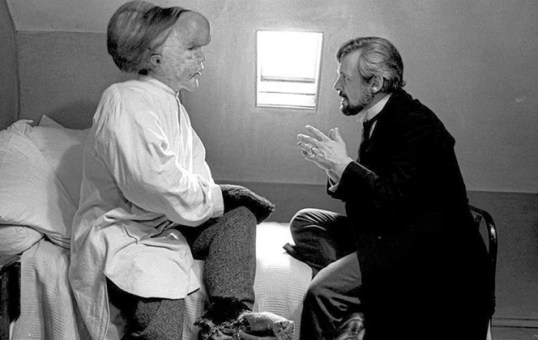
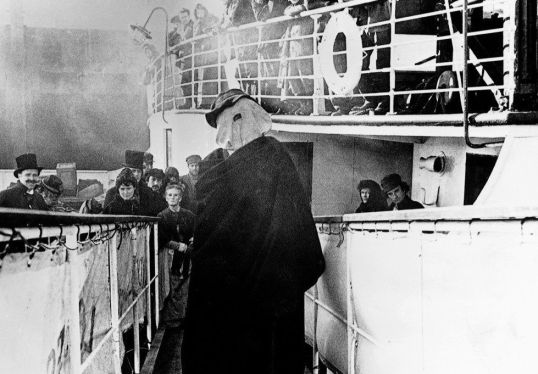
1980’s The Elephant Man is based on the true story of Joseph Merrick (renamed John for the film), a man who was horribly deformed and terribly abused until he was saved from a freak show by a surgeon named Dr. Frederick Treves.  The sensitive and intelligent Merrick went on to become a celebrity in Victorian London, visited by members of high society and allowed to live at London Hospital.  (Even members of the royal family dropped in to visit the man who had once been forced to live in a cage.)  Merrick lived to be 27 years old, ultimately dying of asphyxiation when he attempted to lie down and, in Treves’s opinion, sleep like a “normal person” despite his oversized and heavy head.  In the film, Merrick is played by John Hurt (who gives a wonderful performance that, despite Hurt acting under a ton on makeup, still perfectly communicates Merrick’s humanity) while Treves is played by Anthony Hopkins, who is equally as good as Hurt.  (Hurt was nominated for Best Actor but Hopkins was not.  Personally, I prefer Hopkins’s performance as the genuinely kind Dr. Treves to any of his more-rewarded work as Dr. Lecter.)  The rest of the cast is made up of veteran British stars, including John Gielgud, Wendy Hiller, Freddie Jones, and Kenny Baker.

Lynch’s version of The Elephant Man is only loosely based on the facts of Merrick’s life.  It opens with a disturbing fantasy sequence (one which I assume is meant to be from Merrick’s point of view) in which a herd of elephants strike down Merrick’s mother and then appear to assault her.  Shot in stark black-and-white and often featuring the sounds of droning machinery in the background (in many ways, The Elephant Man feels like it takes place in the same world as Eraserhead), the first half of The Elephant Man feels like a particularly surreal Hammer film.  (Veteran Hammer director Freddie Francis served as The Elephant Man‘s cinematographer.)  Merrick is kept off-camera and, when we finally do see his face, it’s in a split-second scene in which Merrick is as terrified as the person who sees him.  Before we really meet Merrick, we’ve already heard Treves and the hospital administrator (John Gielgud) discuss all of the clinical details of his condition.  We know why he’s deformed.  After we see him, we know how he’s deformed.  After all of that, the audience is finally ready to know Merrick the human being.  Without engaging in too much obvious sentimentality, Lynch shows us that Merrick is a kind soul, one who has been tragically mistreated by the world.  Just as with the real Merrick, almost everyone who meets the film’s John Merrick is ultimately charmed by him.  In the film, Merrick is kidnapped by his former owner, the alcoholic Bytes (Freddie Jones), who wants again puts Merrick on display in a cage.  In the end, it’s Merrick’s fellow so-called “freaks” who set him free and allow him to return to the hospital, where he has one final vision of his mother.  This vision is a much less disturbing than the one that opened the film.  The film celebrates the humanity of John Merrick but is also reveals the genius of David Lynch.  There’s so many moments when the film could have gone off the rails or become too obvious for its own good.  But Lynch’s unique style so draws you into the film’s world that even the mysterious visions of his mother somehow feel completely necessary and natural.  The Elephant Man is the David Lynch film that makes me cry.  Lynch was a surrealist with a heart.

The Elephant Man was only David Lynch’s second film.  He was hired to direct by none other than Mel Brooks, who produced the film but went uncredited to prevent people from thinking it would be a comedy.  (Lynch, however, did cast Brooks’s wife, Anne Bancroft, as an actress who visits Merrick.)  Brooks hired Lynch after seeing Eraserhead and recognizing a talent that many in Hollywood would never have had the guts to take a chance on.  (Despite the success of Eraserhead on the midnight circuit, David Lynch was working as a roofer when he was offered The Elephant Man and had nearly given up on the idea of ever making another film.)  Reportedly, Brooks stayed out of Lynch’s way and protected him from other executives who fears Lynch’s version of the story would be too strange to be a success.  Lynch and Brooks proved those doubters wrong.  Acclaimed by critics and popular with audiences, The Elephant Man was nominated for Best Picture and David Lynch was nominated for Best Director.  I like Ordinary People.  I like Raging Bull.  But The Elephant Man was the film that should have won in 1980.

The Elephant Man remains a powerful movie and an example of how an independent artist can make a mainstream movie without compromising his vision.  (Of course, I imagine it helps to have a producer who has the intelligence and faith necessary to stay out of your way.)  David Lynch may be gone but his art will live forever.  The Elephant Man will continue to make me cry for the rest of my life and for that, I’m thankful.

The Elephant Man (1980, dir by David Lynch, DP: Freddie Francis)