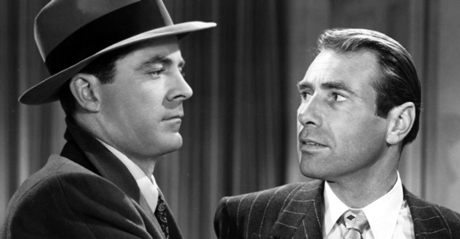
Scenes I Love: The Cross-Examination From Anatomy of a Murder


Since today is Otto Preminger’s birthday, I figured that this would be a good time to share a scene that I love from one of my favorite movies, Preminger’s 1959 film, Anatomy of a Murder.

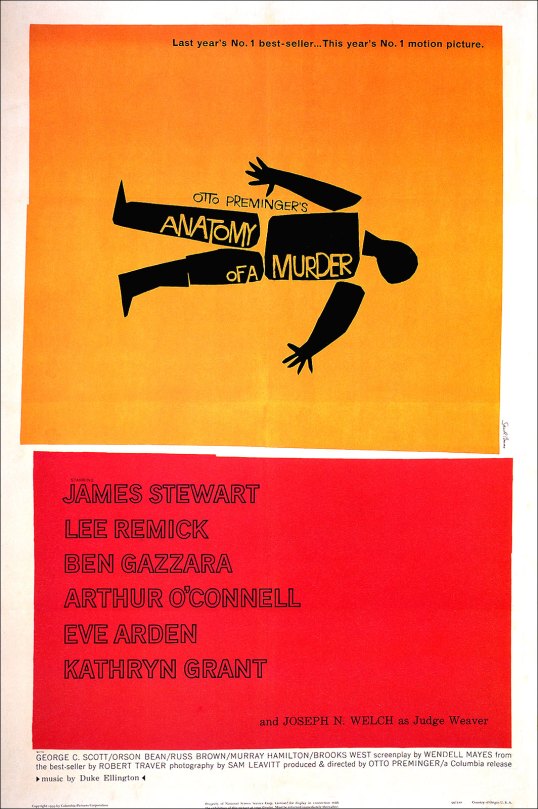
In this scene, prosecutor Claude Dancer (played, in one of his first screen roles, by George C. Scott) cross-examined Laura Manion (Lee Remick), the wife of a man who has been accused of murder.  Playing the role of the defense attorney is James Stewart.  This scene is a master-class in great acting.  Preminger could be a bit of an inconsistent director but his willingness to take on controversial subjects set him apart from many of his contemporaries.  When he had the right material, as he did here, he could create the perfect mix of melodrama and art.  Preminger’s best films, like Anatomy of a Murder, stand the test of time.

Scenes I Love: James Stewart Explains The Four Ways To Defend Murder In Anatomy of a Murder


In honor of James Stewart’s birthday, our scene that I love comes from one of my favorite Stewart films, 1959’s Anatomy of a Murder.

In today’s scene that I love, James Stewart explains to his client (played by Ben Gazzara) that there are four ways that he can defend a murder charge.  The contrast between Stewart’s classic style and Gazzara’s intense method style makes for an intense scene between two very talented and unique actors.

Film Review: The Cardinal (dir by Otto Preminger)


The 1963 film, The Cardinal, opens with an Irish-American priest named Stephen Fermoyle (Tom Tyron) being instituted as a cardinal.

In a series of flashbacks, we see everything that led to this moment.  Stephen starts out as an overly ambitious and somewhat didactic priest who, over the years, is taught to be humble by a series of tragedies and mentors.  It’s a sprawling story, one that encompasses the first half of the 20th Century and, as he did with both Exodus and Advice and Consent, Preminger tells his story through the presence of several familiar faces.  Director John Huston plays the cardinal who takes an early interest in Stephen’s career.  Burgess Meredith plays a priest with MS who teaches Stephen about the importance of remaining humble and thankful.  When Stephen is in Europe, Romy Schneider plays the woman for whom he momentarily considers abandoning his vows.  When Stephen is assigned to the American South, Ossie Davis plays the priest and civil rights activist who teaches Stephen about the importance of standing up for those being oppressed.  In the days leading up to World War II, Stephen is sent to Austria to try to keep the local clergy from allying with the invading Nazis.  Stephen also deals with his own family drama, as his sister (Carol Lynley) runs away from home after Stephen counsels her not to marry a good Jewish man named Benny (John Saxon) unless Benny can be convinced the convert to Catholicism.  Later, when his sister becomes pregnant and Stephen is told that she’ll die unless she has an abortion, Stephen is forced to choose between his own feelings and teachings of the Church.  Along the way, performers like Dorothy Gish, Cecil Kellaway, Chill Wills, Raf Vallone, Jill Haworth, Maggie McNamara, Arthur Hunnicut, and Robert Morse all make appearances.

All of the familiar faces in the cast are used to support Tom Tryon and Tryon needs all the support that he can get.  Despite Otto Preminger’s attempts to make Tom Tyron into a star, Tryon eventually retired from acting and found far more success as a writer of the type of fiction that Stephen Fermoyle probably would have condemned as blasphemous.  Tryon gives a stiff and unconvincing performance in The Cardinal.  The entire film depends on Tryon’s ability to get us to like Stephen, even when he’s being self-righteous or when he’s full of self-pity and, unfortunately, Tryon’s stiff performance makes him into the epitome of the type of priest that everyone dreads having to deal with.  Tryon gives such a boring performance that he’s overshadowed by the rest of the cast.  I spent the movie wishing that it would have spent more time with John Saxon and Burgess Meredith, both of whom give interesting and lively performances.

The Cardinal is a long and rather self-important film.  The same can be said of many of Preminger’s films in the 60s but Exodus benefitted from the movie star glamour of Paul Newman and Eva Marie Saint and Advice and Consent was saved by an intelligent script.  The Cardinal, on the other hand, is a bit draggy and makes many of the same mistakes that many secular films make when they try to portray Catholicism.  Oddly enough, The Cardinal received more Oscar nominations than either Exodus or Advice and Consent.  Indeed, Preminger was even nominated for Best Director for his rather uninspired work here.  Considering the number of good films for which Preminger was not nominated (Anatomy of a Murder comes to mind), it’s a bit odd that The Cardinal was the film for which he was nominated.  (Of course, in 1944, the Academy got it right by nominating Preminger for his direction of Laura.)  The Cardinal is largely forgettable, though interesting as a type of self-consciously “big” films that the studios were churning out in the 60s in order to compete with television and the counterculture.

Film Review: Exodus (dir by Otto Preminger)


First released in 1960 and based on a novel by Leon Uris, Otto Preminger’s Exodous is two films in one.

The first half of the film takes place in Cyprus in the days immediately following World War II.  A young war widow named Kitty (Eva Marie Saint) is sightseeing when she learns of the Karaolos Internment Camp, where the British are interning thousands of Jewish refugees who demand to be allowed to go to the land that will eventually become the State of Israel.  Kitty visits with General Sutherland (Ralph Richardson), who oversees the camp and who is rumored to secretly be Jewish because of his relatively benevolent attitude towards the internees.  Disgusted by the anti-Semitism displayed by many of the British officers (one of whom is played by Kennedy in-law Peter Lawford), Kitty volunteers at the camp and learns about the Holocaust from those who survived it.  She also meets Ari Ben Caanan (Paul Newman), a former officer in the British army.  Ari manages to get control of a cargo ship, one that is renamed Exodus.  Six hundred refugees stage a hunger strike, vowing that they will willingly starve to death rather than be returned to Europe.

The second part of Exodus takes place in what will become the modern State of Israel.  It follows Ari, Kitty, and several of the passengers of the Exodus as they adjust to life and continue to fight for a land of their own, despite the opposition of the British and much of the rest of the world.  Karen (Jill Haworth) is a young woman who searches for her father, a brilliant man who has been driven into a nearly catatonic state by the horrors of the Holocaust.  Dov Landau (Sal Mineo) is an explosives expert who survived Auschwitz as a Sonderkommando and who was repeatedly raped by the guards at the camp.  Dov joins the Irgun, a paramilitary organization that the British consider to be terrorists.  Leading the Irgun is Ari’s uncle, Akiva (David Opatoshu), and Dov soon finds himself being targeted by both the British and the Arabs who, despite the moderating efforts of men like Taha (John Derek, who would later direct Ghosts Can’t Do It), want to violently force the Jews out of the land.

Legend has it that, after a private screening on Exodus, comedian Mort Sahl turned to director Otto Preminger and said, “Otto, let my people go.”  And it’s true that Exodus is a very long film.  Preminger, who started out making film noirs like Laura, spent the latter part of his career making “important” epics and, like many Golden Age directors struggling to compete with television and the 60s counterculture, he tended to make long, star-studded films that dealt with current events and which pushed the envelope just enough to be controversial without actually being radical.  However, I would argue that the three-hour running time of Exodus is justified.  To understand why Ari, Dov, Karen, and the other passengers of the Exodus would rather risk their lives by staying in what will become the State of Israel, one has to understand both what they went through to get there and also the anti-Semitism that they faced even in post-World War II Europe.  If Exodus were made today, it would be a mini-series.  Since it was made in 1960, it was instead a 3-hour film with an intermission.

Exodus holds up relatively well, with the sprawling action anchored by the presence of a cast of familiar faces.  Paul Newman and Eva Marie Saint bring a good deal of movie star glamour to scenes that would have otherwise just been dry exposition.  The film’s heart truly belongs to Jill Haworth and Sal Mineo, both of whom bring two life characters who have very differing views of the world.  Karen remains an optimist, one who is convinced that people can live together.  Dov, fueled by his own guilt and anger, has no room for negotiations and compromises.  Mineo received his second and last Oscar nomination for his performance in Exodus, though he lost to Peter Ustinov’s showy turn in Spartacus.  Exodus itself was clearly made with a hope for Oscar glory.  While Exodus did pick up a handful of nominations, it was left out of the five movie Best Picture slate.  The Academy only had room for one historical epic and they went for John Wayne’s The Alamo.  The eventual winner was The Apartment, the best of the nominated films.  (Indeed, even if Exodus had taken the Alamo’s spot, The Apartment would still be the best of the nominees.)  The Oscars aside, Exodus remains a good example of the type of epic filmmaking that once defined the Hollywood studios.

Scenes I Love: James Stewart Explains The Four Ways To Defend Murder In Anatomy of a Murder


On this date, in 1908, James Stewart was born in Pennsylvania.  Over the course of a long career that saw him become a favorite of every director from Frank Capra to John Ford to Alfred Hitchcock to Anthony Mann, Jimmy Stewart gave a series of amazing performances.  My favorite Stewart film is, of course, It’s A Wonderful Life.  But I also love Stewart’s performance in 1959’s Anatomy of a Murder.  Playing a somewhat cynical attorney, Stewart received his final Oscar nomination for Best Actor for his work in this classic and influential film.

In today’s scene that I love, James Stewart explains to his client (played by Ben Gazzara) that there are four ways that he can defend a murder charge.  The contrast between Stewart’s classic style and Gazzara’s intense method style makes for an intense scene between two very talented and unique actors.

Scenes I Love: The Cross-Examination From Anatomy of a Murder


Since today is Otto Preminger’s birthday, I figured that this would be a good time to share a scene that I love from one of my favorite movies, Preminger’s 1959 film, Anatomy of a Murder.

In this scene, prosecutor Claude Dancer (played, in one of his first screen roles, by George C. Scott) cross-examined Laura Manion (Lee Remick), the wife of a man who has been accused of murder.  Playing the role of the defense attorney is James Stewart.  This scene is a master-class in great acting.  Preminger could be a bit of an inconsistent director but his willingness to take on controversial subjects set him apart from many of his contemporaries.  When he had the right material, as he did here, he could create the perfect mix of melodrama and art.  Preminger’s best films, like Anatomy of a Murder, stand the test of time.

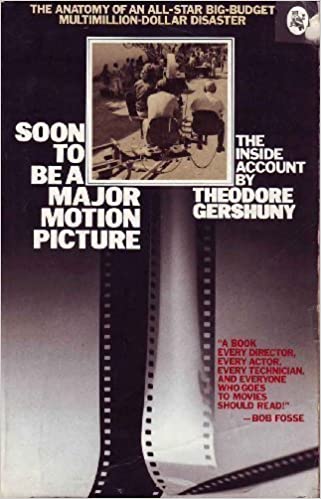
Book Review: Soon To Be A Major Motion Picture by Theodore Gershuny


In 1975, United Artists released a political thriller called Rosebud.

Rosebud was based on a best-selling novel.

Rosebud dealt with terrorism, an important topic both in 1975 and today.

Rosebud was directed by Otto Preminger, an acclaimed, award-winning filmmaker who was known for making controversial movies and who had a showman’s flair for publicity.

Rosebud had an international cast of screen veterans and up-and-coming stars.  Peter O’Toole, Richard Attenborough, Cliff Gorman, Peter Lawford, Raf Vallone, Adrienne Corri, Lalla Ward, Claude Dauphin, Isabelle Huppert, and Kim Cattrall all had key roles.  Former New York City Mayor and presidential candidate John V. Lindsay made his acting debut as a U.S. senator.

Rosebud was released with a good deal of publicity.

And, finally, Rosebud is almost totally forgotten today.  Not only did Rosebud receive less-than-stellar reviews, it’s box office failure pretty much spelled the end of Preminger’s directorial career.  (He directed one more film after Rosebud.)  Rosebud sunk into such obscurity that, for years, it wasn’t even available on anything other than VHS tape.  It was finally given a Blu-ray release in 2021 but, unlike some of Preminger’s other films, Rosebud isn’t going to end up getting a Criterion release anytime soon.  (That said, it can currently be streamed for free on a few sites.  So, go watch it after you finish this review.)

Having seen Rosebud, I can tell you that the film wasn’t forgotten because it was a disaster or anything like that.  Instead, Rosebud was forgotten because it was thoroughly mediocre.  There’s nothing particularly terrible about it but there’s nothing particularly good about it.  Instead, it’s a slowly-paced and flatly directed film.  There are a few interesting scenes, the majority of which involve Richard Attenborough’s terrorist.  But otherwise, it’s just a mediocre film from a director who was past his prime.

Interestingly enough, Rosebud’s mediocrity is what makes the 1980 book, Soon To Be A Major Motion Picture, such an interesting read.  While directing Rosebud, Otto Preminger allowed journalist and filmmaker Ted Gershuny to observe every detail of the production.  From Erik Lee Preminger’s attempt to write a workable script to the casting sessions to the film’s eventual release, Gershuny was there.  Soon To Be A Major Motion Picture tells the story of how a group of talented people ended up making a thoroughly forgettable film.  There have been plenty of books written about the production of terrible movies.  There’s been even more books written about the making of classic films.  But Soon To Be A Major Motion Picture is one of the few books to take a serious and detailed look at what it’s like to make a thoroughly mediocre film.  And let’s be honest, most films are mediocre.  Most films are more likely to be Rosebud than they are to be The Godfather, Goodfellas or Battlefield Earth.

The book, not surprisingly revolves around Otto Preminger.  The Preminger described in the book is a complex figure, a proud man and an occasionally sensitive artist who is also frequently a bully.  As the book makes clear, Preminger can be kind but he also came of age at a time when it was common place for directors to yell and be autocratic.  Preminger’s habit of shouting rubs more than a few crew and cast members the wrong way.  When he’s not yelling, Preminger comes across as thoughtful and witty but there’s also an undercurrent of sadness to him as Preminger realizes that the film industry is changing and that he’s getting left behind.  The fact that he directed films like Anatomy of a Murder, Laura, Exodus, and The Cardinal didn’t matter in the new Hollywood.  The same things that had once led to Preminger being branded a rebel and an innovator now led to him being branded as being out-of-touch.  Rosebud was Preminger’s attempt to remain relevant, both artistically and politically.  Unfortunately, the 70s were a brutal decade for the directors who previously defined Hollywood’s Golden Age.  Some, like John Huston, were eventually able to adjust and make a few more good films before their careers were ended by either retirement or death.  Most, however, were like Preminger, too engaged to quit but too old-fashioned to keep up with the younger filmmakers.  Still, even when it becomes obvious that Rosebud is not going to work as a film, Preminger refuses to give up or surrender.  He’s going to make his movie.

Also making a huge impression is Robert Mitchum.  Mitchum was originally cast in the film’s leading role and, having seen Rosebud, it’s easy to understand why Mitchum would seem like the ideal choice to be play Larry Martin, a cynical and hard-boiled journalist and CIA asset.  When Mitchum first appears in the book, he’s a breath of fresh air.  Even on the printed page, it’s easy to see that Mitchum’s no-nonsense style invigorated the disorganized production.  However, Mitchum quickly becomes disillusioned, walks off the film, and is hastily replaced by Peter O’Toole.  Not even Gershuny seems to be sure what specifically caused Mitchum quit the film, though it’s suggested that Mitchum felt that he had been personally slighted by Preminger.  (At one point, Mitchum claims that Preminger accused him of being drunk when he was sober.  At another point, it’s suggested that Mitchum walked because he realized that film wasn’t going to be any good and he felt he was wasting his time.)  O’Toole does his best to take Mitchum’s place, though his poor health proves to be almost as much of a challenge as Mitchum’s bad attitude.

(That said, O’Toole’s apparent frailty disappeared after the production received a bomb threat that is later revealed to have been a hoax.  The book suggests that O’Toole and his entourage tracked down the hoaxer and essentially beat the Hell out of him.)

It’s a highly interesting and well-written book, one that will make you appreciate the effort that goes into making even a forgettable film.  Used paperback copies can ordered off of Amazon for $22.00.  I found my copy at Recycled Books in Denton, Texas and paid $3.00 for it.  Support you local independent book stores, people.
Lisa Reviews An Oscar Nominee: The Pied Piper (dir by Irving Pichel)


The 1942 Best Picture nominee, The Pied Piper, opens in Eastern France, shortly after the outbreak of World War II.

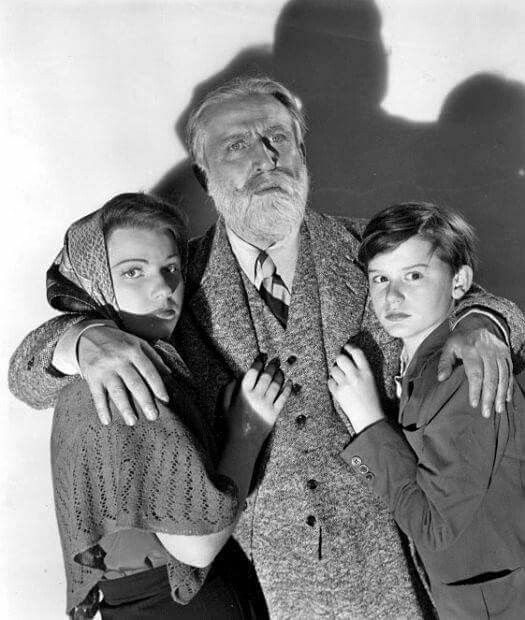
John Sidney Howard (played by Monty Woolley) is an Englishman on holiday.  He says that he just wants to enjoy some fishing before the entire continent of Europe descends into chaos.  He knows that France is going to be invaded at some point and he even suspects that the country will probably fall to the Nazis.  In his 70s and still mourning the death of his son (who was killed during an air battle over occupied Poland), Mr. Howard just wants to enjoy France one last time.  Despite the fact that the bearded Howard bears a resemblance to a thin Santa Claus, he’s quick to declare his dislike of both children and humanity in general.  He’s a misanthrope, albeit a rather friendly one.

Howard’s plans change when the Nazis invade France sooner than he expected.  With his vacation canceled, Howard just wants to get back to England.  Complicating matters is that a diplomat named Cavanaugh (Lester Matthews) has asks Howard to take his children, Ronnie (Roddy McDowall) and Sheila (Peggy Ann Garner), back to England with him.  Despite his self-declared dislike of children, Howard agrees.  However, it turns out that getting out of France won’t be as easy as Howard assumed.  After their train gets diverted by the Nazis, Howard, Ronnie ,and Sheila are forced to take a bus.  After almost everyone else on the bus is killed in a surprise Nazi attack, Howard and the children are forced to continue on foot and rely on the kindness of a young French woman, Nicole Rougeron (Anne Baxer).

Throughout the journey, Howard keeps collecting more and more children.  Everyone wants to get their children to a safe place and Howard soon has a small entourage following him.  Unfortunately, he also has Gestapo Major Diessen (an excellent Otto Preminger) watching him.  How far is Howard willing to go to ensure the safety of the children?

The Pied Piper is an interesting film, in that it starts out as something of a comedy but it then gets progressively darker as events unfold.  At the beginning of the film, it appears that the whole thing is just going to be Howard getting annoyed with the precocious Ronnie and Sheila.  But then that bus is attacked and Howard find himself accompanied by a young boy who has been left in a state of shock by the attack.  When the group is joined by a young Jewish child named Pierre, it’s a reminder that, though the film itself may have been shot on an American soundstage, the stakes and the dangers in occupied Europe were all too real.

The Pied Piper was nominated for Best Picture of the year.  Viewed today, it may seem like an unlikely nominee.  It’s a well-made movie and Monty Woolley gives a good performance as John Sidney Howard.  It’s the type of film that, due to the sincerity of its anti-Nazi message, should bring tears to the eyes of the most hardened cynic but, at the same time, there’s nothing particularly ground-breaking or aesthetically unique about it.  Still, from a historical point of view, it’s not a surprise that this competent but conventional film was nominated.  With America having just entered the war, The Pied Piper was a film that captured the national spirit.  Other World War II films nominated in 1942 included 49th Parallel, Wake Island, and the eventual winner, Mrs. Miniver.

In fact, one could argue that The Pied Piper is almost a cousin to Mrs. Miniver.  Both films are not only anti-German but also unapologetically pro-British.  Just as Greer Garson did in Mrs. Miniver, Monty Woolley is meant to be less of an individual and more of a stand-in for Britain itself.  When both Mrs. Miniver and Mr. Howard refused to surrender in the face of German aggression, these movies were proudly proclaiming that the British would never lose hope or surrender either.

Thankfully, the movies were correct.

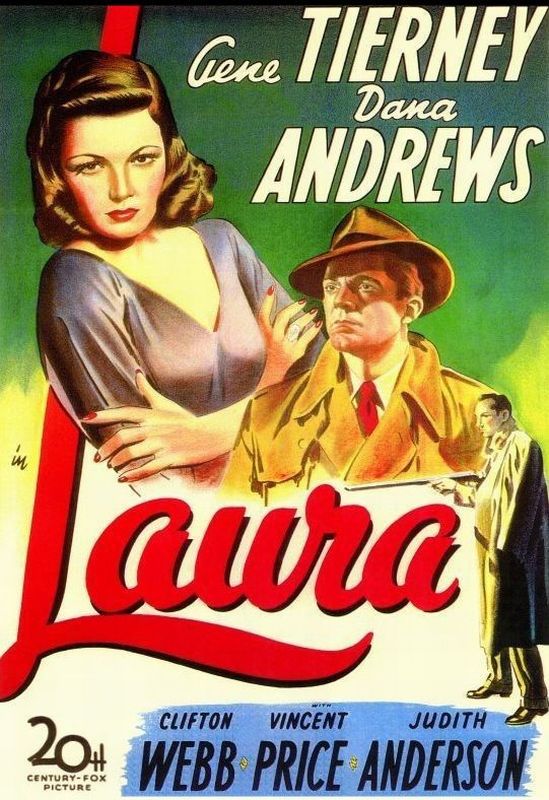
Fall in Love with LAURA (20th Century Fox 1944)


gary loggins's avatarcracked rear viewer

laura1

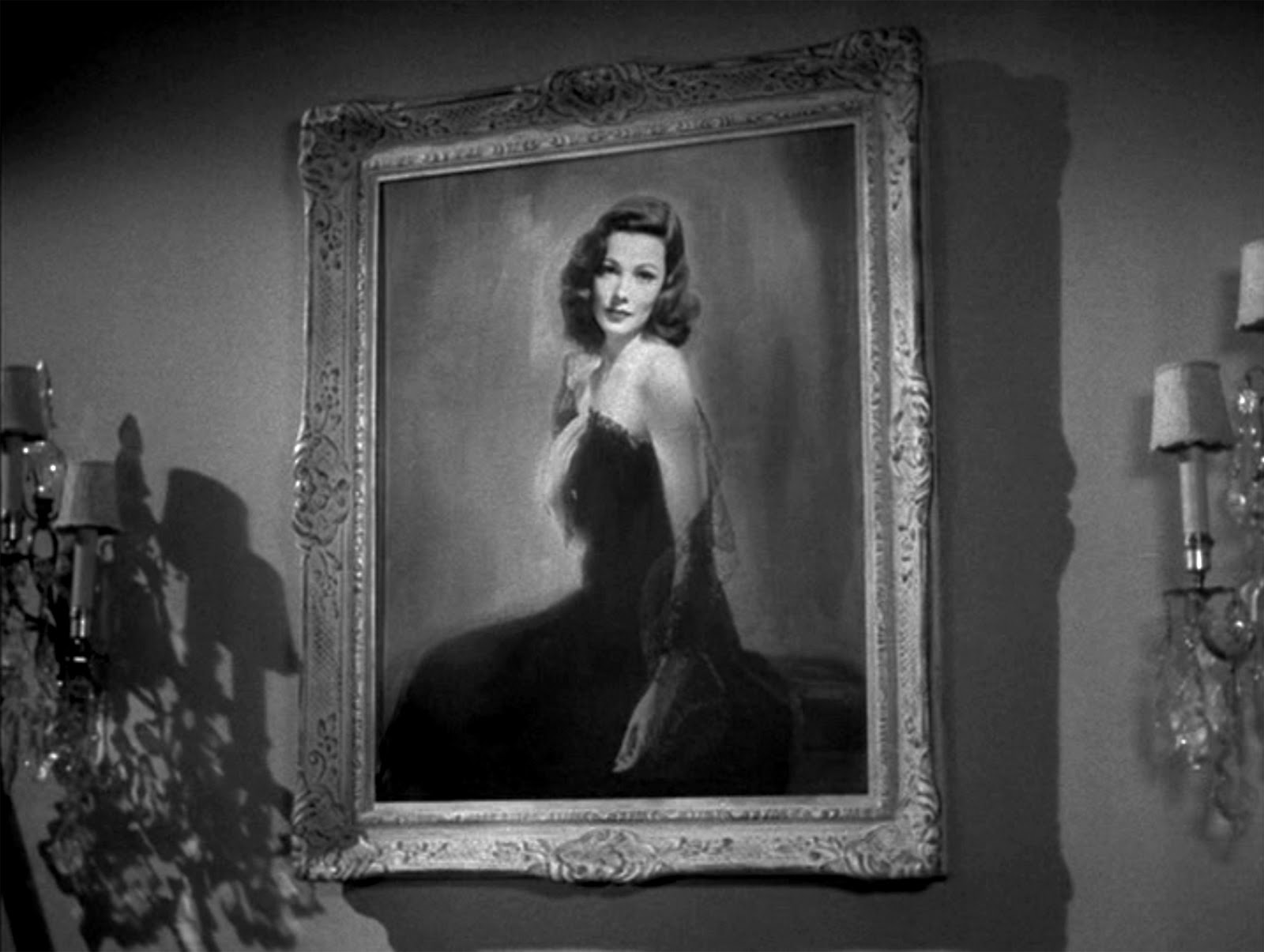
If you’re like me, you’ve probably watched LAURA more than once. It’s one of the top film noirs, indeed one of the top films period of the 1940’s. LAURA is unquestionably director Otto Preminger’s greatest achievement; some may argue for ANATOMY OF A MURDER or even ADVISE AND CONSENT, and they’re entitled to their opinions. But though both are great films, only LAURA continues to haunt the dreams of classic movie lovers, its main themes of love and obsession transferring to its fans even 73 years after its initial release.

laura2

Preminger, along with scenarists Jay Dratler, Samuel Hoffenstein, and Betty Reinhart, weave an intricate, sinister tapestry around the violent death of beautiful New York ad exec Laura Hunt. Cynical police detective Mark McPherson is determined to solve this particularly gruesome murder; Laura was killed at close range by a buckshot-loaded shotgun blast to the face. McPherson begins by questioning Waldo Lydecker, the acerbic newspaper columnist who relates…

View original post 527 more words

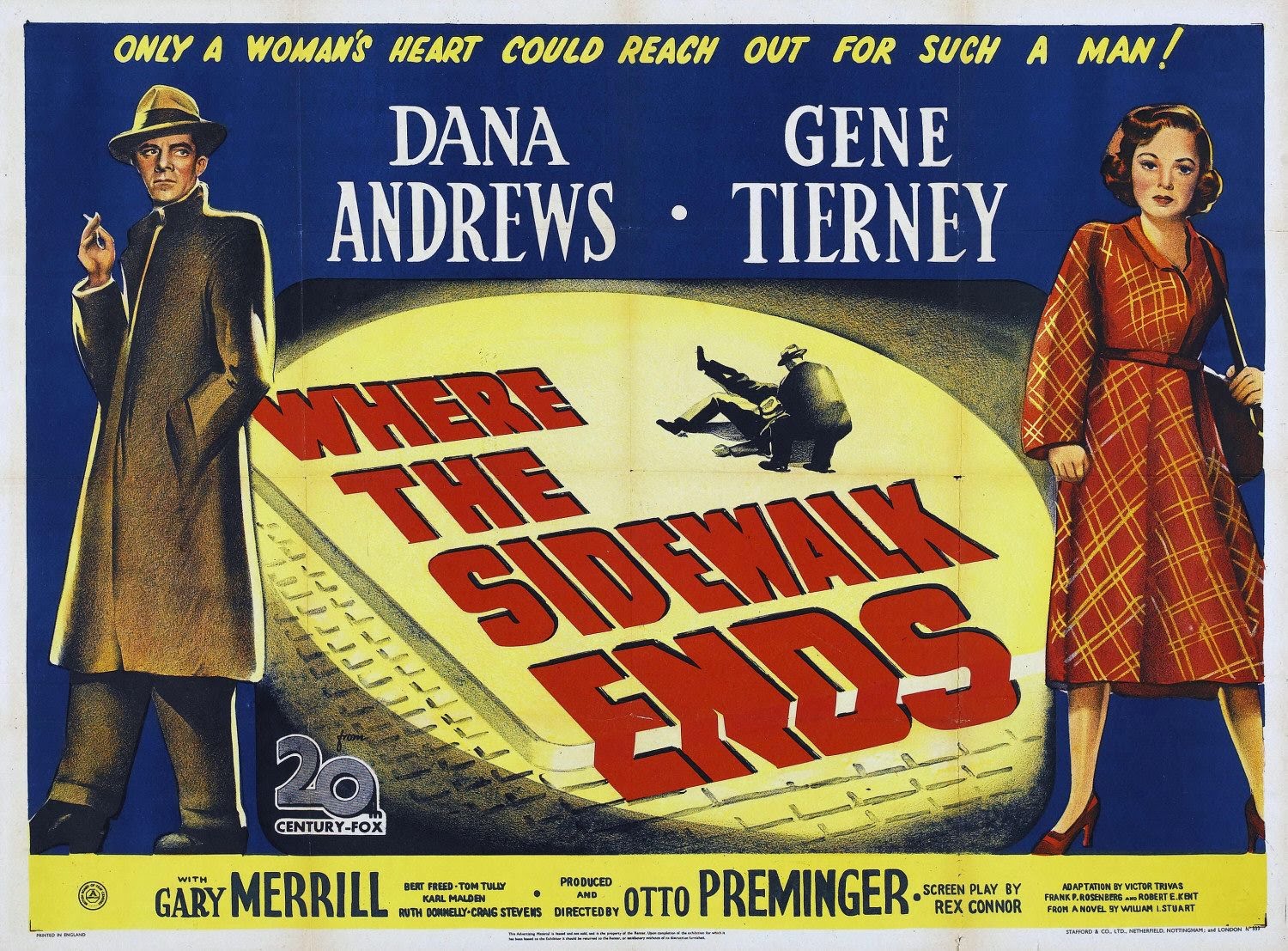
Darkness on the Edge of Town: WHERE THE SIDEWALK ENDS (20th Century Fox 1950)


gary loggins's avatarcracked rear viewer

where1

I recorded WHERE THE SIDEWALK ENDS way back in June, and haven’t watched it until just recently. It was well worth the wait, for this is one of the finest noirs I’ve seen yet. Director Otto Preminger reunited with the stars of his film LAURA, Dana Andrews and Gene Tierney, to give us a bleak crime drama that more than holds its own with the best films noir of the era.

Police Detective Mark Dixon (Andrews) is a proto-Dirty Harry cop, a tough SOB not above laying the smackdown on New York City’s criminal element. Another assault charge leads to Mark being demoted by his superiors. Mark’s got a reason for his brutality tactics, though: his father was a criminal, and he’s psychologically compelled to clean up the corruption in his city.

where4

He’s particularly got a hair across his ass about gambling czar Tommy Scalise (Gary Merrill), who was set up in…

View original post 275 more words