“Today it is science fiction, tomorrow it will be science fact….”
So declared the trailer from 1973’s The Clones.
One of the first films to be made about cloning, this movie tells the story of Dr. Gerald Appleby (Michael Greene), who discovers that there’s another version of him living his life. Dr. Appleby and his clone both find themselves being pursued by two government agents (Gregory Sierra and Otis Brown) and a mad scientist (Stanley Adams).
TheClones requires some patience. It moves at its own deliberate pace and there’s quite a few scenes of Dr. Appleby running through the desert. That said, the film builds up to wonderfully twisted conclusion and the final roller coaster shoot-out makes everything more than worth it.
Ever since I first saw this ennui-drenched film in 2012, I’ve been recommending it to people. I’m happy to share it with you today!
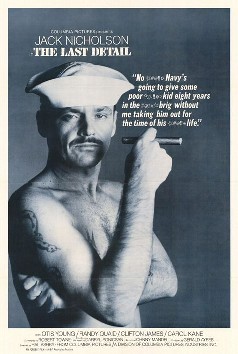
Billy “Badass” Buddusky (Jack Nicholson) and Richard Mulhall (Otis Young) are two Navy lifers stationed in Virginia. On shore patrol, they’ve been assigned to transport a 18 year-old seaman to a Naval prison in Maine. The kid has been dishonorably discharged and sentenced to eight years in the brig for trying to steal $40 from a charity box. (The charity was a favorite of the wife of his commanding officer.) Buddusky and Mulhall are expecting to find a hardened punk but instead, they end up escorting Larry Meadows (Randy Quaid), a timid teenager who suffers from kleptomania and who doesn’t seem to understand just how bad things are going to be for him for the rest of his life. Not only is he going to do eight years in the brig, surrounded by hardened criminals, but his dishonorable discharge is going to follow him for the rest of his life.
Resenting having to take Meadows to prison and also feeling that he’s getting a raw deal, Buddusky and Mulhall decide to make a few stops on their way to Maine, so that Larry can enjoy what little time he has left and hopefully lose his virginity before being locked up. In between brawling with Marines, visiting a brothel (where a young Carol Kane plays one of the prostitutes), and hanging out with a group of hippies (one of whom is played by Gilda Radner), Meadows comes to think of Buddusky and Mulhall as being his best friends. Unfortunately, for Meadows, both Buddusky and Mulhall have their job to do.
Hal Ashby’s road picture is a character study of three men who are all lifers, even if they don’t realize that. Both Buddusky and Mulhall hate the Navy but they also can’t relate to anyone who isn’t a member of the service. Meadows’s entire future has been pre-determined because he tried to steal $40 but he doesn’t realize it until its too late. When the film came out, it was controversial due to its “colorful” language. In an interview, screenwriter Robert Towne defended the frequent profanity because, as he put it, when you’re in a situation you hate, “that’s what you do. You bitch.” Hal Ashby’s loose direction captures the road trip feel as the three leads reluctantly head to their ultimate destination.
The Last Detail features one of Jack Nicholson’s best performances. Buddusky is cynical and doesn’t trust anyone other than Mulhall but even he knows that Larry Meadows deserves better than to spend eight years in the brig. Along with lending his star power to the film and standing by director Hal Ashby when Ashby was arrested for marijuana possession, Nicholson also played a big role in the casting of Randy Quaid as Larry Meadows. (The other final contender for the role was John Travolta but Nicholson insisted on Quaid). The 6’5 Quaid towers of Nicholson and Young, making him look as if he could escape any time that he wants. But Larry is so naive that he doesn’t want to make any trouble for his “friends.” Though this wasn’t his first film, The Last Detail is the film that made Quaid one of the busiest character actors of the 70s and 80s and it also, at least temporarily, made him a part of the Jack Nicholson stock company.
Both sad and funny, The Last Detail is one of the best films of the 70s and features Jack Nicholson at his most unforgettable.
“Nom nom nom nom,” says that monster under the sand.
“Agck! Agck! Agck! Agck!” says the people above the sand.
And that’s all you really need to know about the 1981 film, Blood Beach.
Blood Beach takes place on a beach that also happens to be a hunting ground for this mutated worm thing that lives underground. Basically, whenever anyone takes a stroll on the beach, they get sucked down into the sand and, for the most part, they’re never seen again. Sometimes that’s not a bad thing, as in the case of a wannabe rapist who ends up getting castrated while being pulled down into the sand. But, far too often, the victims are innocent people who were just walking their dog, chasing after their hat, or searching for buried treasure.
The beach becomes so well-known for being a death trap that the locals start to call it Blood Beach but, for some reason, that doesn’t seem to stop people from wandering out on the sand at inopportune times. I mean, it would just seem logical to me that if there’s a monster killing people on the beach then maybe it would be a good idea to avoid the beach for a while. I mean, you could go see a movie or you could lay out and work on your tan in your back yard. Believe it or not, you do have the option of not going to a monster-infested location.
Strangely, there’s one person who is always on the beach but never gets killed. That’s Mrs. Selden (Eleanor Zee), a somewhat odd woman who always seems to be nearby whenever someone is getting dragged into the sand but who never gets attacked herself. Interestingly, Mrs. Selden never seems to be particularly concerned by all the carnage around her. (One victim is even killed while specifically checking to make sure Mrs. Selden is okay.) I kept expecting some sort of major twist where it was revealed that Mrs. Selden was a witch or something but it never happened.
Now, you would think that the presence of an underground monster would be the perfect excuse to call in the national guard but instead, the local police (led by John Saxon’s Captain Pearson) handle it. Sgt. Royko (Burt Young) heads up the monster investigation, which in this film means that he kinda of stumbles from scene-to-scene, never looking particularly impressed by or interesting in anything that’s happening around him. If anything, Royko seems to be annoyed that he’s having to give up time that he could be using to drink beer and watch TV and that attitude makes Royke the hero of this film. Forget the scientist who wants to understand where the monster came from. Forget the habor cop who wants to rekindle things with an old flame. Royko doesn’t care about science or love. He just wants to blow stuff up, which makes him the perfect audience surrogate
Anyway, Blood Beach sounds like it should be a fun movie but it’s not. The movie delivers a lot of beach but very little blood. There’s a lot of “nom nom” but very little “agck!” Blood Beach is almost as much of a misfire as spending spring break in West Texas.
How, you may be asking, did I come to see The Clones, an extremely obscure and low-budget science fiction thriller from 1973?
It all started when I first saw the trailer for the film on 42nd Street Forever, a compilation of old school grindhouse trailers. For whatever reasons, the trailer for The Clones fascinated me. Whether it was the extremely dry narration or the fact that the trailer actually ended with a quote from a then-member of the U.S. Senate, I felt that The Clones was a film that I, as a student of film and history, simply had to see.
How obscure is this film? It’s so obscure that The Clones has never even been released on DVD. In order to see the film, I had to go on Amazon and order a used VHS copy from a some guy in Indiana. When it arrived in the mail, the first thing I noticed was the big “Property of the St. Augusta Public Library” that was stamped on the back of the worn video box.
The fact that my copy of The Clones had obviously seen better days actually added a lot to the viewing experience. Much as true grindhouse fans treasure every scratch and auditory pop whenever they watch a film like Fight For Your Life or Last House on Dead End Street, I found myself oddly proud that my copy of The Clones had obviously survived so much just so that it could eventually end up as a part of my video library.
As for the film itself, The Clones is one of those wonderful low-budget films that deserve to be rediscovered. Dr. Gerald Appleby (well-played by an actor named Michael Greene) is a nuclear scientist who discovers that he’s been cloned and that the clone has essentially been out living his life whenever the original Appleby has been at work. Though it’s hinted that he’s being set up by foreign spies, the reason for Appleby’s cloning remains obscure throughout the entire film. Whether this narrative obscurity is intentional or not, it actually serves the film well as it helps to transform Appleby into almost a Kafkaesque figure.
When Appleby attempts to reveal to the proper authorities that he’s been cloned, he finds himself accused of being an imposter and is forced to literally run for his life. The majority of the film deals with Appleby being chased across the California desert by not only the mad scientist who cloned him (a wonderfully demented Stanley Adams) but also by two ruthless federal agents. The two federal agents are played by Otis Young and Gregory Sierra, two character actors who appeared in several films during the 70s. Sierra and Young are a lot of fun to watch in this film and it’s hard not to like them, even if they technically are villains. They both just seem to be having so much fun trying to kill our hero.
From what little information that I’ve been able to gather about this film’s production, it appears that The Clones was one of the first motion pictures to attempt to take advantage of the paranoia that most people feel over the prospect of humans being cloned. When seen today, the film’s story is a bit predictable because, to be honest, there’s really only so much when you can do with cloning as a plot device. However, The Clones remains an oddly effective film. The low budget (and lack of special effects) actually contributes to the film’s success. Without the crutch of spectacle, The Clones is forced to pay attention to things like characterization. How’s that for a concept?
The film eventually climaxes with a genuinely exciting shoot out in a deserted amusement park and then it all ends, in typical 70s fashion, in a climax that manages to be both fun and depressing at the same time.
The Clones is not necessarily an easy film to see but it’s well worth the effort.


 Through the Shattered Lens