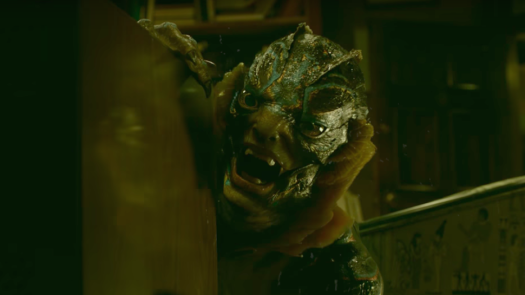
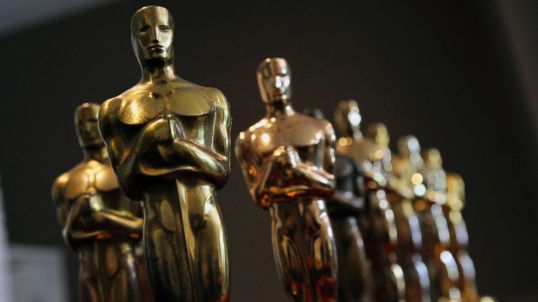
Fans of classic horror movies were dancing in the streets from Karloffornia to Transylvania when THE SHAPE OF WATER won the Oscar for Best Picture last night! After 90 long years, a genre-themed film was given the Academy’s top honor. Guillermo Del Toro, a lifelong fantasy and classic film fan, also received an Oscar as Best Director (and quoted Jimmy Cagney in YANKEE DOODLE DANDY in his acceptance speech!). Coincidentally, last night was the anniversary of the birth of William Alland , producer of THE CREATURE FROM THE BLACK LAGOON, which served as an inspiration for THE SHAPE OF WATER. Somewhere in Hollywood heaven, Mr. Alland, director Jack Arnold, stars Richard Carlson, Richard Denning, Nestor Paiva, and Ben Chapman are all beaming with pride! (Happily, Julie Adams and Riccou Browning are still with us to join in the celebration).
Thank you everyone who joined us today for our Oscar coverage! Thank you for your likes, you comments, your views, and — most of all — for your indulgence! Y’all are the best!
We now return you to your regularly scheduled programming….
The 1964 film, Zorba the Greek, tells the story of two very different friends.
Basil (Alan Bates) is a writer. (“Poetry, essays,” he diffidently says when asked what he writes.) Basil is British-Greek but, having been raised in the UK, he allows his British side to dominate. In this film, that means that Basil is very polite and very reserved. He’s not the type to attempt to flirt with someone who he doesn’t know. He has never spontaneously broken into dance. When he is offered a drink, he asks for tea and is shocked to receive rum instead. If the film was taking place a few decades later, one gets the feeling that Basil would describe Love, Actually as being an okay movie “for people who like that sort of thing.”
And then there’s Zorba (Anthony Quinn). Unlike the wealthy and well-educated Basil, Zorba is a peasant and he’s proud of it. He works hard but he plays hard too and there’s nothing that Zorba loves more than the sound of good music. Zorba not only drinks rum but makes sure that everyone else gets their fill as well. Zorba dances whenever he feels like it. Zorba is larger than life, an unfailingly enthusiastic man who is determined to enjoy whatever time he has left in his life.
When Zorba and Basil first meet, Basil is heading to Crete where he’ll be trying to reopoen a mine that was left to him by his father. As for Zorba, he’s looking for work and, as he explains it, he has tons of experience working as a miner. Though Basil is, at first, reluctant to hire someone who he’s just met, Zorba talks him into it. As quickly becomes apparent, the exuberant Zorba can talk people into almost anything.
You can probably guess where all of this is going. Zorba teaches Basil how to embrace life, which in this film means embracing the Greek side of his heritage. It takes a while, of course. Basil is an extremely reluctant protegé and a good deal of the film’s humor comes from just how uncomfortable Basil occasionally gets with his newfound friend. That said, you don’t have to be a psychic to guess that eventually, the two of them will share a dance on the beach. It may be predictable but that’s not to say that Zorba the Greek isn’t a good film. It’s a very good and entertaining movie, featuring a justifiably famous soundtrack and also one of Anthony Quinn’s best and most exuberant performances.
In fact, Quinn is so perfectly cast as Zorba that he occasionally tends to overshadow Alan Bates, who is equally good but in a different way. In fact, I would say that Bates probably had the more difficult role. Whereas Zorba (and Quinn) spends the entire movie instigating, Basil (and Bates) spends the entire movie reacting. It’s difficult to make passivity watchable but Bates manages to do it.
Of course, Zorba isn’t just a comedy about an unlikely friendship. About halfway through the film, there’s a moment of shocking brutality involving a young widow played by Irene Pappas. It took me totally by surprise and it left me a bit shaken. (It also reminded me a bit of another European film featuring Irene Pappas, Lucio Fulci’s Don’t Torture A Duckling.) It’s a scene that serves as a reminder that 1) not every peasant is Zorba the Greek and 2) friendship and love cannot end darkness but it can make it all a little more bearable.
Zorba the Greek was nominated for Best Picture but it lost to My Fair Lady.
Long before there was Lost, there was Lost Horizon!
Much like the famous television show, the 1937 film Lost Horizon begins with a group of strangers on an airplane. They’re people from all walks of life, all with their separate hopes and dreams. When the plane crashes, they find themselves stranded in an uncharted land and, much like the Lost castaways, they are shocked to discover that they are not alone. Instead, they’ve found a semi-legendary place that is ruled over by a man who has lived for centuries. Much as in Lost, some want to return to civilization while others want to remain in their new home. Both Lost and Lost Horizon even feature a terminally ill woman who starts to recover her health after becoming stranded.
Of course, in Lost, everyone was just flying from Australia to America. In Lost Horizon, everyone is trying to escape the Chinese revolution. Among the passengers on the plane: diplomat Robert Conway (Ronald Colman), his irresponsible brother, George (John Howard), a con artist named Henry (Thomas Mitchell), a paleontologist (Edward Everett Horton), and the very ill Gloria (Isabel Jewell).
While Lost featured a plane crash on a tropical island, Lost Horizon features a plane crash in the Himalayas. In Lost, the sinister Others sent spies to infiltrate the survivors. In Lost Horizon, the mysterious Chang (H.B. Warner) appears and leads the survivors to a place called Shangri-La.
Shangi-La is a lush and idyllic valley that has somehow flourished in one of the most inhospitable places on Earth. The happy inhabitants inform the survivors that they never get sick and they never fight. They’re led by the High Lama (Sam Jaffe), a philosopher who explains that he is several hundred years old. The valley is full of magic and the Lama tells the survivors that Shangri-La is their new home.
Now, I’ve seen enough horror movies that I spent most of Lost Horizon waiting for the Lama to suddenly reveal that he was a vampire or an alien or something. Whenever anyone in a movie seems to be too good to be true, that usually means that he’s going to end up killing someone about an hour into the story. But that didn’t happen in Lost Horizon. Instead, the Lama is just as wise and benevolent as he claims to be and Shangri-La is as much of a paradise as everyone assumes. I guess we’re just naturally more cynical in 2018 than people were in 1937.
Of course, the Lama isn’t immortal. Not even the magic of Shangri-La can prevent the inevitably of death. The Lama is looking for a successor. Could one of the survivors be that successor? Perhaps. For instance, Robert absolutely loves Shangri-La. Of course, his brother George is determined to return to the real world. He has fallen in love with one of the inhabitants of Shagri-La and plans to take her with him, despite the Lama’s warning about trying to leave…
Frank Capra was a huge fan of James Hilton’s book, Lost Horizon, and he spent three years trying to bring it to the big screen. Based on Capra’s previous box office successes, Colombia’s Harry Cohn gave Capra a budget of $1.25 million to bring his vision of Shangri-La to life. That may not sound like much today but, at the time, that made Lost Horizon the most expensive movie ever made. The production was a notoriously difficult one. (The original actor cast as the elderly Lama was so excited to learn he had been selected that he dropped dead of a heart attack.) As a result of both its ornate sets and Capra’s perfectionism, the film soon went overbudget. When Capra finally delivered a first cut, it was over 6 hours long. Capra eventually managed to edit it down to 210 minutes, just to then have Harry Cohn order another hour taken out of the film. When Lost Horizon was finally released, it had a running time of 132 minutes.
Seen today, Lost Horizon is definitely an uneven work. With all the cutting and editing that went on, it’s hard to guess what Capra’s original vision may have been but, in the final version, much more time is devoted to the characters discussing the philosophy of Shangri-La than to the characters themselves. (It’s always good to see Thomas Mitchell but he really doesn’t get much to do.) Since you never really feel like you know what any of these characters were like outside of Shangi-La, it’s hard to see how being in Shagri-La has changed them. You just have to take their word for it. That said, it’s a visually stunning film. Capra may have gone over budget creating the look of Shangri-La but it was money well-spent. If I ever find myself in a magic village, I hope it looks half as nice as the one in Lost Horizon.
Despite all of the drama that went on behind the scenes and a rather anemic box office reception, Lost Horizon was nominated for best picture. However, it lost to The Life of Emile Zola.
Last year, on Oscar Sunday, I shared lists of 16 actors and 16 actresses who has never been nominated for an Oscar. On the list of actors was Sam Rockwell. One year later, Rockwell has not only been nominated for an Oscar but many think he’s the front runner to win!
Needless to say, my list had absolutely nothing to do with this fact. Still, who knows? Maybe one of the actors listed below will be next year’s sure-fire winner.
Here are 8 more deserving actors who have yet to be nominated for an Oscar!
Idris Elba
I have to admit that I’m still shocked that Elba wasn’t nominated for his chilling work in Beasts of No Nation. Elba is one of those supremely talented actors who makes it all look easy. In fact, that may be part of the problem. Elba is such a natural performer that sometimes, I think people overlook just how many different roles he played. Elba seems destined to be nominated someday.
2. Armie Hammer
Armie Hammer has appeared in some truly regrettable films but, at the same time, he’s given really good performances in a handful of memorable ones. It seems like ever since he played twins in The Social Network, Hammer has been circling Oscar recognition. This year, he probably came the closest yet to getting nominated, with his performance in Call Me By Your Name. I would also say that he deserved some consideration for his slyly humorous work in Free Fire.
3. Oscar Isaac
Oscar Isaac is going to be nominated some day. It’s all a matter of when. I would have given him an Oscar just for the way he delivered the line, “I declare him to be an … OUTLAAAAAAAAAAAW!” in Robin Hood.
4. Tobey Magurie
Personally, I think that Maguire has it in him to make a comeback, perhaps even an Oscar-winning comeback. Right now, his main problem seems to be that all of the good Tobey Maguire roles are going to Edward Norton.
5. James McAvoy
McAvoy deserved a nomination this year for his performance in Split.
6. Ben Mendelsohn
There was some speculation that Mendelsohn’s role in Darkest Hour might result in a nomination this year. It didn’t happen but Ben Mendelsohn is another actor who seems to be destined to be nominated eventually. I would have nominated him for his frightening performance in Animal Kingdom.
7. Kurt Russell
A lot of us thought that Russell would receive a nomination for The Hateful Eight but, instead, that film was dominated by Samuel L. Jackson, Jennifer Jason Leigh, and Walton Goggins. Everyone loves Kurt but he’s not getting any younger so someone needs to write him a really great role before he decides to retire to Vancouver.
8. Peter Sarsgaard
Peter Sarsgaard is another one of those really good actors who never seems to get as much appreciation as he deserves. If you want to see how good Sarsgaard can be, track down a film called Shattered Glass.
Here’s hoping that, come next year, at least one of those actors will no longer be eligible for this list!
For 9 decades, the Oscars have been an important part of American life. As I’ve said on this site many times, Oscar Sunday is as much of an unofficial holiday as Super Bowl Sunday. For many of us, the new year doesn’t even begin until the morning after the Oscars.
However, some of the most memorable Oscar winners didn’t even exist! The Academy Awards have been used as a plot device in any number of movies. Here are four of my favorite fictional Oscar winners:
Johnny Fontane (Al Martino) in The Godfather (1972)
Oh, Johnny Fontane. He had such a good singing career going until he started to lose his voice. But, fortunately, there was a part for him in an upcoming picture. As Johnny explained it, the part was a guy just like him. “I wouldn’t even have to act.” The only problem was that studio head Jack Woltz didn’t want to give him that role.
It’s a good thing that Johnny had a Godfather like Vito Corleone. And it’s a good thing that the Godfather had a lawyer like Tom Hagen, a lawyer who didn’t mind arranging for a horse to be beheaded. Khartoun may not have survived but Johnny Fontane got his part and his Oscar.
(Johnny’s adventures at the Oscars are detailed in all their loving glory in Mario Puzo’s novel. Perhaps not wanting to harm its own Oscar chances, the film left out the majority of Johnny’s Hollywood adventures.)
2. Margaret Elliott (Bette Davis) in The Star (1953)
“C’mon, Oscar! Let’s get drunk!”
Listen, you may think that winning an Oscar means that you’re set for life but often, the exact opposite is true. Winning an Oscar has killed many a career. They even have a name for it: The Oscar Curse.
Take Margaret Elliott for instance. She won an Oscar. And now, just a few years later, she’s broke, drunk, and deeply in denial. Can her daughter (Natalie Wood) convince Margaret that it’s time to stop drinking and admit that fame is a hideous bitch goddess? Or will Margaret continue to get drunk with her Oscar staring at her in judgment?
3. Vicki Lester (Judy Garland) in A Star is Born (1954)
Sadly, Vicki is better remembered for what happened during her acceptance speech than for the speech itself. When her husband, notorious alcoholic Norman Maine (James Mason), took the stage and struck his wife while drunkenly motioning, it shocked Oscar watchers everywhere. But Vicki never stopped loving him and, after his tragic death, she let the world know that, “This is Mrs. Norman Maine.”
4. Jerilee Randall (Pia Zadora) in The Lonely Lady (1983)
“I don’t suppose I’m the only one whose had to fuck her way to the top.”
There’s a few ways in which you can view the 1953 film, Shane.
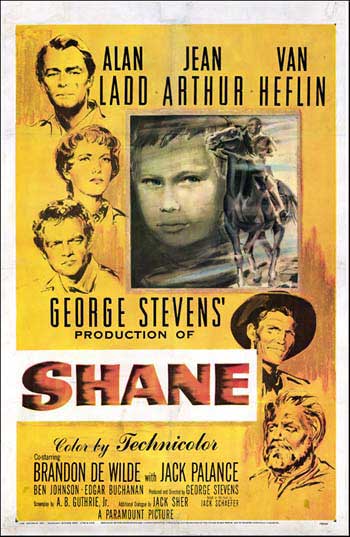
The more popular view is that it’s a Western about a man named Shane (Alan Ladd) who rides into town and gets a job working for the Starretts, Joe (Van Heflin) and Marian (Jean Arthur). Joe is a farmer who is determined to hold onto his land, despite the efforts of cattle baron Rufus Ryker (Emile Meyer) to force him off of it. While we don’t learn much about Shane’s background, it becomes apparent that he’s a man who can fight. That comes in handy when Ryker brings in a sinister gunfighter named Wilson (Jack Palance).
Another view is that Shane is the story of a man who just wants to settle down but, instead, finds himself continually hounded by an annoying little kid, to the extent that he finally gets involved in a gun battle just so he’ll have an excuse to leave town and get away from the little brat. Little Joey Starrett (Brandon deWilde) idolizes Shane from the minute that he comes riding up. When he hears that Shane refused to get into a fight at the local saloon, Joey demands to know whether it was true. He tells his mom that he loves Shane almost as much as he loves his father. When Shane does get into a brawl with all of Ryker’s men, Joey stands in the corner and eats candy. And then, when Shane tries to leave town, Joey runs behind him shouting, “Come back, Shane! Come back!”
Myself, I think of it as being the story of Frank Torrey (Elisha Cook, Jr.). Frank is the farmer that’s been nicknamed “Stonewall,” due to his status as a former Confederate and his quick temper. Stonewall may be smaller than the other farmers but he’s usually the quickest to take offense. Still, it’s impossible not to like him, largely because he’s played by Elisha Cook, Jr. When Wilson feels the need to put the farmers in their place, he does so by picking a fight with Torrey. Standing on a porch in the rain, looking down on the smaller man, Wilson starts to insult both him and the South. When Torrey finally starts to reach for his gun, Wilson shoots him dead. While Torrey lies in the mud, Wilson smirks. It’s a shocking scene, all the more so for being shown in a long shot. (By forcing those of us in the audience to keep our distance from the shooting, the film makes us feel as powerless as the farmers.) If you didn’t already hate Wilson and Ryker, you certainly will after this scene.
Shane is a deceptively simple film, one in which many of the details are left open for interpretation. We never learn anything about Shane’s background. He’s a man who shows up, tries to make a life for himself, and then leaves. He’s a marksman and an obviously experienced brawler but, unlike Ryker’s men, he never specifically looks for violence. In fact, he often seems to avoid it. Why? The film doesn’t tell us but there are hints that Shane is haunted by his past. Shane seems to want a chance to have a life like the Starretts but, once he’s forced to again draw his gun, he knows that possibility no longer exists.
Is Shane in love with Marian Starrett? It certainly seems so but, again, the film never specifically tells us. Instead, it all depends on how one interprets the often terse dialogue and the occasional glances that Marian and Shane exchance. When Shane and Joe get into a fist fight to determine who will face Ryker and Wilson, is Shane really trying to protect Joe or is it that he knows Marian will be heart-broken if her husband is killed?
One thing’s for sure. Little Joey sure does love Shane. “Come back, Shane!” Little Joey follows Shane everywhere, with a wide-eyed look on his face. To be honest, it didn’t take too long for me to get sick of Little Joey. Whenever director George Stevens needed a reaction shot, he would cut to Joey looking dumb-founded. Brandon deWilde was 11 years when he appeared in Shane and he was nominated for an Oscar but he’s actually pretty annoying in the role. Elisha Cook, Jr. was far more impressive and deserving of a nomination.
I know that many people consider Shane to be a classic. I thought it was good, as long as the action was focused on the adults. Alan Ladd plays Shane like a man who is afraid to get too comfortable in any situation and the film works best when it compares his reticence to Wilson’s cocky confidence. Whenever Joey took center stage, I found myself wanting to cover my ears.
Shane was nominated for Best Picture but lost to From Here To Eternity.
Oh, 1919! What a year. The Great War had ended, leaving much of Europe devastated. American soldiers were coming home and, scarred by the horrors they had experienced, becoming members of a lost generation. The Spanish Flu was infecting millions, on the way to eventually wiping out 3% of the world’s population. It was a grim time so it’s no surprise that many chose to close their eyes and pretend like everything was fine. Only a few people were willing to look at the world and say, “There has to be something more.”
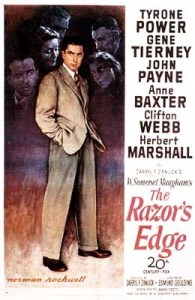
The 1946 film The Razor’s Edge tells the story of one such man. Before the war, Larry Darrell (Tyrone Power, Jr.) was like most of his friends back in Chicago. He was carefree. He was wealthy. He was engaged to marry the beautiful but self-centered Isabel (Gene Tierney). But then he went off to fight in World War I and the experience changed him. On the final day of the war, another soldier sacrificed his life to save Larry and Larry is now haunted by that man’s death. No longer sure about his place in the world, Larry announces that he’s rejecting his former life.
Of course, that’s an easy thing to do when you’re rich. Larry is lucky enough to have an inheritance that he can live off for a few years. All of his former friends think that Larry’s just struggling to adjust to being back home and they expect that he’ll get over it soon enough. Isabel’s uncle, Elliott (Clifton Webb), thinks that Larry’s acting like a total fool. For Larry’s part, he no longer cares what any of them think. He’s going to travel the world, seeking enlightenment.
While Larry’s searching, life goes on without him. Isabel ends up marrying one of Larry’s friends, Gray Maturin (John Payne). Larry’s best friend from childhood, Sophie (Anne Baxter), suffers a personal tragedy of her own and, when Larry next meets her, she’s living as a drunk on the streets of Paris. Larry keeps searching for the meaning of it all. He works in a coal mine. He discusses philosophy with a defrocked priest. Eventually, he ends up in the Himalayas, where he studies under a Holy Man (Cecil Humphreys).
It’s an intriguing idea and still a relevant one. Unfortunately, the movie doesn’t really work because Larry tends to come across as being a little bit full of himself. I could imagine someone like Henry Fonda working wonders with the role but Tyrone Power seems totally miscast as Larry. When you look at Power, you find it hard to believe that he’s ever had a bad day, much less a need to spend months hiding in the Himalayas. He comes across as the last person you would necessarily want to take spiritual advice from. The fact that Webb, Tierney, Payne, and Baxter are all perfectly cast only serves to enforce just how miscast Power is. It’s a well-intentioned film with nice production values but it’s never quite compelling.
The Razor’s Edge was based on a novel by W. Somerset Maugham. Interestingly, the film features Maugham as a character, played by Herbert Marshall. Even more interesting is the fact that the film was apparently remade in 1984, with Bill Murray cast as Larry Darrell. I’ve never seen the remake so I have no idea if Murray is an improvement on Power.
(Also, since I’ve been pretty critical of Power in this review, let me recommend Witness For The Prosecution, in which Power is much better cast.)
The Razor’s Edge was nominated for Best Picture but lost to another film about returning vets, The Best Years of Our Lives.
The year was 1973 and Marlon Brando was the obvious front-runner to win the Oscar for Best Actor. His performance in The Godfather had not only provided an important anchor to that sprawling film but it also rejuvenated his career.
No one was surprised when Liv Ullman and Roger Moore announced that Brando had won the Oscar. The shock came when a young woman named Sacheen Littlefeather approached the stage. The rest is Oscar history:
Brando had actually given Sacheen a 15-page speech that he wanted her to read from the stage. However, the show’s producers — realizing what Brando was planning — told Sacheen that, if she stayed on stage for longer than 60 seconds, she would be forcibly removed. Hence, Sacheen improvised her stage comments and then read Brando’s speech backstage. As a result of this incident, the Academy banned proxy acceptances.
As for Brando’s Oscar, Roger Moore took it home with him and kept it until, a few days later, armed guard showed up to take it back from him.





 Through the Shattered Lens