Excalibur (1981, directed by John Boorman)


During the Dark Ages, Britain is at war.  King Uther Pendragon (Gabriel Byrne) leads his men against The Duke of Cornwall (Corin Redgrave).  Uther and his men swear their allegiance to God and St. George but they trust in the magic of the mysterious Merlin (Nicol Williamson).

Merlin negotiates peace between Uther and Cornwall but Uther throws that peace away when he becomes obsessed with Cornwall’s beautiful wife, Igrayne (Katrine Boorman).  Merlin uses his magic to disguise Uther as Cornwall so that Uther can spend one night with Igrayne.  When Cornwall is killed in battle, Uther marries Igrayne and realizes it was never necesarry to use Merlin’s magic and that Merlin, who has the power to see the future, knew that.  Merlin takes Uther and Igrayne’s infant son from them and then disappears.  Later, Uther is killed by by three of Cornwall’s men.  Before dying, Uther drives his magic sword, Excalibur, into a stone.  On the true king of England will be able to remove it.

Uther’s son, Arthur (Nigel Terry), grows up with no knowledge about his parentage.  When he accidentally draws Excalibur out of the rock, Merlin returns to counsel the new king.  And the new king has much to learn, as not all of the nobleman are willing to accept him as their ruler.  Arthur proves himself worthy to be king while his half-sister, Morgan (Helen Mirren), waits for her chance to get revenge.

Excalibur is one of the most ambitious films made about King Arthur.  John Boorman fits the entire legend of Arthur, Lancelot (Nicholas Clay), Percevel (Paul Geoffrey), Guinevere (Cherie Lunghi), and the search for the Holy Grail into one movie and, as a result, there’s not a dull moment.  Boorman presents the reign of King Arthur as a conflict between England’s pagan past and the new era of man.  Merlin and Morgan’s magic is powerful but, in the end, power is determined by bloody battles fought by men encased in clunky armor.  Arthur, Lancelot, and the other knights claim to live by the honorable, chivalric code but only one of them is able to live up to the ideal.  The others become consumed by lust, jealousy, and a thirst for power.

In my opinion, Excalibur is the best movie made about King Arthur, mostly because John Boorman takes the story seriously and makes us feel like we are watching people who truly are living in different world and a different time.  The chivalric code is necessary to keep the peace in a time when there are multiple pretenders-to-throne.  Mordred (Robert Addie) is not just a villain because he seeks to overthrow his father but also because he is the one person to have no respect for the code or the mystic power of the Holy Grail.

Excalibur has a large cast with many familiar faces.  Keep an eye out for Patrick Stewart as one of Arthur’s earliest supporters and also Liam Neeson as a surly Sir Gawain.  Of all the Lancelots who have appeared in the movies, Nicolas Clay is the best and Helen Mirren is the perfect Morgan.  Nicol Williamson steals the movie as the mysterious Merlin.  And while Nigel Terry was too old for the scenes where Arthur is supposed to be a callow teenager, he grows into the role just as Arthur grew into being king of the Britons.

Monty Python and The Holy Grail will always make me laugh but John Boorman’s big, beautiful, and bloody Excalibur is the best film about Camelot.

Dead Pigeons Make Easy Targets: THE CHEAP DETECTIVE (Columbia 1978)


gary loggins's avatarcracked rear viewer

THE CHEAP DETECTIVE could easily be subtitled “Neil Simon Meets MAD Magazine”. The playwright and director Robert Moore had scored a hit with 1976’s MURDER BY DEATH, spoofing screen PI’s Charlie Chan, Sam Spade, and Nick & Nora Charles, and now went full throttle in sending up Humphrey Bogart movies. Subtle it ain’t, but film buffs will get a kick out of the all-star cast parodying THE MALTESE FALCON, CASABLANCA , TO HAVE AND HAVE NOT, and THE BIG SLEEP .

Peter Falk  does his best Bogie imitation as Lou Peckinpaugh, as he did in the previous film. When Lou’s partner Floyd Merkle is killed, Lou finds himself in a FALCON-esque plot involving some rare Albanian Eggs worth a fortune. Madeline Kahn , John Houseman, Dom De Luise , and Paul Williams stand in for Mary Astor, Sydney Greenstreet, Peter Lorre, and Elisha Cook Jr, respectively, and they milk it for every…

View original post 334 more words

The Game’s Afoot: THE SEVEN-PER-CENT SOLUTION (Universal 1976)


gary loggins's avatarcracked rear viewer

71

Sherlock Holmes has long been a favorite literary character of mine. As a youth, I devoured the Sir Arthur Conan Doyle stories, marveling at the sleuth’s powers of observation and deduction. I reveled in the classic Universal film series starring Basil Rathbone and Nigel Bruce as Holmes and Watson, and still enjoy them today. I read Nicholas Meyer’s 1974 novel “The Seven-Per-Cent Solution” as a teen, where a coked-out Holmes is lured by Watson to Vienna to have the famed Sigmund Freud cure the detective of his addiction, getting enmeshed in mystery along the way. I’d never viewed the film version until recently, and while Meyer’s screenplay isn’t completely faithful to his book, THE SEVEN-PER-CENT SOLUTION is one of those rare instances where the movie is better than the novel.

72

This is due in large part to a pitch-perfect cast, led by Nicol Williamson’s superb performance as Sherlock. We see Holmes at his worst…

View original post 393 more words

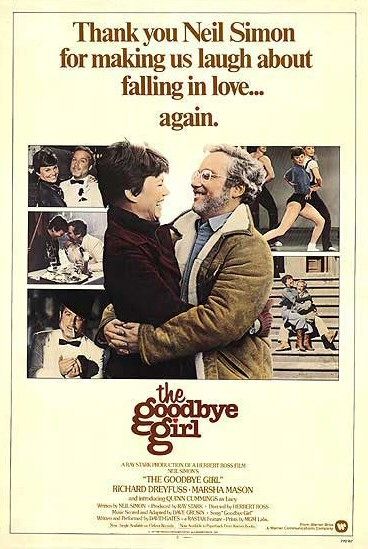
Lisa Watches An Oscar Nominee: The Goodbye Girl (dir by Herbert Ross)


Goodbye_Girl_movie_poster

After I watched San Francisco, I decided to watch yet another film that I had DVRed during TCM’s 31 Days of Oscar.  I had several films to choose from and I ultimately decided to watch the 1977 best picture nominee The Goodbye Girl because, in general, I like movies from the 70s.  Add to that, the film was described as being a comedy and who am I to turn down the chance to laugh?

The Goodbye Girl asks the question, “What would happen if two of the most annoying people on Earth were forced to live together and then ended up falling in love with each other as a result?”  Paula (Marsha Mason) is recently divorced and is trying to raise her 10 year-old daughter, Lucy (Quinn Cumming), while also trying to relaunch the dance career that she put on hold when she got married.  As played by Marsha Mason, Paula is probably one of the most humorless characters to ever be at the center of a romantic comedy.  It’s not just that Paula is written to be a very angry character.  (For the most part, Paula has every right to be angry).  Instead, it’s that Mason gives such a totally sour performance that you get the feeling that Paula has probably never smiled once over the course of her entire life.  When, later on in the film, she does smile, it feels forced and unnatural.  You worry that her face is going to split in half.

In the course of one very bad week, she is abandoned by her actor boyfriend (he’s going to Italy to shoot a film) and she discovers that, before he left, her ex also sublet their apartment to another actor.  That actor is Elliott Garfield (Richard Dreyfuss), who is hyperactive, immature, self-centered, and very, very talkative.  He does things like play guitar in the nude and meditate in the morning.

Once Elliott shows up and barges his way into the apartment, a familiar pattern is established.  Elliott does something eccentric.  Paula yells at him.  Elliott yells back.  Paula yells in reply.  Elliott yells some more.  Even if you never quite buy the idea that the two of them would ever fall in love, you’re glad when they do because at least it gives them something to do other than yell.

(Of course, The Goodbye Girl was written by Neil Simon, which means that not only are Elliott and Paula yellers but they’re also very quippy yellers.  And while I guess we should be happy that Elliott tells the occasional joke, the constant barrage one liners is ultimately rather alienating.  Every time you think that the film is about to make an interesting point about human relationships, Elliott says something quippy and ruins the mood.)

Which is not to say that The Goodbye Girl is a terrible movie.  The scenes where Elliott rehearses and then appears in a terrible production of Richard III are brilliantly done and wonderfully satirize theatrical pretension.  As well, during its second hour, the film settles down a little bit.  Or, I should say, Richard Dreyfuss settles down and actually starts to give a performance that’s more than just a collection of nervous tics.  It helps that once Elliott and Paula are in love, they don’t yell at each other quite as much.  There’s even a rooftop dinner scene where the two actors finally show a hint of chemistry.

Ultimately, The Goodbye Girl is an uneven film that feels a lot like a sitcom.  It’s one of those films that you watch and, even though it’s not terrible, you still find yourself thinking, “This was nominated for best picture?”