Six construction workers (played by Clint Walker, Carl Betz, Neville Brand, James Wainwright, James A. Watson, and Robert Urich) are boated to an isolated island off the coast of Africa. An oil company has assigned them to build an airstrip on the island. On the first day of work, they come across a meteorite buried in the ground. When one of the men tries to pick up the meteorite with the bulldozer, a blue light envelops the bulldozer and, at the same time, fatally injures Robert Urich. Possessed by the meteorite, the bulldozer starts to track the remaining workers down, killing them one-at-a-time. It’s a killdozer!
Based on a short story by Theodore Surgeon and made-for-television, Killdozer asks the question, “Have you ever seen a big, bulky bulldozer attempt to sneak up on someone?” Given that Killdozer is not fast and it’s not very agile, it should be easy to escape it but the construction keep doing dumb things, like getting drunk or trying to hide inside a copper tube instead of just running away. The surviving men wonder how they are going to make it until help eventually arrives. Maybe if you hear Killdozer coming, you should could just step to the side or maybe you could even run behind Killdozer. Instead, the construction workers keep trying to fight it head-on. Every time Killdozer pauses from noisily rolling across the island and sits still because it senses one of the workers might be nearby, I’m reminded that Killdozer is an absolutely ludicrous film but that it’s also wonderfully strange and that it’s also impossible to enjoy it on some level.
The cast is good and, for the most part, so is the straight-forward, waste-no-time direction. The Killdozer deserved an Emmy and maybe its own series but instead, it just had to settle for cult stardom.
How dumb can one movie be without becoming unwatchable?
1985’s Evils of the Night is here to answer that question!
Three space alien vampires (John Carradine, Julie Newmar, and Tina Louise) have led an expedition to Earth. They’ve taken over a hospital and they’re stealing the blood of their patients so that it can be sent back to their dying planet. They especially want young blood, which is why they specifically came to a college town. Unfortunately, their intelligence was faulty and they arrived during the summer, when the campus was closed. (I guess this is one of those rare colleges that don’t offer a summer term.) There’s actually a very lengthy scene in which Carradine explains the faulty intelligence to Newmar and Louise and then Newmar complains about how the alien intelligence service just isn’t that good. What makes this scene so special is that Carradine delivers his lines with a straight face and Newmar actually seems to be sincerely annoyed. Aliens — they’re just like us!
Just because college is out of session, that doesn’t mean that there aren’t any young people hanging out down at the lake. There’s actually quite a few, though all of them look to be a little bit too old for high school or college or whatever they’re supposed to be attending. Several of them are played by veterans of the adult film industry, including Amber Lynn and Jerry Butler. Everyone wants to get laid down at the lake, which is probably the most realistic thing about Evils of the Night. However, John Carradine needs their blood so he has Julie Newmar hire two slovenly mechanics, Kurt (Neville Brand) and Fred (Aldo Ray), and sends them out to kidnap any young people that they find. Kurt and Fred are very good at their job. Newman pays them and mocks them for caring so much about coins. Little do the mechanics realize that the aliens are planning on shooting them with their space laser as soon as they leave the planet.
Evils of the Night is a good example of a bad movie that is oddly watchable just because the viewer finds themselves curious as to just how stupid things can get. The answer here is very stupid and very nonsensical It never seems to occur to anyone just go to a different lake or maybe just do their skinny dipping in a pool somewhere. The plot has a “make it up as you along” feel to it and that, at the very least, keeps things vaguely interesting. The actors playing the “teen” victims are enthusiastic without being particularly good while most of the veterans in the cast are all obviously just there for the paycheck.
That said, John Carradine. Wow. What a career. A trained Shakespearean actor who made his stage debut in 1925 and went on to appear in a countless number of movie, Carradine was a favorite of both John Ford and Fred Olen Ray. Carradine appeared in hundreds of a theatrical films. In fact, his final film was released seven years after Carradine’s death. Carradine was one of the great actors, with that deep voice and that commanding stare. But he was also one of those actors who was apparently willing to appear in just about anything and that’s one reason why he’s still such a beloved icon. Playing an outer space vampire-turned-doctor was definitely not the strangest role that Carradine ever played. Carradine handles his scenes like a pro!
Evils of the Night is dumb but I dare you to look away.
Though the Academy of Motion Picture Arts and Sciences claim that the Oscars honor the best of the year, we all know that there are always worthy films and performances that end up getting overlooked. Sometimes, it’s because the competition too fierce. Sometimes, it’s because the film itself was too controversial. Often, it’s just a case of a film’s quality not being fully recognized until years after its initial released. This series of reviews takes a look at the films and performances that should have been nominated but were, for whatever reason, overlooked. These are the Unnominated.
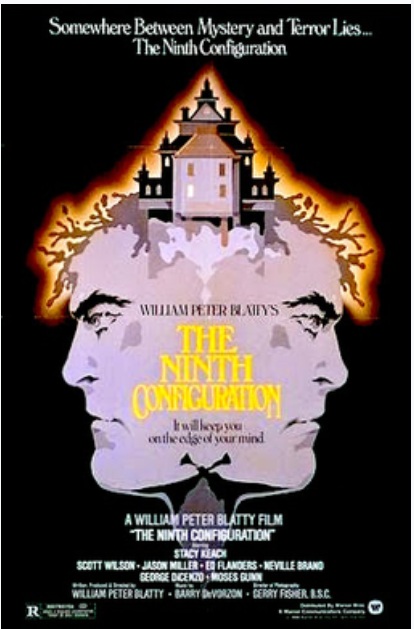
Some films defy easy description and that’s certainly the case with 1980’s The Ninth Configuration.
The film opens with a shot of a castle sitting atop of a fog-shrouded mountain. A voice over tells us that, in the early 70s, the castle was used by the U.S. government to house military personnel who were suffering from mental illness. Inside the castle, the patients appear to be left to their own devices. Lt. Reno (Jason Miller) is trying to teach dog how to perform Shakespeare. Astronaut Billy Cutshaw (Scott Wilson) is haunted by the thought of being alone in space and refuses to reveal why he, at the last minute, refused to go to the moon. The men are watched over by weary and somewhat sinister-look guards, who are played by actors like Joe Spinell and Neville Brand.
Colonel Kane (Stacy Keach) shows up as the new commandant of the the castle. From the first minute that we see Kane, we get the feeling that there might be something off about him. Though he says that his main concern is to help the patients, the man himself seems to be holding back secrets of his own. With the help of Colonel Fell (Ed Flanders, giving an excellent performance), Kane gets to know the patients and the guards. (Despite the objections of the guards, Kane says that his office must always be unlocked and open to anyone who want to see him.) He takes a special interest in Cutsaw and the two frequently debate the existence of God. The formerly religious Cutshaw believes the universe is empty and that leaving Earth means being alone. Kane disagrees and promises that, should he die, he will send proof of the afterlife. At night, though, Kane is haunted by dreams of a soldier who went on a murderous rampage in Vietnam.
The film start out as a broad comedy, with Keach’s smoldering intensity being matched with things like Jason Miller trying to get the dogs to perform Hamlet. As things progress, the film becomes a seriously and thoughtful meditation on belief and faith, with characters like Kane, Billy, and Colonel Fell revealing themselves to be quite different from who the viewer originally assumed them to be. By the time Kane and Cutshaw meet a group of villainous bikers (including Richard Lynch), the film becomes a horror film as we learn what one character is truly capable of doing. The film then ends with a simple and emotional scene, one that is so well-done that it’ll bring tears to the eyes of those who are willing to stick with the entire movie.
Considering all of the tonal shifts, it’s not surprising that the Hollywood studios didn’t know what to make of The Ninth Configuration. The film was written and directed by William Peter Blatty, the man who wrote the novel and the script for The Exorcist. (The Ninth Configuration was itself based on a novel that Blatty wrote before The Exorcist.) By most reports, the studio execs to whom Blatty pitched the project were hoping for another work of shocking horror. Instead, what they got was an enigmatic meditation on belief and redemption. The Ninth Configuration had the same themes as The Exorcist but it dealt with them far differently. (Because he wrote genre fiction, it’s often overlooked that Blatty was one of the best Catholic writers of his time.) In the end, Blatty ended up funding and producing the film himself. That allowed him complete creative control and it also allowed him to make a truly unique and thought-provoking film.
The Ninth Configuration was probably too weird for the Academy. Though it received some Golden Globe nomination, The Ninth Configuration was ignored by the Oscars. Admittedly, 1980 was a strong year and it’s hard to really look at the films that were nominated for Best Picture and say, “That one should be dropped.” Still, one can very much argue that both Blatty’s script and the atmospheric cinematography were unfairly snubbed. As well, it’s a shame that there was no room for either Stacy Keach or Scott Wilson amongst the acting nominee. Keach, to date, has never received an Oscar nomination. Scott Wilson died in 2018, beloved from film lovers but never nominated by the Academy. Both of them give career-best performances in The Ninth Configuration and it’s a shame that there apparently wasn’t any room to honor either one of them.
The Ninth Configuration is not a film for everyone but, if you have the patience, it’s an unforgettable viewing experience.
1980’s Without Warning opens with a father (Cameron Mitchell) and his gay son (Darby Hinton) on a hunting trip. The father taunts his son about not being what the father considers to be a real man. He says that his son would have no chance of surviving in the wilderness.
“Why does it always have to be like this?” the son asks with a sincerity that will break your heart.
Suddenly, a bloodsucking starfish flies through the air, lands on the father, and starts to suck out his blood with a phallic stinger. The father dies while his son watches. The son picks up his rifle and prepares to fight back. This will be the son’s chance to prove that his father was incorrect. This is the son’s chance to prove that he can survive in the wilderness and….
Just kidding. The son forgot to load the rifle and promptly gets a starfish to the eye.
That’s the type of film that Without Warning is. Characters are introduced. The majority of them are played by B-actor who have seen better days. They get a few minutes of character development. Then, they die and the viewer is left feeling a bit depressed because they all seemed like they deserved just a bit more screentime than they received. Larry Storch shows up as a boy scout leader who gets a starfish to the back while trying to light a cigarette. Neville Brand, Ralph Meeker, and Sue Anne Langdon hang out in a bar and refuse to believe that the Earth has been invaded by blood-sucking starfish. Jack Palance plays a hunter and gas station owner who wants to capture an alien as a trophy. Martin Landau plays Sarge, an unbalanced Vietnam Vet who has been telling people for years that there are aliens out there. Everyone laughed at old Sarge but they won’t be laughing for long! At the time this film was made, Palance was a two-time Oscar nominee. He finally won his Oscar for City Slickers, a decade after Without Warning. Martin Landau, for his part, won his Oscar 15 years after Without Warning. Good for them. If nothing else, this movie should remind everyone who has dismissed Eric Roberts’s chances that there’s still time!
That said, none of these familiar faces are the stars of the film. Instead, the majority of the film follows four teenagers on a road trip, Sandy (Tarah Nutter), Greg (Christopher S. Nelson), Beth (Lynn Theel), and Tom (David Caruso). David Caruso as a sex-crazed teenager sounds more amusing than it actually is. If anything, the sight of him wearing shorts and t-shirt is almost blinding. (As a fellow redhead, I sympathize. We burn but we don’t tan.) Tom and Beth die early on, leaving Greg and Sandy to try to escape from the alien (Kevin Peter Hall) who is tossing around the starfish. Both characters are pretty generic but Christopher Nelson is at least likable.
Without Warning has a reputation for being the best film that Greydon Clark ever directed and I would agree that it’s one of his better ones, though I prefer The Forbidden Dance. Then again, when you consider some of the other films that Clark directed, it’s easy to see that Without Warning didn’t exactly have a huge bar to clear. Though the script borrows a bit too much from nearly every other horror film ever made, Without Warning is nicely paced and the killer starfish are genuinely frightening and their bloodsucking is almost Cronenbergian in its ick factor. Just as he would for John Carpenter, cinematographer Dean Cundey gives us some nicely eerie shots of the alien. Landau and Palance go all out, understanding that subtlety has no place in a film like this. Without Warning is a dumb B-movie but it’s definitely entertaining.
Without Warning (1980, dir by Greydon Clark, DP: Dean Cundey)
Welcome to Retro Television Reviews, a feature where we review some of our favorite and least favorite shows of the past! On Tuesdays, I will be reviewing the original Fantasy Island, which ran on ABC from 1977 to 1986. Almost entire show is currently streaming is on Youtube!
This episode features a trip to the past and a surprisingly good turn from Peter Graves.
Episode 3.20 “Nona/One Million B.C.”
(Dir by Earl Bellamy, originally aired on March 1st, 1980)
This week, we have another episode of Fantasy Island in which a somewhat effective fantasy is matched with an incredibly dumb one.
The dumb fantasy involves two women (Phyllis Davis and Jo Ann Pflug) who want to go back to a time when men took care of everything and women didn’t have to do anything. They’re sick of all that women’s lib stuff! Mr. Roarke explains that their fantasy is rather vaguely worded and then sends them back to the time of dinosaurs and cavemen. (Of course, dinosaurs and cavemen didn’t exist at the same time but whatever.) After the two women are nearly killed by a Claymation dinosaur, they are taken in by a tribe of cavemen. Since their modern clothes were ruined in all the excitement, they are given fashionable fur outfits to wear. Despite the fact that they’ve gone back to One Million B.C., the new animal skins outfits have built-in bras, showing that the cave people were more advanced than anyone realized.
Anyway, living in a cave sucks but, fortunately, it turns out that tribe’s leader (Neville Brand) is actually just Mr. Roarke in disguise. Just as the cavemen find themselves in a battle with another tribe of cave dwellers, Roarke reveals himself and ends the fantasy. Yes, it was dumb.
The other fantasy was significantly better. Ned J. Scott (Peter Graves) is a former Chicago cop who is now blind but still obsessed with finding the whereabouts a missing actress named Nona (Joanna Pettet). Roarke gives Scott one of his magic potions, which briefly returns his ability to see. Fortunately, Nona is on Fantasy Island, being held prisoner by a knife-wielding pimp (Edd Byrnes). Scott saves her from the pimp, encourages her not to be so critical of herself, and reunites Nona with her family before losing his eyesight once again. Nona, having fallen in love with Scott, declares that she loves him whether he can see or not. They leave the Island together. Awwwwww!
The second fantasy had its flaws, not the least of which was that Nona certainly got over being a sex slave in record time. But, almost despite itself it still worked. A lot of that is due to Peter Graves. Graves, who we normally think of as being something of a stiff actor, gives a very emotional performance here and the viewer never doubts for a second his love for Nona. Graves especially does a good job in the scenes where Scott realizes that his vision is starting to fade and that he will soon be blind again. He gives a fully committed performance, one that elevates the fantasy.
Finally, this episode features one brief scene of Roarke and Tattoo banter. (Roarke and Tattoo banter used to be one of the show’s trademarks but it was rarely seen during the third season.) Roarke tricks Tattoo into thinking that he’s just taken an invisibility serum. It’s a bit cruel but at least they were speaking to each other again.
Haunted by the death of his teenage daughter and the subsequent collapse of his marriage, William Dorn (Chuck Conners) feels that society is changing too quickly. He misses the days when people were polite and followed the law. Now, he’s upset that he can’t even walk around Los Angeles without seeing people littering. The waitress at the local diner has forgotten the importance of smiling while taking her customer’s order. Hospitals are full of doctors who don’t care about their patients. The colleges are full of long-haired drug pushers. His ex-wife is attending a consciousness raising seminar. William has had it with the 1970s so he decides to start blowing stuff up.
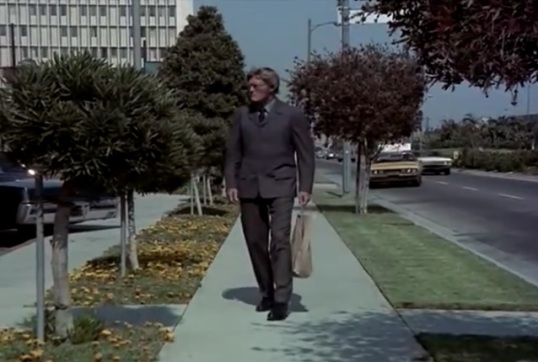
William starts to wander around Los Angeles. Usually, he’s carrying a brown paper sack and, inside the sack, he’s got a ticking time bomb. He always wears the same suit and thick glasses and yet, somehow, no one ever seems to notice or remember him. Even though all of his bombs are timebombs, they still go off within seconds of him planting them, which means that he’s usually only standing a few feet away with they explode. William also sends the police tape-recorded manifestos without making any effort to disguise his voice. William may not be the smartest criminal around but that still doesn’t stop him from terrorizing the city.
Detective Geronimo Minelli (Vince Edwards) is determined to track down the mad bomber, even if it means yelling at everyone that he meets. Minelli is one of those intense detectives who doesn’t care about what the Supreme Court has to say about the rights of suspects and the accused. Unfortunately, the only witness who can identify the bomb is George Fromley (Neville Brand), a sex offender who doesn’t want to admit that he saw the bomber blow up a hospital because he was busy assaulting one of the patients at the time. Can Minelli convince Fromley to provide a physical description of the bomber? And will William Dorn ever realize that it’s probably not a good idea to store a bunch of ticking time bombs in his basement?
First released in 1972 and also known as The Police Connection, Bert I. Gordon’s The Mad Bomber is unique amongst Gordon’s films in that it doesn’t feature any giant animals or killer bugs. In this film, the monsters are all human and don’t have any convenient excuses for their behavior. Though Neville Brand does a good job with the role, George Fromley is still probably one of the most unlikable and despicable characters to ever appear in the movie. Meanwhile. Vince Edwards plays Minelli as being the type of cop who is one bad day away from massively violating someone’s civil rights during a traffic stop. The film does build up some sympathy for William Dorn, with still shots of his daughter used to show us what’s going through Dorn’s mind as he plants his bombs. But then it tosses all that sympathy away by having him target a meeting of feminists, apparently because he blames them for his wife leaving him.
The main problem with the film is that we’re expected to believe that someone who looks like this would be able to walk around Los Angeles and plant bombs without anyone noticing.
That’s nothing against Chuck Conners, who does a good job of portraying William’s frustration with the world. But still, it’s hard to believe that no one is going to notice a dude who is nearly seven feet tall and who is carrying a ticking shopping bag.
Flaws and all, The Mad Bomber is a watchable and occasionally even an engrossing film. It’s certainly one Gordon’s better efforts and Gordon does a good job of creating and maintaining a properly ominous atmosphere, even if it sometimes hard to take seriously the sight of Chuck Conners, lumbering around in his suit and trying to discreetly drop off bombs. In many ways, it’s a film that still feels relevant today. William, like so many. is trying to forcefully stop the world from changing around him. He’s a man who has lost anything and has decided that it’s the fault of everyone else. (In many ways, he’s like Rainn Wilson in Super, ragefully reacting to a world is not as simple as he believes it should be.) The Mad Bomber may not be as much fun as Gordon’s giant monster films but it’s still a film that has something to say.
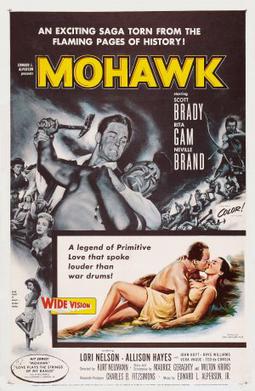
In the late 18th century, Boston socialite Cynthia Stanhope (Lori Nelson) travels to Fort Alden in upstate New York to visit her fiancé, a painter named Jonathan Adams (Scott Brady), who has been commissioned to paint the local scenery. As soon as Cynthia and her mother arrive, they are shocked to discover that not only Jonathan has been painting pictures of the members of the Native local tribes but that he is also now flirting with a barmaid named Greta. Greta is played by Allison Hayes so who can blame him? Cynthia wants to return to their normal upper class life in Boston but Adams has fallen for the untamed wilderness of the frontier.
When Onida (Rita Gam), the daughter of Iroquois chief Kowanen (Ted de Corsia) is captured during a raid on the fort, Adams is assigned to escort her back to her tribe. Leaving behind Cynthia and Greta, Adams falls in love with Onida over the course of the journey. When he meets the Iroquois, he earns the respect of her father and the entire tribe when he agrees to paint the chief’s portrait.
Meanwhile, a haughty settler named Butler (John Hoyt) is trying to play the army and the Iroquois against each other, feeding both of them false information in an attempt to spark a war. Butler is hoping that a war will lead to both sides wiping each other out so that he can once again have the valley to himself. When it turns out that his words might not be enough to spark a war, Butler resorts to murder. When Kowanen’s son is killed, the Iroquois prepare for war while Adams is framed for the crime and finds himself tied to a stake.
Mohawk is a standard B-western, with a plot that is largely lifted from John Ford’s Drums Along The Mohawk. Unfortunately, Adams is about as sympathetic hero as you would expect someone manipulating three different women to be and, when it comes to depicting the Iroquois, Mohawk resorts to too many clichés. This is one of those westerns where the Native characters speak broken English, even when they are just talking to each other.
Mohawk does have three things to recommend it. Number one, John Hoyt was a master at playing haughty villains and Butler is easy to root against. You will look forward to seeing him get his comeuppance. Number two, Allison Hayes was a force of nature and that’s true even in this film, where she’s not given nearly enough to do. Number three, one of Iroquois braves is played by Neville Brand. A highly decorated World War II veteran, Brand built a long career playing tough guys. In Mohawk, it only takes one look at Neville Brand to know that this isn’t someone you want to mess with. Anyone watching would want to stay on Neville Brand’s good side.
Otherwise, Mohawk is forgettable. Two years after it was released, Mohawk’s director Kurt Neumann, would be responsible for the much more memorable The Fly.
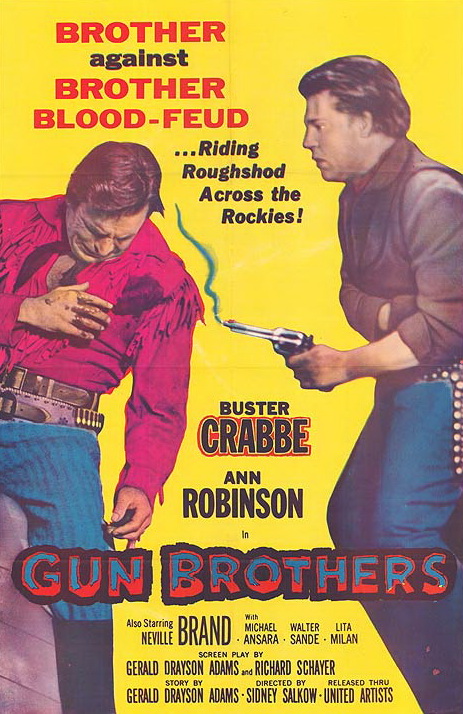
In this western, Buster Crabbe plays Chad Santee, a former Calvary officer who has traveled to Wyoming so he can visit his brother Jubal (Neville Brand) and see Jubal’s ranch. Traveling by stagecoach, Chad meets and falls in love with a saloon singer named Rose Fargo (Ann Robinson). When the stagecoach is held up by outlaws and one of them steals Rose’s broach, Chad decides to track the outlaws down. What Chad doesn’t know is that Jubal is one of those outlaws.
Gun Brothers is an entertaining B-western. There’s nothing surprising about the story but Buster Crabbe is a believable hero and Ann Robinson gets a chance to show off her saloon singing skills. Neville Brand steals the film as Jubal. Before going into acting, Brand was a highly decorated World War II combat officer and he brought his real-life toughness to every role that he played. He could throw a punch and shoot a gun with an authority that few other actors could match. Jubal, like Brand, has obviously seen and experienced things that his self-righteous brother will never be able to understand and, as a result, he’s not as tied down to the laws of society as everyone else. Also turning in good performances are Michael Ansara as an outlaw and Lita Milan, as a Native American woman who is involved with the gang.
Not surprisingly, for a B-western, Gun Brothers is full of characters with names like Shawnee Jack, Yellowstone Kelly, Blackjack Silk, and Moose McClain. It’s a simple movie but one that will be enjoyed by fans of old fashioned western action.
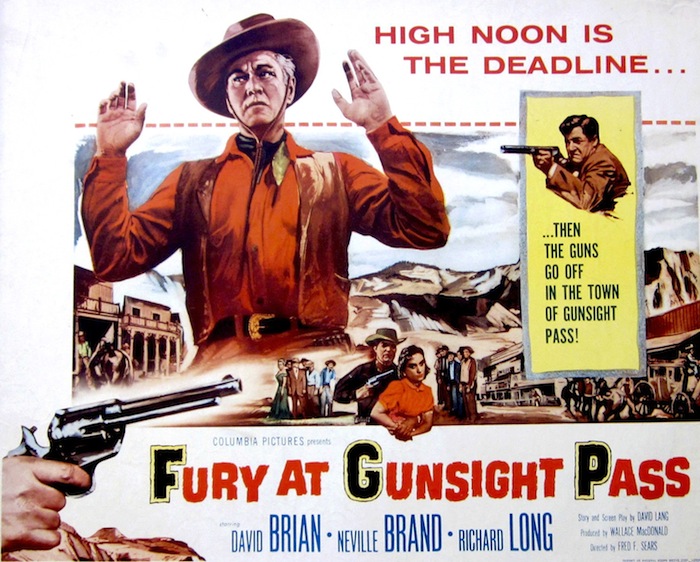
Old west outlaws Whitey Turner (David Brian) and Dirk Hogan (Neville Brand) are plotting on robbing the bank in the town of Gunsight Pass. They’ve even got an inside man to help them get away with the loot, local undertaker Peter Boggs (Percy Helton). Peter is eager to make some money and get away from his nagging wife (Katherine Warren). However, the robbery doesn’t go as planned. Whitey attempts to betray Dirk, there’s a huge shoot out, and several people are killed, including the bank president (Addison Richards). Whitey and his half of the gang are captured while Dirk barely escapes.
Because a satchel of money is missing, Dirk rescues Whitey from the posse and they return to the town of Gunfight Pass, determined to hold the entire town hostage until they get their money. While a huge dust storm blows through the town, the citizens of Gunsight Pass start to turn on each other, accusing one another of having stolen the money for themselves. The now dead bank president is accused of being a part of the robbery and it falls to his son (Richard Long) to try to not only clear his name but to also save the town from Dirk and Whitey.
Fury at Gunsight Pass is a nice discovery, an intelligent B-western that’s about more than just gunfights and money. Though David Brian and Neville Brand are both convincing as the two gang leaders, the movie is mostly about the citizens of the town and how quickly they all turn on each other. The citizens of this town make the ones from High Noon seem brave and supportive. All it takes is a little fear and greed for everyone to turn on each other. The film has such a cynical view of human nature that, in 1956, it probably couldn’t have gotten away with it if it had been anything other than a B-movie.
Fred F. Sears directed a lot of B-westerns, the majority of which were fairly undistinguished programmers. Fury At Gunsight Pass is an exception to that rule and probably the best film that Fred Sears ever directed. It’s a well-acted and well-directed movie that will take even the most experienced B-western fan by surprise.
For today’s horror on the Shattered Lens, we have 1980’s Without Warning.
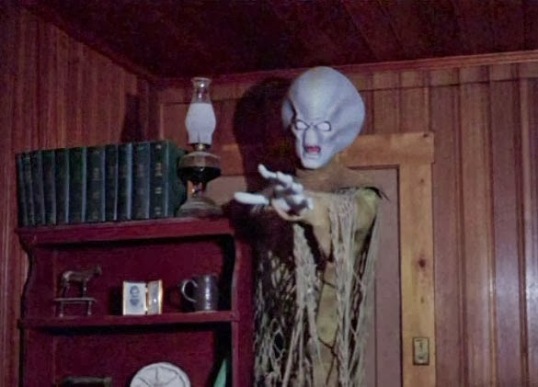
In this horror/sci-fi hybrid, humans are hunted by an alien hunter who uses a variety of weapons and … what was that? No, we’re not watching Predator. We’re watching Without Warning. For the record, Without Warning and Predator may have almost exactly the same plot but Without Warning came out long before Predator.
(Interestingly enough, Kevin Peter Hall played the intergalactic hunter in both films.)
Anyway, Without Warning is probably the best film that Greydon Clark ever directed. Some would say that’s not saying much but seriously, Without Warning is a surprisingly effective film. It also has a large cast of guest stars, the majority of whom are killed off within minutes of their first appearance. That alien takes no prisoners! (I especially feel sorry for the cub scouts.)
Of course, the main characters are four teenagers. One of them is played by David Caruso, which I have to admit amuses me to no end.
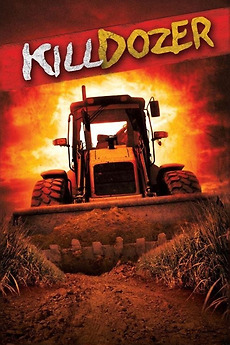 Six construction workers (played by Clint Walker, Carl Betz, Neville Brand, James Wainwright, James A. Watson, and Robert Urich) are boated to an isolated island off the coast of Africa. An oil company has assigned them to build an airstrip on the island. On the first day of work, they come across a meteorite buried in the ground. When one of the men tries to pick up the meteorite with the bulldozer, a blue light envelops the bulldozer and, at the same time, fatally injures Robert Urich. Possessed by the meteorite, the bulldozer starts to track the remaining workers down, killing them one-at-a-time. It’s a killdozer!



 Through the Shattered Lens