Ving Rhames plays Sonny Liston, one of the greatest heavyweights who ever boxed but whose legacy will forever be overshadowed by the man who defeated him twice, Muhammad Ali.
Phantom Punch hits all of the well-known notes of Liston’s life. He grows up dealing with poverty and racism. He goes to prison as a young man and it is there that a sympathetic priest (Rick Roberts) helps him discover that his talent for fighting can be transformed into the skills needed to be a heavyweight contender. Sonny turns pro after he’s released but, even as he angles for a championship fight, he’s still collecting debts for mobsters like Savino (David Proval). Sonny becomes the champ after defeating Floyd Patterson but is hated by white boxing fans who resent that, unlike previous black champs, he doesn’t seem to care about their approval. Both of his losses to Ali lead to accusations that he threw the fights. With the help of his manager (Nichols Turturro), he works his way back up the rankings and is poised for another shot at the title but the Mafia now wants him to throw his fights for real. In 1971, Liston dies of what the police claim was a heroin overdose even though everyone knew that Liston hated needles. There’s not much new to be found in Robert Townsend’s biopic of Liston but Ving Rhames is convincing as Sonny and even brings some humanity to one of boxing’s most fearsome champs. It was a movie made for boxing fans and Rhames looks credible throwing a punch.
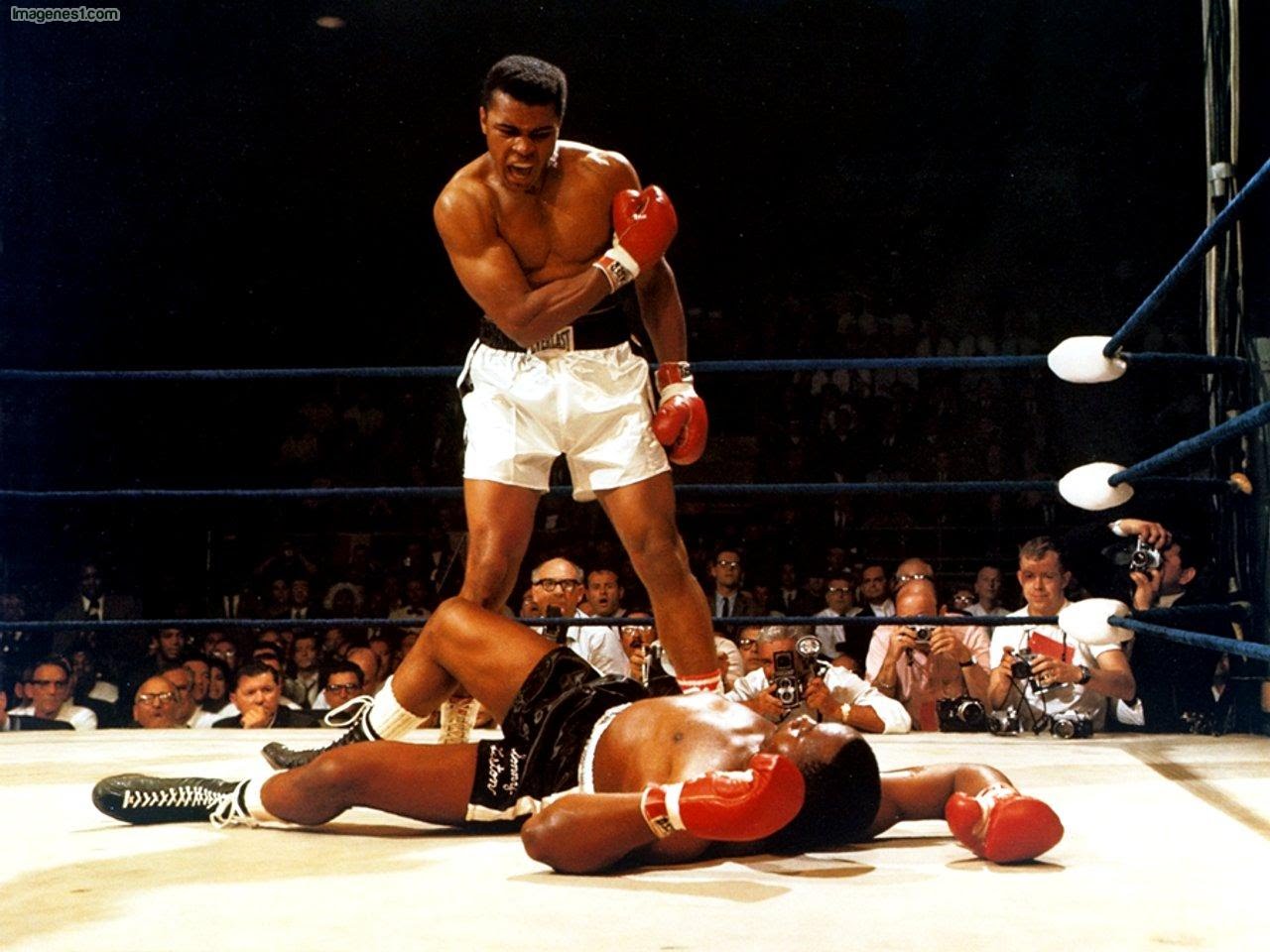
As I watched the movie, I wondered whether Liston really did throw his fights against Ali. I don’t think he did, even though both fights were strange. In the first fight, Sonny put something on his gloves that irritated Ali’s eyes. When that didn’t stop Ali, Sonny retired to his corner and didn’t come out for the seventh round. That led to rumors that the Mob ordered him to throw the fight but if you watch the match, it’s obvious that Sonny was trying to win and he just wasn’t prepared for Ali’s quickness. Liston knew he was losing and, with an aggravated shoulder injury making it difficult for him to throw his heavy punches, Liston bowed to the inevitable and refused to give Ali the chance to knock him out. The second fight was the one where the phantom punch occurred. Liston fell so quickly that, when I first saw it, I thought he had thrown the fight. It wasn’t until I watched the fight in slow motion that I saw that Ali did make contact with Liston before he fell. Liston may have been many things but but he wasn’t a chump. The so-called phantom punch was fast but it was real.
When his little sister falls ill with sickle-cell anemia, Leon Johnson (Leon Isaac Kennedy) has to make a decision. He can either finish his education, graduate from medical school, and treat her as a doctor or he can drop out of school, reinvent himself as “Leon the Lover,” and make a fortune as a professional boxer! At first, Leon’s career goes perfectly. He is winning fights. He is making money. He has a foxy new girlfriend (played Leon Isaac Kennedy’s then-wife, Jayne Kennedy.) But then the fame starts to go to Leon’s head. He forgets where he came from. He’s no longer fighting just to help his sister. Now, he’s fighting for his own personal glory. When Leon finally gets a title shot, a crooked boxing promoter known as Big Man (former JFK in-law Peter Lawford, looking coked up) orders Leon to take a dive. Will Leon intentionally lose the biggest fight of his life or will he stay in the ring and battle Ricardo (Al Denava), a boxer so evil that he literally throws children to the ground? More importantly, will he make his trainer (Muhammad Ali, playing himself!) proud?
Leon Isaac Kennedy, Muhammad Ali, and Peter Lawford all in the same movie!? No surprise here, it’s a Cannon film. Leon Isaac Kennedy was best known for playing a jailhouse boxer in the Penitentiary films and he was a good actor with charisma to burn so it probably made perfect sense to not only cast him in a remake of John Garfield’s Body and Soul but to let him write the script too. The end result is a film that is too heavy-handed to be taken seriously but it is still an entertaining movie. Body and Soul leaves not a single sports cliché unused but Kennedy was a convincing fighter and the boxing scenes are well-directed. Muhammad Ali did a better job playing himself here then he did in The Greatest. All in all, Body and Soul is a good movie for fight fans.
Body and Soul was not a box office success and Kennedy ended his film career a few years after it was released. He is now the head of Leon Kennedy Ministries, Inc of Burbank, California.
I’ve sadly written way too many RIP posts this year. It seems 2016 hasn’t been kind to many of the greats in entertainment. Muhammad Ali, formerly known as Cassius Clay, truly transcended his role as the Greatest Heavyweight Boxing Champion of All Time. His stance against the Vietnam War and subsequent stripping of his title for refusing to enter the draft on religious grounds (he converted to Islam shortly after winning his first title) made him a divisive character during the tumultuous 1960’s and cost him three prime years of his career. He came back and won the championship twice and, love him or hate him, no one could deny his skills in the ring or the strength of his convictions.
Ali was a flamboyant showman in a sport full of monosyllabic bruisers. He made outlandish predictions (“Count on me, he won’t last three”), spouted poetry (“I float like a…
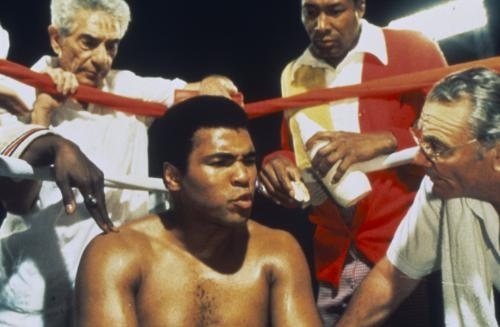
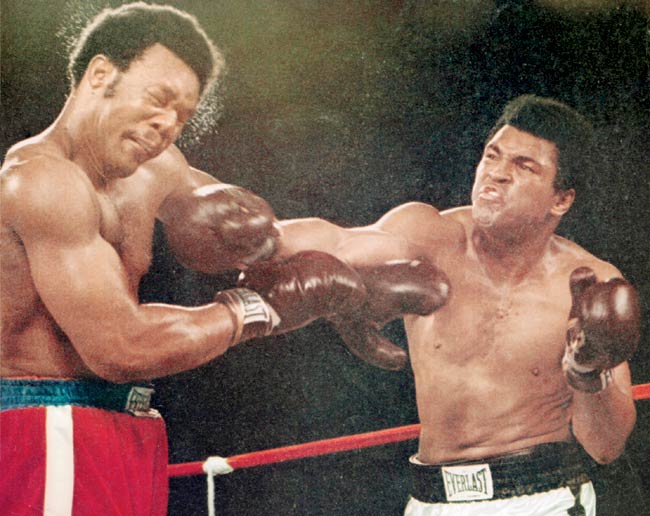
The Greatest opens with 18 year-old Cassius Clay (played by Chip McAllister as a teenager and, as an adult, by Muhammad Ali himself) winning the light heavyweight gold medal at the 1960 Rome Olympics. Returning home to Kentucky, Clay discovers that not even a gold medal can protect him from racism. Angered after a restaurant refuses to serve him and his friend, Clay throws his gold medal into the Ohio River. Under the training of Angelo Dundee (Ernest Borgnine), Clay turns pro and defeats Sonny Liston (Roger E. Mosley) for the heavyweight championship. Inspired by Malcolm X (James Earl Jones), Clay also joins the Nation of Islam and changes his name to Muhammad Ali. As heavyweight champion, Ali battles not only his opponents in the ring but racism outside of it. The Greatest follows Ali as he loses his title for refusing to be drafted and concludes with the famous Rumble in the Jungle, where Ali won the title back from George Foreman.
Sadly, Muhammad Ali has never been the subject of a truly great feature film. Even Michael Mann’s Ali failed to really capture the mystique that made Ali into such an iconic figure. The Greatest is interesting because Ali plays himself. Unfortunately, The Greatest proves that Ali may have been a great showman but he was not a natural actor. You only have to watch the scene where Ali tries to hold his own with Robert Duvall to see just how stiff an actor Muhammad Ali really was. Ali’s best scenes are the ones where he is trash talking his opponents or training. The film opens with Ali jogging while George Benson sings The Greatest Love Of All, a scene that is made all the more poignant when you compare the athletic and confident Muhammad Ali of 1977 with the frail, Parkinson’s stricken Ali of today.
Instead of recreating any of Ali’s legendary fights, The Greatest instead uses actual footage of the matches. The real life footage is the best part of the film. After all these years, Ali’s fights against Sonny Liston, Joe Frazier, Ken Norton, and George Foreman remain exciting to watch. Otherwise, The Greatest is too episodic and low budget to do justice to Muhammad Ali’s story.
If you want to see a truly great film about Ali and his legacy, watch the 1996 documentary When We Were Kings, 2009’s Facing Ali or 2013’s The Trials of Muhammad Ali. Ali is such an iconic figure that it may be impossible for any feature film to properly do justice to his life and legacy. These three documentaries come close.
(Director Tom Gries died during the filming of The Greatest. The movie was completed by Monte Hellman.)
So, it looks like the fight of the century between Floyd Mayweather, Jr and Manny Pacquiao turned out to be more of a whimper instead of a bang.
Now, this short, but sweet 3-round fight from April, 15, 1985 was (and is) what a great fight looks like. It’s the kind of fight Floyd will never put himself in and the sort of fighters he would duck and dodge until they’re on the downside of their careers then he would agree for the money fight.
Floyd is not, as he proclaimed a couple weeks ago, the greatest fighter ever. He’s no Muhammad Ali. He’s no Sugar Ray Robinson. He’s not even in the same league as Sugar Ray Leonard, Roberto Duran, Marvin Hagler and Thomas Hearns.
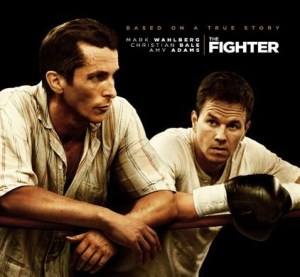
I’m usually pretty cynical when it comes to “inspiring” movies, especially when they’re 1) based on a true story and 2) centered around some sort of professional sport. Usually, these films turn out to be not so much inspiring as just insipid and predictable. However, there is always an exception to any rule and this year, that exception is David O. Russell’s touching and exciting boxing film, The Fighter.
To put it mildly, professional athletics are not my thing. I get bored with football and the squeaky shoes of basketball annoy me. I did briefly get caught up in the world series this year but then the Rangers lost to the Giants and I pretty much swore never to allow my heart to be broken again. Tennis would be tolerable if not for all the grunting. I will occasionally watch a minute or two of golf but that’s just because I think golf courses are pretty. However, boxing does hold a certain primal fascination for me. Maybe it’s because I’ve seen far too many guys do the whole “Who you calling a bitch, bitch?” routine without ever throwing a punch (I swear, guys remind me of cats when they try to verbally spar, with all the hissing and staring) that it’s just undeniably exciting (in so many ways) to actually see two men actually punching each other until one is undeniably the winner. However, boxing — as a sport — is still largely a mystery to me. I don’t know who the current champion is nor do I know how or why he got to be the champion. I can name a few boxers — Muhammad Ali (because everyone knows him), Mike Tyson (ditto), George Foreman (because we own one of his grills), Oscar De La Hoya (because he’s cute), and Lennox Lewis (because he was on the first season of The Celebrity Apprentice).
And now, thanks to The Fighter, I know of “Irish” Mickey Ward and his half-brother Dicky Eklund.
In the film, Mickey Ward (played by Mark Wahlberg) is portrayed as being a well-meaning, blue-collar guy who lives in Lowell, Massachusetts (home of Jack Kerouac) and who makes a living as a “stepping stone,” a below-average boxer who is used by better boxers as just a “stepping stone” on their way to a bigger fight. He is managed by his overbearing mother (Melissa Leo) and is trained by his half-brother, Dicky (Christian Bale). Dicky used to be a pro-boxer himself but, as the film begins, he is more interested in smoking crack than throwing punches. Still, Dicky remains a local hero and his mother’s favorite and Mickey lives in his shadow.
After one final humiliating defeat in the ring, Ward decides to stop boxing and instead devotes his time to his new girlfriend, a bartender named Charlene (Amy Adams). Dicky, meanwhile, ends up getting sent to prison. With Dicky locked away, Mickey starts to come into his own as a person and a boxer and he eventually reenters the ring. Eventually, he gets his chance at a championship fight. However, at the same time, Dicky is released from prison and trying desperately to reenter Mickey’s life despite Charlene’s insistence that Mickey stay away from his loving but self-destructive family.
By the film’s conclusion, the story has become less about Mickey Ward’s fights in the boxing ring and more about his own battle to find the confidence necessary to stop being dominated by the people around him and to live and take responsibility for his own life and his own future. As undeniably exciting as all of the boxing is, it’s the film’s portrait of Mickey Ward as an essentially nice guy struggling to be independent that makes The Fighter such a moving film.
If you’ve read Sharon Waxman’s Rebels in the Backlot, then you might feel that know a bit about director David O. Russell. Of the six directors profiled in that book, Russell came across the most negatively, a temperamental prima donna who was portrayed as being the type to accidentally make a great film. Well, I don’t know if that portrait is an accurate one but The Fighter is no accident. Russell directs this film with an energy and an attention to detail that puts so-called “nice guy” directors like Ed Zwick to shame. For me, Russell is at his best in the film’s opening scenes where Mickey and Dicky strut through the streets of Lowell while Heavy’s How You Like Me Now plays in the background. Not much happens in these scenes. For the most part, Dicky just BSes with the locals while Mickey shyly watches. But, in just a matter of minutes, Russell manages to tell us everything that we need to know about Mickey Ward, Dicky Eklund, and Lowell, Massachusetts.
Russell also gets four excellent performances from his lead actors. Everyone already knows that Christian Bale is amazing in the role of Dicky. Let’s be honest — we all know he would be even before this film opened. He’s Christian Bale and Dicky Eklund is a great role. So instead of repeating what you already know, I’m going to take some time to praise Bale’s co-stars, all three of whom give excellent performances.
As Mickey Ward, Mark Wahlberg once again proves that he’s one of the few leading men working today who can actually bring an air of authenticity to a blue-collar role. At first, it seems like Wahlberg is going to be overshadowed by both Bale and Melissa Leo (much as Mickey was initially overshadowed by Dicky and his mother). However, once Dicky has been sent to jail and the movie focuses on Mickey’s relationship with Charlene, you suddenly realize that Wahlberg really is the movie’s heart and soul. It helps that he has a very real chemistry with Amy Adams. There’s very few actors who can convince you that they’re falling in love on-screen but Wahlberg proves, in this film, that he’s one of them.
Playing Mickey’s mother and manager, Melissa Leo is alternatively touching and horrifying. Whether she’s scolding Dicky for continually choosing drugs over family or accusing Charlene of being an “MTV girl,” Leo dominates every scene she’s in. With this film, Welcome to the Riley’s, and Frozen River, Melissa Leo has quickly become one of my favorite actresses.
Finally, in the role of Charlene, Amy Adams is finally given a chance to show what she’s actually capable of when given an actual character to play. I’ve always liked Amy Adams because she’s always come across as so genuinely sweet in almost every role she’s played. Plus, we’re both redheads, we both wanted to be ballerinas, and we both briefly worked at the Gap when we were 18 (though not at the same time, obviously. And not at the same Gap either). Furthermore, before breaking into acting, Amy Adams was a Hooters girl and I once applied for a job at Hooters though my mom made me go back and withdraw my application an hour later. Plus, Amy was born in Italy which is where I would have been born in an ideal world. And, in an ideal world, I would have her nose as opposed to the one I got stuck with. (Sorry, I love being a fourth Italian but I still have issues with my big, Italian nose…)
So, yes, Amy Adams is one of my favorite actresses which is why it pained me to see her give such an annoying performance in Julie and Julia last year. I was worried that maybe all the sweetness had finally given way to self-parody. However, much as the Fighter is about characters searching for redemption, the movie is also a redemption of sorts for Amy Adams. Yes, Charlene is another sweet-and-nurturing-girlfriend role for Adams but she brings an unexpected edginess and a very genuine anger to her role. Charlene may be a nurturer but she’s no doormat and, for me, there’s something very refreshing about seeing a strong, independent woman in a movie who is also still very feminine, nurturing, and unapologetically sexual. As I previously stated, Wahlberg and Adams have a very real, very definite chemistry in this film and, as a result, this film about a very violent sport is one of the most genuinely romantic that I’ve seen in a long time.
One final note: On a personal level, this movie almost made me want to go out and find a boxer to date. Why? So I’ll have an excuse to get dressed up all sexy-like whenever he has a fight. Seriously, I want that black dress that Charlene wears to all of Mickey’s fights. It’s to die for.
 Ving Rhames plays Sonny Liston, one of the greatest heavyweights who ever boxed but whose legacy will forever be overshadowed by the man who defeated him twice, Muhammad Ali.
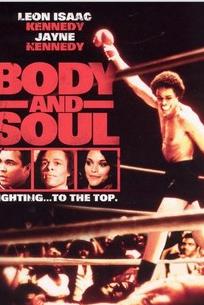 When his little sister falls ill with sickle-cell anemia, Leon Johnson (Leon Isaac Kennedy) has to make a decision. He can either finish his education, graduate from medical school, and treat her as a doctor or he can drop out of school, reinvent himself as “Leon the Lover,” and make a fortune as a professional boxer! At first, Leon’s career goes perfectly. He is winning fights. He is making money. He has a foxy new girlfriend (played Leon Isaac Kennedy’s then-wife, Jayne Kennedy.) But then the fame starts to go to Leon’s head. He forgets where he came from. He’s no longer fighting just to help his sister. Now, he’s fighting for his own personal glory. When Leon finally gets a title shot, a crooked boxing promoter known as Big Man (former JFK in-law Peter Lawford, looking coked up) orders Leon to take a dive. Will Leon intentionally lose the biggest fight of his life or will he stay in the ring and battle Ricardo (Al Denava), a boxer so evil that he literally throws children to the ground? More importantly, will he make his trainer (Muhammad Ali, playing himself!) proud?

 Through the Shattered Lens