4 Or More Shots From 4 Or More Films is just what it says it is, 4 shots from 4 of our favorite films. As opposed to the reviews and recaps that we usually post, 4 Shots From 4 Films lets the visuals do the talking!
Since today is Super Bowl Sunday, it seems appropriate to pay tribute to America’s unofficial holiday with….
4 Shots From 4 Football Films
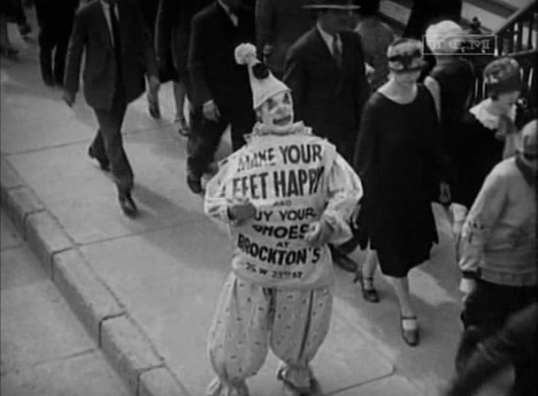
The Freshman (1925, dir by Fred C. Newmeyer and Sam Taylor, DP: Walter Lundin)
Any Given Sunday (1999, dir by Oliver Stone, DP: Salvatore Totino)
Friday Night Lights (2004, dir by Peter Berg, DP: Tobias Schliessler)
Carter High (2015, dir by Arthur Muhammad, DP: Ron Gonzalez)
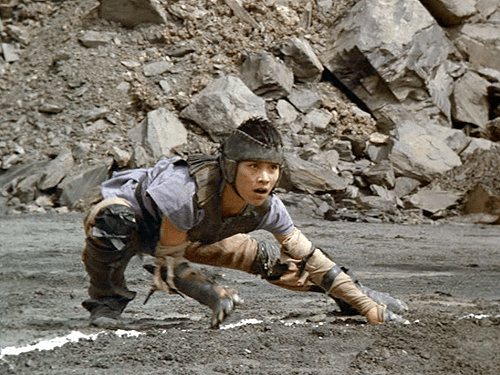
As an obsessed Rutger Hauer fan of the early 90’s, I was working my way through the man’s back catalogue of films when I came across THE BLOOD OF HEROES (1989) on the shelves at my local video store. With its post-apocalyptic setting and its strange sport of jugger, I’ll admit that it was not the kind of film that I’m most drawn to. I generally preferred watching Hauer taking down the bad guys in movies like WANTED DEAD OR ALIVE (1986) and BLIND FURY (1989), which was released the very same year. However, it was a relatively recent Hauer film, so I rented it, cautiously optimistic that it would be entertaining. At the time, it was not my favorite Hauer film, but I remember an 18-year-old version of myself thinking it was okay. I’ve watched it a couple of times over the last 30 years, and even own the DVD, but it’s not one that I pull off the shelf very often. I decided it was time for a fresh viewing.
In the bleak, desolate, futuristic world of THE BLOOD OF HEROES, Rutger Hauer plays Sallow, the leader of a team of juggers. They go from town to town challenging the local team in a sport where you win by placing a dog skull securely on a stake. It’s an extremely violent game consisting of two teams with five players. Four players basically beat the crap out of the opposition with clubs and chains, in hopes that they can provide protection to their one player, the “quick,” who can get the skull on the stake. We meet Sallow’s team who consists of Dog Boy (Justin Monjo), Mbulu (Delroy Lindo), Big Cimber (Anna Katarina), and Young Gar (Vincent D’Onofrio) as they enter a town ready for a match. They win, but Dog Boy, their quick, has his leg broken in the process. Luckily for them, the opponent’s quick Kidda (Joan Chen), who was at least partially responsible for Dog Boy’s gruesome injury, is available to head towards the next town with the ragtag crew! She turns out to be a hell of a player, who’s willing to do whatever it takes to win, including biting an ear off when it’s required. This is what I call dedication. During the course of the story, we find out that Sallow used to be a professional jugger who played in “The League” in the underground cities where the rich, aristocratic people live and treat their champion juggers “almost” like one of them. He got banished when he engaged in a forbidden relationship with one of the overlord’s daughters. With his team of juggers, especially the super talented Kidda and Gar, Sallow leads them to the big city where they will challenge the professionals. For Sallow, it’s a shot at redemption. For the others, it’s a chance to be noticed by the League, which will lead to a much more luxurious life, when they’re not bashing their opponents brains in of course. I may have exaggerated a bit in my headline when I referred to this challenge as the “Jugger Super Bowl,” but it’s still kind of a big deal!
After rewatching THE BLOOD OF HEROES again, while it’s still not my favorite kind of film, I can confidently say that I enjoyed it very much this time around. Most of that joy stems from watching Rutger Hauer in his prime. He’s such a charismatic actor and that even comes across in such a grim setting. I also like his character type, that of the disgraced former hero searching for redemption against a system that had previously discarded him. There’s usually much satisfaction to be had with this type of character, and this movie delivers on that premise. Joan Chen is very good as the new addition to the team who dreams of escaping her town and becoming a jugger star! She and Hauer really carry the film. The rest of the cast also added to my enjoyment of the movie. For me, It’s a lot of fun watching actors like Vincent D’Onofrio and Delroy Lindo in relatively early roles in their long and distinguished careers. I really enjoyed seeing Australian actors Hugh Keays-Byrne and Max Fairchild, both veterans of the MAD MAX series, appear near the end of the film when they make it to the city. Max Fairchild is especially impressive as one of the League juggers and former friend to Hauer. I wanted to give one more shout out, and this one goes out to actor Gandhi MacIntyre, who plays the team manager and doctor in the film. He has a very likable presence and made me smile on multiple occasions. The movie’s pretty serious and dark, and Gandhi’s sense of humor is a welcome presence.
THE BLOOD OF HEROES is written and directed by David Webb Peoples. To date, it’s the only feature length film that Peoples has directed. In my opinion, he does a fine job. He certainly creates an interesting world, with huge contrasts between the barren, rocky outside landscapes and the overcrowded, underground cities. This is not a world I want to live in, but Peoples brought his vision to the screen, albeit within clear budget limitations. Considering it’s from the same guy who wrote BLADE RUNNER (1982) and UNFORGIVEN (1992), the story is pretty simple. And this is fine by me. The story of redemption for some, and of the dream of newfound glory for others, is a story that all of us can relate to at some point in our lives. At this point in my own life, I can relate to both! The movie features some ugly and violent images, but I found myself emotionally pulling for the ragtag group of underdogs in the big game at the end. It’s also pretty cool that Peoples made up his own game when writing the screenplay, albeit a game I would never want to play. The game Jugger, a less violent version of the game introduced in the film, is currently played all over the world.
One final thing I wanted to point out about THE BLOOD OF HEROES is the fact that an author named Danny Stewart has written a book called “Saluting the Blood of Heroes – Behind the Apocalyptic Film.” I just learned of this book while researching the film today for this review. It was published in July of 2024. I just love a world where a person is able to get a book published about the making of an obscure, low budget film from the late 80’s. I won’t be surprised if this ends up in my Amazon cart really soon.
I’ve included the trailer for THE BLOOD OF HEROES (AKA – THE SALUTE OF THE JUGGER) below:
4 (or more) Shots From 4 (or more) Films is just what it says it is, 4 (or more) shots from 4 (or more) of our favorite films. As opposed to the reviews and recaps that we usually post, 4 (or more) Shots From 4 (or more) Films lets the visuals do the talking.
Today, we celebrate the 131st birthday of Texas-born filmmaker, King Vidor! Though Vidor may no longer be a household name, he was one of the most important and idiosyncratic filmmakers of Hollywood’s Golden Age. The Crowd is regularly cited as one of the most influential films ever made. (Certainly every film that’s ever featured a shot of an anonymous office worker sitting in a room full of cubicles owes a debt to it.) Duel in the Sun went on to inspire countless spaghetti westerns. The Fountainhead is also regularly cited as a favorite by a surprisingly large number of directors.
In honor of King Vidor’s life and legacy, here are….
4 Shots From 4 King Vidor Films
The Crowd (1928, dir by King Video, DP: Henry Sharp)
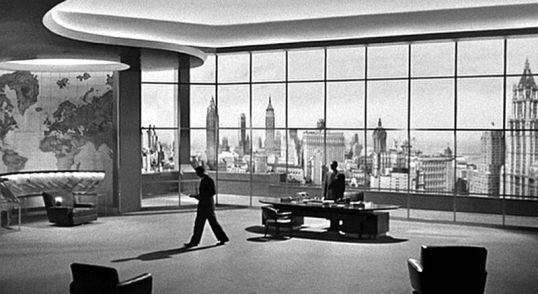
The Fountainhead (1949, dir by King Vidor, DP: Robert Burks)
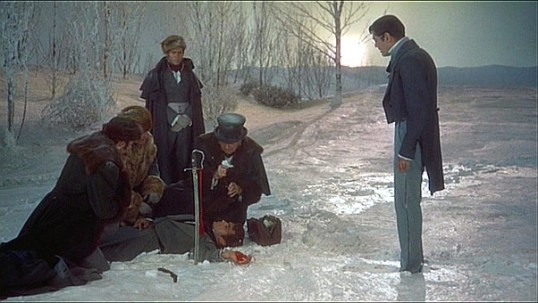
War and Peace (1956, dir by King Vidor, DP: Jack Cardiff)
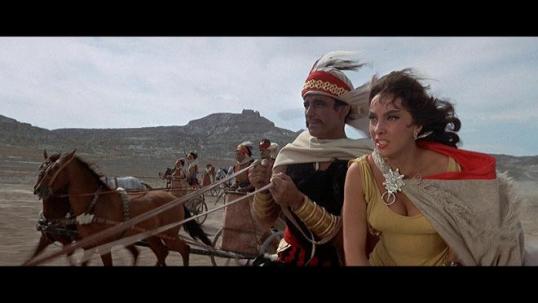
Solomon and Sheba (1959, dir by King Vidor, DP; Fred A. Young)
As some of our regular readers undoubtedly know, I am involved in a few weekly live tweets on twitter. I host #FridayNightFlix every Friday, I co-host #ScarySocial on Saturday, and I am one of the five hosts of #MondayActionMovie! Every week, we get together. We watch a movie. We tweet our way through it.
Tonight, for #ScarySocial, I will be hosting Cannibal Apocalypse, starring John Saxon and Giovanni Lombardo Radice!
If you want to join us on Saturday night, just hop onto twitter, start the film at 9 pm et, and use the #ScarySocial hashtag! The film is available on Prime and Tubi! I’ll be there co-hosting and I imagine some other members of the TSL Crew will be there as well. It’s a friendly group and welcoming of newcomers so don’t be shy!
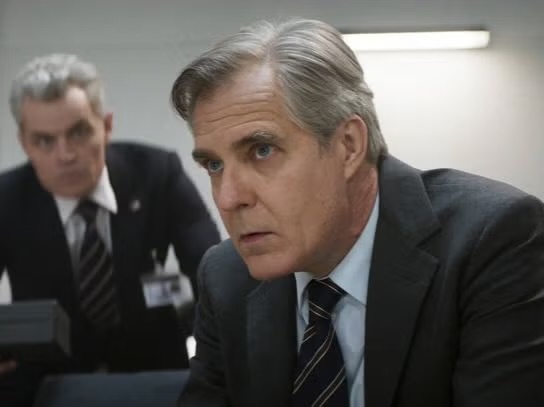
Today is the 66th birthday of the excellent Canadian character actor Henry Czerny. My admiration and appreciation for the man stems primarily from two performances in big movies. The first time I really remember seeing him is when he played the ethically challenged Deputy Director of the CIA Robert Ritter in CLEAR AND PRESENT DANGER (1994). He goes toe to toe with Harrison Ford at times in an incredible performance. Check out the scene below:
A couple of years later Czerny would play IMF Director Kittredge in MISSION: IMPOSSIBLE (1996) with Tom Cruise. Once again, his performance adds greatly to the film and this scene with Tom Cruise may be the best of the movie!
Actors like Henry Czerny are a treasure and I always look forward to seeing them pop up in movies and TV shows. It made me so happy when he showed back up a couple of years ago in MISSION: IMPOSSIBLE – DEAD RECKONING (2023). Happy Birthday, Henry! 🎊🎂🎉
As a horror fan, I always appreciate a good slasher film. As dark and as disturbing as they can be, they’ve also helped me to face down a lot of my own real-life fears. Watching a good slasher film can be cathartic. You may be scared when you’re watching and, if you’re like me, you’ll probably put your hands in front of your eyes during the more graphic kills but, when the end credits roll, you feel proud of yourself for having made it all the way through.
Again, that’s a good slasher film.
A bad slasher film can be, if you’ll excuse the expression, absolute terror.
Mouse of Horrors is not a good slasher film. It’s a film about Chloe (Natasha Tosini) and her friends who, after about 15 minutes of filler, finally go to the “fun fair.” It turns out that the fair is not very fun because it’s home to Dr. Rupert (Chris Lines) and his two sons, one of whom wears a mouse mask and another of whom wears a bear mask. They’re Mickey and Winnie, though they’re never explicitly called that over the course of the film. (The Mouse is played by Lewis Santer while the Bear is played by Stephen Staley). Dr. Rupert needs body parts so he sends his two sons out to collect them. As you may have guessed, this leads to a lot of scenes of spurting blood, hacked-off limbs, and screams. Mickey and Winnie do not speak but Dr. Rupert does. In fact, the old man will not shut up. Even if he wasn’t some old weirdo demanding that his sons hack up random people, Dr. Rupert would be an annoying old crank.
Let’s give some credit where credit is due. The Mouse has potential and physically, Lewis Santer does a good job of portraying The Mouse’s jumpy style of movement. The Mouse mask is creepy, or at least it is at first. Eventually, I got bored with looking at the Mouse and, by the time the Bear started fighting with the Mouse, I no longer cared much about looking at either of them. Still, the killer is one of the most important parts of a slasher film and the Mouse had potential. The setting of the carnival also had potential, though most of it went unused.
The rest of the film, though …. ugh! Seriously, this was one of the worst edited films I’ve ever seen, including one scene where a day for night scene went totally day for a few shots. The story dragged. (It takes 20 minutes to get them to the fun fair when the film really should have started with them already there.) I was never quite sure where the Mouse was in relation to anyone else in the film, negating any chance of generating suspense. Why was the town suddenly deserted? Why did everyone else at the fun fair suddenly disappear except for Chloe and her friends? Why did the Mouse go the local pub to kill a bartender instead of just staying at the fun fair? Does the Mouse walk around town with his mouse mask on? How does he get away with that? I’ve always been the first to say that enjoying a horror film requires a certain suspension of disbelief but the audience has every right to expect some sort of reward for playing along. This film doesn’t offer that reward.
Get ready for a lot more films like this. Copyrights are expiring and everyone wants to either make a film based on their childhood nightmares or get revenge on their English teacher for making them read a book in high school. This was not the first killer Mickey film and I doubt it will be the last.
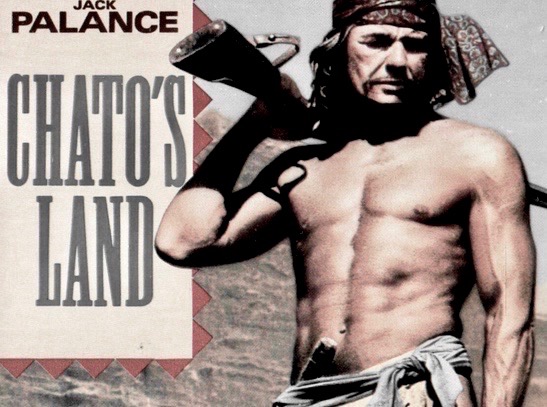
One of the most enjoyable things about being a dad is introducing your favorite things to your kids. I taught my son Hank the sports of basketball, baseball, and golf, and even now there’s nothing we enjoy doing more together than playing a round of golf. Of course, as one of the world’s biggest Charles Bronson fans, I’ve introduced him to many films starring my cinematic hero. It seems that two movies have stood the test of time and have gone on to become two of his favorite movies. The fact that THE DIRTY DOZEN (1967) is one of his favorites isn’t a big surprise as he’s always enjoyed playing video games set during World War II. The other, CHATO’S LAND (1972), was more of a surprise. A few years ago, when Hank was home from college, I asked him if there was a movie he wanted to watch. It could have been any movie in the world, and I was honestly a little surprised when he said he’d been wanting to watch CHATO’S LAND again. Needless to say, this dad was very proud.
Charles Bronson is Pardon Chato, a half breed Apache who’s minding his own business and having a drink in the saloon, when a small-town sheriff decides to give him hell just for being a “breed.” Forced to kill the racist POS in self-defense, Chato heads out of town a day ahead of the posse led by the former confederate Captain Quincey Whitmore (Jack Palance). Whitmore may be leading the posse, but the Hooker Brothers (played by Simon Oakland, Ralph Waite, and Richard Jordan) are just as bigoted as the sheriff who was killed, and they set about bullying their neighbors into joining their hunt for Chato. A couple of the guys who go along because it’s “expected of them” are Joshua Everette (James Whitmore) and Gavin Malechie (Roddy McMillan). When the posse comes across Chato’s home and woman, some of the members decide the wise thing to do is rape her and tie her up as bait. This is clearly not going to work out well for the posse, even those who tried to stop the rape. Using his sneaky Indian skills and the help of a fellow Indian, Chato is able to create a diversion and rescue his woman, but his friend is killed in the process. With his friend murdered and his woman brutalized and raped, Chato is no longer willing to just run away. From this point forward, the hunters will become the hunted as he leads them all further into CHATO’S LAND.
There are several things that I find interesting about CHATO’S LAND. This is the first of six films that director Michael Winner and Charles Bronson would make together. They would all be financially successful films with THE MECHANIC (1972) and the original DEATH WISH (1974) standing out as true 70’s classics. Charles Bronson’s last number one box office hit would be DEATH WISH 3 (1985), which would also be his final film with Winner. It should also be noted that the character of Chato would be an early precursor of the kind of character Bronson would go on to embody almost exclusively throughout the rest of his career, that of the quiet but deadly man of action. Chato only says 13 lines in the entire movie and most of those are in a Native American dialect. Chato doesn’t have that much actual screen time either, but his presence dominates every scene. He’s like the angel of death hanging over the entire proceedings waiting to strike, and Winner continues to build on this tension as the film moves towards its inevitable conclusion. It’s an incredible, physical performance that can only be delivered by an actor like Bronson. Finally, the film has an outstanding cast, a cast that Winner himself would call “as good a cast as I ever assembled.” In addition to Bronson, Jack Palance is excellent as the confederate captain who’s never gotten over losing the war, and who now finds himself losing the battle to control the men in the posse. James Whitmore and Roddy McMillan are solid as a couple of decent men who went along because they felt it was their duty to their neighbors, who now find themselves caught up in a bad situation with even worse men. And finally, Simon Oakland, Ralph Waite & Richard Jordan are the kind of men you love to hate as the ignorant and bigoted Hooker brothers. It doesn’t hurt your feelings at all to see those guys get what’s coming to them.
Overall, CHATO’S LAND is a very good western, dominated by Bronson’s presence in the same way that JAWS (1975) is dominated by a giant killer shark. It was also a hugely profitable film upon its initial release, guaranteeing that Bronson would continue to get starring roles in films backed by American studios. Bronson liked to work with the same directors once he felt comfortable with them, and his collaboration with Winner would prove to be extremely fruitful and help turn him into one of the biggest box office stars in America. Thanks, Michael!
As some of our regular readers undoubtedly know, I am involved in a few weekly live tweets on Twitter and Mastodon. I host #FridayNightFlix every Friday, I co-host #ScarySocial on Saturday, and I am one of the five hosts of #MondayActionMovie! Every week, we get together. We watch a movie. We tweet our way through it.
Tonight, at 10 pm et, #FridayNightFlix presents 2010’s MacGruber!
If you want to join us this Friday, just hop onto twitter, start the movie at 10 pm et, and use the #FridayNightFlix hashtag! It’s a friendly group and welcoming of newcomers so don’t be shy.
Today’s scene that I love comes from my favorite Greydon Clark movie, 1990’s The Forbidden Dance!
Yes, this scene is technically a spoiler. It’s got music! It’s got dancing! It has some deeply questionable stereotypes and some obvious virtue signaling! It has that classic line, “We should just boycott their ass!” It’s got Sid Haig! It’s got everything you could ever hope for!
And remember — this film is dedicated to the preservation of the rain forest.
4 (or more) Shots From 4 (or more) Films is just what it says it is, 4 (or more) shots from 4 (or more) of our favorite films. As opposed to the reviews and recaps that we usually post, 4 (or more) Shots From 4 (or more) Films lets the visuals do the talking.
Today, Through the Shattered Lens wishes a happy 82nd birthday to the one-of-a-kind director, Greydon Clark! And that means that it’s time for….
4 Shots From 4 Greydon Clark Films
Angels Brigade (1979, dir by Greydon Clark, DP: Dean Cundey)
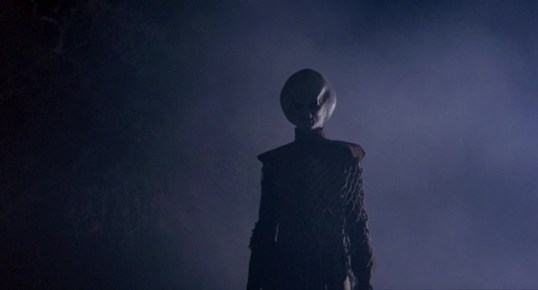
Without Warning (1980, dir by Greydon Clark, DP: Dean Cundey)
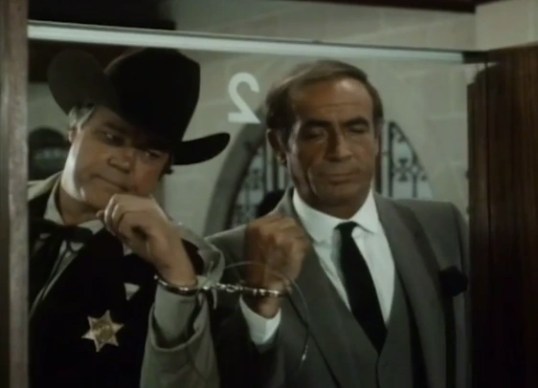
Final Justice (1985, dir by Greydon Clark, DP: Nicholas Josef von Sternberg)
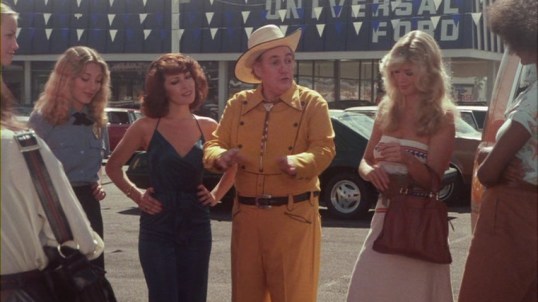
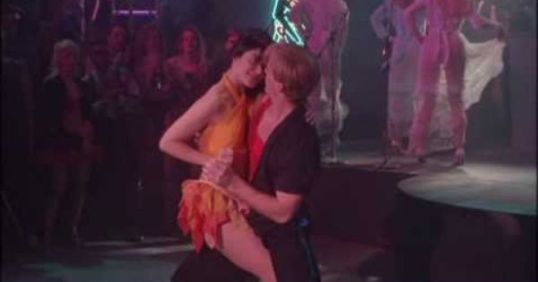
The Forbidden Dance Is Lambada (1990, dir by Greydon Clark, DP: R. Michael Stringer)


 Through the Shattered Lens