Well everyone has to start somewhere! Today I celebrate Alex Winter’s 60th birthday by watching a scene from DEATH WISH 3, the insane Charles Bronson vigilante classic, where Alex earned his first big screen credit as gang member Hermosa! What an honor it must have been for Alex to get smashed in the head with a tire tool by the legend in his signature series of revenge. If you haven’t seen DEATH WISH 3 before, you may never see “Bill” in quite the same light again!
(Note – the scene below features taunts and threats of an extreme sexual nature. Do NOT hit play if that offends you!)
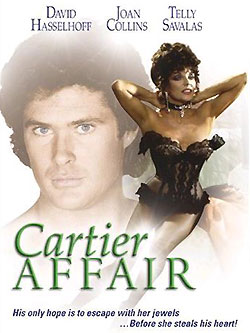
In 1984’s The Cartier Affair, David Hasselhoff plays Curt Taylor. He has spent the last few years in prison, having been convicted of selling deeds to fake oil wells. He has passed the time by watching a soap opera that stars actress Cartier Rand (Joan Collins). He has also managed to get in debt to the local prison mob boss, Phil Drexler (Telly Savalas).
When Curt learns that he’s being released from prison, Drexler informs him that he’s still expected to find a way to pay off his debt. On the outside, Curt discovers that even his parole officer (Ed Lauter) works for Drexler! Curt is assigned to become the private secretary of Cartier Rand and to steal her jewelry. In order to get the job, Curt has to pretend to be gay. That’s the only way that Cartier’s boyfriend (Charles Napier) would be willing to accept the idea of a male private secretary.
(Wouldn’t it just be simpler for Curt to rob a bank or something?)
Once he’s a part of the household staff, Curt discovers that Cartier is more than just the star of his favorite soap opera. She’s someone who is tired of reciting melodramatic dialogue and kissing her co-stars. She has serious ambitions. Curt is immediately attracted to her and soon, Cartier is attracted to Curt. But, of course, Curt is pretending to be gay and, to his horror, Cartier sets Curt up with one of her gay friends.
Meanwhile, the bad guys want their money….
The first half of the film is taken up by scenes of people mistaking Curt for being gay and there are more than a few moments and jokes that a film wouldn’t be allowed to get away with today. A scene where Curt finds himself in a gay bar is cringey because, rather than asking us to laugh at Curt for panicking about finding himself in the rather innocuous location, the film asks us to instead laugh at the sight of men slow-dancing with other men. Early on in the film, there’s a few scene where Hasselhoff overplays his attempts to come across as being gay. Fortunately, Hasselhoff soon stops doing that and his performance improves as the film goes on.
The film gets slightly better during the second half, when Cartier learns the truth about Curt and the two of them somewhat implausibly go on the run from the bad guys. They end up getting chased out to the desert, trading one-liners all the way, and I do have to admit that Collins and Hasselhoff displayed a surprising amount of chemistry during those scenes.
The film is tonal mishmash that doesn’t really work. It tries to parody the type of soap operas that made Cartier Rand a star and it also tries to be a relatively exciting chase film but it keeps getting bogged down in plot points that ultimately feel rather superfluous. My main issue that, if Drexler really wanted to get him money from Curt, it seems like he would have come up with a less complicated scheme, like robbing a bank or fencing stolen goods or something like that. Instead, Curt is supposed to go undercover, pretend to be gay, and rob one of the most famous women on the planet. I mean, Hell, he could have just broken into a jewelry store and gotten it all done in one night. That said, Hasselhoff and Collins have a bit of charm to them. It’s a shame they didn’t co-star in a better film.
4 Shots From 4 Films is just what it says it is, 4 shots from 4 of our favorite films. As opposed to the reviews and recaps that we usually post, 4 Shots From 4 Films lets the visuals do the talking.
It’s the Hoff’s birthday! That means that it is time for….
4 Shots From 4 David Hasselhoff Films
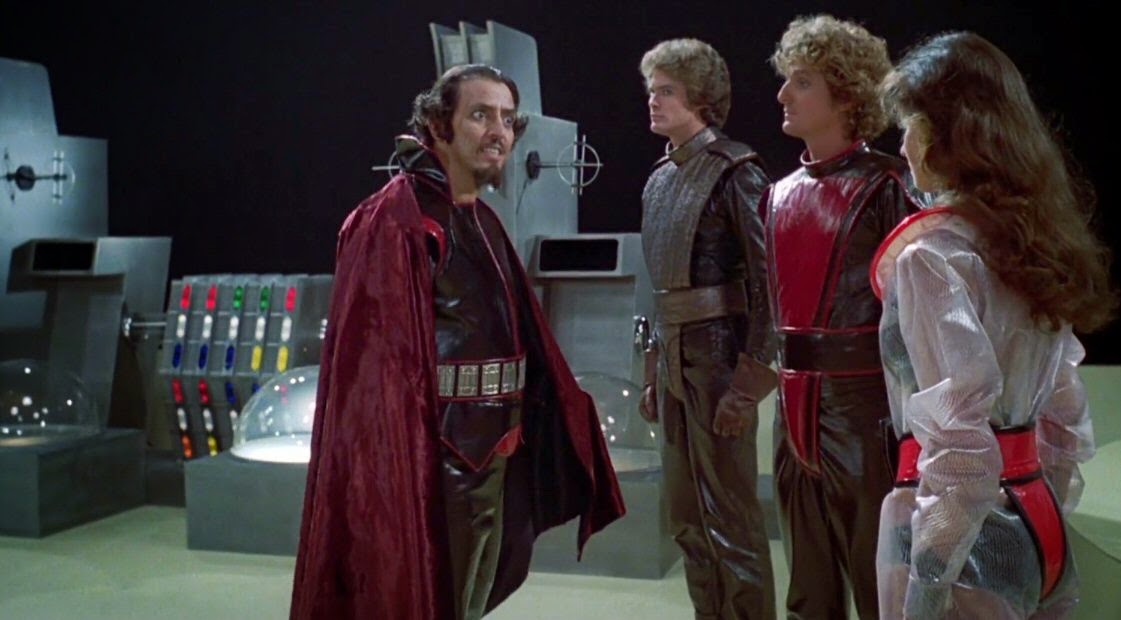
Starcrash (1978, dir by Luigi Cozzi, DP: Paul Beeson and Roberto D’Ettorre Piazzoli)
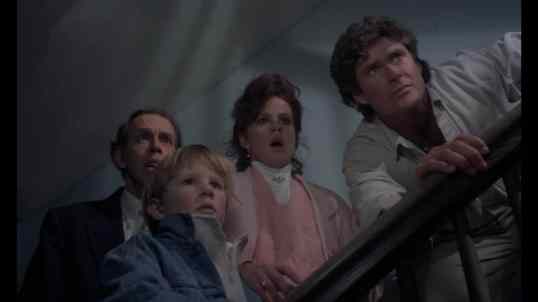
Witchery (1988, dir by Fabrizio Laurenti, DP: Gianlorenzo Battaglia)
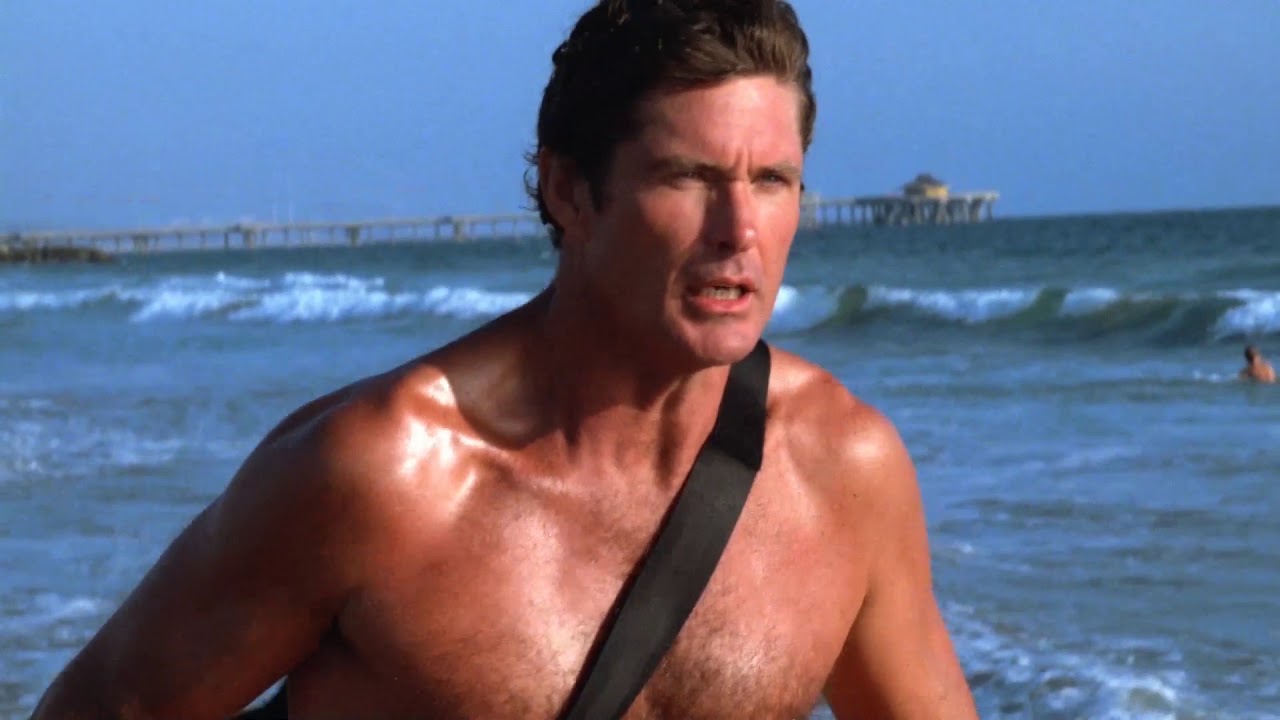
Panic At Malibu Pier (1989, dir by Richard Compton, DP: John McPherson)
Nick Fury: Agent of SHIELD (1998, dir by Rod Hardy, DP: James Bartle)
Today would have been Donald Sutherland’s birthday. Today’s scene that I love comes from one of my favorite Sutherland performances, as the professor who dislikes John Milton in Animal House.
When I was a kid, I loved Corey Feldman. This love was mainly based on three movies, THE GOONIES (1985), STAND BY ME (1986), and THE LOST BOYS (1987). Corey is only two years older than me, so it always felt a little bit like he could have been a friend of mine when I watched his movies. I also thought he was so funny! One of my favorite things about Corey in STAND BY ME is the fact that he’s funny, but he also gives a solid dramatic performance in the film. His character Teddy isn’t scared of anything either, and for a kid who was maybe five feet tall and scrawny when he first watched this movie, that meant something to me! I just love STAND BY ME, and Corey is a big reason for that.
Join me in wishing Corey Feldman a happy 54th birthday, and while you’re at it, check out this scene:
4 Shots From 4 Films is just what it says it is, 4 shots from 4 of our favorite films. As opposed to the reviews and recaps that we usually post, 4 Shots From 4 Films lets the visuals do the talking.
We’re halfway through July, which means that it’s time for me to get ready for October! (Seriously, who cares about August and September?) Here to inspire are….
4 Shots From 4 Horror Movies
Night of the Living Dead (1968, dir by George Romero)
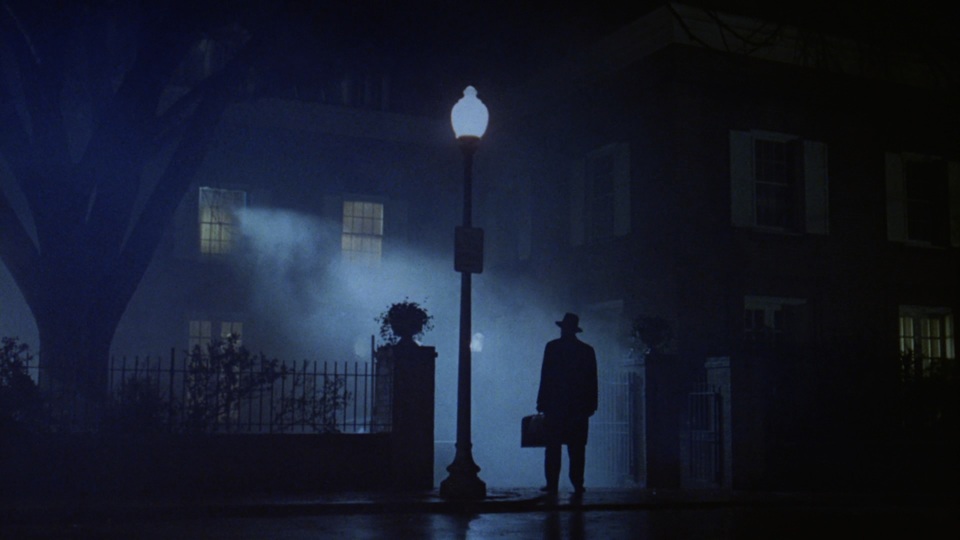
The Exorcist (1973, dir by William Friedkin, DP: Owen Roizman)
Carrie (1976, dir by Brian De Palma, DP: Mario Tosi)
Suspiria (1977, dir by Dario Argento, DP: Luciano Tovoli)
I’ve been a fan of actor Jan-Michael Vincent for about as long as I can remember. I was a grade schooler in the mid-80’s when AIRWOLF was playing on network TV. I loved the show and Vincent’s character, Stringfellow Hawke. It was also around that time that I began my obsession with Charles Bronson, and Vincent co-starred in the iconic 1972 Bronson film THE MECHANIC (1972). Fox 16 out of Little Rock played the movie often, further cementing my appreciation for his work. And I specifically remember renting his 1980 movie DEFIANCE where his character takes on a ruthless gang in New York. It was my kind of movie, and I still watch it every few years. There’s just something I’ve always liked about Jan-Michael Vincent. July 15th, 2025 would have been his 80th birthday so I decided to watch one of his movies that I’ve never seen, VIGILANTE FORCE from 1976. It was playing on Amazon Prime, so I fired it up for my initial viewing.
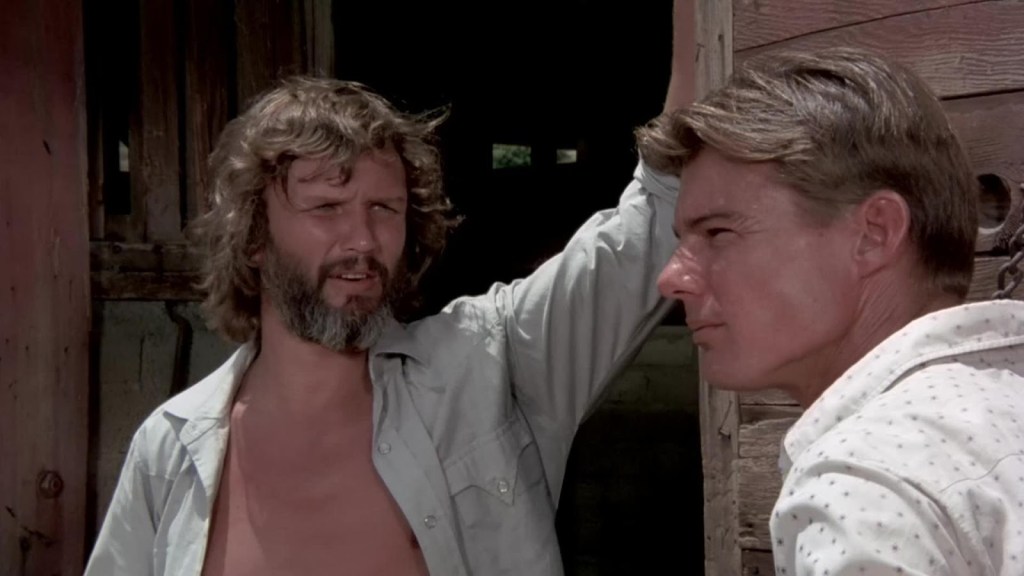
In VIGILANTE FORCE, Jan-Michael Vincent plays Ben Arnold, a guy from the small town of Elk Hills, California. It seems that the discovery of oil in the area has brought about a financial boom, but it’s also brought in a lot of rowdy out-of-towners and a surge in violent crime. Ben convinces the local community leaders to allow him to bring in his brother Aaron (Kris Kristofferson), a Vietnam war hero, to help restore order in town. Aaron assembles a group of ex-military types, friends of his, to help the local police restore order in town. Successful in cleaning out the riffraff at first, Aaron and his team of vigilantes eventually become the riffraff and use their law enforcement powers for their own corrupt, get-rich-quick schemes. Realizing that he made a horrible mistake in bringing in his brother, Ben is forced to confront Aaron and his team of murderous mercenaries in order to reclaim Elk Hills for its citizens.
I had not read anything beyond the title VIGILANTE FORCE and the basic cast list when I sat down to watch this film. I guess that’s a good thing, because I wasn’t expecting this movie to pit the brothers played by Vincent and Kristofferson against each other. I thought the two guys would be working together to get rid of a bunch of rednecks, and we do get that for the first half of the film, but when Kris goes bad, he really goes bad! And nobody is safe. This is one of those movies where he just kills whoever gets in his way, no matter how important or attractive they are. Writer-Director George Armitage, who would direct the excellent MIAMI BLUES (1990) fourteen years later, has said that he was trying to make a point about America’s involvement in the Viet Nam war with the Kristofferson character. Armitage apparently enjoys his references, as the film was made during the USA’s bicentennial year, but his two main characters are named after Benedict Arnold and Aaron Burr. While these ideas may have amused the director, his heavy-handed approach is not good for Kristofferson’s character in this film. His Viet Nam vet basically turns into an evil cartoon about halfway through the film and is no longer interesting, which is a shame because he gives a good performance.
Allegories aside, at its heart VIGILANTE FORCE is B-movie, drive-in fodder, and it’s pretty good at being that. It’s got that unpolished look and raw, energetic feel that I like in my low budget 70’s action movies. As you would expect in a film at this time, Jan-Michael Vincent is impressive and believable as the tough, good guy of the flick. Highly motivated due to the actions of our evil, out of control villain, Vincent handles the action scenes well in the film’s explosive finale. And I mean that literally, it seems that everything blows up big time at the end! Besides Kristofferson and Vincent, the film has a very recognizable supporting cast, which is one of the things I love about 70’s movies. Producer Gene Corman put together a cast that also includes Brad Dexter, Andrew Stevens, Victoria Principal, Bernadette Peters, Paul Gleason, Charles Cyphers, Loni Anderson and a host of other familiar voices and faces who add their unique talents to the proceedings. Principal, still a couple of years away from her career defining role as Pamela Ewing in the DALLAS TV series, is especially beautiful as Vincent’s girlfriend.
Overall, while VIGILANTE FORCE is not required viewing, I can definitely recommend it to anyone who likes 70’s redneck action cinema, or to fans of the main stars. I enjoyed it!
After avoiding it for 25 years, I finally watched the infamous 2000 fiasco, BattlefieldEarth, last night.
BattlefieldEarth, based on a superlong novel by creepy cult guru L. Ron Hubbard, was a longtime passion project of John Travolta’s. Travolta, a Scientologist, had long wanted to make a movie out of Hubbard’s science fiction epic and, on a hot streak following films like PulpFiction and GetShorty, he finally did so in 2000. He played Terl, a member of a giant alien race called the Psychlos. The Psychlos have conquered Earth and humanity has regressed back to an almost prehistoric standard of living. When a brave human, Johnnie Goodboy Tyler (Barry Pepper), defies his elders and proceeds to venture out into the ruins of Denver, he’s captured by Terl. Eventually, Johnnie is shown a copy of the Declaration of Independence and it inspires him to lead a revolution against the Psychlos.
BattlefieldEarth turned out to be just as bad as I had heard, a charmless wannabe epic that used far too many Dutch angles and relied on slow motion to try to create a heroic (or, in some cases, tragic) feel to the action. The plot of the film felt like something recycled from an old 1930s serial, which makes sense when you consider that L. Ron Hubbard was a pulp writer before he decided to become a guru. What I was not prepared for was just how mind-numbingly dull BattlefieldEarth is. Most bad movies can at least make the claim of being entertaining in their badness. If nothing else, you can often admire them for their ambition. Take a film like Plan 9 From Outer Space.Plan9From Outer Space is often derided as being the worst film of all time but it’s still terrifically entertaining and there’s a likable earnestness at the heart of it. Director Ed Wood may not have had a budget and his main star may have been present only through stock footage but, dammit, Wood was determined to make a science fiction epic that would double as a plea for world peace and he did just that. There’s a heart at the center of Plan 9 From Outer Space and that makes it a film that you can mock but you never quite dislike. For all the talk of Battlefield Earth being a passion project for Travolta, the end result is an empty and rather soulless film.
(I nearly listed BattlefieldEarth as being one of our Icarus Files but then I remembered that Icarus at least managed to get close to the sun. BattlefieldEarth can’t even get out of Denver.)
Travolta’s career has never really recovered from BattlefieldEarth. He is an actor who can claim to have appeared in two of the biggest, most influential films of all time — Pulp Fiction and Saturday Night Fever — but his legacy appears to be walking around on stilts in Battlefield Earth. As for Barry Pepper, he does probably about as well as anyone could with the role of Johnnie Goodboy Tyler but still, it’s sad to see a good actor wasted in such a bad movie. (In fact, there’s quite a few good actors — Forest Whitaker, Kim Coates, Richard Tyson — wasted in this movie.) From what I understand, the movie only covered the first 400 pages of Hubbard’s 1100-page novel. Travolta had hopes to do a sequel but that’s not going to happen.
It’s for the best. If people need to see a movie about L. Ron Hubbard’s belief system, they can always rewatch The Master.
Happy Birthday in cinema heaven to 1970’s heartthrob, Jan-Michael Vincent. It’s arguable that a 70’s Vincent was as good looking as a 1990’s Brad Pitt. In the 1980’s, Vincent would play Stringfellow Hawke in the iconic TV series AIRWOLF, where he was the highest paid actor on American television, bringing in $200,000 per episode. As a kid of the 80’s, I loved that show. My own extensive collection of physical media is filled with films starring Jan-Michael Vincent, especially his work from the 70’s and early 80’s. A few of my favorites are WHITE LINE FEVER (1975), HOOPER (1979 – with Burt Reynolds), and DEFIANCE (1980). Unfortunately, severe drug and alcohol abuse ultimately took its toll on Vincent’s career and his post AIRWOLF years were filled with straight-to-video B movies and walk on TV roles. Still, you couldn’t browse the inventory of Mom and Pop video rental stores in late 80’s and early 90’s without seeing loads of films with Vincent on the cover. A true cautionary tale of the damage that intoxicants will ultimately do to the human body and mind, Vincent’s final years were hard to watch, but his great work as a younger man still remains, and that’s what I’m choosing to focus on today.
In honor of what would have been Jan-Michael Vincent’s 80th birthday, I’m going to celebrate here on The Shattered Lens by sharing a scene from my favorite Jan-Michael Vincent movie, THE MECHANIC, co-starring Charles Bronson. Vincent holds his own with the veteran star in one of his most iconic roles!
4 Shots From 4 Films is just what it says it is, 4 shots from 4 of our favorite films. As opposed to the reviews and recaps that we usually post, 4 Shots From 4 Films lets the visuals do the talking.
Today would have been the 89th birthday of the pioneering indie film director, Larry Cohen. It’s time for….





 Through the Shattered Lens