Brad reviews COCKFIGHTER (1974), starring Warren Oates!


I read about the movie COCKFIGHTER many years ago, and I remember the review being very positive. I had never watched the film before, but with today being Warren Oates’ birthday and it being available on Amazon Prime, I decided I’d finally watch it. 

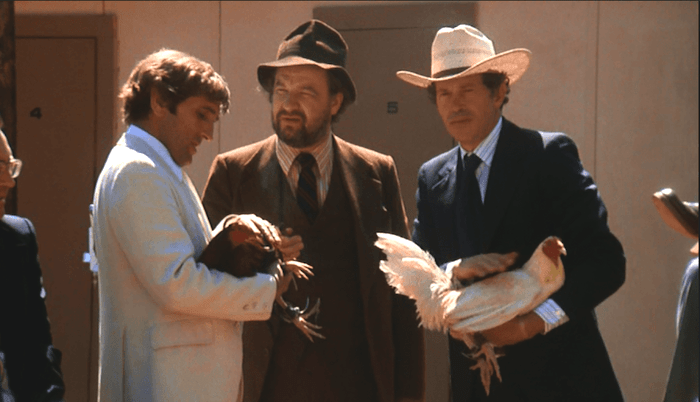
Directed by Monte Hellman and based on Charles Willeford’s 1962 novel, COCKFIGHTER introduces us to Frank Mansfield (Warren Oates), a man completely obsessed with the southern “sport” of cockfighting. As we meet him, he’s in the process of losing a bet and a cockfight with Jack Burke (Harry Dean Stanton). The loss isn’t just a setback, it costs him all of his cash, his truck, his trailer, and his current girlfriend Dody White (Laurie Bird). We also notice in these early scenes that Frank only communicates through sign language and writing notes. It seems that he’s been living under a self-imposed vow of silence. Two years earlier, on the eve of the big, season-ending cockfighting grand finale, Frank’s big-mouthed braggadocio caused him to lose his prized cock, and the prestigious “Cockfighter of the Year” medal in a meaningless hotel bet, also against Jack Burke. Frank vows not to speak again until he wins that medal. Coming up with cash in the only way he can by selling his family’s home, Frank buys a new cock named White Lightning from Ed Middleton, played here by the film’s writer Charles Willeford. Armed with new fowl and a new, capital rich partner named Omar Baradansky (Richard B. Shull), Frank will not let anything stop him, including the love of his life Mary Elizabeth (Patricia Pearcy) or an axe wielding competitor (Ed Begley, Jr.), from being named “Cockfighter of the Year” and finally regaining his voice and the respect he desires!

COCKFIGHTER definitely has some things going for it. First and foremost, Warren Oates is so good in the lead role as the obsessed man who puts success in cockfighting above anything else in his life, including every other person. He literally sells the family home out from under his alcoholic brother Randall (Troy Donahue) in order to fund his next cock purchase after he’s gone bust. This sets up quite the sight gag for such a gritty and realistic film as a large truck and trailer drives away the family home taking up the entire state highway. When his long time fiancé asks him to give up cockfighting, he just gets up, leaves her shirtless and heads back out on the circuit. He writes her a letter from the road and tells her he loves her, but he also makes it clear that life without cockfighting is a life that he’s unwilling to live. Oates’ Frank Mansfield is not the kind of person you’d ever want to depend on in life, but he’s also an uncompromising individual who is determined to live life wholly on his own terms, accepting of the successes and failures that come with it. I watched the film because it features Warren Oates, and after having done so, I can say that his performance is truly special. 

COCKFIGHTER is one of those movies that makes us feel like we’re watching real people, and that’s kind of fascinating even if they reside in a world that we don’t really want to live in. The primary credit for that has to go to director Monte Hellman and Oscar winning cinematographer Nestor Almendros (DAYS OF HEAVEN). The restraint that is shown in the storytelling, as well as the sweaty, ramshackle authenticity of the Georgia locations, brings the story to life. The supporting cast also does its part to create the world of COCKFIGHTER. Harry Dean Stanton as Jack Burke, Frank’s primary rival in the cockfighting game, is excellent as you might expect, and he seems a lot like a regular guy. I really like Richard B. Schull, who plays Frank’s outgoing and talkative partner Omar. His friendly and gregarious personality seems a little untrustworthy at first, but he turns out to be the most likable person in the film. And finally, I want to shoutout Charles Willeford. Not only did he write the source novel and screenplay for COCKFIGHTER, he also gives a solid performance as Ed Middleton, an old-timer in the game who treats Frank with honesty and decency when he’s hit rock bottom. 

With all the positive things I’ve said above, I have to address the graphic depiction of cockfighting in COCKFIGHTER. This was the 70’s, and the scenes shown here are real and were very difficult for me to watch. It’s not fun to see animals fight and kill each other, and this is coming from a person who loves fried chicken and is not particularly an animal lover. The scenes are presented as matter of fact and in service of the story, but that still doesn’t make them easy to watch. Director Monte Hellman has gone on record to express his personal disgust at even filming these scenes. While a movie made in the 1970’s probably couldn’t have been made without these sequences, I just wanted to make it clear that this film is probably unwatchable for a lot of people.

Overall, COCKFIGHTER is a relic of the 1970’s. It’s a gritty and realistic film, featuring a great central performance from Warren Oates. It’s also an ethically troubling film that features real animal on animal violence. Based on that I don’t necessarily recommend the film. Rather, I just want to share my own thoughts, and you can determine if you want to watch it or not. That’s what I’ve tried to do above. 
At Close Range (1986, directed by James Foley)


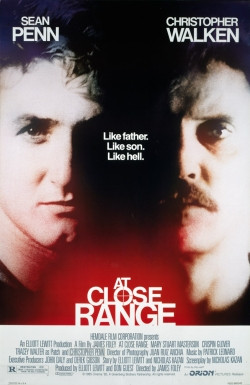
Brad Whitewood, Sr. (Christopher Walken) is known as Big Brad, a rural crime lord who rules the backwoods of Pennsylvania.  When his son, Little Brad (Sean Penn, trying too hard to be James Dean), comes to live with him, Big Brad goes out of his way to try to bring the teenager into his criminal lifestyle.  At first, Little Brad loves being a part of the family business but witnessing a murder and falling in love with Terry (Mary Stuart Masterson) caused Little Brad to start to move away from his father.  With the FBI closing in on the Whitewood family, Brad Sr. starts to eliminate everyone who he considers to be a threat, including the members of his own family.

Based on a true story, this neo-noir features a great cast, including Chris Penn, Millie Perkins, Kiefer Sutherland, Crispin Glover, David Strathairn, Tracey Walter, and Mary Stuart Masterson.  Unfortunately, the movie itself moves at a plodding pace.  There are some good and disturbing scenes, like the montage where Big Brad starts to eliminate the members of his gang.  The film does a good job of showing how seductive Big Brad’s criminal lifestyle can be to a bunch of kids who have basically been written-off by society.  But the story itself is so bleak that most people will end up tuning out long before Little Brad finally turns against his father.

Whatever other flaws it may have, At Close Range does feature one of Christopher Walken’s best performances.  Walken is chillingly evil as Big Brad.  He’s got enough charisma to be believable as someone who could bring a gang together but he’s also frightening as he starts killing anyone who he thinks might talk to the police or the FBI.  Big Brad is a remorseless killer and Walken plays him as being a classic sociopath, someone who cannot understand why the members of his gang and family would get upset when he starts killing some of them.  To Big Brad, that just goes with the territory.  It’s a part of doing business.  With his distinct way of speaking and his trademark tics, Walken is someone who has inspired many impersonators and it can be easy to forget that he’s also a damn good actor.  Films like At Close Range remind us of just how talented Walken actually is.

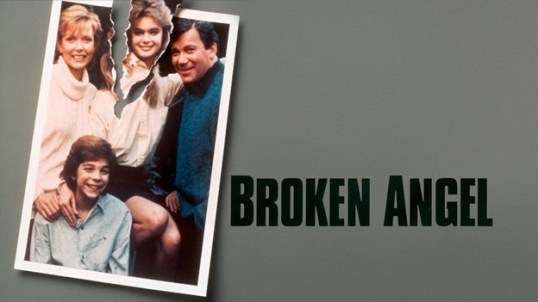
Retro Television Review: Broken Angel (dir by Richard T. Heffron)


Welcome to Retro Television Reviews, a feature where we review some of our favorite and least favorite shows of the past!  On Sundays, I will be reviewing the made-for-television movies that used to be a primetime mainstay.  Today’s film is 1988’s Broken Angel!  It  can be viewed on YouTube.

Chuck Coburn (William Shatner) has a nice house in the suburbs, a nice job, a nice car, and a nice Bruins jacket.  He’s hoping that he can once against have a nice marriage with his wife (Susan Blakely), despite the fact that she cheated on him and she still thinks that he spends too much time at work.

Chuck is proud of his teenage daughter, Jaime (Erika Eleniak).  Jaime seems like the perfect suburban and angelic teenager.  But then Jaime goes to prom and her best friend, Jenny (Amy Lynne), is gunned down in front of her.  Jaime runs from the scene and vanishes.  As Chuck searches for his daughter, he is stunned discover that Jaime, Jenny, and their boyfriends were all a part of a gang!  His perfect daughter was smoking weed, doing cocaine, selling crack, and taking part in rumbles with a rival Asian gang.  Even worse, Jaime’s gang was called …. LFN!

LFN?  That stands for Live For Now.  The Live For Now Gang.  Whenever we see the members of the gang preparing to get into a fight with another gang, they all chant, “LFN!  LFN!”  LFN is a gang of white suburban teenagers and they look just as dorky as they sound.  I mean, I think it would be bad enough to discover that your child is in a gang but discovering they were in a dorky gang would probably make it even worse.

The majority of Broken Angel is made up of scenes of Chuck searching the mean streets of Los Angeles.  He partners with a social worker (Roxann Dawson) who is herself a former gang member.  Chuck discovers that his daughter’s street name was — *snicker* — Shadow.  He also befriend a member of the LFN’s rival Asian gang and tries to encourage her to go straight.  This leads to scene in which he is attacked by Al Leong.  Somehow, middle-aged William Shatner manages to beat up Al Leong.  That, in itself, is worth the cost of admission.

Broken Angel deals with a serious issue but it does so in such an overwrought and melodramatic fashion that most viewers will be moved not to tears but to laughter.  In Broken Angel, William Shatner gave the type of overly dramatic and self-serious performance that he routinely pokes fun at today.  If you’re one of those people who enjoys listening as Shatner emphasize random syllables and takes meaningly pauses, this movie will give you a lot to enjoy.  In every scene, Shatner seems to be saying, “Notice me, Emmy voters!  Notice me!”  Of course, it wouldn’t be until Shatner learned how to laugh at himself that the Emmy voters would finally notice him.

The film ends on an abrupt note but with the promise of better days ahead.  Just remember — keep an eye out for the LFN!

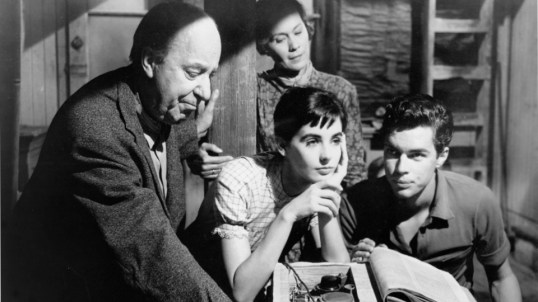
Lisa Reviews An Oscar Nominee: The Diary of Anne Frank (dir by George Stevens)


http://www.youtube.com/watch?v=wRjX3otqSRA

From 1942 to 1944, a teenage girl named Anne Frank lived in hiding.

She and her family lived in what was sometimes called The Secret Annex, three stories of concealed rooms that were hidden behind a bookcase in an Amsterdam factory.  At first, it was just Anne, her older sister Margot, and their parents.  Eventually, they were joined by another family and eventually a dentist, with whom Anne did not get along.  Life was not easy in the concealed space and tempers often flared.  As the months passed, Anne had a romance-of-sorts with Peter, the teenage son of the other family, but she wondered if she truly felt anything for him or if it was just because they were stuck together.  Anne looked forward to someday returning to school and seeing all of her old friends, again.  However, she knew that she could not leave the Annex until the Nazis had finally been forced out of the Netherlands.  She and the other occupants had to remain in hiding and they had to remain perfectly quiet eight hours a day because they were Jewish.  If they were discovered, they would be sent to the camps.  So, they waited and Anne kept a diary.

Tragically, the Nazis did eventually discover the Secret Annex.  Of the 8 occupants, only Anne Frank’s father, Otto, would survive the war.  The rest died in various concentration camps.  Anne Frank’s mother starved to death in Auschwitz.  Her older sister, Margot, was 19 when she fell from her bunk and, because she was in such a weakened state, was killed by the shock.  Anne Frank, it is believed, died a few days after Margot.  She died at the Bergen-Belsen Concentration Camp, one of the 17,000 prisoners to succumb to Typhus.  Before she died, Anne Frank spoke with two former schoolmates who were also being held at Bergen-Belsen.  She told them that she had believed her entire family was dead and that she no longer had any desire to go on living.

However, Otto Frank did survive and, at the end of the war, he returned to the Secret Annex.  That’s where he discovered Anne’s diary.  After editing it (a process that Anne, who aspired to be a journalist, had already started doing shortly before she was arrested), Otto arranged for the publication of the diary.  The Diary of A Young Girl (or, as it was titled in some countries, The Diary of Anne Frank) was a bestseller and has remained one ever since it was first published.  Along with being recognized as being one of the most important books ever written, it’s also been adapted for both stage and screen.

The first such screen adaptation was in 1959.  It was directed by George Stevens and it starred 20 year-old Millie Perkins as Anne.  (Perkins bore a great resemblance to Audrey Hepburn, who was reportedly Otto Frank’s preferred choice for the role.  Hepburn turned him down, saying she would have been honored to have played the role but believed that she was too old to believable as a 14 year-old.)  Joseph Schildkraut played Otto while Diane Baker played Margot and Gusti Huber played Edith Frank.  The Van Daans were played by Shelley Winters and Lou Jacobi while Richard Beymer played their son (and Anne’s tentative boyfriend), Peter.  Ed Wynn, who was best known as a comedian, played the role of Albert Dussell, the dentist to whom Anne took a dislike.  (The surviving family of Fritz Pfeffer — who was renamed Dussell in Anne’s diary — objected to the way he was portrayed in both the book and the film.)

As a film, it has its flaws.  George Stevens specialized in big productions but that was perhaps not the proper approach to take to an intimate film about a teenage girl coming-of-age under the most difficult circumstances imaginable.  Because this was a 20th Century Fox production from the 50s, The Diary of Anne Frank was filmed in Cinemascope, which made the annex itself look bigger than it should.  Scenes that should feel claustrophobic often merely come across as being cluttered.

But, in the end, the story is so powerful and so important that it doesn’t matter.  Though the Annex was recreated on a Hollywood sound stage, the exteriors were actually filmed in Amsterdam.  When we see the outside of the factory where the Frank family lived, we are seeing the actual factory.  When we see repeated shots of the uniformed Nazi police patrolling the streets at night, we know that we’re seeing the actual view that Anne Frank undoubtedly saw many a night from the Annex.  And because we know the story, we begin the film knowing how it’s going to end and that adds an even greater weight to each and every scene.  It’s impossible not to relate to Anne’s hopes for the future and it’s just as impossible to not mourn that Anne never lived to see that future.

Stevens originally planned for the film to end with a scene of Anne at Bergen-Belsen.  To their discredit, 20th Century Fox removed the scene after preview audiences complained that it was too upsetting.  People should be upset while watching (or, for that matter, reading) The Diary of Anne Frank.  Even today, there are people who still seem to struggle with acknowledging the enormous evil that was perpetrated by the Nazis and their allies.  As a result, it’s not uncommon to find people who, when they don’t outright deny that it happened, try to minimize the Holocaust.  It’s a disgusting thing.  There was recently a viral video, which was released by NowThis that featured a student at George Washington University saying, “What’s going to happen if there’s another Holocaust? Well, we’re seeing what’s happening. We’re seeing people die at the border for lack of medical care. That’s how Anne Frank died. She didn’t die in a concentration camp, she died from typhus.”  NowThis later said that the student meant to say that Anne Frank “didn’t die from a concentration camp, she died from typhus,” and you really have to wonder just how fucking stupid someone has to be to think that 1) that’s somehow an improvement on what was originally said and 2) that typhus and the concentration camp were not essentially the same thing.  Even if one accepts that the student misspoke, it would seem that her main complaint was the the concentration camp didn’t have proper medical care, as opposed to the fact that it was specifically created to imprison and kill Jewish people.  It’s an astounding combination of ignorance and antisemitism.  NowThis later edited her comments out of the video, which again seems to miss the point of why people were upset in the first place.  Instead of just saying, “Hey, this idiot is a Holocaust denier and, regardless of whether she hates Trump as much as we do, we want nothing to do with her,” NowThis instead said, “Well, if that comment offends you, we’ll take it out and you won’t have to hear it.”  To me, that’s why The Diary of Anne Frank is still important and why it should still be read and watched and studied.  There are too many ignorant people and craven, weak-willed organizations out there for us to turn our backs on teaching history.

The Diary Anne Frank was nominated for best picture of the year.  While Shelley Winters won the Oscar for Best Supporting Actress, the Best Picture Oscar went to Ben-Hur.  Interestingly enough, Ben-Hur’s director, William Wyler, was originally interested in directing The Diary Anne Frank before George Stevens was brought on board.

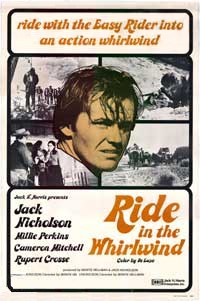
A Movie A Day #348: Ride In The Whirlwind (1966, directed by Monte Hellman)


Three cowboys — Vern (Cameron Mitchell), Wes (Jack Nicholson), and Otis (Tom Filer) — are riding their horses across the old west when they come upon a cabin that is inhabited by one-eyed Blind Dick (Harry Dean Stanton) and his friends.  Though they suspect that Dick may be an outlaw, the cowboys accept his offer to stay the night.  The next morning, they wake up to discover that they are surrounded by a posse.  Mistaken for members of Dick’s gang, Vern and Wes go on the run.  Eventually, they find themselves hiding out at the home of Evan (George Mitchell), Catherine (Katherine Squire), and their daughter, Abigail (Millie Perkins).  While Wes and Vern wait for their chance to escape, the posse grows closer and closer.
A minimalistic western with a fatalistic outlook, Ride In The Whirlwind is today best known for being a pre-Easy Rider credit for Jack Nicholson.  Nicholson not only co-produced the film but he also wrote the script.  With that in mind, it’s not surprising that Nicholson not only gets the best lines but that he also comes close to getting the girl.  Of all the roles that Nicholson played before his star-making turn in Easy Rider, Wes probably comes the closest to being what would be considered to be a typical Jack Nicholson role.  Wes is sarcastic, quick with a quip, and alienated by mainstream society (represented here by the relentless posse).  Nicholson gives a confident performance and it is interesting to see him co-starring with some of the same actors, like Harry Dean Stanton, who would continue to be associated with him once he became a star.  Though the film may be dominated by Nicholson, Stanton also makes a strong impression and comes close to stealing the whole movie.

(Also of note is an early appearance by Rupert Crosse.  Years later, Crosse was set to co-star with Nicholson in The Last Detail but his early death led to Otis Young being cast in the role.)

With its dark outlook and anti-establishment theme, Ride In The Whirlwind was before its time and it struggled at the American box office.  (According to Monte Hellman, it was very popular in France.)  It would be another three years before American culture would catch up with Nicholson’s anti-establishment persona and Easy Rider would make him a star.

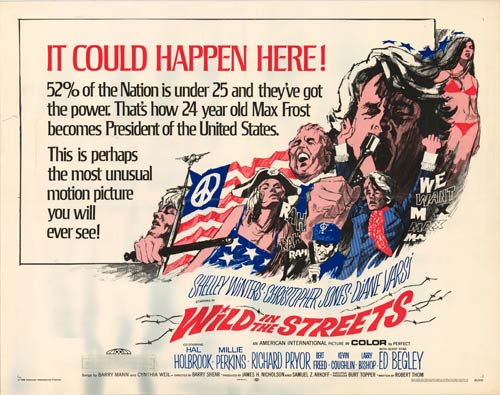
Rockin’ in the Film World #4: WILD IN THE STREETS (AIP 1968)


gary loggins's avatarcracked rear viewer

max1

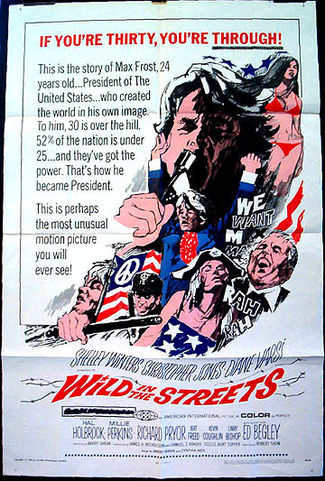
If you think today’s political climate is tumultuous and crazy, wait’ll you get a load of WILD IN THE STREETS. Filmed in the chaotic year 1968, this satirical look at the counter-culture vs the establishment revolves around a power-mad rock star whose call to lower the voting age to 14 results in him becoming President of the good ol’ USA, and sticking it to the over 30 crowd by interring them in concentration camps loaded with LSD-spiked water supplies!

max2

Christopher Jones is Max Frost, née Flatow, the charismatic leader of rock band Max Frost and the Troopers. Pre-credits flashbacks show Max’s unhappy childhood with an overbearing mother (Shelley Winters at her over-the-top best) and abrasive dad (Bert Freed). Max learns to hate all adults and dabbles in making LSD and bombs. After he blows up dad’s car, the rebellious Max leaves home and winds up becoming a mega rock star rivaling the…

View original post 945 more words

Shattered Politics #26: Wild In The Streets (dir by Barry Shear)


Wild_in_the_streets_dvd_cover

I am really not looking forward to turning 30.

Seriously, the great thing about being in your 20s is that everything is set up to specifically appeal to you.  Everyone wants your attention, your money, your tweets, your ideas, you love, and everything else.  And, yes, I understand that most people neither like nor respect my generation but oh well and whatever.  Trust me, the generation coming up behind mine is a hundred times worse.

2008 was a great time to be a politically knowledgeable millennial.  Everyone running for President was desperate to get our vote and they were willing to promise us anything.  And, since my age group voted overwhelmingly for Obama, all of the old elitists in the national media briefly fell in love with us.  (The genius of Obama’s 2008 campaign was to tell us that we were the people that we were waiting for.  Technically, it’s a bit nonsensical but never doubt what you can accomplish by appealing to the ego of the electorate.)

Of course, over the past few years, my generation has essentially been fucked over by both political parties and, since we dared to complain about it, nobody likes us anymore.  But, oh well and whatever.  American culture is basically built around our whims so we really don’t need anyone else’s love.

And, if all this sounds a little bitter or angry, I would point that young people and old people have been at war since time began.  Generational conflict is nothing new.  And if you need proof of that, I suggest watching a film from 1968 called Wild In The Streets.

Wild in the Streets tells the story of Max Frost (Christopher Jones), a rock star who lives in a gigantic mansion with his band and his groupies.   When Max is asked to perform at a campaign appearance for senate candidate Johnny Fergus (Hal Holbrook), he agrees to do so because Fergus supports lowering the voting age.  (When Wild In The Streets was made, you had to be 21 to vote.  So, if your birthday fell on election day, you could cast your first vote and then go have your first legal drink.)  However, at the rally, Max announces that he wants 14 year-olds to have the vote and then performs a song called “14 or fight!”

Max’s song is such a sensation and leads to so many protests that, in a compromise, the voting age is lowered to 15.  Johnny Fergus is elected to the Senate and, before you can say “Blue dog,” promptly starts to ignore the will of the people who supported him.  So, Max arranges for his girlfriend Sally (Diane Varsi) to be elected to the U.S. House.  After spiking the water supply of Washington D.C. with LSD, Sally gets a bill passed and the age requirement for holding political office is lowered to 14!

Of course, in the next election, 24 year-old Max Frost is elected President of the United States.  Soon, anyone over the age of 35 is being sent to re-education camps where they are force-fed LSD.  Max is so ruthless that he even sends his own mother (Shelley Winters) off to re-education.

And, with all the old people gone, everything is perfect for Max.  Except for that fact that 10 year-olds are now demanding the vote…

In many ways, Wild in the Streets feels like a film that could have only been made in 1968.  From the psychedelic direction to the costumes to the hair to music, everything about this movie screams late 60s.  But, at the same time, it’s still a genuinely amusing satire, largely because generational conflict is timeless.  We all think that those older than us are clueless and that those younger are spoiled.  There’s a lot of things in your life that can control.  Sadly enough, getting older is not one of them.

Wild in the Streets is a fun and amusing time capsule.  See it now before the younger generation comes of age and totally fucks up the world.

http://www.youtube.com/watch?v=gs-xc1CKnzY

Film Review: The Shooting (dir by Monte Hellman)


I have to admit that I’m not a huge Western fan.  In fact, I can probably count the number of westerns that I’ve actually enjoyed on one hand.  However, at the same time, those westerns that I did enjoy also happen to be some of my favorite films of all time.  When done poorly, a western can be nearly unwatchable.  When done right, however, nothing beats a good western.

Case in point: 1966’s The Shooting.

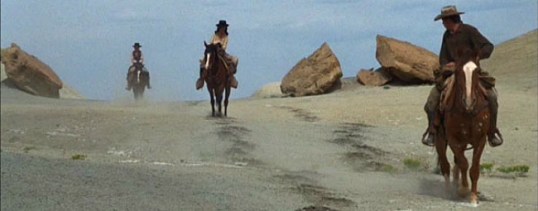
The Shooting tells the story of Willett Gashade (played by Warren Oates), a former bounty hunter who now makes his living a miner.  At the start of the film, he returns to his camp after being gone for several days.  At the camp, he discovers one man dead, one man missing, and one sole survivor, the good-natured by simple-minded Coley (Will Hutchins).  The panicky Coley explains that the camp was attacked by an unseen gunman and says that it was because the missing man had apparently ridden down “a man and a little person” in a nearby town.  How any of this relates to the rest of the film is open to interpretation.

For that matter, the entire film is open to interpretation.  That’s one reason why I love it.

The next day, an unnamed, black-clad woman (Millie Perkins) appears at the camp.  She hires Gashade and Coley to lead her to a town that lies some distance away, on the other side of an inhospitable desert.  Gashade is suspicious of the haughty woman but the far more trusting Coley takes a liking to her immediately.

As Gashade and Coley lead the Woman across the desert, there are hints both obvious and subtle that all is not as it seems.  The Woman, at one point, demands to be led in the wrong direction.  At another point, the woman suddenly shoots and kills her horse.  Eventually, the three of them are joined by Billy Spears (played by a young but already sardonic Jack Nicholson), a well-dressed gunman whose sinister smile does little to hide an obvious sadistic streak and who takes a cruel enjoyment out of taunting and bullying Coley.  It all leads to a shockingly violent and deliberately enigmatic conclusion that raises more questions than it answers.

As directed by Monte Hellman (one of the best directors of the 60s and 70s), the film is less concerned with conforming to the rigid expectations of the western genre and, instead, uses the genre as a way to explore the American culture of violence.  With its cynical dialogue and its stark imagery of a harsh journey through a seemingly endless desert, it’s little surprise that The Shooting is considered to be an existential western.

Fortunately, The Shooting contains a quartet of fine performances that hold the viewer’s interest, even when the story runs the risk of becoming incoherent.  Millie Perkins, who made her film debut playing the title role in 1959’s The Diary of Anne Frank, brings an air of genuine menace to the role of the Woman while Will Hutchins provides the movie with a much-needed heart.  The main appeal of the film, of course, is to see two iconic actors performing opposite each other and neither Warren Oates nor Jack Nicholson disappoints.  Of the two, Nicholson (who co-produced the film with Hellman) has the showier role and he is obviously having a lot of fun playing such an unrepentant villain.  Meanwhile, Warren Oates comes across like a hard-boiled film noir hero who has somehow found himself trapped in a western.

Needless to say, with its deliberately obscure storyline and its refusal to provide a traditional conclusion, The Shooting is not a movie for everyone.  However, for those willing to take a chance, The Shooting can be a very rewarding film.

CA-The-Shooting

Six Trailers of the Supermoon


Picture of supermoon taken by Erin Nicole Bowman

Apparently, as I sit here in my underwear and glasses, the Earth is about as close to the moon as it will ever get.  Because of that, the moon is huge out in the night sky.  Or at least that’s what I’m hearing.  It looks pretty normal to me but anyway, this is being referred to as being “Supermoon.”  I’m not sure why.  If I stood less than an inch from your face, would that suddenly make me Super Lisa? 

But anyway, this weekend’s slightly intoxicated edition of Lisa Marie’s Favorite Grindhouse and Exploitation Trailers is dedicated to Supermoon.

1) Werewolves on Wheels (1971)

Of course, a gigantic full moon would bring a werewolf film with it.  This is one of the thousand or so biker films to come out in the late 60s and early 70s.  These films were interesting mostly from the point of view of how they mixed other genres with the biker conventions.  Werewolves on Wheels did it with lycanthrophy.

2) Werewolf of Washington (1973)

Actually, since it’s a supermoon, we better include two werewolf-themed trailers.  This is for the Werewolf of Washington, starring Dean Stockwell.  For some reason, I’ve actually got several copies of this on DVD (I think this is one of those films that somehow found its way into the public domain) but I’ve yet to actually sit down and watch it.  I think my hesitation has to do with the fact that it appears to be a political satire and it was made in the 70s.  That sounds like a combination for boredom, to be honest.

3) Psych-Out (1968)

Before Dean Stockwell could become a werewolf, he had to serve as Jack Nicholson’s hippie guru in Richard Rush’s Psych-Out.

4) The Shooting (1967)

But before Jack Nicholson could become a hippie, he was a sinister gunman in Monte Hellman’s existential grindhouse western, The Shooting.  The Shooting, which co-stars Warren Oates and Millie Perkins, is an unacknowledged classic and a movie that I’m going to have to review one of these days.  Perkins, by the way, was married to none other than Dean Stockwell.

5) Cockfighter (1974)

And then, 7 years later, Hellman, Oates, and Perkins reunited to make an odd little film called Cockfighter.  This is another film I have to review though I also have to say that, as a former country girl who has actually seen a few cockfights, cockfighting is right up there with dogfighting as far as sickening sadism is concerned.*

6) Macon County Line (1974)

And, of course, while some people in the south were going to cockfights, others were apparently getting killed by redneck lawmen in films like the ’74 classic, Macon County Line.

In honor of Supermoon, I’m going to include two extra trailers.  Seriously, don’t ever doubt that Lisa loves you.

7) The Education of Sonny Carson (1974)

While rural audiences (probably made up of people I’m distantly related to) spent 1974 cheering police brutality and animal cruelty, urban grindhouse audiences were enjoying films like this one.

8 ) Bloody Moon (1981/2)

Finally, since we’re under a supermoon, here’s the trailer for Jesus Franco’s infamous (and frequently banned) slasher Bloody Moon.  I haven’t seen Bloody Moon (copies aren’t that easy to find) but seriously, the involvement of Jesus Franco tells me all I probably need to know.**

—–

*If you’ve got a cock, use it to spread love, not hate.

** Well, we’ll see about that.  I just ordered a copy off of Amazon.